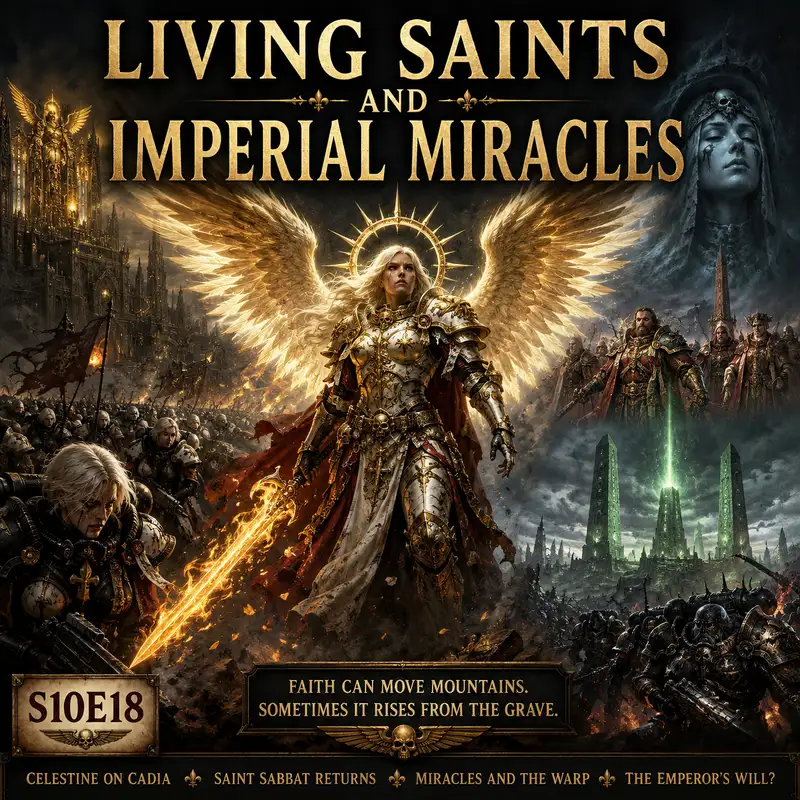
Living Saints and Imperial Miracles
On Cadia, Saint Celestine descended through smoke with golden wings spread behind her and a sword burning in her hand. Around her, soldiers who had already accepted death found enough courage to stand again. Daemons recoiled. The servants of the Black Legion saw an enemy who looked less like a woman than a verdict. Then the ancient blackstone pylons awakened. Their nullifying power rolled across the battlefield, the warp fell silent, and Celestine’s radiance guttered. Her wings faded. Her halo dimmed. For a few terrible moments, the miracle stopped.
That scene contains the central mystery of Imperial faith. Celestine had not been exposed as a fraud. She did not vanish when the light left her. She remained on the field, wounded, mortal, and still determined to fight Abaddon. So what had everyone witnessed before the pylons took effect? Was it the direct power of the Emperor, a rare form of psychic ability, a creature of the warp wearing a human soul, or faith made real by the belief of billions? The Imperium has a firm answer. The evidence is less obedient.
Ten thousand years earlier, the Emperor had rejected worship. During the Great Crusade, he demanded a secular Imperium governed by reason, unity, and force applied on a scale that made the distinction somewhat academic. After the Horus Heresy, he was entombed upon the Golden Throne, and the religion he had opposed spread across his wounded empire. By the forty-first millennium, the Imperial Creed was not merely a belief system. It was law, government, military doctrine, public education, and, on many worlds, the only explanation permitted for why the sun came up.
Within that system, sainthood does not always require a supernatural event. Most Imperial saints are honoured after death for martyrdom, conquest, charity, sacrifice, or exemplary service to the Creed. Their bones become relics. Their weapons are carried in processions. Their names are attached to cathedrals, regiments, feast days, and military campaigns. The Ecclesiarchy is quite capable of turning a dead hero into a pilgrimage route, a source of political legitimacy, and a bitter jurisdictional dispute before the body has properly cooled.
A Living Saint is something else. The title is used for a person whose holiness appears to manifest while they are alive, or who returns after death with powers that cannot be explained away without considerable effort. Living Saints may heal mortal wounds, banish daemons, shine with impossible light, survive destruction, speak with prophetic authority, or inspire armies beyond normal human endurance. They are not simply admired. They become moving centres of gravity around which crusades, cults, and entire political factions begin to orbit.
Most Imperial miracles are smaller than resurrection. Among the Adepta Sororitas, faith can produce what are called Acts of Faith. Battle Sisters endure wounds that should stop them, strike with impossible precision, cross killing ground under fire, or find the strength to continue when discipline alone should have failed. Their hymns build into something more than morale. The distinction matters because the Sisters of Battle are not a corps of sanctioned psykers. They are ordinary humans, at least by Imperial standards, trained to an extraordinary degree and taught that doubt is a breach through which damnation enters.
A sceptical observer can explain many such events without invoking the divine. Elite training looks miraculous to people who do not possess it. Shared ritual can control fear. Survivors remember impossible escapes more clearly than the thousands of equally faithful soldiers who died. Imperial reports are written by institutions with a strong preference for theological conclusions, and battlefield witnesses are rarely noted for calm laboratory procedure. A bolt round missing a canoness by an inch may be a miracle. It may also be poor marksmanship, which the Imperium produces in useful quantities.
Then come the events that resist those explanations. Wounds close in moments. Daemons are driven back by prayer. Flames appear without fuel. Warriors rise after death with no sign of the injuries that killed them. These are not always distant legends preserved by priests. They occur in front of soldiers, inquisitors, Space Marines, heretics, and xenos observers who have no reason to support the Ecclesiarchy’s version of events. The argument is no longer whether something happened. The argument is what kind of thing it was.
Any answer has to pass through the warp. The warp is a realm shaped by thought, emotion, memory, and desire. Psykers reach into it and draw power into reality, usually with the comforting knowledge that something on the other side may reach back. Daemons are not merely aliens from another dimension. They are beings formed from psychic force and sustained by patterns of emotion. In such a universe, belief is not confined to the mind. Enough fear, rage, hope, or devotion can acquire weight.
Faith, however, does not behave exactly like conventional psychic talent. Battle Sisters do not study disciplines, open themselves to daemonic bargains, or knowingly shape warp energy through trained will. They pray, sing, suffer, and act together. Their miracles often emerge from collective conviction rather than individual psychic strength. The result may use the warp as a medium, but the process is not the same as a sanctioned psyker casting a power. The Sisters do not think they are manipulating reality. They believe reality is briefly remembering who rules it.
Celestine’s known story begins not upon a throne, but among the Sister Repentia of the Order of Our Martyred Lady. A Repentia fights to atone for failure, stripped of rank and sent toward the enemy with an enormous blade and a life expectancy best measured in minutes. During the Palatine Schism, Celestine was one more condemned warrior in a brutal campaign against secessionists. She was not yet a golden icon. She was a penitent seeking a death that might restore her honour.
At Eurytion, she found that death. Celestine fell during the assault upon the capital, and her body was recovered with the other dead. Yet life remained in her. When her Sisters cleansed the corpse, they found her wounds gone. The following day she walked at the head of the renewed attack, and the city fell within hours. Whether the victory came from divine power, shock, renewed morale, or all three together scarcely mattered to those who followed her. A dead Sister had returned, and the enemy had broken.
Celestine then diverted the crusade away from the route expected by its commanders and travelled to the remote shrine world of Sanctus Lys. There she entered a hidden crypt linked to Saint Katherine. At dawn she emerged clad in golden armour and bearing the Ardent Blade, a weapon wreathed in flame and fragrant petals. Lord Ansgar and his Thorian allies proclaimed her a Living Saint. The Thorians were inquisitors who believed the Emperor might act through chosen vessels, so discovering a radiant warrior who had already died once was, from their perspective, an encouraging development.
From that point, Celestine ceased to have anything resembling a normal military career. She appeared in wars of faith, destroyed enemies of the Imperium, vanished, died, and returned. Reports placed her at decisive moments separated by years or centuries. Sometimes she led armies for long campaigns. Sometimes she arrived only long enough to break a siege or kill the creature holding an Imperial force together by the throat. She became less a commander with a service record than a recurring answer to emergencies the Imperium had otherwise failed to solve.
Her resurrections are not effortless. Accounts of what Celestine experiences after death describe a nightmare realm in which memory, identity, faith, duty, and hope must be recovered through trial. She does not simply open her eyes on another battlefield. She rebuilds herself while surrounded by forces that want her broken, corrupted, or emptied. Each return is an act of will as much as an act of grace. Death offers no release. It is merely the longest and most painful road back to work.
During the thirteenth Black Crusade, Celestine returned at the head of Sisters of Battle who had been lost in the warp for generations. She raised two fallen canonesses, Eleanor and Genevieve, who became the Geminae Superia at her side. On Cadia, she rallied defenders already being crushed by Abaddon’s war. Her presence did not save the planet, but it changed the scale of resistance. The Black Legion could no longer treat the defence as the final convulsion of a dying fortress. Cadia had acquired an angel, and angels are inconvenient things to leave on an enemy flank.
When the pylons activated, daemons were banished, psychic powers failed, and other warp-born manifestations disappeared. Celestine’s wings and holy radiance weakened with them. For those seeking a mechanical explanation, the implication is obvious. Her power was connected to the warp. Yet that does not settle the religious question. A road can be blocked without proving that the traveller never existed. If the Emperor acts through the warp, then a device that suppresses the warp may interrupt his intervention without revealing whether the source was divine, psychic, or something for which the Imperium lacks a safe vocabulary.
The Pariah Nexus makes the puzzle worse. Necron technologies there produce the Stilling, a condition that suppresses the soul, weakens emotion, and disrupts psychic activity. Yet the Adepta Sororitas have shown unusual resistance to its effects, and faith-driven manifestations have occurred where ordinary psychic power should have failed. Even the Necron savant Illuminor Szeras has struggled to explain the phenomenon. The same broad family of blackstone effects that stripped Celestine’s radiance on Cadia has not consistently erased other miracles. The galaxy provides evidence, then immediately files it in the wrong archive.
Celestine is the most famous Living Saint, but she is not the only pattern available. Saint Sabbat began as a farm girl who received a vision commanding her to reclaim a region of worlds for the Imperium. She obeyed with remarkable thoroughness. Her crusade lasted one hundred and five years and transformed an obscure believer into a conqueror, prophet, and military symbol. The worlds she liberated eventually took her name, which is one of the Imperium’s more permanent forms of gratitude.
Sabbat was martyred on Harkalon after receiving the Nine Holy Wounds. The White Scars recovered her body, and she was interred on Hagia. Her life became scripture, pilgrimage, and geography. Priests traced the routes of her crusade. Generals invoked her before battle. Her tomb was not merely a shrine. It was a strategic symbol tying thousands of worlds to a shared story of liberation. When Chaos later reconquered much of the region, the loss was therefore both military and theological. The enemy had occupied ground the Saint had made sacred.
Millennia later, the Sabbat Worlds Crusade sought to reclaim those planets. The Imperial advance was overstretched, its commanders divided, and its armies badly needed a victory that meant more than a changed line on a chart. Reports emerged from Herodor that Saint Sabbat had returned. The timing was perfect, which in the Imperium is usually enough to make an inquisitor suspicious. A reincarnated saint could restore morale, unify the crusade, and rescue the reputations of officers whose previous achievements had been mostly funerary.
Colonel-Commissar Ibram Gaunt discovered that the woman publicly presented as Sabbat was Sanian, an Esholi priestess he had encountered before. Lord General Lugo had every reason to encourage the claim, and Sanian herself believed in the role. At first, the saint looked manufactured, a political instrument wrapped in sacred language. Lugo understood that a miracle could repair his standing more efficiently than a conventional victory. The Imperium prefers its wonders properly witnessed, officially certified, and, where possible, useful to the chain of command.
Then the deception stopped being simple. During the assault on Herodor, signs of the true Saint appeared where the authorities had not arranged them, among ordinary refugees and defenders. When that fragile vessel was lost, the saintly presence manifested through Sanian in a way that neither Lugo nor Gaunt could command. The woman used as propaganda became something propaganda alone could not explain. Chaos had sent nine assassins, echoing the wounds of Sabbat’s first martyrdom. What they found was not the convenient fraud Imperial officers thought they had built.
The reborn Sabbat became a genuine military force. She inspired defenders facing extermination, fought the agents sent to kill her, and later accompanied the crusade at the front. At Ghereppan, her power helped coordinate Imperial forces and break a major enemy position. The importance of such miracles is not limited to flashes of light or impossible survival. A saint can restore command cohesion, make frightened soldiers advance, draw allies together, and force the enemy to divert elite troops toward killing one person. Faith becomes logistics, intelligence, morale, and manoeuvre.
That strategic value explains why the Ecclesiarchy, the Inquisition, and senior commanders crowd around Living Saints. A saint can legitimise a crusade, condemn a rival, inspire recruitment, and turn a failing campaign into sacred history. She can also become dangerously independent. A saint who obeys is a blessing. A saint who contradicts a cardinal is an administrative emergency with wings. Institutions that proclaim divine intervention still prefer it to arrive through approved channels.
This machinery can obscure the human being at the centre. Celestine is repeatedly killed and sent back into battle. Sanian’s identity is overtaken by a role larger than any private life she might have chosen. Even when the transformation is welcomed, sainthood removes the possibility of ordinary existence. A Living Saint belongs to pilgrims, generals, priests, and enemies. Her wounds become public property. Her doubts become theological crises. Her death becomes a schedule rather than an ending.
More recent accounts show that the pattern is not confined to the Adepta Sororitas. Magda Kesh began as a sergeant of the Mordian Iron Guard, a professional soldier more comfortable with orders than revelations. She survived events that should have killed her and resisted claims that she had been chosen for anything beyond continued service. During a confrontation with the servants of Chaos, that reluctance did not prevent a transformation. Light erupted through her, the enemy was destroyed, and the ordinary guardswoman became another problem the Imperium could only describe as sainthood.
One explanation is that Living Saints are direct vessels of the Emperor. This view fits their visions, their timing, their hostility to daemons, and the repeated sense that they are sent where Imperial survival is in immediate danger. The Emperor is physically imprisoned upon the Golden Throne, but his psychic presence reaches across the galaxy through the Astronomican and through other, less predictable interventions. If he can guide ships and burn within the warp, then empowering a human champion is not beyond the range of established possibility.
A second explanation is that Living Saints are unusual psykers whose abilities are shaped by religious belief. Their powers may emerge unconsciously, interpreted through the symbols their culture provides. Golden wings, holy fire, and prophetic visions are exactly what an Imperial believer expects divine power to look like. This model explains the connection to the warp and the vulnerability Celestine displayed on Cadia. It struggles, however, with collective miracles, repeated resurrection, and faith phenomena that persist inside regions designed to suppress psychic force.
A third explanation is that belief itself creates or reinforces saintly beings in the warp. Billions of worshippers pour hope, fear, and devotion toward the Emperor and the figures associated with him. A human soul might be preserved, strengthened, and returned by that pressure, especially if the Emperor provides direction. This has invited comparisons between Living Saints and daemons. The comparison is useful only to a point. Both may be sustained through the warp, but calling Celestine an Imperial daemon is an interpretation, not a settled fact, and usually a brief final opinion in Ecclesiarchal territory.
The most convincing answer may combine all three models. A Living Saint can begin as a human soul, be chosen or guided by the Emperor, be strengthened by mass belief, and travel through the warp to return. Mechanism and meaning are not enemies in this setting. A weapon has a physical process and a purpose. A message has a carrier and an author. Discovering that a miracle uses the warp does not prove that no one sent it. It only reveals the dangerous medium through which the answer arrived.
The opening of the Great Rift has made these questions more urgent. Warp storms have divided the Imperium, daemonic incursions have multiplied, and reports of visions, saints, impossible survivals, and spontaneous acts of faith have become harder to dismiss as isolated folklore. The faithful see proof that the Emperor is awakening. Sceptics see a galaxy saturated with psychic pressure. Both may be observing the same process from opposite sides of a cathedral door.
Imperial miracles are real in the most practical sense. They alter wounds, battles, decisions, and survival. Living Saints have returned from death, broken enemy attacks, and inspired armies that should have collapsed. None of this proves that every doctrine of the Imperial Creed is true, or that every priest who claims a miracle is honest. The Ecclesiarchy can lie while standing beside genuine holiness. The Imperium can exploit a blessing without understanding it. A true miracle does not make the institution surrounding it virtuous.
On Cadia, Celestine’s wings vanished, and for a moment the divine image was stripped away. What remained was a wounded woman facing an enemy stronger than she was, on a planet already condemned. She continued to fight. That may be the clearest answer the setting offers. A Living Saint is not proof that the Imperium is righteous. She is proof that belief in this universe can become a weapon, and that the weapon may still remember it was once a person.