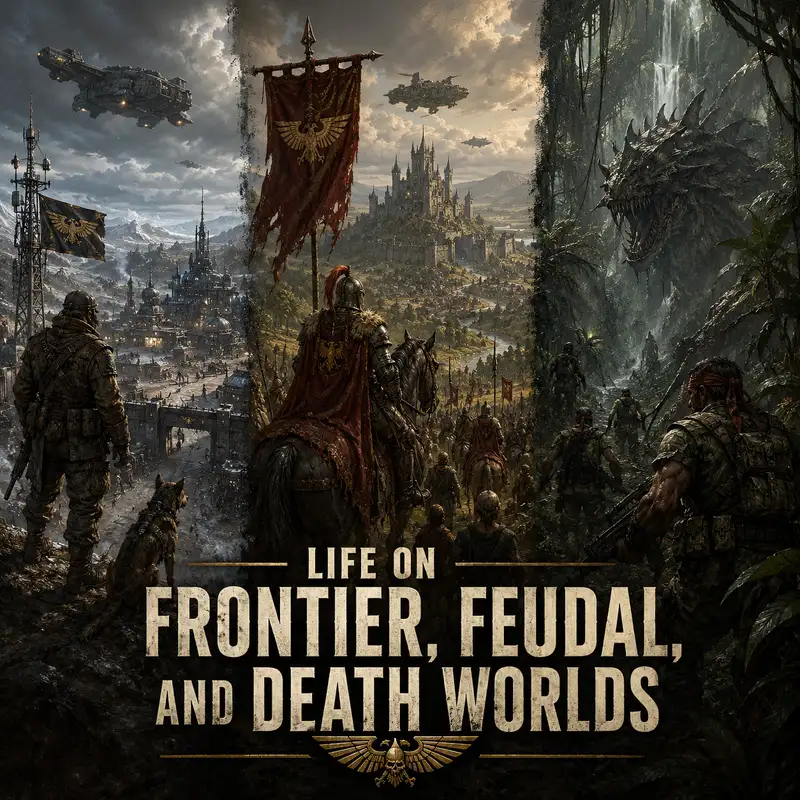
Life on Frontier, Feudal, and Death Worlds
The first warning on a frontier world is often not a siren. It is a dog refusing to leave the doorway, a light moving where no aircraft should be, or a vox operator hearing silence from an outpost that never misses a report. On a feudal world, danger may arrive as riders beneath a noble banner, demanding grain, sons, and obedience. On a death world, danger does not need to arrive. It was there before the settlers, before the Imperium, and perhaps before the local mountains finished exploding. All three worlds belong to the same human empire. That does not mean their people inhabit the same reality.
The labels frontier world, feudal world, and death world sound precise, as though the Administratum has placed the galaxy into neat drawers. It has not. Imperial classifications overlap, change, and sometimes survive long after the conditions that created them. A newly settled planet may also be lethally hostile. A death world may support a feudal society. A feudal world may possess an orbital station, an astropathic choir, and a handful of machines more advanced than anything its peasants could imagine. The name usually identifies the condition Imperial officials consider most important. It does not explain the whole planet.
What joins these worlds is distance from reliable authority, technical support, trade, medicine, and military rescue. The Imperium may claim a world, appoint its ruler, demand its tithe, gather its psykers, and insist upon worship of the Emperor. Between those moments, daily survival is usually a local responsibility. The result is a bargain found across much of the Imperium. Obey, pay, and endure, and the wider empire may leave your customs largely alone. Fail in one of those duties, and the distant government can become remarkably attentive.
A frontier world stands near the uncertain edge of Imperial control. It may be a new colony, an old settlement reclaimed after centuries of isolation, a mining outpost, or a strategic foothold surrounded by hostile or unmapped systems. The frontier is not a single line around the galaxy. Warp routes twist, storms close, and stable passages disappear. A world deep inside a mapped sector can become a frontier when its routes fail. Another may lie beyond the formal border and still receive traders because one stubborn Navigator knows the way.
The first settlers rarely arrive because the planet promises a quiet retirement. Some come under Administratum charter. Others follow Rogue Traders, missionaries, noble houses, mining combines, or Mechanicus explorators. Veterans may be granted land that no one else has managed to keep. Prisoners and debtors may discover that the Emperor has generously offered them a fresh beginning, with the small condition that refusal is not included. However the colony begins, its first years are shaped by shortages and uncertainty.
A frontier settlement is built around whatever cannot be allowed to fail. That may be a reactor, water purifier, landing field, mine head, shrine, or fortified storehouse containing seed grain. Walls are common even when no confirmed enemy has been seen. Auspex masts scan the horizon, and floodlights cover cleared ground. Buildings are often prefabricated, repaired with local materials, and strengthened as the settlers learn which parts of the original survey were optimistic.
Daily life follows the maintenance cycle. Filters must be cleaned. Fences must be checked. Water must be tested. Vox relays must be repaired. Crops adapted to one continent may fail on another because the soil contains an element omitted from the original survey, perhaps because the surveyor was eaten before completing the entry. The colony survives through practical knowledge accumulated by people who stop trusting the first edition of any manual. After several generations, that knowledge becomes custom. After several more, it may become ritual.
Government on the frontier is personal because institutions are thin. The governor may be a hereditary lord, military commandant, company factor, senior priest, or descendant of the expedition leader. Local councils, militia captains, guild elders, and shrine authorities make most decisions. The Adeptus Arbites, when present, concern themselves with Imperial law, sedition, and obligations to the wider state. Ordinary crimes are handled by local enforcers. Imperial justice is majestic in theory. In practice, its nearest representative may be three hundred kilometres away with one working vehicle.
Then comes the tithe. Most Imperial worlds owe something, and the demand is supposed to reflect the planet’s capacity. The difficulty lies in the phrase supposed to. Assessments may be outdated, incomplete, or based on a brief period of unusual success. A frontier governor who promises too much to impress distant superiors can condemn the colony for generations. Grain leaves while local rationing tightens. Young adults are drafted while the settlement still needs workers. The tithe ship departs on schedule. The next supply ship may not.
Religion gives frontier life a language for isolation. Missionaries teach that the Emperor watches from beyond the stars, but local belief reshapes the message. He may be understood as the sun that guides planting, the distant king who commands the sky warriors, or the protector who led the ancestors through the void. The Ecclesiarchy tolerates wide variation so long as central loyalty remains recognisable. A frontier shrine may contain sacred objects that began as expedition equipment. The distinction between relic and spare component becomes delicate when both are needed to start the generator.
Children on a frontier world grow up quickly because competence is survival. They learn which alarms require shelter, which tracks belong to local animals, how to seal a pressure door, and why no one approaches an unmarked object beyond the perimeter. Education is practical and uneven. An elite child may study Imperial history from damaged data-slates. A labourer’s child may learn it through sermons, songs, and names painted on old defence positions. Both know ships come from the stars. Neither knows when the next will arrive.
The frontier offers more freedom than many Imperial worlds, but it is freedom created by absence, not protected by rights. Local leaders can adapt rules quickly. Families can gain status through skill. New communities can form beyond old hierarchies. Yet the same isolation allows governors, companies, and commanders to rule without scrutiny. A settlement may become cooperative because everyone depends upon everyone else. It may also become a private kingdom with a landing pad. The Imperium generally accepts either arrangement until the tithe fails, heresy spreads, or something valuable changes hands without permission.
A feudal world presents a different kind of distance. It is often ancient rather than new. Its people may descend from colonists who lost industrial capacity during the Age of Strife or some later catastrophe. Over centuries, power gathers around land, fortresses, bloodlines, and armed retainers. The society may resemble a kingdom, a patchwork of baronies, a priestly empire, or clans bound by oath. Calling it feudal does not mean every world repeats one period of ancient Terran history. It means obligation is personal, hierarchy is inherited, and power rests on control of people and resources.
The most striking feature of a feudal world is uneven technology. A farmer may work with hand tools beneath the passage of an orbital lander. A noble may wear armour made by local smiths while carrying a laspistol inherited from an ancestor. The governor’s palace may contain a functioning vox array operated by servants who understand the correct prayers but not the principles behind it. At the starport, offworld officials use machines that local villagers interpret through religion and legend. The Imperium does not require every subject to understand the galaxy. It requires the world to remain useful within it.
For most people, life is agricultural. The year is measured by planting, harvest, taxation, holy days, military levies, and the moods of the local ruler. Families work land they may not own. Grain passes upward through several layers of obligation before any reaches the planetary storehouses. Travel is limited. News arrives through priests, merchants, soldiers, and proclamation. A person may live and die within a few days’ walk of the same village, knowing the Emperor as a divine sovereign while having no clear concept of a galaxy.
Feudal government suits the Imperium because both systems understand hierarchy. A village owes service to a lord. The lord owes troops and revenue to a greater lord. The chain continues until it reaches the planetary governor, who owes obedience and tithe to authorities beyond the sky. Imperial institutions do not need to replace this structure if it works. They can stand above it. The local monarch may call herself queen, high chieftain, sun regent, or keeper of the sacred gate. In Imperial records, she is still the governor, and her continued reign depends upon delivering what was promised.
The Imperial Creed is adapted in the same manner. A local warrior god may be reinterpreted as the Emperor in martial aspect. An ancient sky father may become a memory of humanity’s divine ruler. Saints acquire local names, local clothing, and occasionally local relatives that no approved scripture has ever mentioned. Missionaries often prefer careful conversion to needless civil war. The doctrine can be broad. Its limits become visible when a local tradition challenges Imperial authority, tolerates forbidden powers, or directs worship toward something in the warp that has begun answering back.
War on a feudal world begins with the levy. Nobles summon retainers. Villages provide archers, riders, spearmen, or whatever their culture has preserved. The planetary defence force may combine these troops with a small professional core carrying offworld weapons. When the Astra Militarum takes its tithe, recruits can move from banners and oaths into an army of lasguns, artillery, and armoured carriers. Officers must teach new weapons, but they do not need to invent discipline or courage. The harder task is transferring loyalty from a lord whose face they know to commanders serving an empire they have only imagined.
Knight worlds display the contradiction at its grandest. Their societies are often openly feudal, with nobles, bondsmen, artisans, and peasants bound together by inherited duty. Above them tower Imperial Knights, ancient war engines capable of crushing tanks and duelling monsters. The pilot sits within a Throne Mechanicum that links human mind to machine and carries the weight of ancestral memory and tradition. These worlds can preserve astonishing military technology while most of the population lives close to the land. The machine does not abolish feudalism. It becomes the armoured proof that the nobles were born to rule.
Life on a feudal world is therefore neither peaceful pastoral simplicity nor uninterrupted misery. Communities possess traditions, festivals, kinship, craft, faith, and identities older than many Imperial institutions operating above them. People can find meaning within obligations they did not choose. They can also be trapped by birth, debt, gender, caste, or the judgement of a lord whose authority is both legal and sacred. Stability protects the community until it protects the wrong person. The system endures because it is familiar, functional, and useful to rulers at every level.
A death world strips away even the comfort of believing the environment is neutral. The classification is reserved for planets where planetary conditions are exceptionally hostile to human life. The danger may come from climate, geology, radiation, atmosphere, disease, predators, vegetation, or several of these at once. Not every death world is a jungle. Some freeze, burn, poison, quake, flood, or combine the options with admirable thoroughness.
Catachan is the famous example because nearly every part of its ecosystem appears committed to violence. Its jungles contain lethal predators, poisonous organisms, and plant life capable of making an armed patrol regret leaving orbit. Human settlements survive by constant clearing, burning, patrols, and hard-earned local knowledge. The people of Catachan do not become exceptional jungle fighters through a training course added late in life. Their military skills grow from childhood habits. Reading broken vegetation, moving quietly, setting ambushes, conserving ammunition, and noticing when the forest has become too quiet are simply parts of staying alive.
That reputation has a cost. The Imperium celebrates Catachans as hardened soldiers because the survivors are visible. The dead are not. A death-world culture is shaped by grief, replacement, and the knowledge that routine mistakes can kill whole families. Competence becomes a moral expectation. Boasting is tolerated only when ability supports it. Equipment is judged by whether it works wet, dirty, and under attack. Authority tends to follow experience because an impressive title offers limited protection from a predator that has already eaten the previous title holder.
Fenris is hostile in a different way. It is a world of ice-shrouded oceans, violent seasons, unstable geology, and dangerous beasts. Much of its population lives in tribal societies shaped by sea, cold, migration, and war. Islands can be temporary. Routes change. Survival depends upon reading weather and water as carefully as any written text. The people know the Space Wolves through legend as warriors who descend from the sky and choose aspirants from among the strongest. To an offworld administrator, Fenris is a recruiting world. To its inhabitants, it is the entire creation, and the stars belong to saga.
Nocturne offers fire instead of ice. Volcanic activity, radiation, earthquakes, and immense native creatures shape its people and their settlements. Survival requires strong communities, skilled craft, and places of refuge against recurring disaster. The Salamanders draw identity from that world, but their connection is unusual among Space Marines because they remain closely tied to the human population. Nocturne’s danger does not produce only aggression. It also produces an ethic of endurance, craftsmanship, and protection. Hardship can teach that the strong deserve to rule. It can also teach that strength is meaningless unless used to keep others alive.
This is one reason death worlds matter so much to Imperial military culture. The Imperium believes severe environments produce severe people, and there is evidence enough to sustain the belief. Catachan regiments are renowned for operating in hostile terrain. Chapters such as the Space Wolves and Salamanders recruit from worlds where childhood already tests endurance. Yet the logic can become self-serving. The Imperium benefits from soldiers shaped by hardship, so it has little incentive to remove the hardship. Suffering becomes tradition, tradition becomes identity, and identity becomes a reason not to improve conditions.
Not everyone on a death world is a warrior. Most people still repair shelters, raise children, preserve food, care for the injured, make tools, settle disputes, and perform the thousand tasks that keep a settlement alive. Their expertise is often invisible to outsiders. An Imperial regiment may arrive with armoured vehicles, medicae units, and orbital support, then discover it needs a local teenager to explain which water is safe. Advanced equipment can dominate a battlefield. It cannot replace knowledge of a world that kills through small details.
The borders between these categories are therefore porous. Fenris is a death world with a broadly feudal human culture. Old Caliban was both techno-feudal and lethal. A frontier colony established on a hostile planet may be all three in practice, although the Administratum will eventually choose one box, lose the record, and open a second file several centuries later. Classifications describe what the Imperium wants to know. People must live with everything the classification leaves out.
Certain Imperial intrusions cut through every local system. The tithe takes resources and people. The Black Ships come for psykers, sometimes after long intervals that allow fear and superstition to grow around those born with dangerous abilities. Missionaries inspect belief. Administrators measure output. Recruiters take soldiers. Mechanicus agents claim technology and knowledge considered sacred to their order. Each visit reminds the population that local autonomy has limits. The Imperium may be distant, but it is never entirely absent.
Defence remains local until it suddenly becomes galactic. Frontier militias guard walls and patrol roads. Feudal levies answer banners. Death-world hunters track threats that offworld troops cannot see. Together they form planetary defence forces whose first duty is to hold long enough for help to arrive. That help may come late, in overwhelming strength, or not at all. The Imperial response is capable of extraordinary power. Reliability is a separate department.
When troops are raised for the Astra Militarum, the world often loses some of the people best able to protect it. The frontier sends scouts, pioneers, and hard settlers. The feudal world sends disciplined retainers and mass levies. The death world sends survivors with skills purchased through generations of danger. They leave behind families who may never learn where they fought or how they died. To the Departmento Munitorum, they become regimental strength. At home, they remain the missing place at a table.
What, then, is life like on frontier, feudal, and death worlds? It is intensely local. The Imperium provides the grand symbols, the distant obligations, and the occasional arrival of power from the stars. Daily existence is governed by weather, harvest, machinery, kinship, predators, lords, walls, and memory. People survive through adaptations that outsiders may call backward, superstitious, or brutal without understanding why those practices endured.
These worlds also reveal a central truth about Imperial rule. The Imperium does not govern every human life in the same way. It governs through layers, bargains, exemptions, inherited systems, and neglect. Its unity is strongest in war, taxation, and faith. Beneath those demands lies an astonishing variety of human societies. That variety is not evidence of tolerance in the modern sense. It is evidence that a galactic empire cannot standardise everything, and often does not care to try.
On the frontier, a family closes the settlement gate before darkness. On a feudal world, a bell calls labourers from the fields as a noble’s riders pass beneath banners. On a death world, a child pauses before stepping outside and listens for the sound that should be there but is not. Far above each of them, the double-headed eagle marks the planet as Imperial territory. The symbol is immense. The actual work of keeping humanity alive is done below it, by people making homes in places where the Imperium has mostly drawn a line on a map.