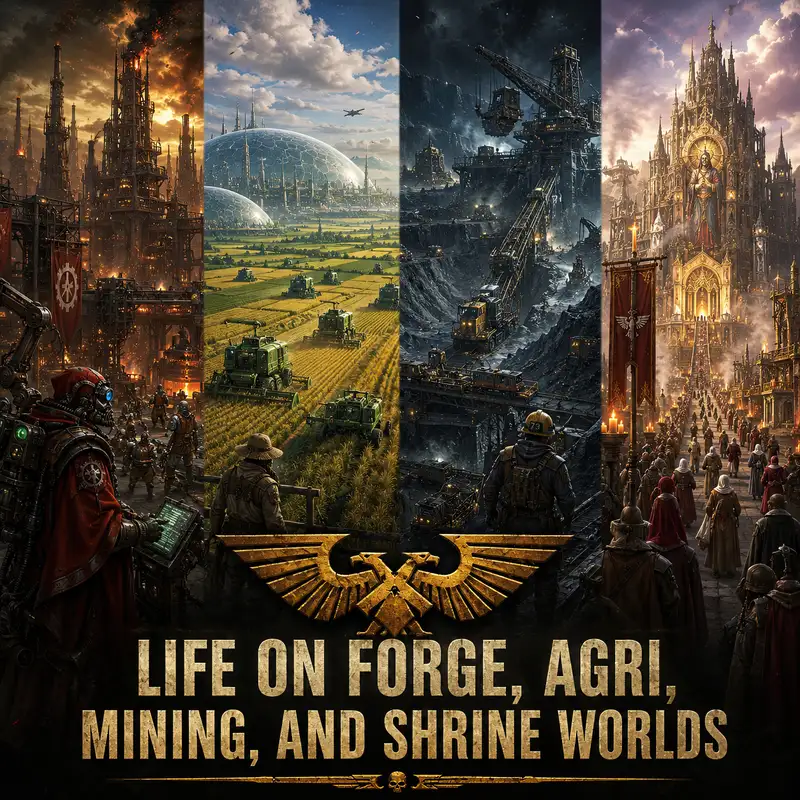
Life on Forge, Agri, Mining, and Shrine Worlds
A child born in the Imperium does not inherit a future. The child inherits a planetary function. On one world, morning begins with a shift bell beneath a sky stained by furnace smoke. On another, dawn spreads across fields hidden by harvest engines. Elsewhere, workers descend through kilometres of rock before they have fully awakened. On a shrine world, bells announce the arrival of pilgrims who crossed the void to stand before a bone, a blade, or a patch of ground declared holy. The Imperium calls these places forge worlds, agri worlds, mining worlds, and shrine worlds. The names sound like descriptions. In truth, they are demands.
An Imperial world may possess continents, climates, cities, languages, and histories stretching back thousands of years, yet the Administratum often reduces it to the one thing it must provide. A forge world provides weapons, machines, and technical knowledge. An agri world provides food. A mining world provides raw material. A shrine world provides faith and sacred authority. None of these categories is uniform. Two forge worlds can disagree over doctrine, and two agri worlds can look nothing alike. The classification does not tell us everything about a planet. It tells us what the wider Imperium considers valuable about it.
This is the central fact of life on specialised worlds. Their people live inside a supply chain. Weather, architecture, social order, education, religion, and even their bodies are shaped by the obligation imposed upon the planet. The Imperium is too large and fragmented for every world to support itself. Hive cities require food from distant systems. Armies require metal, fuel, ammunition, and machines. Fleets consume supplies on an enormous scale. Faith binds populations that may never see an Imperial official. Every specialised world is therefore both essential and expendable, which is an Imperial combination.
A forge world is the clearest example. Seen from orbit, it may resemble a machine that has swallowed a planet. Furnace complexes burn where forests might once have stood. Manufactoria cover continents. Rail lines, conveyor causeways, pipelines, and power conduits form metallic webs across the surface. The atmosphere may be darkened by industrial ash or saturated by radiation. Towers rise like cathedral spires, except their bells regulate production cycles and their chapels contain engines. The noise never truly stops. Even when a district falls silent, the silence usually means that something has gone wrong.
The Adeptus Mechanicus rules these worlds according to the doctrines of the Cult Mechanicus. To an outsider, the distinction between factory and temple can be difficult to find because the Mechanicus does not believe there should be one. A reactor is a source of power and an object of reverence. Maintenance is technical labour and sacred observance. A machine may be activated through a sequence that includes diagnostic checks, coded commands, incense, anointing oils, and prayer. Some rites preserve genuine engineering procedures beneath layers of tradition. Others may be symbolic. The priests performing them do not necessarily consider that distinction important.
Life within this system is intensely hierarchical. At the summit are the Tech-Priests, whose authority rests on rank, knowledge, access, and control of technology. Beneath them are countless adepts, artisans, data clerks, labourers, menials, servitors, and military cohorts. Some workers may possess specialised training passed down through generations. Others repeat one task for an entire lifetime without being told what the finished device will become. A worker might assemble targeting relays for a weapon carried by a soldier on a world whose name the worker will never hear. The relay matters. The worker is replaceable. The production quota is sacred.
The human body on a forge world is treated with a practicality that would be disturbing almost anywhere else. Bionic replacement can be a mark of status, a necessary adaptation, or a religious choice. A damaged limb may be replaced because flesh has failed. Healthy flesh may also be removed because machinery is considered more reliable. Those who rise within the priesthood often become increasingly mechanical, replacing organs and senses while preserving whatever portions of the self they judge necessary. At the lowest levels, servitors provide a darker answer. Human biological material is converted into an obedient component, stripped of meaningful independence and assigned a function. The Mechanicus calls this efficient. The person who once inhabited the flesh is not consulted.
Not everyone on a forge world is a robed priest murmuring to a cogitator. Vast populations may live in industrial habs, raise families, trade favours, tell stories, and develop fierce local identities. Workers know which overseers are cruel, which access tunnels are safe, which machine spirits are temperamental, and which shrine attendant will overlook a minor infraction. Communities form around workshops, production cohorts, generator districts, and shared danger. A child may learn the rhythm of assembly machinery before learning to read. The people adapt because ordinary life does not cease merely because the sky is poisonous. It becomes ordinary life with respirators.
Forge worlds also differ from one another. Mars claims primacy as the ancient centre of the Mechanicus, but other worlds possess their own dogmas, specialities, rivalries, and secrets. Ryza is renowned for plasma technology. Stygies the Eighth has a reputation for secrecy and questionable curiosity. Metalica is associated with relentless industry and crushing noise. These distinctions shape what knowledge is honoured, what behaviour is rewarded, and what risks a ruling priesthood will accept. The Mechanicus is united by creed, but unity in the Imperium usually includes several carefully maintained feuds.
The strategic importance of a forge world is difficult to exaggerate. Some produce common weapons and ammunition for entire war zones. Others manufacture armoured vehicles, voidship components, advanced devices, or the engines of the Collegia Titanica. Many guard techniques that cannot easily be reproduced elsewhere. When a forge world is lost, campaigns may stall because replacement parts no longer arrive. Ships remain in dock. Regiments receive ammunition of the wrong pattern, which is less amusing when the enemy is already approaching. This is why forge worlds maintain Skitarii legions, battle servitors, orbital defences, and sometimes Titan forces. The factories are also fortresses because everyone understands what happens when the furnaces go cold.
An agri world appears gentler from a distance. Imperial charts may show green continents, managed oceans, fertile valleys, or orderly domes. The image suggests peace. That impression can survive until the first inspection of the harvest quotas. Agri worlds exist to feed populations that cannot feed themselves, especially hive worlds, fortress worlds, and forge worlds. Their defining feature is not beauty. It is output. A pleasant landscape may remain pleasant, but it is still expected to deliver its tithe on schedule.
There is no single model for Imperial agriculture. One world may contain grain plains worked by machines the size of buildings. Another may rely on hydroponic towers, fungal caverns, algae reservoirs, protein vats, or herds bred for rapid growth. An arid planet may trap moisture and shelter farmland beneath vast domes. An ocean world may harvest aquatic life on an industrial scale. A planet with dangerous megafauna may convert those beasts into livestock by building larger slaughterhouses. The Imperium is not sentimental about cuisine. If something can be processed, shipped, and consumed without immediately killing the labour force, someone has probably filed it under food.
For the people who live there, the agricultural cycle governs time. Planting, breeding, irrigation, harvest, slaughter, processing, and shipment create the rhythm of the year. In some regions, families may work land associated with their community for generations. Elsewhere, labour gangs move according to schedules issued by distant overseers. Mechanised estates may be controlled by noble houses, guilds, planetary ministries, or religious institutions. Weather is watched with fear, but so are inspectors. A storm can destroy a field. An unfavourable audit can destroy a district.
The popular image of an agri world as endless wheat under a blue sky is therefore only one possibility, and often the least interesting one. Industrial agriculture can poison soil, drain water, spread chemicals, and reduce entire ecosystems to a single useful crop. Workers may spend their lives inside sealed processing facilities rather than outdoors. Vast abattoir complexes can dominate regions. Pest control may involve toxins, flame, engineered predators, or military force when the local wildlife objects to being reclassified as an obstruction. The harvest must continue, and the Imperium has never lacked confidence in disproportionate solutions.
Yet some agri worlds can genuinely be beautiful. Iax was remembered as the Garden of Ultramar before war and corruption ruined it. Tarentus sustains farmland beneath agri domes on an arid world. Other planets contain villages, estates, market towns, rivers, festivals, and traditions older than the institutions collecting their tithe. For some inhabitants, life may be healthier and less crowded than existence in a hive city. That does not make it free. The best produce may be exported, and prosperity lasts only while the harvest satisfies authorities several star systems away.
An agri world’s greatest strength is also its danger. Specialisation allows enormous production, but it creates dependence. If blight, invasion, rebellion, drought, or warp disruption interrupts export, distant populations suffer. A failed campaign on one agricultural planet can mean ration cuts across several worlds. Imperial commanders understand this in theory. In practice, they may still divert troops elsewhere because another objective has been declared more urgent. The resulting food crisis will then be assigned to a different department, where it can mature properly into catastrophe.
Mining worlds reveal the same system with the surface stripped away. Some are scarred by open pits visible from orbit. Others are pierced by shafts descending into darkness. Asteroids may be hollowed out. Frozen planets may be quarried for ice and prepared for interplanetary shipment. Gas giants can be harvested from orbital platforms. Volcanic worlds yield rare elements at a cost measured in machinery and lives. The substance changes. The relationship does not. The world is valuable because something buried within it can be removed.
Daily life on a mining world is shaped by depth, pressure, dust, heat, cold, radiation, unstable rock, toxic gas, and the constant possibility that a machine will fail at the exact moment it is holding several million tonnes of planet above your head. Workers may live in sealed settlements close to the extraction zones or in company habs connected to the mines by rail and lift systems. Shifts can be long because idle machinery produces nothing. Equipment is repaired repeatedly, often with parts that should have been replaced decades earlier. Safety exists, but it competes with quota. Quota usually has better representation at senior meetings.
Mining populations are not necessarily unskilled masses. Deep extraction demands surveyors, engineers, drill crews, explosives specialists, vehicle operators, medicae personnel, and workers who understand local geology through hard experience. A veteran miner may detect a dangerous vibration before an instrument does. Guilds, clans, work crews, and extended families can develop strong traditions and loyalties. These communities remember collapses, rescue efforts, strikes, purges, and disasters long after the official record has reduced them to a temporary decline in output.
The wealth removed from a mining world rarely remains there. Ore travels to forge worlds. Fuel goes to fleets and cities. Ice sustains populations on worlds that have exhausted or poisoned their own water. Rare materials vanish into sealed Mechanicus facilities. In return, the mining planet receives machinery, processed food, replacement workers, and instructions to increase production. If the deposit begins to fail, the authorities may open deeper shafts, expand into more dangerous regions, or abandon exhausted settlements. Imperial development often resembles careful stewardship when viewed from a sufficiently distant office.
Mining worlds are vulnerable to unrest and infiltration. Workers labour in close groups, depend upon one another, and may live far from direct supervision. Families can remain tied to the same settlements for generations. Those conditions create solidarity, but they can also conceal forbidden movements. Genestealer cults have found mining communities useful because secret tunnels, kinship networks, industrial equipment, and legitimate grievances provide cover. Chaos cults can spread through despair or promises of liberation. Miners are not naturally disloyal. A society treated as a disposable tool simply attracts people offering another purpose, even when that purpose has extra arms and plans for planetary consumption.
A shrine world appears to serve a very different need. Its great product cannot be loaded into a cargo hold. These worlds preserve sacred places, relics, tombs, battlefields, visions, martyrdoms, and stories associated with the Imperial faith. Pilgrims travel across sectors to pray where a saint is believed to have stood, died, bled, spoken, or defeated an enemy. The journey may consume years. Some pilgrims spend everything they possess. Some never arrive. The hardships are not always considered failures. Suffering can be interpreted as proof that the pilgrimage matters.
From orbit, a major shrine world may display cathedral cities, processional avenues, monasteries, ossuaries, and landing fields built to receive the faithful. On the surface, the senses are overwhelmed. Bells mark the hours. Incense fights a campaign it cannot win against the smell of crowds. Priests preach from balconies. Choirs sing beneath towering statues. Vendors sell food, candles, prayers, and objects whose connection to the saint ranges from plausible to commercially enthusiastic. The faithful queue for hours or days to enter a chapel for a few seconds. Bureaucrats issue permits for access to eternal truth.
The Ecclesiarchy usually dominates public life. Religious calendars shape work and rest. Processions close streets. Sermons explain victories, disasters, taxes, and weather. Orders of the Adepta Sororitas may maintain convents, hospitals, schools, archives, or armed sanctuaries. Monks, confessors, preachers, shrine attendants, guards, labourers, scribes, innkeepers, guides, undertakers, and sanitation crews all support the machinery of pilgrimage. Even the most sacred city requires drains. The Emperor protects, but someone still has to remove the refuse.
Life for local inhabitants can be privileged and exhausting. They grow up near places outsiders dream of seeing once before death, yet familiarity does not guarantee access. Sacred districts may be reserved for clergy, nobility, military orders, or wealthy pilgrims. The poor may serve the pilgrimage economy without approaching the central relic. At the same time, local identity can be rooted deeply in faith. Families may take genuine pride in maintaining a chapel, sheltering travellers, singing in a procession, or preserving a tradition. It is too simple to call shrine worlds cynical enterprises. Belief is real, even when institutions profit from it.
That sincerity makes shrine worlds powerful. The Imperium cannot govern a million worlds through force alone. It also needs shared meaning. A shrine world turns history into ritual and ritual into loyalty. Pilgrims return home carrying stories, tokens, scars, and renewed conviction. They have seen proof that their world belongs to something larger. Whether every relic is authentic is almost beside the point. The experience is authentic to the pilgrim, and the Imperium understands the political value of that experience very well.
Shrine worlds are therefore strategic targets. To destroy one is to attack memory and morale as well as territory. Chaos forces may seek to corrupt a sacred site. Xenos invaders may treat it as merely another objective, which the Imperium can find even more insulting. Rival Imperial factions may struggle over control of a relic, a pilgrimage route, or the official interpretation of a miracle. When war comes, the defenders fight for more than buildings. They fight for the story those buildings make possible. This can inspire extraordinary courage. It can also produce decisions of impressive and avoidable cost.
Forge, agri, mining, and shrine worlds seem to represent different faces of the Imperium, but they are parts of the same machine. The forge world needs ore and food. The mining world needs machinery. The ships carrying everything require fuel, crews, navigation, and protection. The shrine world blesses the labour, sanctifies the sacrifice, and teaches the faithful why obedience is a virtue. In return, it depends upon distant harvests, manufactured goods, and raw materials for its cathedrals. No specialised world is independent. Each survives because other worlds continue performing their assigned function.
This interdependence explains both the endurance and fragility of the Imperium. Specialisation allows production on an enormous scale. It also means that the loss of one world can wound many others. A forge falls silent, and armies lack ammunition. An agri world burns, and hives begin to starve. A mining complex collapses, and shipyards wait for metal that will not arrive. A shrine is desecrated, and unrest spreads among populations that believed its sanctity guaranteed order. The Imperium responds with convoys, decrees, crusades, rationing, prayer, and occasionally the discovery that the responsible office was destroyed three centuries earlier.
The people who live on these worlds are not merely victims or symbols. They build cultures inside the roles imposed upon them. Forge workers develop pride in precision. Farmers measure their lives by seasons and survival. Miners trust the person beside them because rock does not care about rank. Shrine keepers preserve stories that give meaning to suffering. There is dignity in their labour, fellowship in their communities, and courage in their endurance. The tragedy is that the wider Imperium usually values those qualities only when they improve output.
A specialised Imperial world is therefore not defined simply by what it makes. It is defined by what making that thing does to everyone who lives there. The forge world turns life into production and production into worship. The agri world turns landscapes into rations. The mining world turns planets into cargo. The shrine world turns memory into faith. Each offers purpose, identity, and belonging. Each also narrows the range of lives its people are permitted to imagine.
When the cargo ships depart, they carry weapons, grain, ore, fuel, relics, and pilgrims. They also carry away the reason the planet matters to distant authorities. Below, the furnaces continue burning, the harvesters turn, the mine lifts descend, and the bells call another procession into the streets. The Imperium does not ask what these worlds might become. It asks what can be taken from them, and how long the people upon them can keep giving.