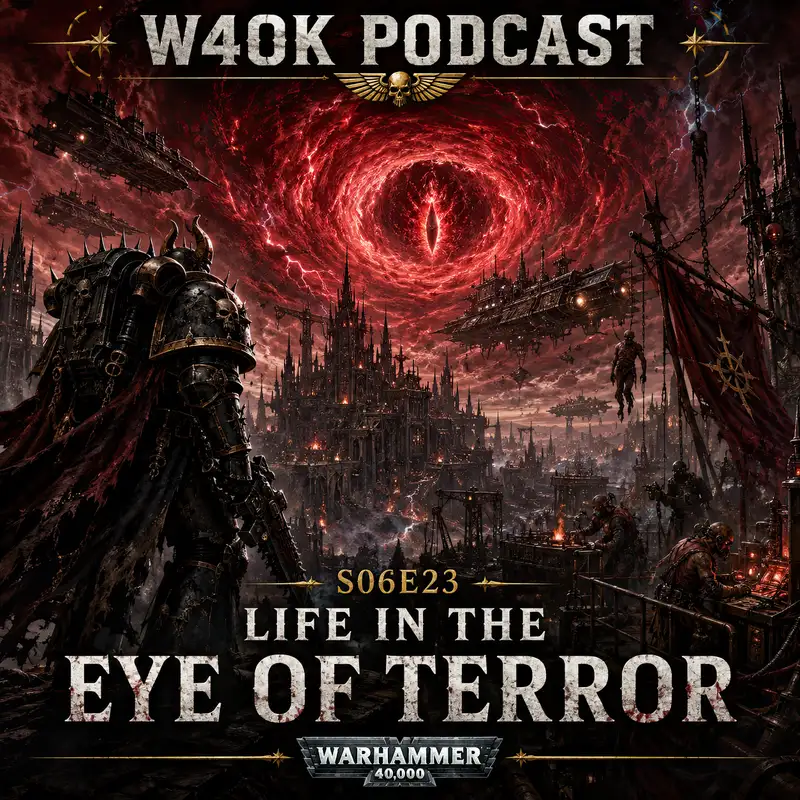
Life in the Eye of Terror
Inside the Eye of Terror, a warrior can remember the Siege of Terra as a wound from his own lifetime while the galaxy beyond has counted ten thousand years. A mortal born beside him may belong to one of many generations of a family that has never seen an ordinary sky. Their ship may have crossed a gulf in hours, only to discover that centuries passed at its destination. A fortress can stand for millennia and vanish between one sentry watch and the next. This is the first fact of life inside the Eye. Time is not a reliable companion, distance is negotiable, and reality has ceased pretending that it is impartial. Yet people still wake, work, bargain, worship, quarrel, repair machinery, raise children, and prepare for war. The strangest thing about the Eye of Terror is not that life there is impossible. It is that life continues.
The Eye began with the destruction of an older civilisation. When the Aeldari empire collapsed and the Chaos God Slaanesh was born, the psychic catastrophe tore open a vast wound where realspace and the warp overlap. Stars, worlds, and the ruins of Aeldari dominion were swallowed into a region governed partly by physical law and partly by thought, emotion, symbolism, and the will of supernatural powers. The Eye is therefore not merely a storm that ships must cross. It contains places. Some are recognisable planets. Others are fragments of worlds, drifting fortresses, impossible cities, daemon domains, ship graveyards, and landscapes that behave more like dreams than geography. Calling it a region of space is convenient, rather as calling a burning cathedral a source of warmth is technically accurate.
After the Horus Heresy, the defeated Traitor Legions fled into this wound. Imperial vengeance followed them during the Scouring, but the Eye offered protection that loyalist fleets could rarely penetrate in strength. It became a refuge, an arsenal, a prison, and a proving ground. The traitors had escaped destruction, but they had also entered a realm that would reshape them. Some remained organised around their old Legion identities. Others fractured into warbands, cults, pirate fleets, and personal empires. Rivalries that began during the Great Crusade survived because many of the original participants survived. The Long War was not an inherited grievance for all of them. For some, it remained personal. The Imperium outside aged into a civilisation of myth and bureaucracy while veterans inside the Eye continued arguments begun beneath the walls of the Imperial Palace.
There is no single landscape that defines the Eye. One world may possess continents, oceans, fortresses, and a sun that rises with reasonable punctuality. A neighbouring world may grow mountains in response to anger, rain teeth, or rearrange its cities when a sorcerer dreams. Some daemon worlds are shaped by the personality of a ruling prince. Others are contested by warbands, gods, daemons, and mortal populations whose struggles alter the ground beneath them. Even relatively stable territory can be isolated by warp tides. A port that was reachable yesterday may be separated today by a corridor full of predatory entities or by several subjective centuries. Maps exist, but they are records of past negotiations with reality. A wise captain values a good chart. A wiser captain also values the person who knows when the chart has begun lying.
The inhabitants are far more varied than the image of a lone Chaos Space Marine standing on a mountain of skulls would suggest. Heretic Astartes dominate many strongholds, but they are few. Around them live enormous mortal populations. There are slaves taken in raids, descendants of ancient Legion serfs, mutants born beneath corrupted skies, cultists seeking favour, mercenaries, pirates, armourers, scribes, ship crews, miners, gladiators, priests, surgeons, and technicians. The Dark Mechanicum maintains forge complexes where forbidden machines are built and daemonic entities are bound into engines. Sorcerers gather apprentices and expendable assistants. Traders move ammunition, captives, relics, and information between masters who may despise one another but still require supplies. Daemons appear as allies, predators, patrons, prisoners, or weather. The Eye is not empty wilderness. It is a broken civilisation with too many rulers and no shared law.
For most mortals, daily life begins with practical needs. Air must be circulated. Water must be found or made. Food must be grown, processed, stolen, or replaced with something that merely claims to be food. Voidships require crews. Bolters require ammunition. Armour needs seals, cabling, and replacement plates. Fortresses need labourers, and labourers need enough nourishment to remain useful. The warp can violate natural law, but most warlords prefer not to base their entire supply system on the hope that physics will feel charitable. Even the most devoted servants of Chaos depend upon routine. Bells mark shifts. Overseers count workers. Tech-adepts inspect reactors. Armed guards watch everyone. The gods may reward passion, but a cruiser still becomes remarkably quiet when nobody remembered to maintain the plasma drives.
This dependence on labour creates an economy, although it is rarely a gentle one. There is no universal coin accepted across the Eye. Wealth may be measured in weapons, fuel, gene-seed, slaves, clean water, functioning machinery, captured psykers, navigational knowledge, or the favour of a powerful patron. Warbands raid the Imperium for more than vengeance. They need bodies, materials, ships, and specialists. They also raid one another. A defeated rival's armour can be repaired, his followers absorbed, and his stronghold stripped to the foundations. Bargains are enforced by hostages, oaths, sorcery, reputation, and the expectation of retaliation. Commerce survives because even immortal killers cannot personally manufacture every shell, stitch every wound, and pilot every transport. Hatred encourages self-reliance. Logistics encourages a limited reconsideration.
Authority inside the Eye is personal. A daemon prince, Chaos lord, sorcerer, Dark Magos, or warband champion rules because enough dangerous followers accept that rule and enough enemies have failed to end it. This sounds like pure anarchy, but successful domains develop structure quickly. Guards have chains of command. Priests regulate ritual. Artisans receive protection because their skills are scarce. Slaves are sorted by value. Tribute is collected. Punishments are made public. Local custom may be brutal, but it is still custom. Chaos does not abolish order. It removes the moral and institutional limits that might protect the weak from whoever controls it. A fortress can be disciplined, productive, and efficiently governed while remaining a place of absolute horror. Indeed, efficiency often makes the horror more durable.
For a Chaos Space Marine, existence is divided among warfare, maintenance, politics, and the demands of patronage. His armour may contain components forged before the Heresy and repairs taken from a dozen enemies. His warband must secure ammunition, replacement organs, slaves, ships, and recruits. Old Legion traditions still shape how he fights and whom he trusts. An Iron Warrior may value siegecraft and bitter calculation. A Word Bearer may understand conquest as sacred duty. A Night Lord may regard fear as both weapon and inheritance. Yet no Legion is perfectly unified, and no reputation explains every individual. Some warriors worship a particular god. Some pursue Chaos Undivided. Some claim contempt for worship while accepting gifts, summoning daemons, and living in a realm saturated with divine influence. The distinction is important to them, which does not mean the gods are obliged to respect it.
Mutation is part biology, part theology, and part politics. Exposure to warp power can alter flesh, armour, memory, and desire. A warrior may grow stronger, develop an unnatural sense, or acquire a limb that makes doors an ongoing tactical problem. The same change can be proclaimed a blessing by a victorious champion and condemned as corruption in a defeated rival. Possession may be voluntary, coerced, or arranged by a superior who has concluded that another person's soul is an underused resource. Some hosts gain terrible power. Others lose control of their bodies. Chaos Spawn reveal the final danger of uncontrolled transformation, when identity collapses beneath accumulated mutation. Inside the Eye, the body is not private territory. It is evidence in a continuous argument about favour, worth, and ownership.
Daemons make that argument impossible to dismiss. In the Imperium, many citizens can spend an entire life treating daemons as a forbidden rumour. Inside the Eye, they may inhabit the next chamber. Wards, offerings, true names, binding circles, and ritual precautions become matters of survival. A daemon may guide a fleet, guard a gate, possess a weapon, or devour the person who assumed the agreement was still valid. Daemon engines embody the local relationship between industry and the supernatural. They are not simply machines decorated with sinister symbols. They are constructed prisons and partnerships, joining metal, weaponry, and warp entities through methods the Dark Mechanicum pursues without the Mechanicus habit of asking whether knowledge should remain buried. The answer is generally no, followed shortly by screaming.
Some domains achieve stability by imposing a single will upon everything within reach. Medrengard, the fortress world associated with Perturabo and the Iron Warriors, represents Chaos expressed through industry, siegecraft, and relentless competition. Its strongholds and manufactories exist to produce war. Iron Warriors test defences against one another, build engines, enslave labour, and turn bitterness into infrastructure. The landscape is not random. It is shaped by a culture that believes weakness should be exposed and crushed. For the mortals beneath that system, survival depends upon usefulness and obedience. A skilled artificer may receive food, shelter, and protection unavailable to common labourers. None of this makes the domain merciful. It makes cruelty organised, which is often worse.
Sorcerous domains present another form of existence. The long exile of the Thousand Sons in the Eye produced societies steeped in psychic power, mutation, scholarship, and impossible landscapes. Sortiarius, their principal daemon world for much of that exile, was described through crystal formations, shifting colours, strange creatures, and altered human populations. Knowledge carried status, but knowledge also attracted danger. Sorcerers maintained hierarchies of apprenticeship, rivalry, and occult authority. Rubric Marines stood as silent reminders of the Legion's catastrophe, warriors reduced to dust sealed within armour by the spell intended to save them. Mortal servants copied texts, tended temples, prepared rituals, or became subjects within experiments they did not understand. In such a realm, a library could be more dangerous than a battlefield, particularly when the books were aware that they were being read.
Other realms are shaped by the emotional logic of a particular god. In Nurgle's domains, decay can become community, endurance, and acceptance twisted into submission. Disease is not merely suffered. It is interpreted as belonging. The afflicted may feel relief from fear and pain even as their bodies become reservoirs of corruption. In Khornate territories, status is won through violence, but disciplined martial societies can exist alongside frenzy because slaughter on an organised scale still requires weapons, arenas, and commanders. Tzeentchian domains reward ambition and change until nobody can be certain whether promotion is success or the first stage of disassembly. Slaaneshi societies pursue sensation, perfection, and obsession beyond any natural limit. Each begins with a recognisable desire. Strength, hope, endurance, excellence. The horror lies in what happens when that desire is given no boundary and no final satisfaction.
Mortal communities adapt to these conditions because human beings can adapt to almost anything, including circumstances that should probably have inspired a firmer refusal. Children can be born in the Eye. Families, clans, crews, and hereditary castes can persist across generations. They develop languages, taboos, trades, festivals, and stories about the powers above them. A child raised beneath a mutable sky may learn which colours warn of a warp storm, which shrine offers protection, and which corridor must never be entered while it is breathing. To an outsider, every detail is monstrous. To the inhabitant, it is simply local knowledge. This normality is essential to understanding the Eye. Some communities have never known any other order and cannot imagine one. Most people cannot live in constant theatrical madness. They create routines, even when those routines include blood tithe, mutation inspections, and avoiding the moon when it looks directly at the city.
Not every mortal embraces this world. Many are captives. Some preserve fragments of older belief, hide forbidden loyalties, sabotage machinery, or wait for a chance to escape. Others cooperate because refusal means death, and cooperation today may protect a child or earn another ration. The line between victim and servant becomes difficult to draw after years of compromise. A slave may rise to overseer. An overseer may become a cult leader. A cult leader may gain genuine supernatural power and use it against the same people from whom he came. Corruption rarely requires a single dramatic decision. It can proceed through practical steps, each one defensible in isolation. The Eye's most effective lesson is that survival has a price, then that the price was inevitable, and finally that paying it was a form of wisdom.
Travel binds these scattered societies together, and travel is never simple. Fleets move along routes opened by tides in the warp, guided by Navigators, sorcerers, daemonic compacts, ancient beacons, or experience purchased at terrible cost. A nearby system may be unreachable while a distant fortress lies one transition away. Ships can emerge early, late, or altered. Crews therefore become valuable communities of specialists, even when their masters treat them as property. Ports gather traders, raiders, pilgrims, mercenaries, and spies. Information about a safe passage can be worth more than a captured tank. Control of routes creates political power. Abaddon's greatest achievement was not merely defeating rivals in battle. He repeatedly persuaded, threatened, and organised forces that preferred private war, then directed them toward a shared enemy beyond the Eye.
For centuries, the Cadian Gate restricted the largest movements between the Eye and surrounding realspace. Cadia and the Imperial defences around it turned escape into campaign. The Eye was therefore both sanctuary and confinement. Black Crusades were military invasions, but they were also openings through which accumulated ambition, hunger, and resentment could pour outward. The destruction of Cadia during the thirteenth Black Crusade and the eruption of the Great Rift changed that strategic balance. Chaos forces gained wider paths into a divided Imperium, although surviving Imperial bastions around the old gate continue to resist. For inhabitants of the Eye, the outside galaxy remains enemy territory, hunting ground, source of recruits, and proof that the Long War still has purpose. Raiding is not an interruption of local life. It is one of its principal industries.
Time distortion gives that war a peculiar emotional force. A Legionary may have experienced only centuries since the Heresy while Imperial history records ten millennia. A mortal crew may serve the same ship for generations while its commander changes scarcely at all. Elsewhere, a champion can return from a short voyage to find his fortress ruled by descendants of servants he remembers meeting as children. This breaks ordinary ideas of continuity. Promises outlive those who heard them. Revenge remains fresh long after the target civilisation has forgotten the original offence. Veterans speak of the Emperor, Horus, and the Siege of Terra as lived experience, while their mortal followers understand the same events as sacred antiquity. The Eye preserves the past, but not gently. It keeps old wounds open and then gives them weapons.
Life there is therefore not constant battle, although battle is never far away. It is the labour required to make battle possible. It is the forge worker casting armour for a warrior who may sacrifice him tomorrow. It is the ship crew calculating a route through a storm that whispers their private names. It is the mutant farmer tending a crop beneath a sun that changes colour with the mood of a distant prince. It is the warlord negotiating for ammunition while claiming that compromise is beneath him. It is the priest explaining that suffering is proof of favour, and the slave deciding whether disbelief is worth expressing aloud. The Eye contains terror, but terror alone cannot sustain an empire. It also contains routine, hierarchy, aspiration, dependency, and the stubborn human talent for making a home in the ruins of reason.
That is what life in the Eye of Terror finally means. It is not simply endless torment, because torment by itself would leave only corpses. It is a functioning civilisation built where physical reality, political authority, and personal identity can all be rewritten by power. Its people survive through usefulness, loyalty, violence, belief, and compromise. Some find purpose there. Some find freedom from Imperial rule. Some find opportunities impossible elsewhere. All pay within a system that turns desire into chains and adaptation into complicity. Somewhere beneath a sky that remembers the birth of a god, a worker tightens the last bolt on a warship older than his entire bloodline. The vessel will soon carry monsters into the galaxy, and his reward is permission to remain alive until it returns. The Eye does not merely destroy those within it. It teaches them to call survival a gift.