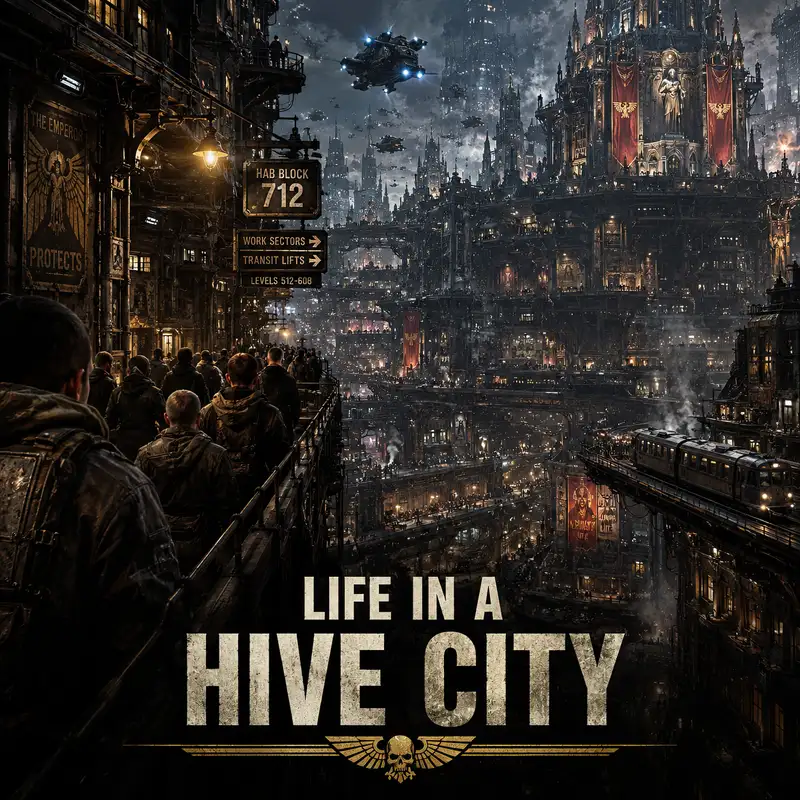
Life in a Hive City
The first thing a child in a hive city learns is not the face of the Emperor. It is the sound of machinery stopping. A hive is never truly quiet. Ventilation fans throb behind the walls. Transit lines grind through buried tunnels. Pumps force water upward through pipes older than the families living beside them. Somewhere, furnaces roar, manufactorums hammer, and generators shake the foundations. That endless mechanical pulse is so constant that people cease to hear it. Silence is different. Silence means the air scrubbers have failed, the power has gone, or a sealed door will no longer open. In a place where millions may depend on a single forgotten machine, stillness is not peace. It is a warning.
A hive city is often described as a mountain of metal filled with people, but that image is still too simple. A hive is a city built upward because there is nowhere else to go, and downward because upward became too expensive. It is a fortress, factory, cathedral, prison, market, and burial mound on the same ground. Its population may number in the millions or billions. Some hive worlds are covered with these cities. Others have only a few, separated by poisoned deserts, ash plains, or regions stripped bare to feed them. The central question is not how so many people can live in one place. The Imperium has never lacked methods for keeping people alive. The real question is what kind of life is produced when an entire city becomes a machine, and every human being inside it is expected to serve as one of its replaceable parts.
Most hives were not designed in a single age. They grew by accumulation. A settlement became a city. The city became an industrial centre. Walls were raised, then buried beneath later walls. Habitation blocks climbed over workshops. New transit tunnels cut through forgotten foundations. Administrators added districts without removing the old ones, because demolition would interrupt production and production was the reason the city existed. Over centuries, the hive became a record of its own history written in steel, stone, rust, and sealed doors. A worker might live above foundations laid before the Imperium reached the world. A noble might dine in a palace whose lower vaults connect to streets erased from every surviving map. The city remembers everything, but it explains nothing.
The hive’s vertical shape becomes a social order. At the top are the spires, where noble houses, senior officials, guild magnates, military commanders, and wealthy merchants live above much of the pollution. Their halls may have real windows. Their gardens may contain living plants rather than devotional images of plants. Some can look upon the sky, an experience so remote from the lower hive that it may sound like a sailor’s tale. Beneath the spires lies the upper hive, home to administrators, specialists, prosperous guilds, officers, and those fortunate enough to possess skills that cannot be replaced before the next shift. Below that stretches the vast middle hive, where most of the work is done. Farther down are the lower levels, the sump, the underhive, and eventually regions where formal government becomes a rumour repeated by tax collectors with armed escorts.
For the majority, life begins in a hab block. The room may belong to a family, a work crew, or whoever holds the correct ration seal. Space is measured carefully. Privacy is a luxury. Heat comes from pipes, machinery, bodies, or all three. Light is artificial and often controlled by shift schedules rather than sunrise. A person may grow up without ever seeing an open horizon. Morning begins when bells, sirens, lumen changes, or public address systems announce the next labour cycle. People wash with rationed water, dress in often-repaired clothes, collect food, and join the human current moving toward elevators, gantries, rail lines, or stairwells. The journey may take hours because every route is crowded and every alternative was sealed three generations ago.
Work defines the day and often the family. Hive cities exist to produce, process, store, repair, administer, or transport something the Imperium requires. One district may assemble weapons. Another refines chemicals. Another produces cloth, vehicle parts, ammunition, or components whose purpose is unknown to everyone touching them. Workers may perform the same motion for an entire shift and the same occupation for an entire life. Guilds, hereditary contracts, debt obligations, and local custom can bind a family to a trade. This does not mean every hive dweller stands at a production line. Hives require clerks, loaders, medicae staff, cooks, engineers, corpse handlers, preachers, guards, merchants, and many people employed to record the work done by everyone else. The Administratum may not know whether a ventilation duct still exists, but it can often produce six forms concerning its maintenance.
The labour itself can be exhausting, dangerous, and strangely intimate. A crew may know one machine better than they know the district beyond their hab. They understand its vibrations, warning sounds, overheated bearings, and when an overseer must be distracted so an illegal repair can be made. Officially, maintenance follows sacred procedure. In practice, many systems continue because generations of workers have learned how to keep them alive despite missing parts, poor instructions, and supervisors who regard deviation as sabotage. This is one reason hive society survives conditions that appear impossible from outside. The people are not merely passive victims of the city. They possess local knowledge the city cannot function without. The Imperium rarely celebrates that knowledge, because admitting dependence on ordinary workers would create several administrative complications and possibly a meeting.
Food, water, and air reveal the real politics of the hive. Almost everything must be delivered, pumped, recycled, purified, or rationed. Water may pass through countless users before reaching the lower levels. Air grows warmer, dirtier, and more chemically dangerous as it circulates through industrial districts. Food can include imported grain, fungus, algae, vat-grown material, recycled protein, and whatever a market seller can describe with confidence. Corpse-starch exists in parts of the Imperium, but it should not be imagined as the universal meal of every hive citizen. The Imperium is vast, and its methods of feeding people range from merely unpleasant to theologically inventive. What matters is dependency. A blocked transport line, failed pump, contaminated reservoir, or delayed ration shipment can threaten an entire district. Hunger in a hive is rarely caused by a total absence of food. It is caused by food being on the wrong level, owned by the wrong guild, or trapped behind the correct paperwork.
Yet a hive is not only misery. Human beings build lives in places that were never built for them. Families decorate walls. Workers keep small shrines beside tool lockers. Neighbours share water during shortages and quarrel over corridor space when the shortage ends. Markets fill with cooked food, counterfeit permits, spare parts, dubious medicines, and rumours of better work in unseen districts. Children play in service tunnels and learn which warning lights are harmless. Couples marry. Old soldiers tell stories. People sing work songs, remember lost relatives, and develop fierce loyalties to a block, guild, or transit station. These attachments matter because the wider Imperium is too large to imagine. Terra may be the centre of humanity, but the next corridor is where life happens.
Religion gives that life a larger frame. The Emperor is present in statues, sermons, shift prayers, purity seals, and the language of duty. A manufactorum may open its cycle with a blessing. A family may keep a worn image of a local saint believed to protect children from industrial accidents. Priests interpret suffering as sacrifice and labour as service to humanity. This faith can be sincere, coercive, comforting, political, or all four at once. For many citizens, the Imperial Creed is practical rather than abstract. It is the explanation for why the shift must continue despite injury, why a son sent to the Guard should be honoured, and why survival itself can be understood as obedience. The Ecclesiarchy offers meaning to people whose lives are otherwise measured in quotas. It also reminds them that failure may possess a spiritual dimension, which is an efficient way to improve attendance.
Government in the hive is equally immediate. Most citizens will never see a planetary governor, a high-ranking Imperial official, or an inquisitor. Authority arrives as local enforcers, guild representatives, overseers, ration clerks, priests, and district officials. The Adeptus Arbites are often misunderstood as ordinary police. Their primary duty is to enforce Imperial law and protect Imperial authority, especially against rebellion, sedition, or failure by a world’s rulers. Daily order is usually handled by local forces whose names and methods vary from world to world. In some hives they are disciplined institutions. In others they are private armies with legal badges. Their purpose is not necessarily to make life safe. It is to keep production moving, prevent unrest from spreading, and ensure that violence remains properly authorised.
This creates space for gangs, syndicates, protection groups, and informal courts. In the lower hive, a gang may control access to water, power, medicine, or a safe route between districts. It may be a criminal organisation, a neighbourhood defence force, a political faction, or all three depending on who is asking. On worlds such as Necromunda, gang warfare is woven deeply into the economic and social structure of the hives. Houses compete through trade, violence, and control of territory. A worker may belong to a house before thinking of themselves as a citizen of the planet. Such loyalties provide identity and protection, but they also keep conflict alive. The hive’s rulers may tolerate this because divided populations are easier to manage, and because small wars below are preferable to one large war above. This is sound policy until the small wars become large, which they do with admirable regularity.
Below the governed levels lies the underhive, though the boundary is rarely neat. The underhive is where infrastructure has failed, authority has withdrawn, and discarded people use discarded spaces. There are settlements, workshops, shrines, gang territories, polluted sumps, and ruins from earlier ages. Some descend voluntarily in search of freedom or wealth. Others are driven down by debt, crime, mutation, political defeat, or simple bad luck. Abandoned districts still contain valuable materials, ancient machinery, lost records, and things that should have remained lost. The underhive is dangerous, but it is not empty chaos. Communities form there as they do everywhere else. The difference is that survival depends less on official permission and more on knowing who owns the bridge ahead.
Deeper still are places where even underhivers hesitate to go. Toxic waste collects in sumps. Structural supports corrode. Mutants and outcasts build isolated enclaves. Predators, escaped experiments, cults, and stranger threats find shelter beyond regular patrols. Genestealer cults have often exploited the crowded, hidden, and resentful populations of industrial worlds, offering belonging while preparing planetary betrayal. Chaos cults can grow for similar reasons, though their promises differ. They do not spread simply because hive citizens are ignorant or wicked. They spread because a hive produces secrecy, injustice, desperation, and millions of people whom the authorities notice only when quotas fall. A message that says your suffering has purpose can become powerful. A message that says your oppressors deserve destruction can become stronger. The fact that the messenger may possess additional limbs or whisper in several voices is sometimes discovered rather late.
The upper hive tells itself a different story. Nobles may view the lower levels as a source of labour, revenue, and occasional security problems. Their lives can include education, ceremony, political marriages, private armies, and rivalries that destroy districts they never visit. Yet the spires are not free. Noble houses are bound by inheritance, obligation, vendetta, and competition. A failed alliance can ruin a dynasty. A missed tithe can invite Imperial intervention. A rival may control the elevators, power grid, or governor’s attention. Wealth protects the upper classes from the daily dangers of the lower hive, but it does not release them from the system. It gives them more comfortable rooms in which to fear it.
Not every hive follows the same pattern. Some are primarily industrial. Some serve as ports, military centres, mining hubs, capitals, or pilgrimage sites. A hive on Armageddon is shaped by war and heavy industry. A hive on Necromunda is shaped by ancient manufacturing, house politics, and the vast divide between spire and underhive. Other worlds have hives with different cultures, climates, and institutions. Some districts may be clean, disciplined, and relatively secure. Others may resemble permanent disaster zones. Life can differ sharply between levels separated by a few hundred metres. This variety matters. The Imperium is not a single culture reproduced across a million worlds. It is a framework of obligations imposed upon countless local societies, provided those societies worship correctly, pay what is demanded, and do not ask how the framework is functioning.
The fragility of hive life is easy to miss because the city looks indestructible. Its walls may withstand bombardment. Its towers may rise through cloud layers. Its factories may have operated for thousands of years. Yet the people inside depend on tightly connected systems. A power failure stops lifts, pumps, and doors. A ventilation breakdown can poison entire zones. Fire moves through ducts and cable runs. Disease spreads rapidly in crowded habs. Industrial accidents can destroy blocks before officials decide which department was responsible. A minor disruption in one district may cascade through dozens of others. The hive survives because repairs are constant, supplies are redirected, and losses are absorbed. Imperial records may describe this as resilience. The families in the affected levels may use a less flattering word.
War exposes both the strength and weakness of the hive. Its population provides workers, militia, soldiers, and recruits for the Astra Militarum. Its manufactorums can arm regiments and distant campaigns. Its walls and depth make it a formidable fortress. At the same time, every crowded level becomes a battlefield waiting to happen. Streets become firing lanes. Transit tunnels become invasion routes. Hab blocks become strongpoints. Defenders may know the terrain intimately, but attackers need only disrupt power, water, or air to create panic. Orks, Chaos forces, Tyranids, and rebels can turn a hive into a war of rooms, stairs, bridges, and shafts. Victory at the top does not guarantee control below. A hive can continue fighting after its rulers believe the battle is over, because no one informed the lower levels that the war had ended.
For many citizens, military service offers one of the few recognised ways out. Recruitment may be voluntary, compulsory, hereditary, or part of a planetary tithe. A hive-born soldier brings particular strengths. Crowds do not intimidate them. Confined spaces feel normal. Industrial noise is familiar. They may possess fierce loyalty to district, gang, guild, or regiment. They may also find open fields deeply unsettling. The Imperial Guard sends them beneath skies they never imagined, against enemies once known only from sermons and workplace notices. Some leave hoping for honour or escape. Some are simply selected. A few return. Those who do may discover that the hive has changed, their hab has been reassigned, and the machine has continued without them.
A complete life in the hive may pass within a remarkably small physical area. Birth is recorded by a clerk or local authority. Childhood is spent learning family duties, hazards, and the boundaries of safe movement. Adolescence may bring apprenticeship, gang initiation, factory placement, or recruitment. Adulthood is work, family, rationing, worship, and maintaining the relationships that make survival possible. Old age, where it exists, may bring respect for skill or dismissal as an unproductive burden. Death leads to ritual, recycling, burial in crowded vaults, or whatever local conditions permit. The individual disappears, but their tools, shift, debts, room, and ration allocation remain. Someone else takes their place. The hive does not mourn as a city. People do.
That difference is the heart of life in a hive city. From above, the hive looks like a system. Populations become labour figures. Districts become output totals. Deaths become acceptable losses. Administrators speak of capacity, stability, and compliance. From within, it is remembered faces, favours owed, routes avoided, meals shared, and machines kept running by people whose names will never enter an Imperial archive. The city is oppressive not because every moment is pain, but because every private life exists inside demands too large to escape. Even happiness must fit between shifts.
The hive therefore produces a particular kind of humanity. Its people are adaptable, suspicious, communal, hierarchical, and extraordinarily skilled at finding life in neglected spaces. They endure conditions that would break outsiders, not because suffering makes them noble, but because generations developed habits of survival. They know authority is distant until it becomes violent. They know machinery is sacred, but also that sacred machinery sometimes needs to be struck with a wrench. They know the Emperor protects, though doors should still be locked. Their world may be only a few kilometres wide, yet it contains nations, wars, religions, markets, and dynasties.
Life in a hive city is not simply a life of endless labour beneath a polluted sky. It is a human life compressed inside an Imperial engine. The hive gives shelter, work, identity, and community. It also consumes health, freedom, memory, and people at a scale no individual can resist. Its greatest achievement is that it makes the impossible ordinary. Billions wake, work, argue, worship, trade, love, fight, and die inside a structure that should have collapsed centuries ago. The machinery continues because people continue. And when the machinery finally falls silent, the people are the first to understand what that silence means.