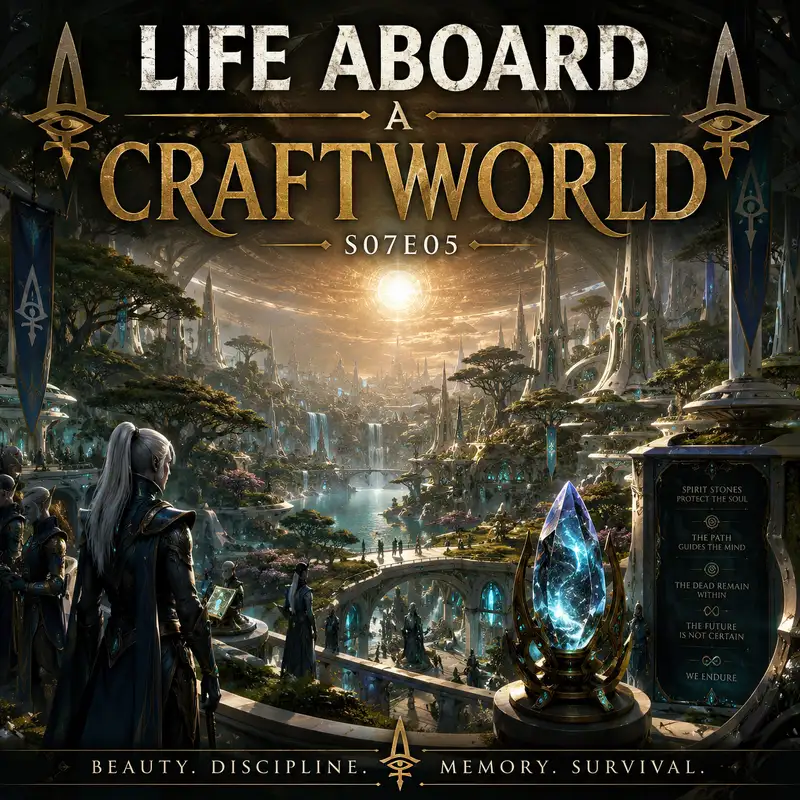
Life Aboard a Craftworld
Dawn arrives on a world that has no sky. An artificial sun brightens above a forest whose oldest trees descend from a civilisation that vanished before humanity learned to sail between stars. Lakes catch the light. Pale towers rise like bone grown into cathedral spires. Beneath the roots, bridges, and silent avenues, the souls of the dead move through a hidden psychic network. This is not a planet, although it contains landscapes large enough to forget the difference. It is not merely a ship, although it crosses the void. It is a craftworld, one of the wandering homelands of the Asuryani Aeldari. To live aboard one is to inhabit an ark, a city, a temple, a fortress, and a mausoleum at the same time. The question is not whether such a place is beautiful. It is. The question is what that beauty costs, and how an entire people have organised daily life around never again becoming what they once were.
Craftworlds began long before the catastrophe the Aeldari call the Fall. In the final age of their ancient empire, great trading vessels and self-contained communities travelled far from the core worlds. Some crews saw corruption spreading through Aeldari society and withdrew from it. As excess, cruelty, and psychic obsession consumed the old civilisation, these ships became escape vessels. They carried people, art, knowledge, animals, seeds, and fragments of worlds that could not be saved. The Fall then tore through the Aeldari realm and gave birth to Slaanesh, the Chaos God who still hungers for Aeldari souls. Some craftworlds were destroyed in the psychic shock. Others escaped, damaged and diminished, carrying survivors into a galaxy filled with the ruins of their own supremacy. Over the millennia, the vessels grew around their original cores until they became roaming realms of wraithbone and living technology. Their passengers were no longer travellers. The ship was now the country.
A human warship is a weapon with corridors, engines, magazines, barracks, and perhaps a chapel large enough to remind the crew who owns their fear. A craftworld can contain mountain-like structures, broad waterways, cultivated wilderness, residential districts, shrines, plazas, docks, and immense domes with their own climates. Artificial suns pass through cycles of light and darkness. Forests and gardens renew the air. Lakes and preserved ecosystems offer more than decoration. They are pieces of a lost inheritance, maintained because memory for the Aeldari is not an academic exercise. It is habitat. A citizen may walk beneath branches descended from a homeworld that no longer exists outside legend and nightmare. The experience would be peaceful, but never innocent. Every leaf is proof that something survived. It is also proof that nearly everything else did not.
Much of the craftworld is formed from psychically responsive materials, especially wraithbone, shaped rather than manufactured in the crude human sense. Bonesingers use disciplined psychic talent, music, and ritual to coax structures and devices into being. Walls curve as if grown. Vehicles and weapons appear elegant because their form follows a different relationship between mind and matter. Machinery is present, but it does not advertise itself with boilers, chains, and a workforce being slowly deafened. This alone would make the place suspicious by Imperial standards. Yet Aeldari technology is not effortless magic. It depends upon specialised knowledge, inherited practice, and a civilisation preserving what it can no longer easily replace. Bonesingers maintain the vessel. Artisans shape functional objects with psychic resonance. Gardeners preserve ecosystems, while mariners guide smaller ships and journeys through the Webway. The craftworld must sustain air, water, food, energy, culture, and memory. Elegance does not cancel maintenance. It only makes the maintenance sound better.
Daily existence is not a permanent military parade. Most Asuryani are not Aspect Warriors, Farseers, or legendary heroes. They create music, sculpture, poetry, jewellery, garments, gardens, and performances. They study history and myth. They form friendships, rivalries, romances, and families across lives that can span centuries. A concert may matter as much to its audience as a campaign does to an Autarch, because artistic expression gives form to emotions that might otherwise become overwhelming. Their civilisation did not survive by rejecting beauty. It survived by placing boundaries around appetite. The difference is crucial. Craftworld life can be joyful, intimate, and intensely aesthetic. The danger lies not in feeling too little. For the Aeldari, the danger has always been feeling without limit. Even ordinary relationships carry the weight of a dwindling people. Children are precious, losses remain vivid for generations, and a friendship may survive several complete changes of vocation. Time does not make memory lighter when memory is one of the things your civilisation is built to protect.
That is why the Path shapes almost every life aboard a craftworld. A Path is partly a vocation, partly a discipline, and partly a protective structure for the mind. An Aeldari may devote a period of life to art, healing, craftsmanship, scholarship, service, seafaring, war, or psychic study. The precise Paths are numerous, and different craftworlds preserve different traditions. While walking one, the individual narrows attention and develops a controlled identity suited to that pursuit. The Path is chosen, inhabited, mastered, and eventually left behind. An artist may later become a mariner. A craftsperson may become a warrior, then return to civilian life carrying memories that must be carefully contained. Across a long lifespan, one person can live several distinct careers, each pursued with a depth that a human specialist might find unnerving. The Asuryani do not dabble. Dabbler is probably not a word their civilisation has ever needed very often.
The danger is that focus can become captivity. An Aeldari may become so absorbed in a Path that leaving it becomes impossible. Those lost upon the Path of the Warrior become Exarchs, permanently bound to an Aspect Shrine and to the identity of war. Those lost upon the Path of the Seer become Farseers, unable to turn away from the branching possibilities of the future. Such figures are respected because they possess extraordinary mastery. They are also feared because mastery has consumed the rest of the self. The Path protects the Aeldari from uncontrolled obsession by giving obsession a shape, but the shape can close like a trap. Craftworld society asks its people to become fully devoted without becoming permanently possessed by devotion. Considering what happened to their ancestors, the caution is understandable. It is not necessarily comfortable.
Not every Aeldari accepts that structure. Some feel constrained by the rituals, expectations, and emotional boundaries of craftworld life. They leave as Outcasts, often becoming Rangers, scouts, wanderers, or Corsairs. The Path of the Outcast sounds like a contradiction, and it is. Even rebellion is given a name and a place within Asuryani culture. Outcasts taste freedom beyond the craftworld, but they also surrender part of its protection. They travel among alien worlds, move through the Webway, and encounter cultures their kin may know only through prophecy or military reports. Some return after years or decades, bringing experience that sheltered citizens lack. Others drift farther away until home becomes memory. Their departure reveals something important. A craftworld is not a prison in the simple sense. Its people can leave. The harder question is whether anyone raised beneath the shadow of Slaanesh can ever be entirely free of the reason the walls were built.
There is no single government shared by every craftworld. Each is an independent realm with its own history, institutions, and political temperament. Many are guided by Seer Councils, whose Farseers examine possible futures and advise on choices least likely to end in catastrophe. Autarchs provide military command, drawing on experience gained across several warrior traditions. Other influence may rest with clan leaders, noble houses, shrine councils, or civic authorities shaped by local custom. Prophecy does not remove politics. It gives politics an additional battlefield. Seers can disagree. Visions can be incomplete. Attempts to avoid disaster can help create it. A policy debate may concern consequences centuries away, involving people who have not been born and wars that might never occur. To an ordinary citizen, guidance from a Farseer may be wise, infuriating, or both. Being told that the council has selected the least terrible future is reassuring only until someone asks what happened in the others.
The deepest source of unease is worn against the body. Craftworld Aeldari carry spirit stones, also called waystones, intended to capture the soul at the moment of death. Without one, the soul is exposed to Slaanesh. Human cultures fear death for many reasons. The Asuryani have the additional problem that their afterlife contains a known predator with a personal interest in them. A spirit stone is therefore more than jewellery or religious symbolism. It is emergency shelter for the self. When an Aeldari dies, recovering that stone becomes a duty of extraordinary importance. Warriors may risk living comrades to retrieve the dead because leaving a stone behind means abandoning a soul to a fate their entire society was built to prevent. Every battle is fought under this private pressure. Armour can be replaced. A weapon can be regrown. A lost spirit stone is a person condemned beyond death.
Returned stones are joined to the craftworld’s Infinity Circuit, the psychic network running through its wraithbone skeleton. There the dead remain protected and become part of a vast communal consciousness. The circuit can guide the living, empower the vessel, and preserve memories far older than any surviving citizen. This means the ancestors are not metaphorically present. They are within the walls. Seers and Spiritseers can commune with them, though such contact is not the same as holding an ordinary conversation with a living relative. Individual identity may persist, blur, or merge within the greater whole. The precise experience is often described through psychic sensation rather than simple mechanics. What matters is the social consequence. A craftworld carries its cemetery inside its nervous system. To damage the ship is to wound a city, a historical archive, and an afterlife at once.
In desperate war, some souls are called back into motion. Spirit stones can be placed within wraith constructs, including Wraithguard and Wraithlords. To an outsider, these appear to be elegant war machines. To the Asuryani, they are the dead compelled to fight for the living. Their perception of the material world is dreamlike and distant, so Spiritseers guide them through the fog of wraithsight. Awakening them is not treated lightly. It is an admission that the living population is no longer enough. On Iyanden, where Tyranid invasion killed so many, ghost warriors became a defining part of survival. Ancestors march through halls they once knew, unable to experience them as they did in life, carrying weapons because their descendants have run out of safer choices. The plan has one considerable advantage. The dead are already beyond complaining about mobilisation orders. The living understand exactly what the order means.
War transforms the living through the Path of the Warrior. Aspect Shrines teach distinct forms of combat associated with different facets of Khaine, the shattered Aeldari god of war. Dire Avengers embody disciplined attack and defence. Howling Banshees turn speed, terror, and close assault into ritualised art. Fire Dragons focus destructive fury against hardened targets. Each shrine offers a controlled way to enter a dangerous part of the Aeldari psyche. Warriors adopt a mental war mask that separates battlefield violence from the rest of the self. When the battle ends, most try to set it aside and return to other Paths. Exarchs cannot. When danger is great enough, ordinary citizens also become Guardians. The musician, gardener, or artisan puts aside civilian work and takes up arms. The difference matters. A Guardian is a citizen temporarily carrying war. An Aspect Warrior is immersed in a discipline built around it.
The craftworld itself may resemble a warship, but it is too valuable and often too vast to be treated as one casually. It moves through realspace with the patience of a migrating continent. Smaller warships, transports, and scouts range ahead, while Webway routes allow forces to travel without dragging the entire homeland toward every crisis. Those ancient passages are powerful, but damaged, labyrinthine, and not perfectly safe. A craftworld can also be hunted in the void. If an enemy reaches it, the battle is no longer at the frontier. It is inside the nation. Corridors become defence lines. Biodomes become objectives. The Infinity Circuit becomes a target. Human commanders may speak of destroying an enemy vessel. For the Asuryani, the same act can mean planetary annihilation and the desecration of every grave at once. The army is not defending territory alone. It is defending every garden, memory, unborn child, and soul embedded in the ship.
The tone of that defence differs sharply between craftworlds. Saim-Hann is shaped by proud clans, ritualised honour, and fierce independence. Alaitoc is known for strict adherence to the Path, a discipline that may help explain why so many restless citizens leave as Outcasts. Biel-Tan has long been more militant, driven by dreams of restored Aeldari dominance. Ulthwé lives under the influence of powerful seers and constant proximity to the Eye of Terror. Iyanden carries the silence left by catastrophic loss, with too many empty places and too many dead defenders. These differences are not decorative colours. They shape upbringing, government, military service, attitudes toward outsiders, and the meaning of survival. Calling all their inhabitants craftworlders is accurate in the same way that calling every human society Imperial is accurate. It tells you which civilisation claims them, not how they live.
Ordinary beauty therefore has a defensive quality. A maintained garden declares that the craftworld still expects a future. A newly sung chamber declares that its people intend to need more space. A child learning an old tale is evidence against extinction. The Asuryani remember the Fall through myth, ritual, performance, and the daily boundaries of the Path, but they do not spend every hour kneeling before catastrophe. They still argue over art, status, philosophy, and affection. They still become bored. They still make mistakes that are personal rather than cosmic, which must be refreshing. Outsiders usually see aloof warriors, cryptic seers, and sudden violence. They rarely see the centuries of culture those warriors are trying to preserve, or the quiet places to which they hope to return when the killing is finished.
The Asuryani preserved much of the old empire’s knowledge, yet they cannot restore that empire without confronting what destroyed it. Their ancestors possessed extraordinary power and used freedom without restraint until desire itself became a god. Craftworld culture reveres ancient art while fearing ancient appetite. It uses technologies from a golden age while treating that age as a warning. It remembers lost gods, worlds, and supremacy, but memory can inspire humility or feed arrogance. Some Asuryani seek coexistence when it serves survival. Others regard younger species as squatters among ruins that still belong to Aeldari history. Both attitudes can grow from the same grief. Life aboard a craftworld does not produce universal wisdom. It produces people educated by catastrophe, and education is never the same thing as agreement.
Slaanesh remains the pressure behind every spirit stone, Path, war mask, and Infinity Circuit. Together they create a civilisation of extraordinary control, but control has costs. Emotion must be channelled. Identity must sometimes be partitioned. The future must be examined for threats. The dead must remain near. The Asuryani may appear cold to humans because they hide intensity beneath discipline. The reality is closer to the opposite. Their restraint matters precisely because their inner lives are not mild. A craftworld is calm in the way a sealed reactor is calm. The order is real. So is the force being contained. There are forests under perfect light, art created with psychic precision, centuries available for mastery, and technologies that make Imperial industry look like organised blunt-force trauma. Yet every citizen wears protection against damnation, every government plans around extinction, and every wall contains the dead. Paradise is not quite the word.
Life aboard a craftworld is neither a perpetual war council nor a tranquil dream. It is the daily practice of surviving beautifully. The Asuryani plant forests inside a vessel because they refuse to become only refugees. They create art because fear cannot define every hour. They walk the Paths because freedom without structure once became annihilation. They carry spirit stones because even death is contested territory. They consult the dead because the past is not past when it is literally built into the floor beneath them. From a distance, a craftworld appears to be an immense ship moving silently through darkness. From within, it is a people moving through grief without surrendering culture, pleasure, argument, or hope. Its artificial dawn is not an imitation of a lost world. It is a decision repeated every day, that there will still be light, even when the only sky left is one they had to build themselves.