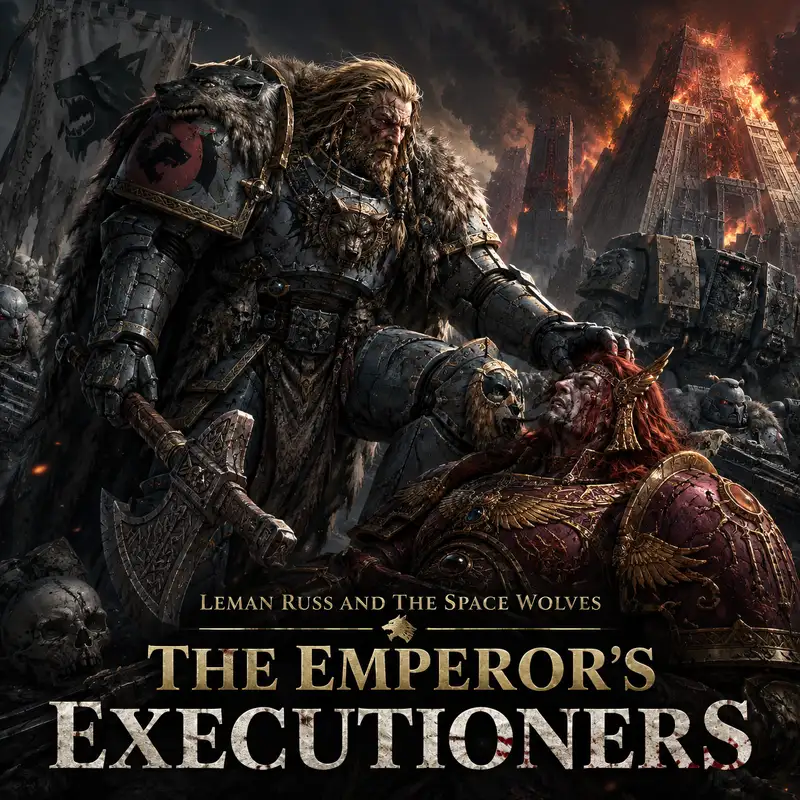
Leman Russ and the Space Wolves: The Emperor’s Executioners
By the time Leman Russ reached the heart of Tizca, Prospero was burning. The pyramids of the Thousand Sons were collapsing under bombardment, their libraries were becoming furnaces, and two Legions that had once conquered in the Emperor’s name were killing one another in the streets. Russ had come believing he was carrying out a lawful sentence. Magnus the Red believed the sentence proved that the Imperium had never understood him. Between them stood broken orders, old hatred, wounded pride, and the careful interference of Horus. When the brothers finally met, Russ broke Magnus across his knee and cast down the Crimson King. It was the sort of victory for which the Space Wolves had been created. It was also one of the greatest disasters of the Horus Heresy.
That contradiction defines Leman Russ. He is remembered as the Wolf King, the savage primarch of Fenris, the roaring warrior who drank deeply, laughed loudly, and solved difficult political questions with an axe. He and his sons were called the Emperor’s executioners, a weapon reserved for enemies who were not merely to be defeated but punished, erased, or made into a warning. Yet Russ was neither a mindless berserker nor a simple attack dog. His barbarism was partly genuine, partly cultural, and partly performance. He understood that fear could win a battle before the first blade was drawn. The danger was that after wearing the mask for long enough, even a primarch could forget where the mask ended.
The Sixth Legion had a violent reputation before Russ was ever found. Raised in secrecy during the last years of the Unification Wars, its earliest recruits were drawn from scattered and often brutal warrior cultures of Terra. The Legion was smaller than many of its peers, difficult to control, and unusually prone to fatal reactions during implantation. Its warriors excelled at shock assault, pursuit, and punitive operations. They did not move through a city like an army carefully capturing objectives. They spread through it like a fire, bypassing strongpoints, tearing apart resistance, and hunting anyone who fled. On the world of Delsvaan, their first great recorded campaign, they achieved compliance with appalling speed and left one city drenched in blood. Imperial observers questioned their discipline. The Emperor appears to have been satisfied with the result.
Their enemies gave them an insulting name. They called the Sixth the Rout, comparing them to packs of carrion beasts that chased the exhausted and fell upon the helpless. The name remained, but its meaning changed. The Legion adopted it, as warriors often adopt an insult once they discover it irritates the people who coined it. Even so, the early Sixth had a genuine problem. Their aggression produced victory, but victory alone did not provide purpose. They were dangerous in the way an unsheathed blade is dangerous. They could kill. They had not yet decided what killing meant.
Leman Russ gave them an answer because Fenris had given one to him. Fenris was a death world of violent seasons, unstable islands, freezing seas, volcanic upheaval, and predators large enough to make ordinary human settlement seem like a clerical error. Its people survived in tribal communities where food, shelter, reputation, and loyalty were inseparable. A warrior fought for the people beside him because failure did not mean a disappointing report. It meant the hearth went cold and the children died. Fenrisian culture could be cruel, but its cruelty was rarely abstract. Life imposed a price, and everyone knew who would pay it.
The stories of Russ’s childhood are sagas rather than reliable archives. They describe an infant primarch raised among wolves, later taken in by a human king, and eventually becoming a ruler in his own right. The details are layered with deliberate myth, but the broad shape is clear. Russ survived alone, entered Fenrisian society, mastered it, and made its values his own. He learned loyalty through the pack, kingship through the tribe, and war as a duty owed to those who depended upon him. He was not a primitive who could understand only the axe. Once found, he absorbed the scale and technology of the Imperium with remarkable speed. The wild king understood starships perfectly well. He simply preferred that they contain a good feasting hall.
Fenrisian tradition remembers the Emperor’s arrival as a contest. Russ supposedly defeated the stranger in eating and drinking before the Emperor ended the matter by knocking him unconscious. The tale may be allegory, exaggeration, or a remarkably informal accession ceremony. Its meaning is more important than its literal accuracy. Russ did not submit because someone displayed a title. He submitted after strength had been demonstrated. From that moment, his loyalty to the Emperor was personal, absolute, and bound by oath. He would argue with his father’s methods, resent his commands, and misunderstand his intentions, but he would not willingly betray him.
Russ became the second primarch openly restored to the Imperium after Horus. He took command of the Sixth Legion and brought with him several hundred Fenrisian warriors who had survived the transformation into Space Marines despite being older than normal candidates. These oath-bound companions became his first Varagyr, his Wolf Guard. He scattered some among the Terran-born Legionaries and took the whole force into battle. His purpose was not simply to test them. He wanted Terran and Fenrisian, gene-son and sworn companion, to bleed together until they became one people.
That forging took place in the Wheel of Fire, a region overrun by Orks. Russ divided his forces into fast, independent hunting groups and attacked world after world. The campaign was not elegant. It was relentless. The Space Wolves gave the Orks no time to gather their strength, striking isolated domains, pursuing broken armies, and turning local advantages into a wider collapse. Losses were severe, but the Legion emerged transformed. Russ had not removed its fury. He had chained fury to discipline, loyalty, and a defined purpose. The old Sixth had killed because killing came easily. The Space Wolves would kill because the pack had been threatened and the king had named the prey.
This is the foundation of their military culture. Space Wolves fight as packs within a larger hunt. Their commanders are expected to display initiative rather than wait for every order. Their senses, reflexes, and aggression are heightened by the unusual genetic legacy called the Canis Helix. Their teeth lengthen. Their features grow increasingly feral. In rare and terrible cases, the change overwhelms the warrior and produces the Wulfen, creatures balanced somewhere between Space Marine and beast. Russ did not create these dangers, but his genetic pattern stabilised a Legion that had already been suffering from them. He gave the beast a name, a place, and rules. That is not the same as curing it.
He also remade the Legion around Fenrisian memory. Deeds became sagas. Officers became jarls and thegns. Priests carried the traditions of healer, keeper of the dead, and guardian of the Legion’s spiritual order. Rune Priests wielded psychic power through Fenrisian symbols and insisted that their practices were different from the sorcery they condemned in others. From inside the culture, the distinction was sincere and carefully maintained. From outside, it could look remarkably like a psyker explaining that the rules applied to a different kind of psyker. This tension would matter when the Imperium judged Magnus.
As the Great Crusade expanded, Russ and his Legion were increasingly used for work that other forces either could not perform or were not trusted to remember. They fought secret wars against psychic infestations and horrors that Imperial authorities later erased from the record. After the Rangdan Xenocides, the Space Wolves and Dark Angels were ordered to purge regions believed to remain tainted, leaving inhabited sectors lifeless so the threat could not return. This was not conquest. It was excision. The Imperium had decided that survival required an atrocity, and Russ was among those chosen to commit it.
That is when the whisper of executioner became attached to him. It was never merely a claim that the Space Wolves were the strongest Legion. They were not. Nor did it mean they always won. It described a relationship with authority. The Wolves answered most directly to the Emperor and accepted missions in which obedience mattered more than reputation. They were not builders like the Imperial Fists, governors like the Ultramarines, or exemplars intended to make conquest look civilised. They were the force sent when the Emperor wanted resistance ended, contamination removed, or an oathbreaker taught that Imperial patience had limits and those limits were armed.
The fate of the two lost Legions hangs over this reputation. Later hints and rumours have encouraged the belief that Russ destroyed one or both of his forgotten brothers. The surviving record does not prove it. The silence surrounding those Legions is deliberate, and the Space Wolves’ role remains uncertain. Russ may have been involved. He may have known more than most. He may simply have benefited from a reputation that made everyone believe he had already killed a primarch. For an executioner, uncertainty can be useful. The condemned behave differently when they think the axe has fallen before.
Russ cultivated that fear. Outsiders saw pelts, fangs, ritual scars, drinking horns, and warriors speaking in the dense language of saga. Many concluded that the Space Wolves were barely civilised. They missed the intelligence beneath the performance. Fenrisian stories carried history, law, warning, genealogy, and coded obligation. The Legion’s apparent disorder concealed flexible command. Its boastfulness established reputation and commitment. Its savagery made enemies underestimate its planning. Russ understood the value of appearing simpler than he was. A brother who dismissed him as a drunken barbarian had already surrendered an advantage.
Yet the performance also fed his pride. On Dulan, Russ and Lion El’Jonson of the Dark Angels clashed over how to defeat the tyrant Durath. Russ had sworn to kill Durath personally. The Lion reached the enemy first and took the victory, provoking a furious confrontation between the brothers. Their fight became the foundation of a rivalry that their sons would ritualise for ten thousand years. Beneath the comedy of two demigods settling a command dispute with their fists lay a serious flaw. Russ treated personal honour as part of strategy. When those aligned, he was formidable. When they did not, the Legion could pay for its father’s temper.
His confrontation with Angron revealed the better side of the same instinct. Russ tried to warn the World Eaters that the Butcher’s Nails and Angron’s example were destroying them. The argument became a battle remembered as the Night of the Wolf. Angron believed he had defeated Russ in personal combat. Russ’s point was that while Angron pursued the duel, the Space Wolves had surrounded him and placed the World Eaters in a position where they could kill the primarch at terrible cost. Angron did not care. Russ had attempted to teach a lesson about command, loyalty, and the difference between winning a fight and preserving a Legion. He discovered that a lesson is wasted on a man who considers survival an inconvenience.
Magnus was a different problem. The Crimson King represented almost everything Russ distrusted. Magnus believed knowledge could master the warp. Russ believed some doors were sealed because what stood behind them was stronger than the person opening them. Magnus saw the Rune Priests as hypocrites. Russ saw the Thousand Sons as sorcerers hiding arrogance beneath scholarship. Each brother recognised a real flaw in the other, and each used that flaw as permission to ignore his own.
At the Council of Nikaea, the Emperor ordered the Legion Librarius programmes dissolved and their members returned to ordinary battle duties, forbidden to use their psychic powers. Magnus was publicly censured. Russ supported the judgment, while the Space Wolves continued to employ Rune Priests according to their own traditions. The distinction may have carried meaning within Fenrisian practice, but politically it was difficult to defend. Russ believed his priests respected limits that Magnus refused to acknowledge. Magnus believed Russ’s fear had merely dressed itself in animal skins and called itself wisdom.
Then Magnus attempted to warn the Emperor of Horus’s betrayal by projecting his mind across the galaxy. The warning was sincere. The method was catastrophic. Magnus shattered the psychic protections around the Emperor’s secret work beneath Terra and opened a path for daemonic invasion. The Emperor ordered Russ to bring Magnus back to Terra for judgment. Horus, still publicly the trusted Warmaster, interfered with that mission and encouraged a harsher outcome. He understood both brothers well. Magnus could be driven into rebellion through despair. Russ could be driven into destruction through duty and anger.
Prospero became the perfect trap. Magnus, crushed by guilt and convinced punishment was deserved, withdrew and prevented his own forces from preparing properly. Russ arrived expecting sorcery, deception, and resistance. Attempts at communication failed or never reached the brother they were meant to reach. Once fighting began, every event confirmed what each side already feared. The Thousand Sons saw executioners. The Space Wolves saw forbidden powers unleashed openly. Custodians, Sisters of Silence, soldiers, Titans, and Legionaries turned Tizca into a killing ground. By the end, Magnus accepted the aid he had once believed he could control, and the survivors of his Legion escaped into the warp.
Russ won the battle and fulfilled Horus’s purpose. The Thousand Sons were driven from the Emperor, the Space Wolves were badly weakened, and two loyal Legions had torn each other apart before the wider rebellion was understood. This is the central failure of the executioner. Russ had been trained to carry out the sentence, not to question the hand presenting the warrant. His loyalty made him dependable. It also made him usable.
The lesson did not arrive gently. Before the Wolves could recover, the Alpha Legion trapped them in the Alaxxes Nebula. Russ called for help and almost none came. His Legion, isolated by its old role and distrusted by many of its brothers, discovered the price of having spent decades as the Emperor’s feared weapon. A weapon does not have friends. It has an owner, a target, and perhaps a cupboard where it is kept between emergencies.
Russ survived and returned toward Terra, but he was no longer certain that obedience alone was enough. He sent watch-packs to observe other primarchs, still acting as guardian and potential executioner. When Horus advanced, Russ chose not to remain behind the walls. Armed with a spear given by the Emperor, he led the Space Wolves in a direct attack upon the Warmaster. The decision was strategically questionable and entirely consistent with him. Russ believed his purpose was to confront the traitor brother whom he had failed to recognise and end the rebellion at its source.
He reached Horus and wounded him with the spear. For a moment, the weapon cut through corruption and exposed something of the brother Russ had once known. Then Russ hesitated. The Emperor’s executioner, who had destroyed Prospero while Magnus was still recoverable, could not finish Horus when Horus truly had become the enemy. It was not fear. It was recognition. Russ wanted his brother to return, or at least wanted the possibility that he might. Horus struck him down, and the Space Wolves were shattered in the escape. They had traded much of their remaining strength for a wound that weakened the Warmaster but did not stop him.
This was Russ’s final transformation. The young Wolf King had believed that loyalty gave violence meaning. Prospero taught him that loyalty could be manipulated. Horus taught him that judgment could not be separated from love, grief, and responsibility. An executioner who feels nothing is a monster. An executioner who feels too late leaves ruins behind him.
After the Heresy, Russ remained with his sons for a time, but eventually departed Fenris and vanished into the wider darkness. He left Bjorn behind, a decision that wounded the warrior who would become the first Great Wolf and, much later, the ancient Dreadnought called Bjorn the Fell-Handed. Space Wolf tradition says Russ will return when the Wolftime comes, during the Chapter’s greatest need. Whether that promise is prophecy, saga, or hope preserved for ten thousand years remains unsettled.
The Space Wolves of the forty-first millennium still carry his contradictions. They are fierce servants of the Imperium, yet suspicious of distant authority. They celebrate the hunt, the feast, the oath, and the saga, but beneath the noise lies a culture built around memory and obligation. They can be brutal, proud, and dangerously certain. They can also defend ordinary people against Imperial institutions that regard those lives as administrative debris. The sons of the Emperor’s executioner have learned, imperfectly, that a warrior must sometimes judge the command as well as the enemy.
Leman Russ was the Emperor’s executioner because he would go where others hesitated, do what others refused, and bear a reputation others could not survive. He was not chosen because he lacked a conscience. He was chosen because his conscience was chained to loyalty, and for many years that chain held. His tragedy was discovering that obedience cannot replace judgment, and that an executioner who never questions the sentence may become the weapon of the guilty. In the Fang, the seat of the Wolf King remains empty. The axe has not been forgotten. The hand that once carried it has gone into the dark, perhaps in search of the wisdom that duty alone could not give him.