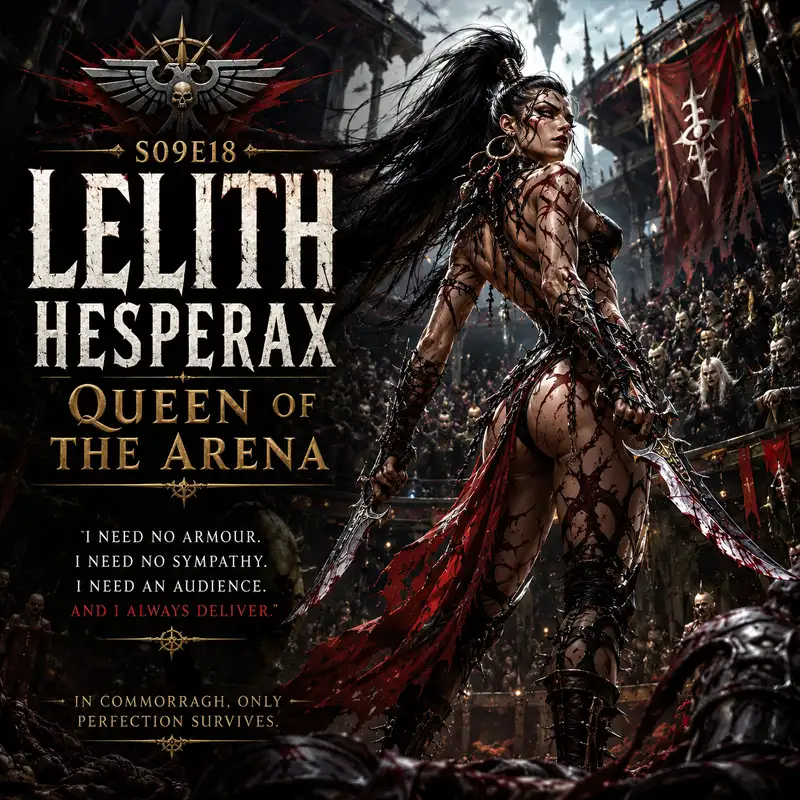
Lelith Hesperax: Queen of the Arena
The first thing most opponents notice is that Lelith Hesperax appears to have forgotten her armour. The second is that she carries only a pair of knives. By the time they understand that both choices are deliberate, the crowd is usually cheering over what remains of them. In the arenas of Commorragh, warriors arrive wrapped in powered plate, carrying energized blades, poison launchers, or weapons designed by minds that consider ordinary cruelty rather unimaginative. Lelith steps onto the blood sands almost bare, her long hair unbound, her body exposed, and her expression calm. She is not offering the enemy an advantage. She is showing the audience that she has already measured every possible attack and found none worth fearing. The arena begins as a contest between two fighters. Within moments, it becomes a demonstration conducted by one.
Calling Lelith the Queen of the Arena sounds simple until one asks what a throne means in Commorragh. The Dark City is not a place where titles are protected by law, inheritance, or even common decency. Power survives because it can make rivals afraid, followers ambitious, and spectators hungry for more. Lelith possesses all three forms of power. She is not merely the most celebrated gladiator among the Drukhari. She is an institution built from movement, reputation, and the carefully managed expectation that anyone challenging her will die beautifully. Her central achievement is not that she kills. Commorragh is exceptionally well supplied with people who can do that. Lelith became queen because she turned killing into authority, and because she learned to control an audience as completely as she controls the distance between two blades.
Commorragh hangs within the Webway, a maze of impossible spaces outside the ordinary geography of the galaxy. It is less a city than a collection of realms, ports, fortresses, stolen suns, and predatory neighborhoods forced together by conquest and treachery. Its inhabitants are the Drukhari, descendants of the ancient Aeldari civilization whose excess helped bring Slaanesh into existence. That catastrophe did not end when their empire fell. The Dark Prince still drains at the souls of the Drukhari, a slow spiritual hunger that can be held back by feeding upon the suffering of others. Pain restores them. Terror sharpens them. Agony is not simply a pleasure in their society, although it is certainly that. It is nourishment, currency, medicine, entertainment, and political fuel. Commorragh has found a survival strategy. Like many policies adopted in desperation, it has developed a rather enthusiastic bureaucracy.
The Wych Cult arenas stand at the center of that system. Their spectacles provide the Drukhari masses with the suffering they crave, while granting the powerful opportunities to display wealth, settle rivalries, and advertise their own importance. Captives from realspace are thrown against trained gladiators, alien beasts, engineered monsters, and one another. The contests are designed not merely to end in death, but to prolong fear and heighten anticipation. A clean execution would be wasteful. The crowd wants reversals, humiliations, impossible escapes, and the precise instant when hope becomes knowledge. Wyches are therefore more than soldiers. They are performers whose technique must be visible, whose danger must feel genuine, and whose victories must satisfy an audience that has watched almost every conceivable method of murder. Impressing Commorragh is difficult. Its critics tend to carry knives, and poor reviews are often delivered in person.
Lelith did not begin life as the favored daughter of a noble house. Later accounts describe her as vat-born, created within the fleshworks of a Haemonculus named Yukor alongside a litter intended for the arenas. The training was not education in any humane sense. It was selection through calculated brutality. The young were forced into lethal trials, sometimes armed with little more than shards of metal and wire, while Wracks and other horrors reduced their numbers. Survival proved usefulness. Failure simplified the inventory. Lelith endured, escaped Yukor's control, and carried a small number of fellow survivors with her into a wider world that was only marginally less murderous. This origin matters because it established the pattern of her life. She was created to be owned, trained to perform, and expected to enrich someone else. Her rise began with the refusal to remain property.
She found her place within the Cult of Strife, one of Commorragh's greatest Wych Cults, and rose until she became its Succubus. The title suggests a commander, but a Succubus must be several things at once. She leads raids, manages rival performers, negotiates with Kabals, satisfies patrons, and remains personally capable of killing anyone who mistakes administration for weakness. Advancement is public. Every victory creates followers and enemies in roughly equal measure. Every wound becomes gossip. Every hesitation becomes an invitation. Lelith prospered in this environment because the arena rewarded precisely what her childhood had taught her. She understood that control could never be assumed. It had to be demonstrated, repeatedly and in front of witnesses. Her authority was not granted by the Cult of Strife. The cult gathered around her because her fame made everyone near her more dangerous, more desirable, and more profitable.
Her methods distinguished her even among the Wyches. Drukhari gladiators commonly use combat drugs, stimulants, engineered reflex enhancers, and equipment designed to push an already remarkable body beyond its natural limits. Lelith rejects such assistance. She has treated narcotic enhancement as weakness, preferring to rely upon her own speed and skill. Her usual weapons are simple knives, not because better weapons are unavailable, but because simplicity places the burden of victory entirely upon the wielder. Her long hair is woven with hooks and barbs. Her fingernails are sharpened. She wears little protection and carries scars so few that they become part of her legend. None of this is modesty. Lelith is perhaps the only person in Commorragh capable of turning minimal equipment into an act of vanity.
The spectacle works because her apparent vulnerability is bait. Armour invites an opponent to strike where it is weakest. Lelith offers the whole body and makes every choice wrong. She controls distance with minute shifts of balance. She studies shoulders, hips, breath, and gaze, reading commitment before a blow has properly begun. A heavily armed champion may possess greater strength, reach, and protection, yet those advantages matter only if the weapon arrives where its target remains. Lelith is already elsewhere. She does not simply dodge. She moves in ways that cause one attack to obstruct the next, turning an enemy's equipment, allies, and momentum into additional hazards. When she finally closes, she aims for joints, arteries, eyes, and the small failures in posture that panic creates. Her body is not stronger than every opponent. Her understanding of violence is faster.
This is also why descriptions of Lelith as merely a duelist miss something essential. A duel can be private. Her art requires witnesses. She decides when the crowd may believe she is threatened, when an opponent may recover, and when the ending will arrive. She can kill quickly, but speed alone would deny the arena its emotional harvest. Instead, she stages superiority. A foe is allowed to attack, fail, realize why the attack failed, and then attempt something more desperate. Each failed effort enlarges Lelith's control. The audience is not watching to discover who will win. It is watching to discover how completely the loser will understand defeat. That distinction transforms combat into ritual. The blood is real, the danger is real, and the result appears inevitable only after Lelith has made inevitability entertaining.
Fame in Commorragh is a military resource. The Cult of Strife can offer its services to Kabals planning realspace raids, and Lelith's presence turns an expedition into an event. Archons gain prestige by securing her cooperation. Rivals measure themselves against her attention. Accounts place her within the violent politics surrounding Asdrubael Vect's ascent, including the killing of an Archon whose removal helped clear Vect's path. Whether every later telling has preserved the precise details is less important than the relationship it reveals. Vect understands spectacle as well as Lelith does. He rules Commorragh through fear, patronage, manipulation, and the constant reminder that rebellion may already be part of his plan. Lelith commands a different loyalty. The crowds love what she does. That makes her useful to Vect, and therefore dangerous to him.
Away from the arenas, Lelith joins raids when the prey promises novelty. Ordinary victims have little to teach her, and repetition is the enemy of reputation. She seeks champions, unusual species, and situations that can be reshaped into performances. On one Imperial world, she transformed an entire city into a killing ground of traps and staged encounters, converting streets, sanctuaries, and defensive positions into parts of a vast arena. The defenders believed they were fighting for survival. The Drukhari nobility watched a festival. This is the point where admiration for Lelith's skill must not soften what she is. Her artistry depends upon captives who did not consent to become scenery. The elegance of her movement does not reduce the cruelty. It makes the cruelty more deliberate.
Her participation in the struggle around Duriel offers another revealing example. While Aeldari forces confronted the Tyranid threat, Lelith and warriors of the Cult of Strife fought alongside their distant kin for motives that were not exactly charitable. She wanted living Tyranid specimens for the arenas. Even during a battle against organisms bred to consume worlds, her thoughts returned to the next spectacle. The operation succeeded, providing new monsters whose instincts could be tested against gladiators and prisoners under controlled conditions, assuming the word controlled is permitted considerable flexibility. For Lelith, the galaxy is not divided into allies and enemies so much as performers, prey, and possibilities. A crisis is serious. It may also have excellent booking potential.
The title of Queen therefore contains a trap. Every performance that strengthens Lelith's legend also raises the standard of the next. Commorragh does not reward yesterday's perfection for long. A defeated champion becomes a story, then a memory, then decoration. Lelith must remain new without ceasing to be recognizable. She must appear vulnerable without being wounded, surprised without losing control, and challenged without allowing the outcome to become truly uncertain. Her refusal of enhancement makes the feat more impressive, but it also removes excuses. If she slows, she cannot blame a failed drug, damaged armour, or defective implant. Her identity rests on the claim that skill alone is enough. In a civilization terrified of decline, she has made personal perfection her answer. The cost is that perfection must never take the evening off.
The arrival of Yvraine disrupted that answer. Yvraine emerged as the prophet of Ynnead, the Aeldari god of the dead, and gathered followers from divided branches of the ancient species. Her Ynnari offered something the Drukhari had scarcely imagined possible: relief from the spiritual thirst imposed by Slaanesh. Lelith defeated Yvraine in the arena, yet the encounter opened a path that victory could not close. Yvraine's power could quiet the hunger that had shaped every Drukhari choice since the Fall. Lelith committed much of the Cult of Strife to the Ynnari cause and traveled with Yvraine's followers. This was not a conversion into gentleness. Lelith did not suddenly discover moral philosophy between knife strokes. She had found freedom from a need that even her mastery could not defeat.
That freedom also offered a larger hunt. Lelith developed an interest in Lucius the Eternal, the champion of Slaanesh whose curse allows him to return through those who take pride in killing him. To most warriors, Lucius is a problem best addressed from a safe distance, preferably by someone else. Lelith imagines stripping away his daemonic armour and facing him in the arena as the ultimate contest. The ambition is perfectly suited to her. Lucius is another performer whose legend depends upon combat, humiliation, and an audience, even when that audience is a god. Yet the proposed duel contains a cruel uncertainty. If Lelith killed him and felt pride, would his curse claim her? If she felt nothing, would the victory still mean what she wanted? The greatest opponent may be dangerous not because he can defeat her, but because victory itself could become the trap.
Life among the Ynnari could not hold Lelith indefinitely. Their cause concerns the survival and possible reunification of the Aeldari, questions of destiny large enough to burden prophets and exhaust everyone traveling with them. Lelith fought for Yvraine and defended her, but devotion was never the foundation of the arrangement. She grew restless. The absence of soul thirst gave her freedom, yet freedom created an unfamiliar question: what should she choose when survival no longer chose for her? Lelith returned toward Commorragh, not because the Dark City had become safe or welcoming, but because it contained the rivals, crowds, and unfinished relationships through which she understood herself. A person may escape an arena and still carry its boundaries in the mind.
Her return revealed that Commorragh had continued without her, an offense the city was almost certainly committing on purpose. Pretenders had risen. The Cult of Strife no longer possessed unquestioned favor. Morghana Nathrax, a survivor connected to Lelith's earliest years, now led the Cult of the Thirteenth Night and stood as a rival elevated within Vect's political theater. An assassin's attack and a chain of provocations drew Lelith deeper into the Dark City. The available accounts present Vect as the architect of the pressure, arranging enemies so that each would destroy the other or emerge more useful to him. It was a familiar Commorragh solution: place two knives in a box, shake vigorously, and claim that the surviving knife always belonged to you.
The expected ending was a duel. Lelith and Morghana met under Vect's gaze, with supremacy and survival made part of the performance. Both knew the language of the arena. Both understood what the crowd required. Lelith gained opportunities to kill her rival and discovered that she did not want to take them. Morghana reached the same boundary from the opposite direction. Their fight lost its elegant form and became desperate, physical, and emotionally confused, precisely the sort of disorder Lelith normally removes from combat. The decisive moment was not a perfect strike. It was refusal. Each woman confronted the possibility that their shared history meant more than the role Commorragh had assigned them. In a city where affection is usually treated as leverage, declining to kill became a more radical act than murder.
Vect answered their refusal with attempted execution. Lelith and Morghana fought through the forces sent against them, and Lelith reached the figure of the Living Muse himself. She broke through his defenses and severed a hand, a gesture direct enough to be understood even in a political culture fond of metaphor. Vect permitted a settlement while warning against open challenge. The scene should not be mistaken for the overthrow of Commorragh's ruler. Vect survives defeats by ensuring they become someone else's lesson, and any encounter with him may contain layers unseen by every participant. What matters for Lelith is that she no longer fought to satisfy the crowd, defend a title, or complete another person's script. She fought because she had chosen someone and something beyond the performance.
That choice does not make Lelith heroic. The dead of countless arenas do not return because their killer has developed emotional complexity. She remains a Drukhari raider, a master of the Cult of Strife, and a predator whose search for worthy opponents leaves ordinary people buried beneath the spectacle. Yet she is no longer adequately described as a flawless killing machine. Her greatest vulnerability was never exposed skin. It was the possibility of wanting something she could not convert into applause. Morghana, Yvraine, and even the lure of Lucius reveal different pressures upon her identity: connection, freedom, and the need for a challenge that can still define her. Each threatens the closed perfection of the arena.
Lelith Hesperax is Queen of the Arena because she understands every part of it. She understands the opponent's body, the audience's hunger, the patron's ambition, and the political value of a death delivered at exactly the right moment. She made herself indispensable to a civilization that consumes suffering and then proved capable of stepping beyond the role it built for her. The arena remains her throne, but it is also the cage she can now see. Somewhere in Commorragh, the crowd still waits for Lelith to raise her knives and confirm that nothing has changed. The most dangerous possibility is not that she will lose. Commorragh has always understood defeat, resurrection, replacement, and revenge. It is that, for the first time, she may decide the crowd does not choose who must bleed.