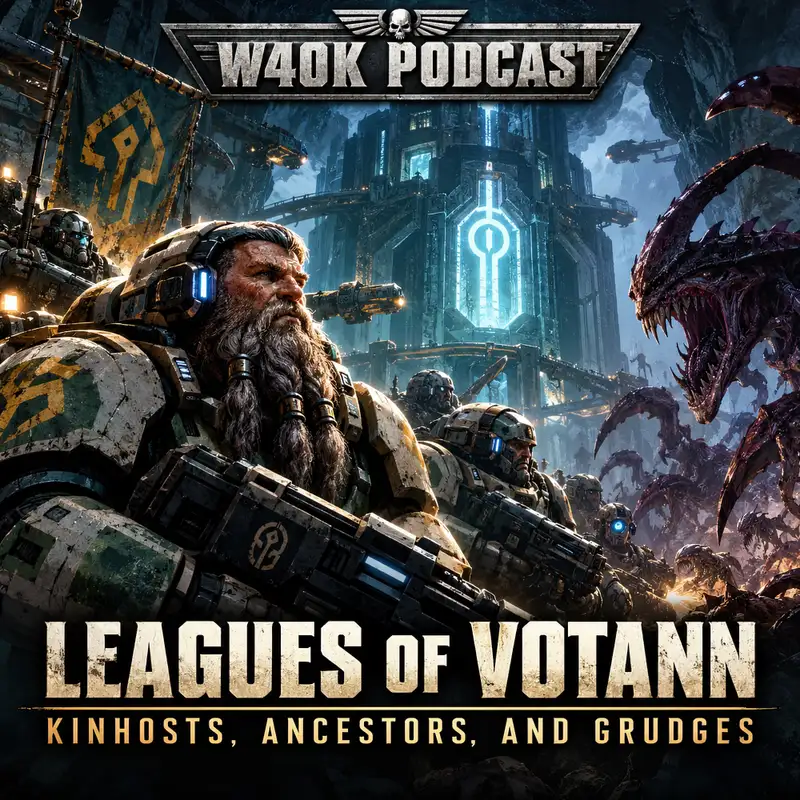
Leagues of Votann: Kinhosts, Ancestors, and Grudges
By the time Hive Fleet Leviathan moved on, there was almost nothing left of the Emberg-Aegnir Bloc. Its holds had been emptied, its defenders consumed, and its last warriors had died around the machine they valued above every fortress and every seam of ore: their Votann.
The Tyranids had devoured the League, but the Ancestor Core survived. That survival was not a victory. Burdened by the hopelessness and grief of the Kin who had perished in its defence, the ancient intelligence broke. Other Leagues mourned what had happened, yet they dared not approach the ruined machine. They feared that contact through their beacons and Fanes might spread its corruption into their own ancestral systems. The surviving Votann became the Mad Core, alive, isolated, and filled with the final anguish of a dead people.
One warrior remained. Buri Aegnirssen, last survivor of the Bloc, turned loss into purpose. The Tyranids are known to the Kin as the Bane, and Buri hunts them with an intensity that makes even other Kin uneasy. He carries trophies cut from their bodies and seeks out their largest beasts. Some say he is trying to balance the debt of his destroyed League one monstrous life at a time.
That story contains the Leagues of Votann in miniature. A kinhost formed to defend its people. An Ancestor Core that served as archive, counsellor, creator, and sacred heart. A grudge that outlived the League itself. To understand how the Kin wage war, those three things cannot be separated.
The Kin are often described by outsiders as abhumans, an offshoot of humanity adapted to life in the galactic core. That Imperial label is convenient, but it explains far less than the Imperium assumes. The Kin do appear to share an ancient ancestry with humanity, yet their own beginnings lie behind layers of lost history, inherited myth, and guarded data. They do not define themselves by their relationship to Terra, and they have little interest in asking permission from an empire that has forgotten more technology than it understands.
Their civilisation grew in the galactic core, where stars crowd close together and gravity, radiation, stellar debris, and unstable worlds make ordinary settlement difficult. The Kin did not merely endure those conditions. They were made for them. Biological Kin are produced through carefully maintained genetic templates called cloneskeins. New citizens emerge from crucibles fully grown, carrying inherited knowledge and deliberately shaped bonds of loyalty to their kindred.
Different cloneskeins provide different advantages. Some improve resilience, perception, stamina, or resistance to hostile environments. Rare strains produce the limited psychic ability associated with the Grimnyr. The result is not a population of identical copies, but a manufactured people whose diversity has been planned around survival. Their family bonds are no less real because design played a part in creating them. Among the Kin, origin matters less than belonging.
That principle extends beyond flesh. Ironkin are true machine intelligences created by the Votann and housed in mechanical bodies. They work, explore, argue, and fight beside biological Kin as members of the same society. Their minds and drives are not identical to those of their flesh-and-blood relatives, and ambition among them is uncommon, but they are not servitors or property. An Ironkin may be a miner, a pilot, a technical specialist, a scout, or a warrior. The body is personal, not a disposable shell. Flesh or metal does not determine who belongs at the hearth.
This simple equality makes the Leagues deeply unsettling to the Imperium. The Imperium has spent ten thousand years insisting that independent machine intelligence is one of the oldest roads to catastrophe. The Kin have spent those same millennia living beside it, trusting it with weapons, ships, and command responsibilities. Both civilisations consider the other dangerously irresponsible. On this point, diplomatic meetings tend to become brief.
At the centre of every League stands one or more Votann. These Ancestor Cores are colossal sentient supercogitators created by hands lost to history. Their self-organising data-stacks and quantum infocores contain military theory, genealogical information, scientific knowledge, philosophy, industrial methods, and Standard Template Construct systems dating back to humanity’s technological height. They are not merely libraries. They analyse, advise, design, remember, and shape the generations that depend upon them.
The Kin rarely explain this to outsiders. Revealing the truth would invite invasion, particularly from the Adeptus Mechanicus, which would regard an intact Ancestor Core as a miracle, a heresy, an archaeological treasure, and a reason to deploy several armies at once. The Kin therefore speak of the Votann with reverence and deliberate vagueness. Secrecy is a sacred custom, but it is also sound perimeter security.
Most Kin cannot simply walk up to an Ancestor Core and ask it a question. Contact is made through interfaces called Fanes, and access is carefully controlled. The Grimnyr, sometimes called Living Ancestors, are among the principal intermediaries. They carry a rare psychic cloneskein and stand closer to priests than almost anyone in the largely secular culture of the Leagues. Even then, they do not command the Votann. They consult them, interpret them, and sometimes wait.
That waiting has become a problem.
The Ancestor Cores were never designed to operate for tens of thousands of years beneath an endless weight of new data. Every generation adds experience, records, calculations, genealogies, and requests. The Cores continue to grow, but their ability to process what they contain is failing. A question that once produced an answer in moments may now require decades. Some responses take centuries. Individual Votann have developed quirks, moods, contradictions, and what outsiders might call personalities, though saying so within a Kinhold would be unwise.
The decline is no longer confined to slow replies. Cloning processes show signs of degradation. The Votann are choosing to create fewer Ironkin. The Ancestor Cores remain powerful, but their decisions are becoming harder to predict and their gifts less abundant. The Kin possess extraordinary technology, yet the source of much of that technology is becoming slower, stranger, and less reliable.
This is the central tragedy of their civilisation. The Kin built their identity around continuity. Their ancestors are not distant figures preserved only in story. Ancestral knowledge remains present in the systems that create new citizens, guide kindreds, and hold the accumulated lessons of countless lives. Yet the very act of preserving everything is choking the machines meant to preserve it. The past is not disappearing. It is becoming too vast to search.
A League is not a single nation in the Imperial sense. It is an alliance of kindreds, guilds, holds, fleets, and commercial interests bound by oaths and negotiated obligations. Some Leagues contain hundreds of kindreds. Others are younger, smaller, or scattered across wandering fleets. Their unity is practical as well as cultural. Trade agreements, defence pacts, shared claims, and loyalty to the same Ancestor Cores hold them together.
This leaves considerable room for difference. The Greater Thurian League is ancient, wealthy, and influential. The Trans-Hyperian Alliance favours exploration and lives across widely dispersed fleets. The Ymyr Conglomerate is renowned for its engineering. The young Kronus Hegemony trains immense military forces to defend and strengthen its newly awakened Votann. The Urani-Surtr Regulates hold their ground against repeated invasions with a determination that has outlived several reasonable opportunities to reconsider.
The Leagues therefore share a civilisation without behaving as a single empire. They trade with one another, compete, exchange knowledge, honour agreements, and sometimes feud. What they possess in common is not a throne or a universal ruler. It is a way of measuring obligation.
The same principle shapes the kinhost. A kinhost is not necessarily a permanent standing army with fixed regiments and an unchanging chain of command. It is the armed strength a kindred assembles for a particular task. The mission may be exploration, defence, extraction, conquest, contract work, or revenge. Units are gathered, reorganised, and dissolved according to need.
Their guide is an ancient body of military and logistical wisdom known as Gräf Zero One. Its exact origin is uncertain. Kin traditions associate it with a long-fallen League from the earliest era of their recorded history, but the document has been copied, traded, re-recorded, and adapted so many times that its first author may never be known. It contains organisational diagrams, operational principles, logistical methods, and models for constructing forces suited to different undertakings.
The Kin respect it deeply without treating it as an excuse to stop thinking. A commander may depart from its recommendations when conditions demand it, then return to its principles once the emergency has passed. This is a modest idea by the standards of the forty-first millennium, where many armies consider tactical flexibility suspicious and doctrinal failure sacred.
In times of crisis, a kindred may form a Votannic Council that brings together its greatest authorities. A High Kâhl represents martial leadership. A Lord Grimnyr provides ancestral and psychic guidance. A Brôkhyr Forge-master speaks for the engineers and forges. Beneath them, merchants, guild leaders, and senior officers conduct daily affairs through the Hearthspake.
The Hearthspake is famous for prolonged debate. Matters can be argued for months inside the great chamber known as the Spakerönde. This does not mean the Kin are indecisive. It means they prefer to finish the argument before committing lives, ships, and ammunition. Once the decision is made, implementation tends to be considerably faster.
Gräf Zero One provides names for many of the forces that follow. An Oathband is assembled for direct military action and the defence of vital interests. A Prospect sends Hernkyn scouts and Cthonian miners to locate new wealth and determine whether it can be taken. A Harvest secures active extraction sites. A Forgeband serves the interests of the engineering guilds. After a catastrophe or unforgivable insult, the survivors may be reorganised into a Grudgeband whose purpose is not acquisition, defence, or profit, but the settlement of a wrong.
This mission-based structure explains the mixed character of a Kin army. Hearthkyn Warriors form its dependable centre, but they are not a separate warrior caste. They are citizens drawn from the kindred, trained to fight and equipped with void-sealed armour and weapons built to exacting standards. They may be miners, technicians, traders, or artisans when they are not under arms. A Hearthkyn does not stop being part of civilian society when the armour comes off, assuming the armour comes off and the relevant guild has completed the forms.
Theyns lead Hearthkyn squads, while Kâhls command larger forces. A good Kâhl is not merely brave. The role requires judgement, an ability to calculate the cost of engagement, and the authority to cast the Eye of the Ancestors over chosen enemies. That phrase describes more than vengeance. It is a method of assessment. The Kin identify which enemy formations threaten the mission, which targets justify the expenditure of ammunition, and which losses must be answered.
Einhyr Hearthguard are selected from proven veterans and equipped with heavy exo-armour. Their place is earned through accomplishment rather than inherited nobility. They serve as bodyguards, assault troops, and immovable anchors when a line must hold. Brôkhyr engineers maintain the weapons and vehicles, while Thunderkyn carry heavy industrial firepower into battle. Cthonian Beserks use mining tools, demolition charges, cybernetic enhancement, and an alarming willingness to approach fortifications from the shortest possible direction.
Hernkyn range ahead of the main force. Pioneers and Yaegirs scout routes, identify deposits, assess enemy positions, and mark claims. Sagitaur vehicles carry small teams quickly across hostile ground, while the Hekaton Land Fortress provides transport, protection, and heavy firepower. Ironkin fight throughout the formation, from ordinary crews to the towering Steeljacks designed for shock combat. Memnyr Strategists process streams of battlefield information and compare them with the kinhost’s available resources before advising its leaders.
None of this makes the Kin invincible. Their forces are often compact, their numbers are limited, and every casualty removes a trained citizen from the kindred as well as a soldier from the line. Their machinery is sophisticated but cannot always be replaced quickly. Their weapons are powerful, yet the Leagues do not possess the limitless manpower of the Imperium, the self-repairing legions of the Necrons, or the biological abundance of the Tyranids.
That limitation reinforces their method. A Kin assault is usually deliberate. Scouts gather information. Leaders assess value. Vehicles move troops toward decisive ground. Heavy weapons break the strongest resistance. Infantry secure the claim. Engineers preserve damaged equipment and exploit what has been captured. Even their aggression has an industrial rhythm. The objective is not simply to destroy the enemy. It is to emerge with the mission completed and enough strength remaining to benefit from victory.
The Kin summarise their outlook in a hard little saying. Luck has. Need keeps. Toil earns.
It is a philosophy of possession, but not one that most neighbours find comforting. The Kin believe that effort, necessity, and productive use create legitimate claims. A resource wasted by one civilisation may be judged better employed by another. An asteroid, wreck, mineral seam, data archive, or entire world can therefore become the subject of negotiation, purchase, salvage, or armed acquisition.
The Leagues are capable traders and willing contractors. They can honour bargains with impressive fidelity, provided every term has been understood in the same way by both sides. They may fight as mercenaries, exchange technology, recover wrecks, or sell access to routes through dangerous space. They are not driven to conquer everything they see.
They are also perfectly capable of deciding that another people’s ownership is inefficient. A colony may believe that generations of habitation establish an unquestionable right to its world. A Kin prospect may observe that the colonists have extracted less than one percent of the available mineral wealth and are standing above a useful mantle deposit. Both parties can present a coherent argument. Only one brought a Hekaton Land Fortress.
This is where pragmatism meets the grudge.
A grudge is not merely anger, and it is not a momentary loss of temper. It is a record that an obligation has been broken or a cost imposed upon the Kin. A murdered citizen, a stolen claim, a betrayed contract, a destroyed vessel, an insult to the ancestors, or an attack upon a Fane can become part of that account. The scale of the response depends upon the scale of the wrong, the value of the offender, and the resources available to settle it.
The Kin may be patient. A debt does not cease to exist because immediate payment is inconvenient. Their civilisation is built around inherited memory, durable records, and obligations that bind groups rather than isolated individuals. A wrong can therefore survive the people who first committed it. To an outsider, this can look like irrational hatred carried across generations. To the Kin, forgetting would reward breach of oath and make every future agreement less secure.
On the battlefield, this produces a cold form of vengeance. Kâhls identify the formations responsible for losses and focus fire upon them. The guilty are not merely hated. They are prioritised. A grudge gives the kinhost moral certainty, operational focus, and a clear measure of what remains unfinished.
It can also become a trap.
The calm calculation of cost and yield can be consumed by the need to answer a wrong. A force created to protect a claim may chase an enemy beyond the point of profit. Survivors may reorganise their entire lives around revenge. A Grudgeband can take the broken remains of earlier formations and turn them into a weapon aimed at one offender, even when no material return is possible.
Buri Aegnirssen is the purest expression of that danger and that loyalty. His League is gone. Its holds cannot be restored by killing another Tyranid beast. Its Votann has become a Mad Core that other Kin fear to approach. No practical calculation can return what Hive Fleet Leviathan consumed.
Yet the debt remains.
That is why the Leagues of Votann are more than a technologically advanced mining culture and more than a familiar ancient archetype carried into space. Their strength comes from the way family, labour, memory, and military power reinforce one another. Biological Kin and Ironkin belong to the same hearth. Citizen soldiers fight beside guild specialists. Temporary kinhosts are shaped around exact purposes. Ancient machines preserve the knowledge that keeps the whole civilisation alive.
Their weakness rises from the same foundation. The Ancestor Cores are failing beneath the weight of everything they remember. The Kin depend upon systems they cannot fully replace and truths they will not share. Their devotion to obligation creates remarkable trust among themselves, but it can turn injury into a campaign without an end.
When a kinhost advances, it is not merely an army moving toward an objective. It is a family carrying its industries, contracts, ancestors, and unfinished accounts into battle. Behind every claim stands a Votann growing slower in the dark. Beside every warrior stands another Kin, flesh or metal. And somewhere in the ancestral record, beneath losses not yet answered, a line remains open.
The Kin do not forget, because forgetting would mean surrendering part of what makes them Kin.