Kroot, Vespid, and the T’au Empire’s Other Peoples
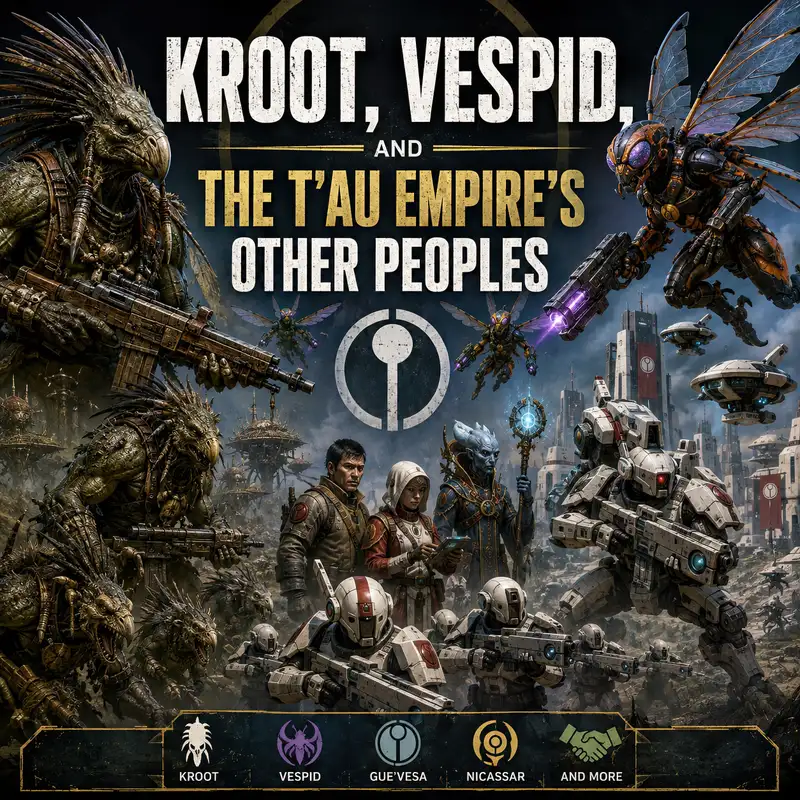
The T’au battle line looks complete until it begins to move. Fire Warriors mark targets with disciplined bursts, battlesuits rise above the smoke, and drones pass data through the air. Then the ground cover answers with Kroot rifles. Winged Vespid descend through the haze carrying weapons no T’au could operate in quite the same way. Human voices relay warnings in another language, while alien scouts report from places a Fire Caste commander never knew were occupied. The clean geometry of the T’au army is real. So is the crowded, untidy coalition hidden inside it.
That coalition raises an awkward question. Is the T’au Empire genuinely a union of different peoples, or a T’au hierarchy that has learned to make efficient use of foreigners? The answer lies in the very different bargains made with the Kroot, the Vespid, human converts, psychic explorers, mercantile Kin, and lesser-known species whose names survive at the edges of campaign records. The Greater Good promises that difference can become strength. It does not promise that everyone will decide what the Greater Good means.
T’au society begins with the castes. Fire fights, Earth builds, Water negotiates, Air travels, and the Ethereals direct the whole. Those divisions are presented as cooperation, with each part serving a purpose no other part can fulfil. Alien peoples stand outside that system. A Kroot does not enter the Fire Caste simply by carrying a rifle. A Vespid does not enter the Earth Caste because Vespid crystals improve a T’au weapon. Auxiliaries are praised for remaining distinct, but the strategic centre remains T’au. They are partners in the project without becoming authors of its design.
When the Empire encounters a new civilization, the process usually begins with observation and diplomacy. The Water Caste offers trade, protection, technology, and a place in a future larger than one world. The Earth Caste demonstrates what cooperation can build. If persuasion fails, the Fire Caste waits behind the diplomats with a less conversational form of policy. This does not make every offer fraudulent. Many peoples gain security, medicine, and protection that the Imperium would never extend to an alien. It means the open hand and the closed fist belong to the same body.
The Kroot entered that arrangement as allies with a history of their own, not as primitives waiting to be discovered. Their homeworld, Pech, had endured repeated war with the Orks. Long before the T’au arrived, Kroot had learned from devoured Ork bodies in the most literal way their species permits. They built cities, developed industry, and created immense Warspheres capable of carrying kindreds through the void and the warp. The Kroot later suffered defeat, and Ork occupation spread across their worlds. When T’au forces encountered them on Krath, they were badly outnumbered but still fighting.
The first alliance was made in battle. T’au forces intervened, reinforcements followed, and the conflict expanded into a decade of war to reclaim the Kroot core worlds. Pech was eventually liberated. At the Sacred Oathstone, the great Shaper Anghkor Prok pledged his people to the T’au Empire. The oath mattered, but so did its form. Prok did not propose that the Kroot become blue-skinned citizens with cleaner architecture. He argued that Pech should not be rebuilt as an industrial world. The Kroot would return to older ways, preserve their strength, and carry their hunt into the stars.
That decision explains the Kroot place in the Empire. They serve the T’au, but also the survival and development of their own species. Their loyalty is contractual, cultural, and personal rather than simply ideological. Payment matters. Honour matters. The opportunity to hunt unfamiliar prey matters greatly. T’au officials speak of service to the Greater Good. Kroot Shapers can accept that language while pursuing a purpose older and considerably hungrier. Neither side needs to be deceiving the other. Alliances often endure because each participant believes it is accomplishing something different.
Kroot biology turns diet into destiny. By consuming other creatures, they can absorb useful traits into later generations, and perhaps under some circumstances alter living individuals. This is not random feasting dressed up as science. Shapers direct what a kindred hunts and refuses to eat. They watch for desirable characteristics, guard against dangerous influences, and avoid paths that might cost the Kroot their intelligence or flexibility. A Shaper is part commander, part spiritual authority, and part keeper of a living breeding program. The job requires a strong stomach, although that is not rare on Pech.
A kindred is more than a military unit. It is family, culture, memory, and biological project. Different kindreds develop different bodies and talents because their ancestors followed different prey. Related forms such as Krootox and Kroot Hounds remind them that adaptation can create power while narrowing other possibilities. Far-ranging kinbands seek useful genetic material across the galaxy, then return what they have learned. In some traditions, the hunter’s final contribution is made through ritual consumption by the kindred. The individual dies, but the journey is not lost.
This makes Kroot mercenary service easier to understand. A foreign war is not merely employment. It is access to environments, enemies, and genetic possibilities that Pech cannot provide. Warspheres travel far beyond T’au borders, and independent communities accept contracts across the galaxy. Officially, the T’au alliance is meant to be exclusive. In practice, the Kroot continue the mercenary trade because the ever-hunt is not a hobby to be suspended for administrative convenience. The Empire tolerates much because the Kroot honour contracts and remain extremely useful. Policing every Warsphere would also be an ambitious way to begin a civil war.
On the battlefield, Kroot provide capabilities the Fire Caste lacks or prefers not to emphasize. They infiltrate dense terrain, identify prey by scent and sound, screen formations, spring ambushes, and close with enemies who survive T’au gunfire. Their rifles are firearms and fighting staves at once, fitted with blades for the moment range collapses. Krootox bring strength and heavier weapons. Hounds pursue fleeing prey. A Hunter Cadre can remain mobile and precise while its Kroot allies occupy woods, ruins, tunnels, and the violent few metres that T’au doctrine would rather solve from farther away.
That division of labour is efficient, but it can become morally convenient. Auxiliaries are often placed where T’au lives would otherwise be spent. A commander may sincerely admire Kroot courage while assigning a kindred to hold ground the Fire Caste considers too costly. T’au doctrine can describe this as using every people according to its strengths. The Kroot may accept the danger because battle serves the hunt and a contract must be honoured. Yet the question remains who writes the plan, who decides which lives are scarce, and who waits in the trees when the enemy arrives.
The cultural boundary is equally revealing. Many T’au find Kroot consumption of the dead disturbing, especially when the dead are intelligent. Kroot custom sees useful flesh, inherited strength, and respect for what was taken in battle. The alliance survives through rules, including the firm understanding that fallen T’au are not on the menu. This is tolerance in a practical, negotiated form. The T’au need not approve of Kroot tradition. The Kroot need not pretend their oldest customs are merely colourful local cuisine. Both sides know where the line is, and that the alliance depends on not testing it.
The Vespid entered the Empire through a different door. Their homeworld is a storm-wracked gas giant with a narrow habitable region high in its atmosphere. Rocky islands float among violet skies, held aloft by trapped gases, while valuable crystalline deposits form beneath them. Vespid communities carved settlements into those islands and built societies suited to a world with no ordinary ground. Flight was not a specialist skill there. It was a condition of civilization. When the T’au arrived, they encountered hundreds of city-nations and a species whose senses, movement, and communication had evolved in an environment almost impossible for a T’au to experience unaided.
The first negotiations went badly. Vespid speech was not simply unfamiliar words. It involved wing vibrations, pheromonal signals, and perhaps a shared psychic element. Water Caste envoys could not interpret it reliably, and Vespid aggression kept both sides at a dangerous distance. The Earth Caste answered with the communion helm. Worn by Vespid Strain Leaders, the device translated their complex signals into forms T’au allies could understand. Once communication became possible, resistance gave way to cooperation with remarkable speed.
That speed casts a shadow over the arrangement. The most benign explanation is also the most obvious. Two peoples who could not understand one another finally received a working translator, and fear became alliance. Another interpretation is that the helms do more than translate, shaping or directing those who wear them. The surviving accounts do not prove that suspicion. They cannot entirely dismiss it either, because T’au communication with Vespid formations is concentrated through leaders equipped with T’au-made devices. In an empire devoted to managed harmony, the difference between translation and influence is not a small technical detail.
Whatever the political truth, Vespid military service is not an imitation of the Fire Caste. Stingwings are fast, lightly armoured aerial shock troops. They move through broken terrain and vertical spaces with a freedom battlesuits can match only through machinery. Their neutron weapons combine T’au engineering with radioactive crystals from their homeworld. Vespid wing harmonics interact with those crystals, allowing the weapons to function at their best in Vespid hands. The result is not a T’au gift handed to a grateful client. It is hybrid technology that neither civilization would have produced alone.
Neutron blasters give Stingwings lethal power at close range, especially against heavily armoured infantry. They descend where a conventional firing line has no angle, strike a vulnerable point, and move before the enemy reorganizes. Fire Caste commanders value their independence and manoeuvrability, often using them near battlesuits or reconnaissance elements. T’au handlers may be proud of the Strains under their care, and that respect appears genuine. Yet the arrangement remains unequal. Strategic command is T’au, the communications system is T’au-controlled, and Vespid voices reach most outsiders through a T’au filter.
The contrast with the Kroot is sharp. Kroot autonomy is loud, mobile, and difficult to hide. Their Warspheres leave. Their mercenaries take foreign contracts. Their Shapers openly pursue a Kroot future. Vespid autonomy is harder to measure because their relationship with the Empire passes through the communion helm and Strain Leader. The Kroot bargain is written in oaths, payment, and appetite. The Vespid bargain is written in translation. One partner can walk away and hunt elsewhere. The other may be willing to remain, but the records rarely let us hear that willingness in an unmediated voice.
Beyond them stand the human Gue’vesa, whose existence is an accusation aimed directly at the Imperium. Some descend from populations absorbed when their worlds joined or fell to the T’au. Others are defectors who compared Imperial life with the Empire’s promises and made a choice Imperial authorities consider unforgivable. They may receive better food, medicine, education, and security than many Imperial citizens ever see. They may also face ideological instruction, surveillance, restricted advancement, and re-education when loyalty is questioned. Liberation and assimilation can occupy the same building, sometimes on adjacent floors.
Human auxiliaries are useful not only as soldiers but as interpreters of human behaviour. They understand Imperial language, habits, fear, and faith in ways the Water Caste must study from outside. Their presence also complicates T’au confidence. Humans are emotionally intense, psychically brighter than the T’au, and connected to a civilization of horrifying scale. A Gue’vesa soldier may sincerely believe in the Greater Good while retaining family customs, old prayers, or memories of an Imperial regiment. The Empire can offer that person a future. It cannot make the past disappear by issuing a pulse rifle and new vocabulary.
The Nicassar reveal another limit. They are nomadic, highly psychic explorers whose vessels drift on journeys that may require long hibernation or assistance from T’au ships. Their curiosity makes them valuable scouts, while their psychic nature gives them senses the T’au lack. It also creates a diplomatic problem. The Imperium’s terror of alien psykers is so extreme that the T’au have reason to conceal Nicassar partners from human observers. Here the Empire’s celebrated openness becomes selective secrecy. Cooperation is encouraged, provided the wrong neighbour does not learn exactly who has been invited to dinner.
Other relationships are looser still. Tarellian warriors have reasons of their own to hate the Imperium and can find common cause with T’au forces without surrendering their identity. Trading groups once called Demiurg by outsiders are connected to the Kin of the Leagues of Votann, and some shared ion technology through commerce rather than conquest. The Nagi, small psychic beings once fought by the T’au, later appear as advisers associated with the Ethereal Caste. Galg, Hrenian, Morralian, Ranghon, and other names surface briefly in the record. The Empire is more crowded than its clean propaganda images suggest.
These peoples do not all occupy the same legal or political position. Some inhabit incorporated worlds under T’au rule. Some are client species. Others are allied communities, auxiliaries, trading partners, or mercenaries whose contracts align with T’au expansion. The word Empire suggests a single map shaded one colour. The reality is overlapping bargains held together by trade routes, garrisons, shared enemies, Ethereal authority, and the promise that cooperation is safer than isolation. Usually, that promise is correct. The galaxy has set a painfully low standard for enlightened government.
The T’au deserve credit for recognizing something most galactic powers refuse to admit. Another species can possess a valuable perspective rather than merely a target profile. Kroot senses, Vespid flight, Nicassar psychic talent, human experience, and Kin technology are treated as assets worth preserving. The Imperium often answers difference with a flamer. The T’au are willing to begin with a conversation. That distinction is enormous to the people who survive because of it.
It is not the same as equality. The Ethereals remain above the system. T’au institutions define acceptable cooperation, T’au commanders direct most joint wars, and T’au diplomats decide when refusal has lasted long enough. Alien culture is protected when it can be reconciled with the Greater Good, useful when it strengthens the Empire, and dangerous when it challenges the centre. Even respect can become classification. The Kroot are admired hunters, the Vespid valued shock troops, and the Gue’vesa useful human intermediaries. Each compliment quietly describes a function.
The deepest test came with the Fourth Sphere Expansion. A vast T’au fleet carrying many auxiliaries was hurled into the warp by experimental travel technology. The T’au possess only a faint presence in that realm, but many allies do not. Daemons attacked. Ships vanished. Amid the catastrophe, survivors encountered an entity associated with the Greater Good, apparently shaped by the beliefs of non-T’au peoples who had given the philosophy a spiritual form. Whether it was a goddess, a warp reflection, or something more deceptive, it represented a Tau’va the T’au themselves had not created.
Some Fourth Sphere survivors reacted with horror. They blamed the auxiliaries for the entity and the daemonic attention surrounding the fleet. After returning to realspace, elements of the Fourth Sphere massacred non-T’au populations, sacrificed auxiliaries in battle, and treated former partners as contamination. The violence was serious enough that T’au leadership punished commanders, ordered re-education, and separated alien forces from the worst contingents after a bloody Kroot uprising. The Empire did not officially embrace the killings. It also could not pretend that loyalty to the Greater Good had erased fear of the alien.
That episode exposes the central contradiction. The T’au Empire needs other peoples materially, militarily, and perhaps spiritually. Yet some T’au remain unsettled by the possibility that the Greater Good can become something they do not control. Auxiliaries were invited to believe in a shared destiny. Their belief may have changed the warp. The philosophy crossed species boundaries and returned as a power with a face of its own. For a civilization that prefers every part of society to have an assigned place, this was cooperation behaving with alarming independence.
The Kroot, Vespid, and the Empire’s other peoples are neither decorative allies nor simple victims. They make choices within unequal conditions. The Kroot preserve an ancient hunt through T’au partnership. The Vespid turn translation and shared technology into battlefield power, even while outsiders question who controls the conversation. Humans seek lives beyond the Imperium. Nicassar explore. Traders exchange secrets. Minor species use the Empire as shelter against predators that would erase them. Their reasons are practical, cultural, and sometimes sincere expressions of faith.
The T’au Empire is a coalition because its non-T’au peoples retain identities, capabilities, and motives that shape the whole. It is also a hierarchy because the Ethereals and T’au castes keep authority to define the common purpose. Both statements are true. The Greater Good is kinder than extermination, more flexible than Imperial rule, and more demanding than its calm language first suggests. It offers different peoples a place, then places them where T’au strategy believes they belong.
Yet the arrangement does not move in only one direction. Kroot contracts limit what the Empire can demand. Vespid crystals reshape its weapons. Human converts alter its understanding of humanity. Psychic allies expose dangers the T’au cannot perceive. The faith of auxiliaries may even have given the Greater Good a presence in the warp. The Empire gathers other peoples to transform them into parts of a T’au future, but they transform that future in return. Behind every immaculate Fire Caste formation is the rustle of Kroot in the undergrowth, the vibration of Vespid wings overhead, and a multitude of voices the T’au can translate, direct, and never completely own.