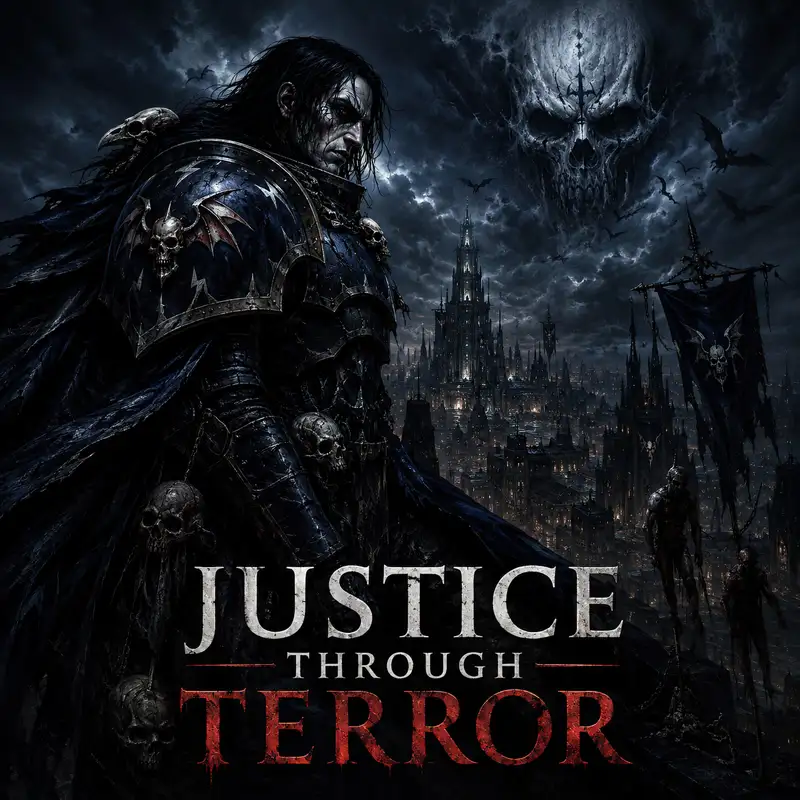
Konrad Curze and the Night Lords: Justice Through Terror
On Nostramo, crime did not end because courts became honest, police became brave, or rulers discovered a sudden affection for the public good. Crime ended because something worse than the criminals began moving through the dark. Gang masters vanished from locked rooms. Corrupt judges were found displayed where everyone could see the verdict. Entire districts learned that a scream in the night might be a warning intended for someone else. By the time the planet understood that a single being was responsible, the name Night Haunter had become more powerful than any law.
Konrad Curze would later point to Nostramo as proof that his methods worked. A violent world had become orderly. Murderers hid. Syndicates collapsed. Ordinary people could walk streets that had belonged to predators. The result was real enough. The problem was everything beneath it. Curze had not built justice. He had made disobedience terrifying. That distinction would define his life, corrupt his Legion, and leave the Night Lords unable to tell the difference between punishment and cruelty.
Nostramo was a sunless industrial world whose wealth came from its mines and whose society had been captured by criminal dynasties. Its cities rose beneath a black sky, lit by artificial glare and the furnaces of extraction. Violence was not an interruption to normal life. It was one of the institutions that governed it. The rich protected themselves through bribery and private force. The poor survived by joining gangs, serving them, or remaining unnoticed. Official authority existed, but it had long since become another department of organized crime.
Into this world fell one of the Emperor’s scattered sons. Curze had no adoptive family, no kindly teacher, and no tribe waiting to claim him. He emerged alone, grew with unnatural speed, and learned Nostramo by watching what its people did when they believed no one stronger was looking. He also suffered visions of the future. They came without mercy or useful explanation, showing betrayal, death, and disasters that had not yet occurred. For a child with no guidance, they were less a gift than a sentence delivered before the trial.
Curze concluded that fear was the only language Nostramo respected. He did not organize a rebellion or publish a code of laws. He hunted. His victims were criminals, exploiters, and officials whose authority rested on suffering. Their deaths were deliberately public and deliberately dreadful. Each punishment was also a message. Curze wanted one execution to prevent a hundred crimes, and on Nostramo the calculation appeared to succeed. The Night Haunter became an unseen government whose entire civil service consisted of himself.
There is an uncomfortable logic in this. If one act of terror forces a city to surrender, fewer people may die than in a conventional campaign. If the population believes punishment is certain, many crimes may never occur. Curze understood fear as a weapon that could produce obedience quickly and at comparatively low military cost. The trouble was that he treated obedience as proof of justice. A population doing nothing wrong because it is watched by a monster may be orderly. It is not necessarily free, loyal, or morally improved.
When the Emperor arrived, he found Nostramo quiet and its pale ruler already expecting him. Curze had foreseen enough of the meeting to understand that the golden figure from the stars was his father. The Emperor gave him the name Konrad Curze and command of the Eighth Legion. It was less a rescue than a joining of compatible instruments. Curze had built a planet-sized reign of fear. The Emperor had already created an army suited to carrying that method across the stars.
The early Eighth Legion had been recruited in part from the children of Terra’s vast prison underworlds, places where brutality was education and darkness was ordinary. Even before Curze took command, the Legion was used for punitive operations, suppression, and the destruction of enemies whose defiance needed to become an example. The Great Crusade had many ways to achieve compliance. Some Legions inspired admiration. Some broke fortresses. The Eighth made nearby systems reconsider their principles before the fleet arrived.
Under Curze, this role became a doctrine. The Night Lords attacked command structures, power networks, and symbols of security. They used darkness, sudden aerial assaults, distorted vox transmissions, and carefully staged atrocities to convince an enemy that resistance would bring suffering far beyond military defeat. Their midnight-blue armour carried lightning and trophies intended to be seen. They did not merely want to kill defenders. They wanted the survivors to imagine what would happen next, usually in more detail than was healthy.
At their most disciplined, the Night Lords could conquer through reputation. A rebellious government might surrender after receiving evidence of what had happened to another world. A garrison might abandon its positions when the Legion’s broadcasts began. From a cold strategic view, terror was a force multiplier. The Night Lords could paralyze forces larger than themselves because frightened soldiers make poor decisions, frightened leaders become isolated, and frightened populations often demand peace at almost any price.
Curze believed this made his Legion more honest than its brothers. Every Legion used overwhelming violence to expand the Imperium. The Night Lords simply removed the banners and noble language. They showed conquest as coercion and punishment as spectacle. There was truth in that accusation. The Great Crusade offered unity, but refusal was rarely treated as a permanent option. Curze’s mistake was to assume that exposing hypocrisy excused whatever he chose to do. It does not require a philosopher to notice that two wrongs can coexist. The Imperium nevertheless spent considerable resources testing the theory.
The Legion’s methods also had no dependable boundary. Curze’s judgment came from his own certainty, not from evidence tested by an independent authority. Punishment could fall on the guilty, the suspected, the associated, or simply those whose suffering would frighten others most effectively. Once pain becomes communication, an innocent victim may be considered useful precisely because the audience identifies with them. That is the point where deterrence stops wearing the mask of justice and becomes rule by hostage-taking.
The Night Lords increasingly embraced the performance of fear. Human remains became decoration. Cruelty became a measure of status. Officers competed not only in victory, but in the imagination with which they delivered it. Some warriors still understood terror as a means to force rapid compliance. Others enjoyed the means and became less concerned with the end. An army created to punish criminals began filling its ranks with men who would have prospered among the criminal dynasties of Nostramo.
This degeneration was not accidental. While Curze campaigned, Nostramo’s ruling families found ways to manipulate recruitment. Instead of sending only capable candidates, they emptied prisons and offered killers whose absence was politically convenient. The Legion received recruits shaped by the very culture Curze claimed to have defeated. He recognized what was happening, and his contempt for his sons deepened. Yet contempt is not reform. He punished failure, despised weakness, and expected fear to correct men who had been selected because fear and violence were already their native customs.
Jago Sevatarion, better known as Sevatar, became First Captain and one of the Legion’s most important figures. He was ruthless, intelligent, and capable of seeing the weakness in Curze’s argument. Curze claimed that terror was necessary because nothing else could work. The obvious question was whether he had seriously attempted anything else. Curze had no convincing answer. His certainty depended on treating his first solution as the only possible one, then using every later failure as evidence that he had been right from the beginning.
His visions made that habit more dangerous. Curze often saw terrible futures, but foresight in this universe is not a railway timetable. Visions may be symbolic, incomplete, altered by choice, or shaped by the expectations of the person receiving them. Some accounts suggest that Curze could perceive more than one possible outcome, yet repeatedly fixed upon the darkest. He then acted as though the result were inevitable. Each violent choice brought the feared future closer, which he accepted as confirmation rather than consequence.
This is why comparisons with Sanguinius matter. Both primarchs saw their own deaths. Sanguinius was burdened by prophecy, but continued to ask whether courage and loyalty might give meaning to a fate he could not escape. Curze used prophecy to remove meaning from choice. If the future was fixed, then he could not be responsible for becoming the creature he had foreseen. Fatalism became his final defence. It was also the prison he guarded most carefully.
Corvus Corax offered another painful contrast. The Raven Guard also fought from shadow, struck suddenly, and understood the power of fear. Corax had grown under oppression and used stealth to break tyrants. Curze had grown amid oppression and used terror to become an absolute ruler. Their similarities exposed the weakness of Curze’s claim that environment had made every choice for him. Corax was not gentle, and the Great Crusade was not a humanitarian enterprise, but his existence proved that darkness did not require the Night Haunter’s answer.
The collapse came into the open when Curze learned that Nostramo had returned to corruption. His peace had lasted only while the fear of his immediate presence remained strong. He had created no trusted institutions, no durable civic culture, and no lawful system capable of surviving him. At roughly the same period, his worsening visions and behaviour brought conflict with his brothers. After Fulgrim revealed that Curze had spoken of civil war, Rogal Dorn confronted him. Curze responded by savagely wounding Dorn and fleeing Imperial authority.
He returned to Nostramo not as a reformer facing the failure of his policies, but as a judge passing sentence on the entire world. The Night Lords’ fleet fired upon the weakness in the planet’s crust associated with Curze’s original arrival. Nostramo broke apart. Countless people died because crime had returned after the Night Haunter left. Curze called it punishment. It was also the destruction of the evidence. The world’s relapse demonstrated that terror had suppressed behaviour without changing the society beneath it, so Curze destroyed the society.
Nostramo’s death severed what remained of the Legion’s place within the Great Crusade. Curze was already under suspicion, his sons were increasingly uncontrollable, and the Emperor’s government could no longer pretend that the Eighth Legion’s excesses were merely an energetic interpretation of policy. Horus offered rebellion, and Curze joined him. He was not simply seduced by promises of power, nor did every Night Lord become a devoted worshipper of Chaos. For Curze, treason offered vindication. The Imperium he condemned would finally reveal its violence against itself.
At Isstvan Five, the Night Lords entered history as open traitors. They arrived among the second wave sent to support loyalist forces, then attacked those forces from behind. Curze confronted Corax and helped prevent the Raven Guard primarch from killing Lorgar. The moment was fitting. The brother who used darkness in the service of liberation faced the brother who used it to prove that liberation was a lie. The battlefield did not settle their argument, but it gave the Night Lords permission to abandon the last restraints they still recognized.
Curze later captured Vulkan, whose endurance and compassion offended his worldview almost as much as his inability to remain dead. Curze subjected him to elaborate torment, trying to break more than his body. Vulkan represented the possibility that immense strength did not require contempt for ordinary human life. If Vulkan could be made cruel, hopeless, or morally compromised, Curze could treat him as further proof that nobility was merely hypocrisy awaiting sufficient pressure. Vulkan suffered, escaped, and denied him that satisfaction.
During the Thramas Crusade, the Night Lords fought the Dark Angels across the eastern reaches of the Imperium. Curze’s Legion used raids, ambushes, and terror to spread disorder over a vast region. Lion El’Jonson answered with relentless pursuit and increasingly effective counterstrokes. The campaign lasted years and inflicted terrible damage, but the Night Lords were eventually broken as a coherent strategic force. Their methods could destabilize worlds. They were less suited to preserving unity when a disciplined enemy survived the first shock and forced them into sustained war.
Curze himself became more erratic. He fought the Lion, was terribly wounded, and later stalked the Dark Angels’ flagship, the Invincible Reason, turning its immense corridors into a hunting ground. He escaped into Macragge and brought terror to the heart of Guilliman’s ordered realm. There, his existence became an accusation directed at all three loyalist brothers present. Guilliman represented law, the Lion represented ruthless necessity, and Sanguinius represented hope in spite of foreknowledge. Curze insisted that beneath their differences, they were killers serving a greater killer.
The accusation could not be dismissed entirely. The Emperor had created Curze, given him a Legion already suited to punitive terror, and used him during the Great Crusade. Imperial leaders objected most strongly when his violence became inconvenient or politically uncontrollable. Curze was a monster, but not an alien intrusion into the Imperial project. He was one of its authorized tools. The uncomfortable question was never whether he had been useful. It was why usefulness had been mistaken for moral legitimacy until the weapon turned around.
Yet Curze’s insight into Imperial hypocrisy did not absolve him. He understood that the system was violent, then chose to become its purest expression. He recognized that fear could compel obedience, then refused to build anything that might replace fear. He claimed he had no choice, while repeatedly arranging events to match his visions. When his brothers offered judgment, imprisonment, or even the possibility of redemption, he treated every alternative as another threat to the story he needed to believe.
After the Heresy, the Night Lords did not remain a united Legion for long. Their captains had learned to rule through intimidation, personal reputation, and private violence. These are excellent habits for creating rivals and poor ones for creating a stable chain of command. Warbands separated under competing leaders. Some embraced Chaos worship, while others regarded the gods with suspicion or contempt. Many became raiders and predators who used the old Legion doctrine without Curze’s claim that it served justice. The mask had finally fallen away, and quite a few seemed relieved.
Curze withdrew to Tsagualsa, where his visions told him an Imperial assassin would come. He ordered his sons not to stop her. The Callidus assassin M’Shen entered his fortress and reached him. Curze did not resist. His death was not merely surrender and not quite repentance. It was the final scene in an argument he had staged for decades. The Emperor would send a killer to punish him, just as Curze had killed to punish others. In his mind, that symmetry proved he had always understood justice correctly.
His famous final declaration was, “Death is nothing compared to vindication.” It is a powerful line because it contains both his intelligence and his delusion. The Emperor’s decision to have him killed did expose the Imperium’s reliance on assassination and force. It did not prove that Curze’s victims had deserved their fate, that collective punishment was just, or that no better path had existed. Being executed for murder does not retroactively make every murder lawful. Curze died believing the verdict against him was evidence for the defence.
Even his carefully arranged ending escaped his control. Night Lords pursued M’Shen despite his orders, driven by loyalty, anger, or hunger for the relics she carried. The Legion did not receive one final moral lesson. It received another story about fear, vengeance, and possession. Curze had spent his life insisting that examples shape behaviour. His own death became an example he could no longer interpret, claimed by sons who had learned the spectacle but not the supposed purpose.
Ten thousand years later, the Night Lords remain among the most feared of the Traitor Legions. Their warbands attack from darkness, isolate communications, exploit panic, and make civilian suffering part of military planning. They are not uniform. Some serve Chaos deeply, some bargain with it, and some still imagine themselves above worship. What unites them is the inheritance of terror as identity. They do not merely use fear because it works. They need enemies to be afraid because fear is the last surviving proof that the Night Lords matter.
Konrad Curze did bring order to Nostramo, and the Night Lords sometimes ended wars before conventional armies could begin them. Terror can do that. It can empty streets, silence dissent, break formations, and persuade a government that surrender is preferable to the next transmission. What it cannot do by itself is establish justice, because justice requires limits upon the punisher as well as the punished. It requires something more durable than the certainty that a stronger creature is watching.
Curze could see futures, yet he spent his life narrowing them. He transformed warning into destiny, punishment into theatre, and fear into a substitute for law. His sons inherited the method after losing even the excuse. The tragedy of the Night Lords is not that terror never worked. It worked often enough to persuade a primarch that nothing else was necessary. Nostramo became quiet beneath the Night Haunter, then died by his hand, and in that silence lies the final judgment on justice through terror.