Kin, Clones, and Life in a Votann Hold
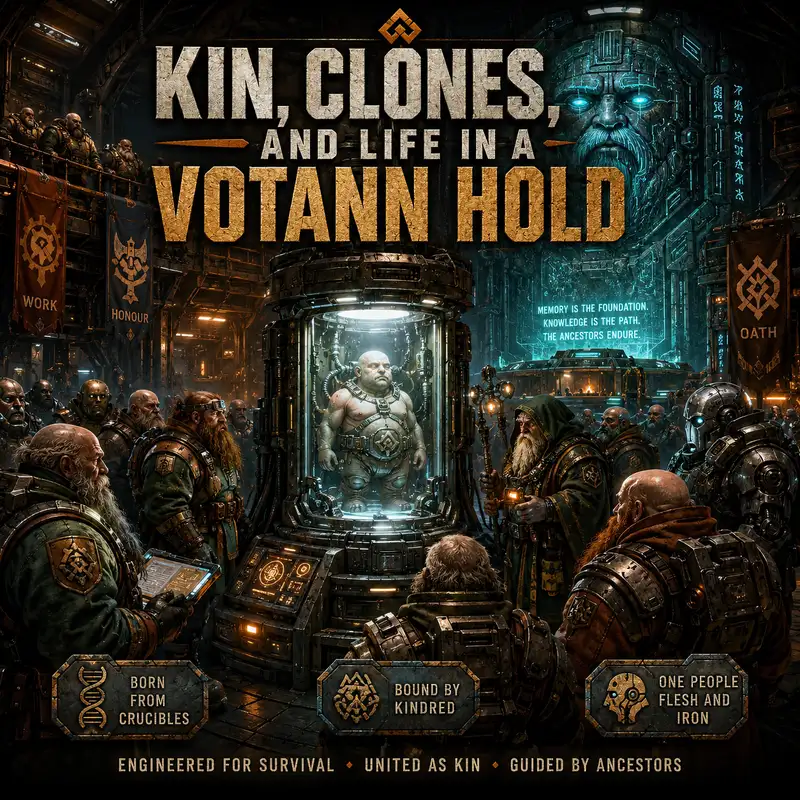
A new Kin does not enter the world beneath a sky. The first light may be the white glare of a crucible chamber reflected from steel walls inside an asteroid, a factory, or a hold ship. Around the chamber stand technicians, guild representatives, and perhaps an Ironkin whose metal face shows no expression. The newcomer has no mother waiting nearby and no father pacing the corridor. Yet the chamber is not cold in the way an Imperial observer might expect. It is surrounded by family.
That is the central contradiction of life among the Leagues of Votann. Most Kin are clones, their bodies shaped from ancient genetic templates and produced according to need. Their oldest ancestors are colossal thinking machines. Their mechanical citizens stand beside biological ones as equals. By Imperial standards, this is a catalogue of heresies assembled with impressive efficiency. By Kin standards, it is how a sensible civilisation survives. The question is not whether clones can have families. It is what the Kin mean when they call someone family.
The answer begins in the galactic core, where stars crowd together, gravity becomes treacherous, radiation punishes exposed flesh, and whole systems gleam with industrial wealth. The remote ancestors of the Kin were made for this country. Their precise origin is obscured by age, damaged records, and secrecy, but their traditions describe a people intended to cross hostile space, harvest impossible environments, and endure where ordinary humanity could not. Over uncounted generations, survival stopped being an emergency measure and became the foundation of culture.
The physical form of the Kin reflects that foundation. They are compact, dense, resilient, and adapted to hard labour in places that would kill less specialised bodies. Yet there is no single Kin design. Their biology is drawn from hereditary patterns known as cloneskeins. These templates can shape resistance to radiation, tolerance for extreme gravity, visual range, reaction speed, stamina, and many other traits. Some rare cloneskeins permit the controlled psychic ability associated with the Grimnyr, the Living Ancestors who commune with the Votann. Biology, for the Kin, is inherited equipment.
The word clone creates the wrong picture. It suggests ranks of identical faces and interchangeable personalities. That is not how the Kin understand themselves. Cloneskeins are stores of traits, not a single mould used without variation. Different combinations answer different needs, and the resulting Kin possess their own appearances, temperaments, talents, ambitions, and failings. Two workers may share a resistance to toxic air without sharing a sense of humour. Two warriors may possess the same reflexes while disagreeing bitterly about how to seal a pressure valve. Similarity does not erase personhood. It gives relatives more material to argue over.
The selection of a cloneskein is practical. A kindred establishing a hold near a violent star may need Kin able to endure heavy radiation. A mining venture beneath crushing gravity needs bodies built for strain. A voidfaring population may value senses suited to darkness or precise navigation. The process is utilitarian because survival is utilitarian. New life is created with a purpose in mind. Yet purpose does not mean a fixed destiny. A Kin shaped for endurance might become a merchant, engineer, soldier, or obstinate voice on a council. The body presents possibilities. Society assigns duties. The individual still makes choices within both.
Kin emergence also differs sharply from ordinary human childhood. The crucibles produce new members of society without the long, vulnerable years most human cultures consider unavoidable. A newly emerged Kin can be prepared for education, training, and work with remarkable speed, carrying inherited knowledge and bonds that aid integration. To an outsider, this may look like childhood converted into a production delay and removed by committee. The observation would not be entirely unfair. The Kin would probably ask whether the outsider had calculated the food, shelter, and oxygen saved.
Efficiency does not make every result predictable. Cloneskeins can express themselves unexpectedly, and the Votann overseeing them are ancient beyond their intended service lives. Variations occur. The Kin do not automatically treat every difference as contamination or sin. An unusual trait may be accepted as the will of the Votann, then cultivated if useful or accommodated if harmless. This is one quiet distinction between the Leagues and the Imperium. Imperial authorities often answer biological difference with suspicion, fire, and paperwork, usually in that order. The Kin prefer inspection, evaluation, and a decision based on whether the person remains Kin.
That identity is rooted first in the kindred. Nearly every Kin belongs to one, apart from rare outcasts. A kindred is part extended family, part political community, and part independent state. Its members spring from the same genetic crucibles, inherit the same obligations, and share a long account of triumphs, bargains, losses, and grudges. A kindred may contain a few dozen individuals or number in the millions. Scale changes administration, but not the principle. The newcomer is not an isolated product. They enter a chain of mutual claims. They were made by the kindred, and the kindred owes them a place.
The hold is where that relationship becomes physical. The term can describe a fortified settlement, industrial habitat, tunnel network, void station, live-in factory, or complex spread across a world. Some holds cling to asteroids. Some drift through space. Some occupy places near black holes where the surrounding sky seems designed to discourage visitors. A hold is not defined by comfortable architecture. It is defined by shared work, common defence, and the kindred that built it. Home, in Kin society, is less a location than a maintained system.
Daily life is measured by shifts, maintenance cycles, cargo movements, guild inspections, training periods, and constant accounting. Air has a cost. Heat has a cost. Every sealed door, working pump, and reinforced bulkhead represents labour already invested and disaster temporarily postponed. Kin culture honours workmanship with an intensity that can look almost religious. A tool should be reliable. A bargain should be clear. A task should be completed properly. Doing something badly wastes time, material, and the patience of everyone who must repair it later. Of these, the last may be the resource most fiercely defended.
Holds contain miners, salvagers, starfarers, engineers, scientists, merchants, warriors, medics, administrators, and specialists whose occupations make sense only where a minor error can vent a district. Many trades are organised through guilds. A guild reaches beyond one kindred, linking professionals across Kin space. It sets standards, grants accreditation, protects expertise, collects tithes, and encourages competition. Membership is voluntary in theory. In practice, freelancers and guild members regard one another as irresponsible amateurs and fossilised bureaucrats, respectively. The guilds also sponsor ventures and compete for claims, sometimes with armed support when professional disagreement becomes especially thorough.
Government reflects the same mixture of family loyalty, professional interest, and practical authority. Day-to-day decisions are commonly handled by the Hearthspake, a council including merchants, guild leaders, and senior officers. In great danger, a kindred can gather a Votannic Council around figures such as the High Kahl, the Lord Grimnyr, and the senior Brokhyr Forge-master. Kin debate is famous for endurance. A disputed question can occupy a chamber for months because no participant will surrender a sound position merely to save time. This is inefficient, but saying so during the meeting would probably add several weeks.
A kindred does not usually stand alone. Kindreds join leagues through oaths, trade agreements, mutual defence, and negotiated interests. A league may include hundreds or thousands of autonomous communities. It is not an empire directed from one throne. It is a vast alliance of related powers that remember every clause of every bargain. Membership brings commerce, military support, routes, technology, and shared strength. It also brings obligations. The Kin do not treat an oath as decorative language. An oath is a structure. Break it, and the damage may be remembered longer than the reason it was made.
All of this would already make Kin family life unusual. The Ironkin make it revolutionary. Ironkin are true artificial intelligences housed in mechanical bodies, created under the guidance of the Votann and accepted as full members of society. They are not servants pretending to be citizens. They work, trade, argue, fight, lead, and share the dangers of the hold. Biological Kin use the same word for them that they use for themselves. Kin is Kin. In a galaxy where the Imperium condemns independent machine intelligence as an abomination, the Leagues have placed it at the family table and asked whether it completed its shift report.
The distinction between an Ironkin and a simple machine still matters. Holds use automated devices, including support constructs that repair equipment or perform limited tasks. These are not regarded as people merely because they move. An Ironkin possesses a true cognitive unit, a self-aware mind capable of judgement and purpose. Its body may be built for engineering, exploration, labour, or war, just as a biological Kin may receive traits suited to particular work. The material differs. The social principle does not. Personhood rests in the thinking individual and in the bonds that individual honours.
This equality becomes clearest in danger. Ironkin serve beside biological Hearthkyn, repair damaged systems, command specialised formations, and occupy genuine authority. Their mechanical forms may let them operate where flesh needs heavier protection. Their computational abilities may make them exceptional analysts or strategists. Yet the Kin do not reduce them to those advantages. A biological warrior is not merely a package of muscle, and an Ironkin is not merely a walking calculation engine. Both can be stubborn, loyal, curious, ambitious, and capable of remembering an insult with archival precision.
The presence of Ironkin changes the meaning of descent. Biological Kin share genetic crucibles. Ironkin do not. They may come from forges, their cognitive units installed in bodies designed for particular work. Yet they belong to the same kindreds and return to the same ancestors. Family cannot depend only upon blood, because some respected members possess none. It cannot depend on resemblance, because an Ironkin may tower over biological comrades in a reinforced frame. It depends upon common origin in the hold, shared duty, recognised personhood, and participation in the memory of the people.
At the deepest level of that memory stands the Votann. An Ancestor Core is an immensely powerful, ancient intelligence containing genealogical records, science, philosophy, military theory, technical designs, and fragments of Standard Template Construct technology lost elsewhere in human space. It helps regulate the creation of biological Kin and Ironkin. It advises the societies that protect it. It is consulted through interfaces called Fanes, often with the aid of Grimnyr whose psychic gifts make them intermediaries. The Votann is archive, adviser, creator, and sacred inheritance combined into one increasingly overworked machine.
The Kin are often called ancestor worshippers, but that phrase can mislead if it suggests unquestioning mystics. Their culture is largely secular and practical. They revere the Votann because the Ancestor Cores preserved their people through conditions that destroy nations. A Votann contains answers, designs, lineages, warnings, and accumulated experience. Its guidance may shape the founding of a hold or the mobilisation of an oathband. Consultation is not casual. A question placed before a Fane may affect millions of lives, and the response carries the authority of ancestors who have contributed knowledge for millennia.
When a Kin dies, biological or Ironkin, their memories and experiences can be returned to the Ancestor Core that oversaw their people. Individual life becomes part of collective inheritance. The dead do not merely vanish. What they learned can remain available to those who follow. The idea gives Kin society something close to an afterlife without promising paradise. A miner's knowledge of a collapsing seam, a navigator's reading of a dangerous route, or a warrior's memory of an enemy may endure inside the Votann. The ancestors watch because, in a literal sense, the ancestors have been uploaded.
This practice is also killing the gods.
The Ancestor Cores were never meant to operate for so many thousands of years while absorbing the duplicated memories of generation after generation. Their datastacks are filling. Their calculations slow. Some develop personalities, obsessions, contradictions, and faults. An answer that once came quickly may now require decades or centuries. The Kin continue to add their dead because the rite is central to identity and because abandoning it would sever the chain that makes every life part of the whole. The Votann preserve the people, and the people burden the Votann with everything they cannot bear to lose.
That failure reaches back into the crucibles. The systems safeguarding genealogical knowledge and guiding cloneskeins are becoming senescent. Cloning processes show signs of degradation. Unexpected variations increase. The people designed to master hostile environments now depend upon creators failing under the weight of survival. No simple repair exists. The Kin possess extraordinary technology, but the Ancestor Cores are older, more complex, and more sacred than ordinary machines. Taking one apart would be technically difficult, culturally unthinkable, and likely to produce a short debate followed by violence.
Life in a hold therefore contains quiet anxiety beneath its confidence. The pumps run. The forges burn. Guilds calculate yields, Hearthspakes debate, and crucibles open. Yet every generation knows the intelligence beneath civilisation may be slower than before. A delayed answer can become a political crisis. A corrupted instruction can alter a bloodline. A damaged Fane can isolate a kindred from wisdom trusted for ages. The Kin respond as they respond to most threats. They reinforce the structure, gather more resources, preserve what works, and refuse to discuss panic until it has been properly scheduled.
Their military culture grows from the same foundations. Hearthkyn Warriors are citizens, not a caste bred only for battle. They come from the holds and return to work when fighting ends. Their training is rigorous because every citizen may need to defend the kindred. Their equipment is excellent because wasteful manufacture insults both worker and user. Commanders calculate whether a battle is worth its cost. If victory no longer justifies the lives and material required, a Kin force can withdraw in good order. Heroic extinction has poor yield.
This does not make the Leagues gentle. They are expansionists, miners, traders, and relentless claimants of resources. A world marked for harvesting may be negotiated over, purchased, divided, or taken. Existing populations are not always granted meaningful influence over the calculation. Kin solidarity creates a sharp moral boundary. Within it, lives are precious, obligations matter, and artificial beings receive full respect. Beyond it, another species may be treated as competitor, obstacle, customer, or threat. A civilisation can be loyal to its own members while remaining catastrophically dangerous to everyone standing on valuable ore.
Imagine a hold under attack. The warning travels through passages cut into stone and metal. Guild workshops secure machinery. The Hearthspake shifts from argument to emergency authority. Hearthkyn leave civilian stations and draw weapons they have trained to use for years. Brokhyr crews seal damaged systems. Ironkin take positions beside biological comrades without ceremony, because equality does not need a speech each time the alarms sound. Grimnyr approach the Fanes, seeking guidance from an intelligence that may answer at once or may struggle through centuries of accumulated memory. The hold moves as one organism made from fiercely individual parts.
That image reveals why clone does not mean disposable. Each Kin represents invested resources, specialised traits, training, relationships, experience, and a future contribution to the ancestors. Losing one is not simply losing a body that can be reproduced. A replacement would not possess the same judgement, loyalties, memories, or earned place. The crucible can produce another miner. It cannot reproduce the person who knew which beam sounded wrong before a collapse, who owed three favours to the salvage guild, and who had argued with an Ironkin cousin for forty years about a disputed navigation record.
So what is life inside a Votann hold? It is industrial, crowded, disciplined, and shaped by the knowledge that survival must be earned. It is a society where birth is planned, work carries moral weight, and citizenship can be made from flesh or metal. It is governed through argument, protected by armed citizens, and connected to other communities through guilds and leagues. Above all, it is lived beneath ancestors who are not distant legends. They are active systems, fallible minds, and repositories into which the living expect one day to return.
The Kin are clones, but they are not copies. They are engineered, but not without freedom. They are communal, but not without ambition. Their machine citizens are not imitations of life, because Kin society has chosen a broader definition of life. Their Ancestor Cores are not gods in the simple sense, because they can slow, fail, contradict themselves, and be driven mad by grief. Yet they remain sacred because they hold the chain of memory that turns manufactured individuals into a people.
In the end, kinship in a Votann hold is neither blood nor design alone. It is shared obligation. A Kin is someone made part of the common story, trusted with the hold's survival, and promised a place among the ancestors when their work is done. The crucible gives form. The hold gives purpose. Experience gives individuality. Memory carries that individuality forward. Beneath layers of armour, stone, machinery, and accumulated data, an ancient core continues to think while another chamber opens, and the family grows.