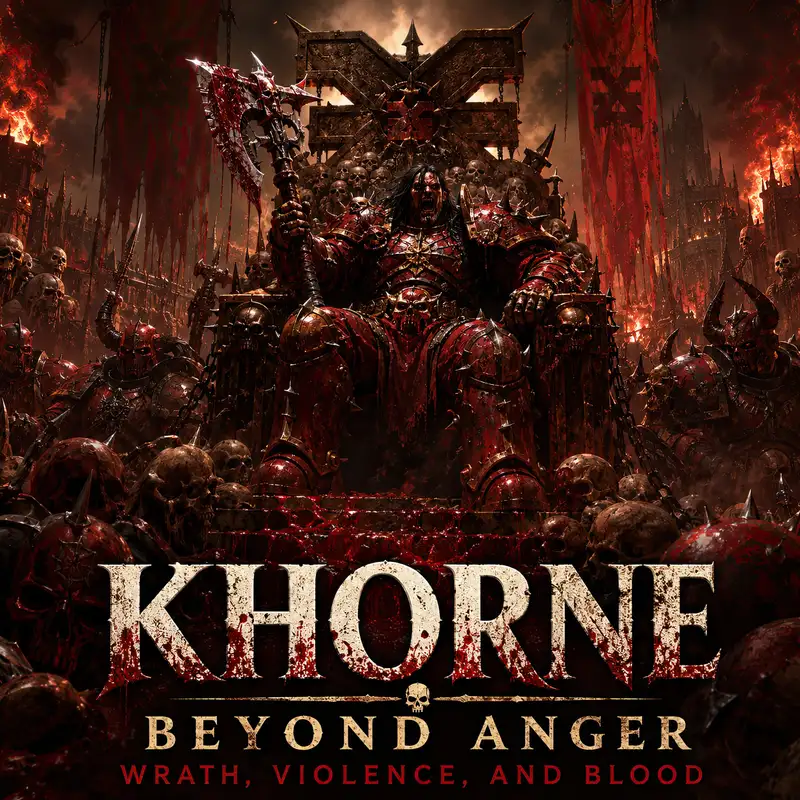
Khorne Beyond Anger: Wrath, Violence, and Blood
The first blow is struck in self-defence. The second is punishment. The third is proof that the killer can still command something in a universe that commands almost everyone. By the tenth, the original grievance has become difficult to remember. The blood remains. Somewhere beyond material reality, something has been listening from the first. It does not ask whether the victim was guilty, whether the cause was just, or whether the hand holding the weapon once trembled. It asks only whether another blow will follow.
Khorne is commonly reduced to anger with an axe. That description is not entirely wrong, which is what makes it dangerous. Khorne is the Chaos God of wrath, hatred, bloodshed, martial fury, and murder, but he is larger than any single emotion. Anger is a feeling. It can pass. It can be resisted, redirected, regretted, or forgiven. Khorne is what happens when anger is given permanence, ritual, identity, and a reason to continue after the original cause has vanished.
Like the other great powers of Chaos, Khorne exists within the Warp, the realm shaped by thought, emotion, memory, and psychic pressure. He is not simply a large creature sitting somewhere behind the stars, although the inhabitants of the Warp often appear in forms that make such descriptions useful. Khorne is both a god and a concentration of impulses. Every hatred sustained, every feud inherited, every act of violence celebrated, and every life taken in fury adds to the pattern from which he is made.
This is why calling Khorne the god of anger explains too little. A frightened conscript can be angry. A grieving parent can be angry. A prisoner can be angry at a jailer, and that anger may be the last intact part of the prisoner’s humanity. Khorne does not create every grievance, and he does not need to. He takes the moment when anger demands action and whispers that only violence is honest. Then he encourages the victim to keep striking until the distinction between justice and appetite has disappeared.
Wrath has always carried the suggestion of judgment. It is not merely fury, but fury directed against something declared deserving. That makes wrath especially useful to Khorne. Few people begin by believing that slaughter itself is sacred. They begin by believing that someone must pay. The enemy betrayed them. The officer abandoned them. The governor starved them. The alien killed their family. The rival clan dishonoured their ancestors. The first act of violence therefore feels like correction. Khorne’s corruption lies in turning correction into a way of life.
The Blood God does not require his followers to begin as monsters. He requires them to accept one simple measure of truth. Strength proves worth. Victory proves righteousness. The dead have lost the argument. In a galaxy where law is often arbitrary, institutions are cruel, and mercy can be fatal, that promise has considerable appeal. It removes uncertainty. There is no petition to file, no priest to persuade, no tribunal to survive. There is only the weapon, the target, and the result. Imperial bureaucracy rarely offers such prompt service.
Blood is central to Khorne because blood is the undeniable evidence that violence has occurred. It is life made visible at the moment it is being lost. A skull serves a similar purpose. It is a trophy that cannot flatter its collector, dispute the account, or request a recount. The Skull Throne is therefore more than decoration. It represents Khorne’s entire moral economy. Every skull is a claim that force has settled a question, even when no question remained to be settled.
The visions associated with Khorne’s realm follow the same logic. There is the Brass Citadel, the throne, mountains of skulls, rivers and seas of blood, furnaces, weapons, and endless armies. These images are not merely scenery. They are violence turned into geography. Khorne’s daemons embody different aspects of the same principle. Bloodletters are murder given rank and file. Flesh Hounds are pursuit without mercy. Bloodthirsters are warlords formed from battle frenzy, towering expressions of the desire to meet strength with greater strength.
Yet Khorne’s servants are not all mindless berserkers. Some are, and they tend to be memorable because they arrive at high speed while carrying chainaxes. Others remain capable commanders, armourers, priests, pilots, and strategists. Khornate hosts can use ambushes, fortifications, artillery, armoured vehicles, voidships, and carefully prepared assaults. Khorne does not object to planning. He objects to plans that replace the act of domination with endless hesitation, deception, or sorcerous manipulation. A good plan that produces a mountain of corpses is still a good plan.
The Blood Pact of the Sabbat Worlds demonstrate this particularly well. They are devoted to Khorne, but they are not simply a screaming mob. They field disciplined formations, trained officers, specialist troops, armour, and effective military intelligence. Their devotion does not prevent organisation. It gives organisation a bloody purpose. They show that Khorne is not merely the god of losing control. He is also the god of controlling violence so efficiently that it can be delivered on command.
This distinction matters because rage can be tactical. A commander may hold assault troops in reserve until the enemy line is weakened. A champion may refuse a challenge because the wider battle matters more. A warband may retreat, resupply, and return with heavier weapons. None of these actions is automatically un-Khornate. The objective is not to behave stupidly. The objective is to create conflict, prove strength, and offer blood. Khorne has room for discipline, provided discipline remains the servant of slaughter rather than its restraint.
The question of honour is more complicated. Some followers of Khorne believe in codes of combat. They seek worthy opponents, value courage, despise cowardice, and prefer to kill face to face. This can resemble honour from a distance, particularly when compared with poison, sorcery, or betrayal. Yet Khorne’s favour does not depend upon moral virtue. The weak are not protected because attacking them would be dishonourable. They are often killed because their weakness makes resistance brief. A warrior’s code may shape how blood is taken, but it does not make the taking merciful.
That is why the familiar claim that Khorne represents honour should be treated carefully. He can reward martial pride, direct confrontation, endurance, and courage. He can inspire contempt for trickery and admiration for a powerful foe. None of this means he respects innocence, surrender, restraint, or proportionality. Khorne’s version of honour begins and ends with the legitimacy of violence. It is a code for killers, not a defence of those who cannot fight.
His hatred of sorcery follows the same pattern. Khorne does not reject the Warp. He is a god of the Warp, his daemons are formed from it, and his blessings transform flesh in ways no surgeon could honestly describe as routine. What he rejects is the sorcerer’s claim that knowledge, incantation, and manipulation can triumph over raw strength. To Khorne, psychic power often appears as violence performed at a safe distance by someone who believes cleverness should outrank courage. The Blood God prefers a more personal form of disagreement.
Even here, the principle is not perfectly tidy. Khornate armies use rituals. They summon daemons. They carry icons that focus warp power. They bind daemonic entities into engines and wield weapons saturated with supernatural force. The distinction is ideological rather than scientific. A spell is condemned as cowardly artifice. A prayer that causes the sky to bleed is apparently acceptable, because Chaos has never been burdened by a demanding standards committee.
No mortal story reveals Khorne’s nature more clearly than that of Angron and the World Eaters. Angron’s rage did not begin with worship. It began with enslavement, mutilation, and betrayal. On Nuceria, the Butcher’s Nails were driven into his brain, forcing pain upon him and rewarding aggression with brief relief. He was made into a weapon before he ever served the Emperor, and he was denied even the death beside his fellow gladiators that he had chosen for himself.
The Emperor recovered Angron but did not heal the wound at the centre of him. Angron was placed in command of a Legion that wanted a father and received a man who saw in them another army of masters. Many of the World Eaters accepted versions of the Butcher’s Nails in an effort to understand him, imitate him, or earn his approval. The result was not brotherhood. It was shared torment, institutionalised. Their pain became doctrine, and doctrine became a military culture built around the temporary silence produced by violence.
Khorne did not need to invent this tragedy. He only needed it to continue. During the Horus Heresy, the World Eaters’ brutality deepened into devotion, whether every warrior understood that devotion or not. Angron’s transformation into a Daemon Primarch did not cure him, liberate him, or grant meaning to his suffering. It made the suffering eternal and gave it cosmic reach. He became an immortal engine of the same violence that had always been imposed upon him.
That is one of Khorne’s cruelest promises. He offers the victim the power to become impossible to victimize again, but the price is becoming an instrument of victimisation. Angron can no longer be dragged into an arena by mortal masters. He carries the arena with him. Wherever he goes, everyone is forced inside it. His freedom consists of ensuring that no one else is free.
The World Eaters show how Khorne turns pain into inheritance. The Butcher’s Nails explain much of their fury, but they do not excuse every choice or account for every form of Khornate worship. Across the galaxy, people without the Nails still fall to the Blood God. Some are soldiers who discover that battle is the only place they feel alive. Some are slaves who overthrow their masters and then need new enemies. Some are champions who fear that peace will make them irrelevant. Khorne can use agony, but he can also use pride.
Kharn the Betrayer embodies another stage of this descent. Once a captain capable of loyalty, leadership, and even attempts to restrain Angron, he becomes a champion for whom friend and foe are increasingly secondary categories. What matters is whether someone stands within reach and whether their death adds to the tally. His title is not an unfortunate misunderstanding. It is the natural destination of a faith in which allegiance matters less than the next act of violence.
The source of the blood does not matter to Khorne. This is not merely a slogan about indiscriminate savagery. It is the central fact that separates the god’s interests from those of his worshippers. A warlord wants victory. A cult wants territory. A soldier wants survival. Khorne wants the struggle to continue. If his own followers die in the assault, their blood still serves him. If rival champions butcher one another over who deserves his favour, the dispute has already pleased the judge.
This makes Khorne uniquely difficult to oppose through violence, because violence is often the only available means of opposing him. An Imperial regiment defending civilians from a Khornate invasion may have no choice but to fire. A Space Marine may need to meet a berserker in close combat. A world may survive only because its defenders kill faster than the attackers. Their cause matters enormously to the people they save, but the emotional and psychic violence can still strengthen the pattern Khorne represents.
That does not mean resistance is pointless or that every defender becomes a secret worshipper. Intent, discipline, identity, and choice still matter. The danger lies in what follows. Does the soldier stop when the threat ends? Does the commander distinguish necessity from pleasure? Does victory bring relief, or disappointment that there is no one left to kill? Khorne enters through the moment when violence ceases to be a terrible means and becomes the only condition in which the self feels complete.
The Imperium is especially vulnerable because it has made violence sacred in its own language. It praises martyrs, venerates weapons, burns heretics, and wages wars of extermination while insisting that every act is necessary for human survival. Sometimes that claim is true. The galaxy contains enemies that cannot be reasoned with and threats that will consume entire worlds. Yet necessity repeated for ten thousand years can become habit, and habit wrapped in prayer can become an altar without anyone admitting which god is being fed.
A commissar executing a panicked soldier does not become a servant of Khorne merely by pulling the trigger. A planetary governor ordering mass reprisals may still believe entirely in Imperial authority. A crusade can march beneath the Aquila while leaving behind enough rage, grief, and slaughter to nourish the Blood God. Chaos does not always require formal conversion. Sometimes it benefits from institutions that are certain corruption only happens to other people.
Khorne’s power therefore grows not only from berserkers chanting his name, but from the structure of the age itself. The forty-first millennium is a civilisation-wide engine for producing trauma. Populations are conscripted, displaced, punished, invaded, and sacrificed. Children inherit wars older than their bloodlines. Soldiers are taught that hatred is vigilance and mercy is treason. Under such conditions, Khorne’s message does not sound like madness to everyone. To some, it sounds like an honest description of how the galaxy already works.
His rivalry with the other Chaos Gods reveals the limits of that honesty. Tzeentch values schemes, transformation, and the power of knowledge. Slaanesh turns sensation, obsession, and perfection into endless appetite. Nurgle offers endurance through surrender to decay. Khorne despises their methods, yet he shares their central hunger. Each god takes something real within mortal experience and expands it until it consumes every competing value. Khorne’s simplicity is therefore deceptive. A single command can imprison a soul as effectively as the most elaborate plot.
Slaanesh is often treated as Khorne’s opposite because one exalts excess and sensation while the other exalts martial fury and destruction. Yet Khorne’s followers are not free from excess. Their excess is repetition. One enemy is never enough. One victory proves nothing for long. One skull only creates the need for another. The apparent austerity of Khorne conceals an appetite as bottomless as any other. He strips away luxury, subtlety, and pleasure, then leaves the worshipper addicted to the purest sensation of all: power over life and death.
The gifts of Khorne make the trap harder to escape. His favour can bring strength, speed, endurance, resistance to psychic attack, and transformations that turn a mortal killer into something far more dangerous. Success appears to confirm the creed. The champion grows powerful because violence works, then concludes that violence is true because it produced power. Every reward narrows the range of choices until even hesitation feels like weakness and thought feels like betrayal.
Failure serves him almost as well. A defeated follower may blame insufficient fury and seek greater sacrifice. A victorious follower must defend the title against challengers. A warlord who conquers a world must find another world, because peace offers no tribute. Khorne’s path has no retirement plan. The nearest thing to promotion is becoming powerful enough to attract increasingly lethal opposition.
His daemons make this cycle visible. They are not a separate species with ordinary lives elsewhere. They are fragments and expressions of the god’s nature, shaped into forms that can enter battle. When bloodshed and rage tear reality thin, the daemons arrive because the battlefield has begun to resemble the realm from which they came. Their presence then intensifies the slaughter, which weakens reality further. Violence does not merely summon them. It prepares the world to think like them.
The sacred number eight, the brass icons, the chains, the axes, and the piles of skulls provide Khorne’s followers with ritual order. This may seem strange for a god associated with frenzy, but ritual turns impulse into culture. It allows warbands to recognise one another, measure achievement, establish rank, and transform murder into worship. A killer may act alone. A religion of killing needs symbols, witnesses, and an account of who deserves the next skull.
That account is always broadening. At first, the enemy deserves death. Then cowards deserve death. Then the weak. Then rivals. Then allies who failed to show sufficient zeal. Finally, the distinction between deserving and available becomes unnecessary. The follower has moved beyond anger because anger still needs an object. Khorne requires only motion, impact, and blood.
This is the meaning of Khorne beyond anger. He is not simply the sudden red moment when restraint fails. He is the system built afterward to make failure permanent. He is wrath declared righteous, violence declared truthful, blood declared payment, and the skull declared proof. He can wear the face of vengeance, honour, duty, liberation, survival, or military necessity, because any of them can be stripped of proportion and turned toward endless conflict.
The final horror is that Khorne does not need everyone to love war. He needs enough people to believe that one more act of violence will finally settle the matter. The soldier strikes to survive, then to avenge, then to prove strength, then because stopping would require remembering why the killing began. By that point, the Blood God has taken everything he was offered. He never needed the soldier’s loyalty. He needed only the next blow.