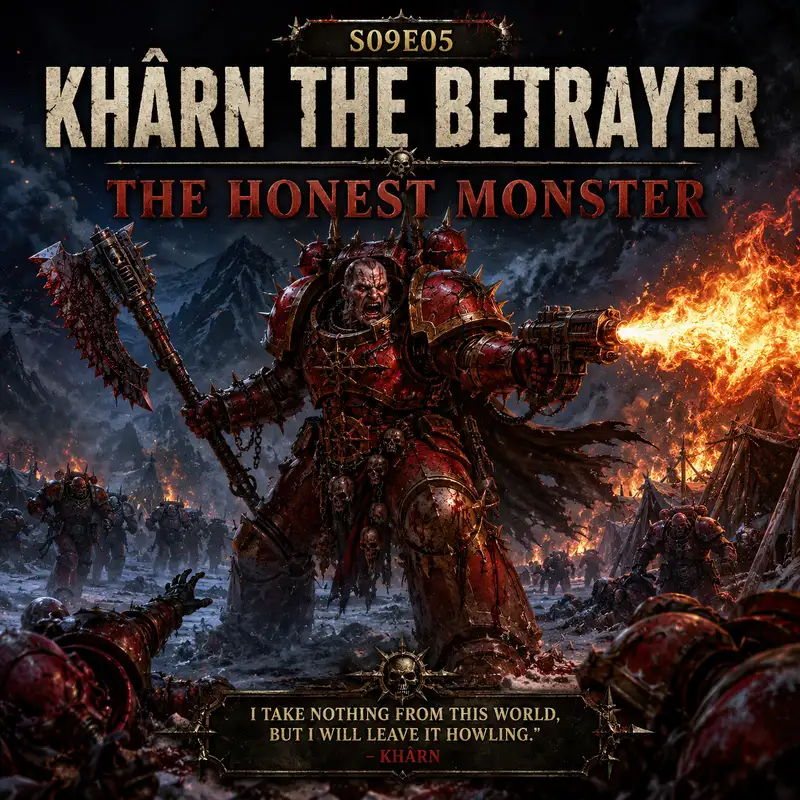
Khârn the Betrayer: The Honest Monster
The night on Skalathrax was cold enough to kill a Space Marine, and Khârn answered the weather by setting fire to the shelters. The warriors inside were his own brothers. They had fought beside him through the Great Crusade, the Horus Heresy, and the long retreat from Terra. Now they were trying to survive until dawn. Khârn broke open their refuge, drove them into the freezing dark, and killed anyone who objected. It was not an accident. It was not friendly fire. It was a decision, made with a flamer in one hand and a chainaxe waiting in the other.
That decision earned him the name Betrayer, but the name can be misleading. Khârn did not betray the World Eaters because he secretly served another master or because he hoped to seize their fleet. He betrayed them by taking their own creed more seriously than they did. The Legion had spent years declaring that strength, fury, and bloodshed mattered more than restraint, mercy, or even survival. At Skalathrax, Khârn removed the final exception. Brotherhood would no longer protect anyone. Loyalty would no longer interrupt the killing. The World Eaters had built a religion of violence, and Khârn became its most honest priest.
Calling him honest is not praise. Honesty can describe a confession as easily as a virtue. Khârn is honest because he rarely hides his purpose behind a noble future. He does not promise to save humanity, perfect the species, restore an empire, or unlock forbidden wisdom. He kills because killing has become the only act that still feels true. That clarity makes him easier to understand than many servants of Chaos. It also makes him more frightening. There is no grand plan to debate, no wounded ideal to rescue, and no convenient lie that can be peeled away to reveal a better man underneath.
The man underneath once existed. Khârn was born on Terra and inducted into the War Hounds, the Legion that would later become the World Eaters. He rose to command the Eighth Assault Company, not through frothing madness, but through discipline, courage, and ability. The early War Hounds were already brutal troops, trained to close with an enemy and break resistance at intimate range. Yet they were still a Legion. They possessed command structures, traditions, and bonds of trust. Their violence was a military instrument. It had a target, a purpose, and, at least in theory, an officer responsible for deciding when it should stop.
Then the Emperor found Angron on Nuceria. The lost primarch had been enslaved, forced into gladiatorial combat, and implanted with the Butcher's Nails, devices that punished calm thought and rewarded aggression. He had escaped with his fellow gladiators and chosen to die beside them in rebellion. The Emperor denied him that death. Angron was taken from the battlefield while his comrades were left behind to be destroyed. Whatever the Emperor intended, Angron understood the act as abandonment and theft. He arrived among his gene-sons not as a returning father, but as a prisoner who had been given an army he did not want.
The first officers who approached him paid for the misunderstanding with their lives. Angron raged inside the Legion's ship, rejecting the warriors who had waited for him. Khârn volunteered to enter next. When Angron attacked, Khârn did not try to defeat him. He endured the assault and presented obedience without pretending affection already existed. He offered Angron something the primarch could use, a Legion willing to follow him and a galaxy full of enemies. It was a practical answer to an impossible problem. Khârn succeeded because he did not ask Angron to become the father the War Hounds had imagined. He met the real man in front of him.
That became Khârn's role. As Angron's equerry, he stood between the primarch and the Legion, translating rage into orders and preserving what cohesion he could. He could sometimes calm Angron when others could not. He understood the shame beneath the fury and the grief beneath the contempt. For a time, Khârn was the anchor of the World Eaters, the officer who kept their broken father connected to sons he repeatedly rejected. The tragedy is not that Khârn failed to understand Angron. The tragedy is that he understood him, loved him in the manner available to a Space Marine, and chose to follow him anyway.
Angron demanded that the Legion reproduce the Butcher's Nails. The devices carved pain into every quiet moment and gave relief through violence. They did not merely make warriors angry. They narrowed the range of experiences that remained bearable. Patience became agony. Reflection became punishment. Companionship survived only when it led toward battle. The World Eaters accepted the implants for many reasons. Some wanted greater strength. Some wanted their primarch's approval. Some believed shared suffering might finally make them his true sons. It was a family reconciliation conducted through brain surgery, which was about as sensible as it sounds.
Khârn volunteered early and survived. That choice matters. He was not simply seized by enemies and transformed against his will. He knew the Nails had damaged Angron. He had watched the primarch's pain govern an entire Legion. Still, he accepted the same machinery into his own skull, seeking closeness with a father who could barely offer it. The act was loyal, courageous, and catastrophic. It reveals the pattern that would define Khârn's life. He repeatedly recognizes the nature of the danger before him. Then he steps closer, because distance would feel like betrayal.
The Nails did not erase Khârn at once. He remained an effective captain, a skilled duelist, and a warrior capable of friendship. He trained and fought beside legionaries from other formations, including Sigismund of the Imperial Fists and Argel Tal of the Word Bearers. He could still laugh, reason, plan, and judge character. His later reputation sometimes makes the fall appear instantaneous, as though one surgical procedure turned an officer into a red-armoured storm. The reality was slower and therefore worse. Khârn retained enough of himself to understand each compromise while the compromises steadily reduced the self that was doing the understanding.
When Horus rebelled, Khârn followed Angron into treason. His loyalty was personal before it was ideological. The Emperor had taken Angron from his comrades, bound him to a crusade, and failed to heal the Nails. Khârn had ample reason to hate the Imperium's treatment of his primarch. Yet the rebellion did not free Angron. It gave his pain a larger battlefield. On Isstvan Three, the traitors purged loyal elements from their own Legions. Khârn fought former comrades and was nearly killed, his body impaled during battle. He survived, as he would survive several endings that ought to have been final.
The Shadow Crusade through Ultramar showed that Khârn was still more than a weapon. There he formed an unlikely friendship with Argel Tal, a Word Bearer bound to a daemon but capable of loyalty and doubt. Both men served corrupted Legions. Both understood that their fathers and commanders were using them. Both still valued a bond that existed outside doctrine. Argel Tal could quiet Khârn when the Nails pressed hardest. Their friendship did not redeem either warrior, but it proved that Khârn still possessed the ability to choose one person over the demands of rage.
Erebus recognized the danger in that friendship. The Word Bearers' chaplain was a conspirator who treated people as pieces in a design only he claimed to understand. He arranged Argel Tal's death because the warrior might interfere with Khârn's destined fall. When Khârn learned what had happened, he dragged Erebus into a fighting pit and dismantled him with controlled fury. Erebus escaped through sorcery before the killing blow. The moment is remembered because Khârn's rage feels almost righteous. He is avenging a murdered friend and punishing a manipulator. Yet even here the distinction between justice and appetite is beginning to disappear.
Khârn despised Erebus because Erebus lied, schemed, and used the language of destiny to excuse betrayal. Khârn preferred an enemy who stood in front of him. He preferred a blade whose purpose was visible. That preference became part of his appeal and part of his damnation. Direct violence can feel cleaner than manipulation, especially in a universe built from propaganda and secret bargains. It is still violence. Khârn's contempt for hypocrisy did not make him moral. It merely made him a murderer with accurate opinions about another murderer.
During the Shadow Crusade, Lorgar transformed Angron into a Daemon Prince of Khorne. The act prevented the Nails from killing the primarch's body, but it did not heal him. Angron's pain became eternal, his rage magnified and bound to a god that would never permit release. Khârn had spent years trying to keep his father alive. He received something that could not die and had even less freedom than before. Chaos often grants requests with the enthusiasm of a hostile quartermaster. The item is technically delivered. The recipient soon learns why the paperwork did not include a return policy.
Khârn continued toward Terra. By the Siege, the balance within him was collapsing. The Nails drove him toward constant violence, and Khorne's influence turned each act of slaughter into fuel for the next. He could still act with purpose, lead assaults, and recognize old comrades, but the space between impulse and action had nearly vanished. He fought through the defenders of the Imperial Palace as if the war had become a single unending duel. The captain who once translated Angron's rage into orders was becoming rage that no order could contain.
Sigismund finally met him in the inner battles of the Siege. They had once trained as fellow warriors. Now Sigismund had become the Emperor's black-clad champion, stripped of warmth by faith and duty, while Khârn had become the chosen instrument of bloodshed. Khârn tried to provoke recognition from him. Sigismund answered with silence and the sword. The duel was not simply order against chaos. It was one ruined ideal confronting another. Khârn even recognized that Sigismund had been hollowed out by the war, though this insight did nothing to save him.
Sigismund killed Khârn on Terra, the world of Khârn's birth. His body was recovered and carried away during the traitors' retreat. By any ordinary measure, the story should have ended there. It did not. Khârn later lived again, whether through the direct favour of Khorne or some other dark miracle. The uncertainty is appropriate. What returned was not a rescued man. It was a champion whose usefulness had survived his death. Resurrection under Chaos is rarely evidence of affection. It is closer to a master repairing a favoured tool.
The World Eaters fled Terra without Horus, without victory, and increasingly without Angron's guidance. The Legion that had once been held together by Khârn began to fracture. The Nails made patience scarce, compromise painful, and leadership dangerous. Officers fought for authority. Warbands peeled away. Some still hoped Khârn might awaken and restore unity. They remembered the equerry who had brought Angron to the bridge and the captain who could make broken warriors move in one direction. They were waiting for the old anchor. What woke was the force that would cut the chain.
At Skalathrax, the World Eaters encountered a stronger force of Emperor's Children. Khârn helped turn confrontation into battle and then rallied his scattered brothers with the promise that they could fight as one Legion again. For a brief time, it worked. The World Eaters attacked with enough fury to threaten their enemies despite the odds. Khârn seemed to be performing his old role, giving the Legion purpose through a shared target. The reunion was real, but it depended entirely on violence. Once the battle paused, there was nothing else holding them together.
Skalathrax's night brought lethal cold. Warriors on both sides sought shelter as temperatures plunged. For most soldiers, this would have been common sense. Even berserkers require functioning muscles, sealed armour, and the occasional concession to weather. Khârn saw cowardice. The World Eaters had proclaimed themselves servants of battle, yet they were allowing the environment to interrupt the killing. He took up a flamer, burned the shelters, and attacked those who tried to stop him. Fire pushed his brothers back into the cold, where enemies, exposure, and fellow World Eaters waited.
This was the betrayal. Khârn destroyed more than bodies. He destroyed the possibility that the World Eaters could still be a Legion. Military formations depend on controlled violence. Soldiers accept danger because they believe the warrior beside them will face outward, officers will preserve the force when possible, and shared identity means something under pressure. Khârn reversed every assumption. He treated survival as weakness, shelter as disobedience, and comradeship as an obstacle. Once that logic was accepted, the Legion had no center. It shattered into warbands and has rarely acted as a unified whole since.
Khârn's act was monstrous, but it was not inconsistent. The World Eaters had already sacrificed discipline to aggression, judgment to the Nails, and loyalty to the approval of a father who despised them. They had claimed that violence revealed truth. At Skalathrax, Khârn forced them to live according to that claim. If bloodshed is sacred in itself, then the identity of the victim becomes secondary. If strength alone determines worth, then the exhausted deserve no protection. If rage is the highest state, then anyone asking for restraint sounds like a traitor. Khârn did not invent the creed that destroyed his Legion. He completed it.
That is why the word honest fits him. Other champions of Chaos often preserve a flattering story about themselves. The conqueror claims necessity. The sorcerer claims enlightenment. The corrupter claims improvement. Khârn offers no such comfort. He does not pretend Gorechild is a surgical instrument or a tool of liberation. The ancient chainaxe, once wielded by Angron, exists to tear bodies apart. Khârn uses it accordingly. His armour, his weapons, and his presence announce the same truth. He has become a man for whom every problem ends at striking distance.
Yet Khârn is not simply mindless. That would make him less responsible and less interesting. Accounts of his later existence still show flashes of calm, tactical awareness, and deliberate choice. He can lead warriors, select a target, and cooperate long enough to reach an enemy. Chaos commanders sometimes invite him into their wars, although inviting Khârn is less like hiring a mercenary and more like opening a cage in the general direction of the opposition. The uncertainty is not whether he will kill. It is how long geography will persuade him to begin with someone else.
His lucidity also explains why he inspires followers. The World Eaters do not all worship confusion. Many admire certainty. Khârn has no hesitation, no fear of consequence, and no visible desire for comfort. To warriors tormented by the Nails, his condition can resemble freedom. He has stopped resisting the impulse that makes ordinary existence unbearable. That is the seduction. Surrender feels like relief. The pain of choosing disappears when every choice has the same answer. Khorne's gift is not peace, but it can silence the struggle for peace, which is close enough to deceive the desperate.
Khârn's relationship with Angron makes the final irony sharper. He once served as the bridge between a wounded father and an unwanted Legion. He sought the Nails to share Angron's pain. He followed the rebellion in part because the Imperium had wronged that father. In the end, Khârn became an image of Angron's worst legacy, not his lost humanity. He preserved the rage and discarded the reason for it. The slave who hated tyranny became a daemon prince. The son who understood the tragedy became the champion who repeated it.
Across the long millennia after Skalathrax, Khârn appears wherever slaughter offers a worthy path. He fights the Imperium, xenos powers, daemons, and fellow servants of Chaos. Alliances around him are temporary arrangements measured in distance from his axe. He does not build a stable realm or offer a political future. Even when larger commanders direct his fury toward a useful objective, they do not truly possess him. Khârn belongs to Khorne, and Khorne's demand is simple enough to survive the collapse of every strategy around it.
There was courage in Khârn. There was loyalty, perception, humour, and even friendship. Those qualities did not vanish before his crimes. They helped carry him toward them. Courage allowed him to enter Angron's chamber. Loyalty led him to accept the Nails. Perception let him understand the lies around him. Friendship gave his anger a target when Argel Tal died. None of these virtues protected him because he placed them in service to a creed that consumed every limit. A virtue does not remain virtuous merely because the person exercising it feels sincere.
The title Betrayer therefore names more than one night. Khârn betrayed the Legion at Skalathrax, but he also betrayed the captain he had been. He betrayed the purpose of the courage that once let him face Angron without hatred. He betrayed brotherhood by demanding that it prove itself through endless bloodshed. Most of all, he revealed how thoroughly the World Eaters had already betrayed themselves. Their collapse did not begin when the shelters burned. The fire only made the damage visible.
Khârn is the honest monster because he refuses the last protective lie. He does not claim that violence will create peace after one more campaign. He does not claim that the next victim will satisfy the hunger. He does not claim that brotherhood, victory, or survival will place a boundary around the killing. On Skalathrax, in a night cold enough to freeze transhuman flesh, he used fire to strip away every excuse his Legion had left. Khârn never pretends the axe is anything but an axe, and he keeps swinging when there is no enemy left.