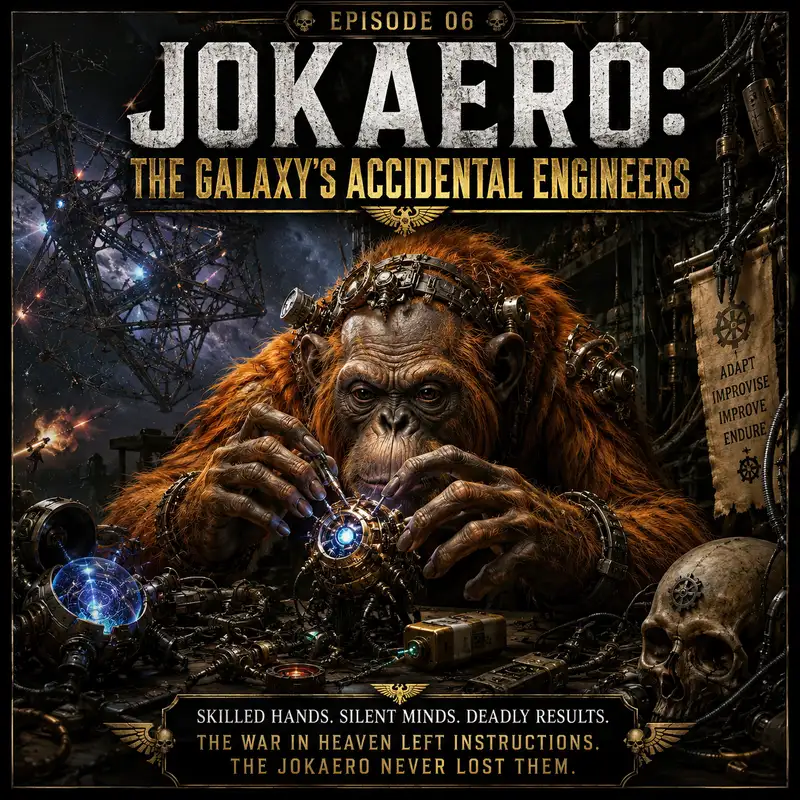
Jokaero: The Galaxy’s Accidental Engineers
The Deathwatch approached the Jokaero star-frame expecting an execution, not a battle. The alien vessel appeared almost undefended, an open lattice of machinery turning slowly against the dark. Orange-furred figures moved across its exposed framework with no visible urgency. Then the structure answered with the firepower of an entire fleet. The Space Marines of Fort Nullifact broke off their attack and watched from a safer distance as the star-frame spun away into the void. It was a brief encounter, but it contains the whole Jokaero problem. What looked fragile was heavily armed. What looked primitive was incomprehensibly advanced. What looked like an animal had prepared an answer before the Imperium understood the question.
The Jokaero are usually described as ape-like xenos, heavyset and orange-furred, with long, dexterous digits and a resemblance to the orangutans of ancient Terra. That description is accurate and almost useless. A human observer sees an animal. An Imperial xenologist sees a specimen. An inquisitor sees a weaponsmith. A tech-priest may see a walking theological crisis. The Jokaero themselves show little interest in correcting anyone. They do not announce their titles, explain their principles, or submit designs for approval. They take whatever machinery is nearby, dismantle it, rearrange it, and produce something that should not exist. Then, quite often, they wander away.
That creates the central mystery. Are the Jokaero intelligent engineers who simply cannot, or will not, communicate with other species? Are they creatures following technological instincts without understanding what they make? Or is the distinction itself a human mistake, created by a civilisation that assumes intelligence must resemble its own? The Imperium has spent ten thousand years classifying minds by whether they speak properly, obey authority, and fill in the correct forms. The Jokaero fail all three tests. They can still turn a piece of scrap into a weapon capable of vaporising the official conducting the examination.
The oldest accounts place their origin in the War in Heaven, millions of years before the Imperium. The Old Ones, facing extinction, shaped younger species to resist the Necrons and the star gods called the C'tan. Some creations were warriors. Others were psychic weapons, survivors, or tools built for tasks that later ages barely remember. The Jokaero appear to have been one of those designed species, gifted with a biological and instinctive mastery of technology. Their creators died or vanished. The war ended. The Jokaero remained, carrying instructions written not on parchment or data-slate, but into the species itself.
That origin should be treated with some caution. The War in Heaven survives through myth, alien memory, fragmentary records, and later interpretation. Even when the broad account is accepted, the precise purpose of the Jokaero remains uncertain. They may have been support organisms, technological mimics, emergency fabricators, or something for which the modern galaxy has no proper category. What matters is that their abilities do not appear to be taught in the usual sense. A Jokaero does not spend decades studying reactor theory before opening a damaged power core. It handles the machine as naturally as another creature might climb, hunt, or build a nest.
This is why the phrase accidental engineer is both useful and misleading. Their creations often appear spontaneous. They do not begin with a visible plan. They may alter a weapon in the middle of a battle, add components whose purpose no one understands, or spend hours adjusting a device that seemed perfectly serviceable. The result may be a dramatic improvement. It may be an elegant piece of ornamentation. It may be both. To an Imperial observer, the process looks random because the Jokaero provides no explanation. Yet randomness is not the same as incomprehension. A bird does not need an architectural lecture to build a nest, and a Jokaero does not seem to need a blueprint to rebuild a lascannon.
Their most famous creations are digital weapons. The name does not refer to computers. It refers to digits, meaning fingers. These are weapons miniaturised into rings, bracelets, or similarly small objects, concealing the destructive force of much larger devices inside something that can pass for jewellery. Imperial nobles, assassins, inquisitors, and other people who expect dinner conversations to become firefights prize them greatly. The achievement is not merely making a gun smaller. The Jokaero compress power generation, heat management, focusing systems, ammunition, and control mechanisms into a space where an Imperial artificer might struggle to fit a decorative skull.
Miniaturisation reveals something important about the Jokaero mind. Imperial technology often solves problems through scale. If more power is required, the Imperium builds a larger reactor, surrounds it with a cathedral, and assigns several hundred people to chant at it. Jokaero technology moves in the opposite direction. It reduces, integrates, and adapts. A device does not need to proclaim its importance. It needs to work. This makes Jokaero craftsmanship especially valuable to the Inquisition, whose agents benefit from weapons, shields, surveillance tools, and emergency systems that can be concealed inside ordinary equipment. Subtlety is useful when investigating heresy. It is also useful when the investigation inevitably catches fire.
Digital weapons are only the best-known example. Jokaero have produced defensive orbs, tiny spy devices, unusual force fields, food synthesizers, and light sculptures. Some of their mechanisms appear to interact with psychic forces, suggesting that the boundary between engineering and the warp may not exist for them in the same way it does for humanity. They can repair damaged machinery, combine incompatible systems, and create devices from components that should never have worked together. A group with enough wreckage can build something as ambitious as a spacecraft. A lone Jokaero may turn a ruined war machine into a battlefield asset and continue improving it after everyone else is satisfied.
Their star-frames are the grandest expression of this ability. They are described as open, geometric frameworks rather than sealed vessels in the Imperial style. Their shapes are not merely structural. Older reports suggest the Jokaero alter the configuration of these lattices to draw upon currents or forces running through the galaxy, allowing the craft to move in ways Imperial observers struggle to explain. Some accounts even compare their geometry to Blackstone Fortresses, though a shared origin remains speculation. The important point is simpler. To the Jokaero, a spacecraft may not be a fixed machine. It may be a changing equation, adjusted physically until the universe permits the desired result.
That approach makes them almost impossible to copy. The Adeptus Mechanicus preserves technology through approved patterns, sacred procedures, and controlled repetition. A sanctioned component should be made the same way every time, because deviation risks failure, corruption, or worse. Jokaero creations resist that logic. They improvise. Two apparently identical problems may receive different solutions. A modification that works brilliantly in one weapon may never be repeated in another. The Jokaero rarely provide diagrams, and even when observers recover one of their devices, understanding the arrangement does not guarantee understanding the principles. The machine can be examined. The thought that made it remains out of reach.
For the Mechanicus, this is offensive on several levels at once. The Jokaero manipulate technology without ritual, authorisation, or visible reverence for the machine spirit. They alter sanctioned wargear because a cable seems misplaced or a barrel lacks pleasing symmetry. They may improve an ancient weapon in minutes while a trained tech-priest has spent a century learning which access panel may be opened without permission. Yet the priest cannot dismiss the result, because the altered weapon fires farther, strikes harder, or suddenly possesses a protective field no one requested. Theologically improper engineering becomes easier to tolerate when it is standing between you and a daemon.
The Inquisition therefore maintains an awkward relationship with them. Imperial law condemns the alien, but inquisitors are granted broad freedom to use dangerous tools in defence of humanity. A Jokaero weaponsmith may appear in an inquisitorial retinue beside soldiers, savants, assassins, sanctioned psykers, and other specialists. Calling the creature a pet or servant makes the arrangement sound more controlled than it usually is. A Jokaero works when the task interests it, when materials are available, or when solving the problem serves its immediate needs. The inquisitor may issue orders. Whether the Jokaero accepts that those sounds carry authority is another matter.
Capturing one does not solve the problem. Jokaero are famous for turning confinement into an engineering exercise. Remove obvious tools, and they use the fittings. Remove the fittings, and they examine the lock. Give them nothing, and the sensible jailer begins wondering which part of the cell he has mistakenly classified as nothing. They build to survive, escape, protect their kin, or satisfy whatever internal requirement has seized their attention. The most successful human relationship with a Jokaero is therefore less like ownership and more like a temporary alignment of interests. The human provides materials and relative safety. The Jokaero refrains from converting the transport into something with a different destination.
Their social life also challenges the claim that they are mindless. Jokaero travel in family groups, often led by a senior male or female, and they act together to protect one another. They avoid close combat when possible and prefer to fight from a safe distance, which is a remarkably sensible doctrine by the standards of the forty-first millennium. Groups may raid isolated settlements, power stations, or mining vessels for components, using coordinated attacks and withdrawing before a larger response arrives. This is not the behaviour of solitary animals stumbling through machinery. It suggests planning, shared priorities, and an understanding of risk.
The clearest evidence comes from their dealings with other communities. At Precipice, the settlement beside a Blackstone Fortress, Jokaero arrived aboard an open-latticed vessel and became valued as repairers, craftsmen, and medical specialists. They traded, although their sense of value did not always match anyone else's. When one of their number, called the Tinkerer by outsiders, disappeared, the others withheld their services until the missing Jokaero was recovered. Perhaps this was instinctive group protection. Perhaps it was deliberate negotiation. Either way, a species supposedly lacking culture organised a work stoppage and obtained the return of a colleague. The distinction may have mattered more to the embarrassed customers than to the Jokaero.
They also display preferences that are difficult to reduce to survival. Jokaero make light sculptures. They add filigree, symmetry, and decorative changes to machines. Some modifications appear aesthetically motivated even when no practical advantage is obvious. An Imperial observer may dismiss this as compulsive behaviour, but that judgement reveals more about the observer than the maker. Art is often recognised only when its creator explains it in a familiar language. The Jokaero offer no artist's statement. They simply place beauty beside function and continue working.
A useful example comes from the war for Pandorax. There, a Jokaero named K'Cee served with an inquisitorial party and became involved with an ancient Imperial super-heavy tank. The machine was a relic of a more capable age, immense, battered, and difficult to restore. K'Cee repaired it, then kept going. Systems were improved, weapons were altered, protection was added, and the tank's performance moved beyond what its human crew expected from so massive a vehicle. Some changes seemed decorative or baffling. Others proved decisive against enemies no ordinary field repair should have allowed the tank to face.
K'Cee did not produce a technical manual explaining the work. The tank became the explanation. That is characteristic of Jokaero engineering. Their proof is operational. A weapon fires. A shield holds. An engine wakes. A machine designed to crawl begins moving with indecent speed. Human specialists are left staring at the results, attempting to decide which laws have been broken and which departmental seal should be applied afterward. The Jokaero, meanwhile, has already opened another panel because one of the controls is slightly off-centre.
The Pandorax example also shows why calling their work accidental misses the point. K'Cee's alterations were not always predictable to the humans nearby, but they repeatedly addressed real threats. The Jokaero adapted equipment while conditions changed, improving weapons and systems as new problems appeared. That is not blind assembly. It is responsive engineering carried out without the visible stages humans expect. There is no lecture, no design review, and no reverent pause before touching ancient machinery. There is observation, manipulation, testing, and another adjustment. The method is unfamiliar. The competence is not.
Even the apparent inconsistency of their inventions may have a logic. Human engineers value standardisation because human institutions must train workers, supply parts, and reproduce results across thousands of sites. The Jokaero have no known industrial empire to support. Their family groups carry the factory in their hands and, perhaps, in their genes. They do not need a universal pattern if each individual can create a solution from whatever is available. What looks like failure to standardise may be freedom from needing standards at all. It is an efficient system for nomads living among the ruins of other civilisations.
That freedom also limits them. The Jokaero do not appear interested in conquest, administration, or building a territorial state. They possess technology that could make them a major galactic power, yet they do not gather fleets beneath a single ruler or impose a coherent programme on surrounding species. Their groups wander, scavenge, trade, flee, and defend themselves. They solve immediate problems rather than historical ones. This may be instinctive constraint left by their creators. It may be a cultural choice outsiders cannot recognise. It may simply be that galactic dominion looks unattractive to a species sensible enough to have seen what it does to everyone else.
Their lack of empire is one reason others underestimate them. Power in the forty-first millennium is measured in worlds, armies, and monuments. The Jokaero leave few of these. Their achievements are scattered among inquisitorial vaults, alien markets, forgotten battlefields, and machines that no longer resemble their original patterns. They have no grand archive proclaiming what they accomplished. Their history is written in objects and escapes. A ring that kills like a rifle. A field that holds back something from the warp. A tank that should be dead but is moving. An empty cell with a lock neatly disassembled from the inside.
The encounter at Fort Nullifact demonstrates what happens when that dispersed power is mistaken for helplessness. The Deathwatch are among humanity's greatest alien hunters. They approached a Jokaero star-frame prepared to destroy it and discovered that the structure could answer like a battle fleet. The Jokaero did not pursue a crusade of vengeance. They did not broadcast a warning or demand recognition. They repelled the attack and departed. That response was restrained, practical, and devastatingly clear. The galaxy had presented a threat. The Jokaero had modified the situation until the threat went away.
So, are they truly intelligent? The surviving evidence cannot settle the question according to human definitions, because those definitions depend heavily on language and self-explanation. The Jokaero coordinate, trade, protect family members, display preferences, create art, adapt under pressure, and solve problems across fields ranging from weapons design to medicine and space travel. If all of that is instinct, then instinct is doing work that most Imperial universities could not manage with a thousand years and an unlimited supply of servitors. If it is conscious intelligence, then the Jokaero may simply see no advantage in discussing it with people who keep trying to put them in cages.
Their greatest mystery is not how they build such machines. It is what the act of building means to them. A human engineer imagines a design, separates purpose from material, and follows steps toward a finished object. A Jokaero may experience none of those boundaries. Machine, environment, danger, and solution may form one continuous pattern. The creature touches the pattern and changes it. From that perspective, a digital weapon, a star-frame, and an escape device are not inventions in separate disciplines. They are corrections applied to reality.
That makes the Jokaero one of the purest surviving echoes of the War in Heaven. The great powers of that age built species as instruments, embedding war, psychic potential, resilience, or knowledge into living bodies. Most such creations became nations, empires, or ruins. The Jokaero became wanderers carrying a vanished civilisation's engineering instinct from wreck to wreck. They do not preserve the Old Ones through temples or chronicles. They preserve them whenever a pair of long fingers closes around broken machinery and begins to rearrange it.
The Jokaero are accidental engineers only to observers who mistake silence for ignorance and blueprints for understanding. Their work is not accidental. It is immediate, embodied, and so deeply rooted that they may no more need to explain technology than a human needs to explain how to reach for a cup. The real accident is historical. A species created for a war before humanity existed survived its makers, its purpose, and the civilisations that followed. It still roams the galaxy, quietly correcting machines, escaping cages, and reminding the proudest engineers of the Imperium that knowledge does not always look like knowledge.