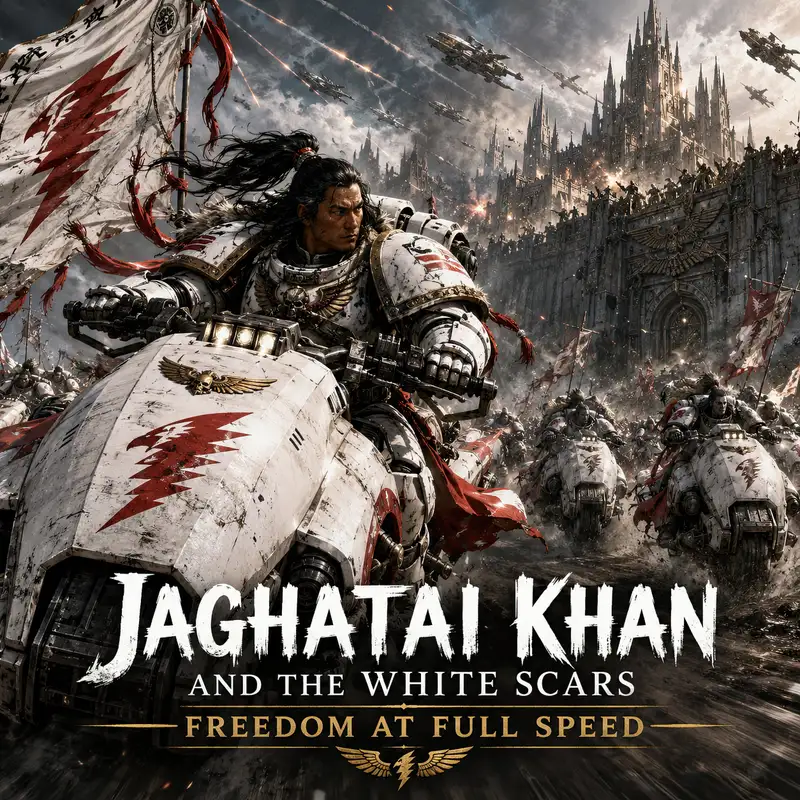
Jaghatai Khan and the White Scars: Freedom at Full Speed
At the Siege of Terra, the safest place in the Imperium was behind Rogal Dorn’s walls. Jaghatai Khan considered this a strong argument for leaving them. Outside the Imperial Palace, armies had been abandoned beneath a sky crowded with traitor ships. The ground was becoming a continent of trenches, corpses, artillery craters, and plague. Dorn saw a defensive problem measured in gates, reserves, and hours. The Khan saw an enemy that had been allowed to choose the shape of the war. So the White Scars rode out. Their jetbikes burst through the palace lines, white armour flashing beneath the ash, and struck the besiegers before wheeling away again. It looked reckless. It was not. Jaghatai had spent his life learning that movement was more than speed. Movement was choice, and choice was the beginning of freedom.
That distinction matters, because the White Scars are easily reduced to a single idea. They are the fast Space Marines. They use bikes, speeders, rapid strikes, and enough engine noise to make subtlety file a formal complaint. All of that is true, but it is only the surface. Jaghatai Khan did not value speed simply because going quickly amused him. He valued speed because it denied the enemy control. A moving army could refuse the wrong battle, create the right one, rescue the isolated, punish the exposed, and vanish before a slower commander had finished issuing orders. The White Scars’ way of war grew from a deeper belief. No warrior was truly free merely because no chain was visible. Freedom required discipline, judgement, and the strength to choose without surrendering the self.
The world that taught Jaghatai this lesson was Chogoris, a planet of immense grasslands, high mountains, blue seas, and hard distances. Its dominant power was an ordered empire ruled by the Palatine, supported by disciplined infantry, armoured horsemen, wealth, and settled cities. Beyond that empire lay the Empty Quarter, where nomadic tribes fought from horseback over land that could barely support them. The Palatine regarded these people as raiders, slaves, and occasional sport. The tribes regarded the Palatine’s realm as rich, powerful, and too slow to understand the wind. Into this divided world came one of the Emperor’s lost sons. He was found by Ong Khan, leader of the Talskar tribe, and raised not in a palace but among riders, hunters, storytellers, and warriors who carried their homes with them.
The surviving accounts of Jaghatai’s youth are wrapped in legend, and White Scars tradition does not always separate history from poetry. The shape is clear. He grew with impossible speed, learned warfare almost as naturally as breathing, and saw that the tribes’ endless feuds served only the Palatine. When Ong Khan was killed by a rival tribe, Jaghatai answered with annihilating vengeance. It was a brutal act, not the clean beginning of a noble hero. The lesson he drew from it was equally severe. If the tribes continued to spend their strength killing one another, they would remain prey. He began conquering them, breaking old rivalries, mixing warriors from different peoples, promoting ability rather than birth, and directing their violence outward. Jaghatai did not bring freedom through gentle persuasion. He brought unity at sword point.
Once the tribes were united, the Palatine’s empire faced an enemy it had been designed to dismiss. Its armies were larger, heavier, and better equipped. They could seize ground and hold formation. They could not force Jaghatai to fight where they were strongest. His riders struck supply lines, isolated columns, drew pursuit into bad terrain, and dissolved into the grasslands. The Palatine possessed the impressive machinery of war. Jaghatai controlled the decision to engage. That difference destroyed the empire. Chogoris was united under the Great Khan, and the pattern of his future campaigns had already been written. He did not smash strength against strength when he could make strength irrelevant. He preferred to make the enemy tired, angry, scattered, and certain that one more charge would finally catch him. This is a dependable method for defeating armies and an excellent way to ruin a general’s afternoon.
When the Emperor reached Chogoris, Jaghatai recognised something familiar in him. Here was another conqueror who intended to unite a divided people, except the people now occupied the stars. The Khan swore allegiance and accepted command of the Fifth Legion. That did not make him an unquestioning believer. Jaghatai admired the scale of the Emperor’s vision, but he was never comfortable with the empire required to realise it. The Imperial Truth claimed to free humanity from superstition while demanding obedience to a ruler of almost supernatural power. Compliance offered unity, security, and progress, usually after the arrival of an expeditionary fleet large enough to make disagreement irrelevant. Jaghatai saw the contradiction. He served anyway, because he believed disunity would be worse. His loyalty was therefore never simple devotion. It was a judgement, and judgements can be reconsidered.
The Legion he inherited was unusually well suited to him. Before finding its primarch, the Fifth had been known as the Star Hunters. Its warriors served as scouts, pathfinders, and raiders, often operating far ahead of the Great Crusade’s main fleets. They were divided into largely autonomous pioneer companies, each accustomed to surviving without close supervision. Their victories opened roads for others and were often credited to the armies that followed. They became Terra’s forgotten sons, which suited them more than it offended them. They had already learned to live at the edge of maps, to gather information, harass stronger enemies, and make decisions without waiting for permission from commanders several star systems away. Jaghatai did not have to teach them independence. He had to give that independence a shared purpose.
The transformation into the White Scars was not simply a change of armour and a sudden institutional enthusiasm for motorcycles. Jaghatai gathered the scattered companies and bound them through Chogorian ritual. Warriors took new names, marked themselves with scars, and entered a culture that valued the hunt, the spoken tale, calligraphy, poetry, craftsmanship, and disciplined self-knowledge. The result baffled outsiders. The White Scars looked like barbarians to those who believed civilisation could be measured by the weight of a ceremonial breastplate. In reality, they were among the most reflective of the Legions. They laughed in battle, composed verse, debated philosophy, and cultivated restraint. Their aggression was real, but it was directed. A blade swung in anger might be powerful. A blade swung at the precise instant chosen by a calm mind was much more dangerous.
That same balance shaped their military doctrine. White Scars commanders studied terrain, weather, enemy habits, communications, and lines of retreat. They used reconnaissance to find weakness before unleashing speed. They feigned withdrawal, encouraged pursuit, divided formations, and returned from unexpected directions. Their ships were modified for acceleration, sometimes at the expense of armour and firepower. Their brotherhoods were trusted with wide tactical freedom, because a rapid campaign collapses if every decision must climb a long chain of command and then descend again wearing three seals and a revised routing number. This did not mean the Legion lacked order. It meant that every warrior was expected to understand intent. Jaghatai wanted obedience that could think, not obedience that became helpless when the plan met reality.
Among the primarchs, this made him an outsider. Some brothers mistook his reserve for ignorance. Others saw his Chogorian customs and assumed savagery. Jaghatai rarely worked hard to correct them. Being underestimated offered practical advantages, and he had little appetite for courtly competition. He was closer to Horus than many loyalist histories prefer to admit, and he respected Magnus despite recognising the danger in the Thousand Sons’ confidence. Horus understood the Khan’s impatience with bureaucracy and the burdens of empire. Magnus understood that the universe was stranger than the Imperial Truth allowed. These friendships mattered when rebellion came. Jaghatai had reasons to distrust Terra, reasons to admire Horus, and reasons to question the Emperor. Anyone who claims his choice was obvious has benefited from knowing the ending.
The debate over psychic power reveals the Khan’s philosophy clearly. The White Scars used Stormseers, psykers trained through Chogorian traditions that emphasised limits, ritual, and control. Jaghatai did not believe the warp was harmless. He believed it could be approached, carefully, by people who understood that mastery began with restraint. At the Council of Nikaea, the Imperium chose prohibition instead. Magnus had pushed too far, while many of his opponents treated all psychic practice as the same danger. The Khan’s position occupied the uncomfortable ground between them. He rejected both ignorance and excess. That position was not indecision. It was the belief that power should be used without allowing power to define its user. In a setting where nearly everyone eventually becomes the servant of whatever they hoped to command, this was an unusually sensible idea.
When the Horus Heresy began, the White Scars were campaigning against Orks in the Chondax system. Traitor manipulation and warp disturbances isolated them from reliable news. Messages arrived late, contradicted one another, or carried claims too monstrous to accept. Horus had rebelled. The Emperor had betrayed his sons. Leman Russ had destroyed Magnus. Loyal Legions had become traitors, and traitors claimed loyalty. Jaghatai refused to choose on the basis of the loudest message. This delay caused suspicion on both sides, but it was consistent with his character. Freedom meant refusing to let another man’s urgency become his judgement. He broke through an Alpha Legion blockade using a rapid formation known as the chisel, then took his fleet toward Prospero to discover what had happened for himself.
Prospero offered no comforting answer. The world had been devastated by the Space Wolves, the Thousand Sons were broken, and the warp clung to the ruins. A manifestation of Magnus urged Jaghatai to reject the Emperor, while Mortarion arrived hoping to draw him toward Horus. The Khan listened, questioned, and refused both men. He could see that the Emperor had concealed truths and made catastrophic decisions. He could also see that Horus’s cause was no longer a rebellion of honourable warriors correcting an unjust father. Something else stood behind it. Corruption had entered the war, and it did not offer freedom. It offered appetites that became masters, promises that became chains, and power that gradually erased the person who accepted it.
The crisis reached inside the White Scars themselves. Warrior lodges and old loyalties had prepared some officers to support Horus. While Jaghatai sought answers, a faction led by senior commanders attempted to seize control of the fleet and commit the Legion to the Warmaster. The coup failed, but its existence exposed the cost of the Khan’s distance. He had allowed his sons freedom, and some had used it to betray his command. His response was severe. The leaders were judged, and many who had followed them became the Sagyar Mazan, condemned to seek atonement in suicidal war against the traitors. This was not mercy in any gentle sense. It was also not mindless execution. Jaghatai gave them a path to restore meaning through sacrifice. Among the White Scars, choice carried consequence. An oath freely given was not an oath lightly discarded.
Jaghatai chose the loyalist cause without pretending the Imperium was innocent. He did not suddenly decide that the Emperor had always been honest, that Terra’s bureaucracy was delightful, or that Rogal Dorn should be encouraged to design more walls. He chose because Horus had surrendered the very thing the Khan valued most. The Warmaster claimed liberation while becoming the instrument of the warp. His followers spoke of freedom as they submitted to rage, sensation, disease, ambition, and voices that never stopped asking for more. The Emperor’s rule was harsh and deeply compromised, but humanity might still possess a future within it. Under Chaos, human desire itself became occupied territory. Jaghatai remained loyal because he could have turned away and did not. His allegiance had moral weight precisely because it was chosen with open eyes.
Reaching Terra became a war of years. Warp storms blocked the direct routes, traitor fleets closed around the White Scars, and their lightning campaign became a struggle of attrition. They struck supply lines, isolated formations, and forced Horus to spend strength hunting them, but losses mounted. Qin Xa, one of the Khan’s closest companions and finest warriors, died in the fighting. The Legion that had made movement into freedom found the galaxy itself becoming a cage. Their escape depended on the Dark Glass, a device connected to the hidden paths of the Webway. Activating it required the sacrifice of the chief Stormseer, Targutai Yesugei. His death opened the road to Terra. Jaghatai wanted to turn and settle his account with Mortarion, but he accepted escape because honour that wasted Yesugei’s sacrifice would have been vanity wearing armour.
The White Scars arrived at Terra diminished, exhausted, and still dangerous. Their approach to the siege immediately collided with Dorn’s. The Praetorian thought in fortifications, depth, and the preservation of limited reserves. Jaghatai thought in initiative, disruption, and people left beyond the walls. He resented the decision to abandon Imperial Army formations outside the palace perimeter. He also understood that a defender who never attacks allows the enemy to solve one problem at a time. His sorties were not merely expressions of impatience. They gathered intelligence, destroyed concentrations, rescued survivors, and forced the traitors to guard against sudden attack. Dorn’s strategy was necessary. So was the Khan’s refusal to let necessity harden into paralysis. Terra survived because its defenders were not all the same man in differently coloured armour.
The decisive expression of Jaghatai’s method came when the Lion’s Gate Spaceport fell into traitor hands. The port allowed Horus to pour reinforcements onto Terra and threatened to close the route by which loyalist relief might arrive. Retaking it seemed impossible. That made it exactly the kind of problem the Khan preferred. He gathered the White Scars, Imperial armour, and other surviving forces for a counterattack from the palace lines. This was not a neat parade of jetbikes circling slower allies. It was a combined assault through a landscape saturated with poison, artillery, daemons, and Death Guard. Speed created the breach, but courage and endurance had to hold it. The White Scars reached the spaceport because they moved faster than the traitors expected. They kept it because, when required, the riders of Chogoris could plant their feet and refuse to move at all.
At the centre of the battle stood Mortarion. He had once despised tyrants and sorcerers. By Terra, he had become a daemon primarch bound to Nurgle, swollen with unnatural endurance and surrounded by corruption. His tragedy made him the perfect opposite of Jaghatai. Both had distrusted the Emperor. Both valued independence. Both believed themselves difficult to master. Mortarion accepted power to escape weakness and discovered that the gift owned him. Jaghatai accepted pain, limitation, and uncertainty rather than surrender his judgement. Their duel was therefore more than a contest of weapons. Mortarion was stronger than he had been, and the Khan could not defeat him by ordinary means. Jaghatai attacked his pride, endured punishment that should have killed him, drew close, and finally struck the blow that banished his brother back into the warp.
The victory nearly killed him. His sons found a body that appeared beyond saving and carried him from the field while the spaceport burned around them. He survived, though his recovery was slow and incomplete when the immediate war ended. The image is fitting. Jaghatai won not by remaining untouched, but by deciding what cost he would pay and refusing to let his enemy decide it for him. The Lion’s Gate assault did not save the Imperium by itself, but it cut the flow of traitor strength, restored a vital position, and gave the defenders something the siege had steadily taken from them: room to act. For the White Scars, that was the same as air.
After the Heresy, Jaghatai joined the Great Scouring and hunted the retreating enemies of the Imperium. His end, if it was an end, came as it could only have come. While pursuing Drukhari raiders, he entered the Webway and vanished. No reliable account settles his fate. Perhaps he died in that impossible labyrinth. Perhaps he was captured. Perhaps he still hunts through roads that do not obey distance or time. The White Scars have never accepted the absence as proof of death. They continue to watch the horizon, maintain the traditions of Chogoris, and fight as if their primarch might return from the next storm.
Ten thousand years later, the White Scars remain easy to misunderstand. Their speed is visible, so it receives the attention. Their deeper strength is harder to paint on armour. They cultivate independent judgement without abandoning shared purpose. They preserve poetry beside warfare, laughter beside discipline, and a love of open horizons inside an Imperium built from walls, laws, and sealed tombs. They are not gentle champions of universal liberty. They are Space Marines, created for conquest and preserved by a brutal state. Yet within those limits, they carry one of the setting’s clearest ideas of freedom. A warrior must know what he serves, understand the cost, and retain enough of himself to choose loyalty rather than merely obey.
Jaghatai Khan was free not because no one commanded him, but because neither fear, pride, empire, nor the warp could make his final choice for him. His speed was the outward form of that refusal. He would not fight where an enemy placed him, believe what a messenger demanded, or accept that a wall had become the edge of possibility. He could retreat without surrender, obey without becoming owned, and remain loyal without pretending his masters were pure. That is why the White Scars ride so quickly. They are not fleeing duty. They are racing toward the place where duty can still be chosen. Somewhere beyond the last gate, beneath an open sky or within the lightless roads of the Webway, the Warhawk’s path remains unfinished.