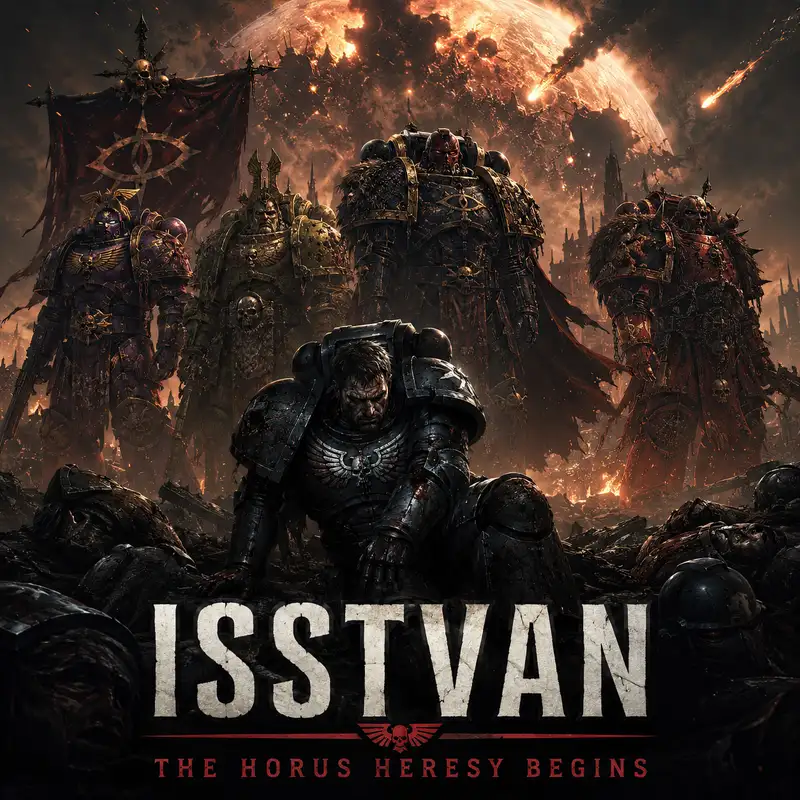
Isstvan: The Horus Heresy Begins
The first men to understand that the Great Crusade was over were standing beneath a dead city, listening to an entire world burn above them.
They had gone underground because a warning had reached them only moments before the bombardment. Beyond the shelter walls, the life-eater virus stripped flesh from bone, forests collapsed into filth, and the atmosphere filled with the gases of sudden decay. Then the fleet in orbit ignited those gases. Fire crossed Isstvan the Third in a single planetary breath.
The warriors in the bunkers were Space Marines. The fleet killing them belonged to their own Legions.
Horus had already betrayed the Emperor in thought, oath, and secret preparation. Isstvan was where that betrayal became military fact. It was not one battle, but two connected acts of murder. On Isstvan the Third, Horus tried to purge loyalty from his own army. On Isstvan the Fifth, he used the Imperium’s faith in brotherhood to destroy the force sent to punish him. Together, they turned conspiracy into civil war.
After his corruption, Horus possessed an enormous advantage. He was still Warmaster. The Emperor had returned to Terra and left him with authority over the Great Crusade. Horus could move fleets, redirect Legions, assign campaigns, and place potential enemies far from one another without announcing that he had become their enemy. The Imperium had handed him the keys to its war machine. It had not considered the possibility that he might drive it directly into a wall.
Yet Horus also had a problem. A Space Marine Legion was not a single mind. Primarchs inspired extraordinary loyalty, but their sons had sworn oaths to the Emperor, to the Imperium, to one another, and to the ideals they believed the Great Crusade served. Some warriors would follow their primarch anywhere. Others would not follow him into treason.
That uncertainty was especially dangerous within the four Legions already gathered around Horus: the Sons of Horus, the Emperor’s Children, the World Eaters, and the Death Guard. Their primarchs had committed themselves to rebellion, but thousands of their warriors remained doubtful, resistant, or openly loyal. Horus could not begin a march on Terra with armed loyalists aboard his own ships. He needed to identify them, isolate them, and kill them before the wider Imperium understood what was happening.
A rebellion on Isstvan the Third gave him the opportunity. The world had rejected Imperial rule, and suppressing such defiance was ordinary work for the Space Marine Legions. Horus assembled an assault force from the four Legions and selected the companies he considered unreliable. The chosen warriors were told they would lead the attack and restore compliance.
It looked like an honour.
In reality, it was a list of men marked for death.
The list could never be perfect. Loyalty was not stamped visibly onto armour, and Horus’s agents were judging character, friendships, old disputes, and private doubts. Some future traitors went to the surface with the condemned. Some loyalists remained aboard the fleet. The purge was less a precise separation than a brutal attempt to improve the odds before open war began. Horus was willing to lose useful followers so long as he removed enough dangerous opponents. Efficiency, in this case, meant accepting a considerable margin of fratricide.
Among them were captains whose names would become inseparable from the opening of the Heresy. Garviel Loken and Tarik Torgaddon of the Sons of Horus had served close to the Warmaster and had watched his character change. Saul Tarvitz of the Emperor’s Children lacked the theatrical brilliance admired within his Legion, but possessed something more useful in a catastrophe: sound judgement. Other loyalists came from the Death Guard and the World Eaters, men who could accept obedience to a primarch only while that primarch remained worthy of obedience.
The assault on the planet began as expected. Drop pods and landing craft carried the selected companies into the rebellious cities. They fought their way through defenders, seized positions, and prepared for the next stage of the campaign. They had no reason to think the greatest danger was above them. Their brothers still held the fleet. Their primarchs still issued the orders. Every familiar symbol of authority remained in place.
That was the essential quality of the Isstvan trap. It did not require the loyalists to make a foolish decision. It required them to behave normally.
Saul Tarvitz discovered enough of the plan to understand that the forces on the surface were about to be exterminated. He escaped the control of the traitor fleet and carried a warning down to the planet. The message arrived too late to save everyone, but early enough for portions of the loyalist force to reach sealed shelters and underground structures.
Then the virus bombs fell.
The life-eater weapon was designed to consume organic matter with terrifying speed. Soldiers, civilians, animals, crops, and forests became fuel for the same chain of destruction. When the released gases were ignited from orbit, the firestorm completed what the virus had begun. Isstvan the Third ceased to be a rebellious world and became a corpse.
The planetary population disappeared with it. Those people had become useful first as a justification for military action and then as material to be erased alongside the loyalist Legions. Horus claimed to be rebelling against a distant and tyrannical Emperor, yet his opening act treated an entire human world as expendable scenery. The contradiction would define much of the war. Grand promises about liberation were repeatedly carried forward by men standing on the ashes of those they had supposedly intended to save.
Horus expected silence.
Instead, signals emerged from beneath the ruins.
The loyalists had survived in numbers large enough to fight. Their survival transformed an execution into a siege, and the traitors could not simply leave them behind. These were Space Marines who now knew the truth and who might still find a way to warn Terra. They had to be destroyed completely.
Angron had little interest in waiting for another distant bombardment to settle the matter. The primarch of the World Eaters descended to the surface, and traitor forces followed. Horus’s carefully controlled purge became a ground war among warriors who had once shared campaigns, victories, and blood-oaths. The first open battles of the Heresy were not fought between unfamiliar armies. They were fought between men who recognised one another’s tactics because they had learned them together.
The surviving loyalists formed an improvised army from four Legions. Saul Tarvitz became its commander not because of rank alone, but because he had seen the danger, acted decisively, and earned the trust of warriors who no longer knew which authorities could be trusted. Under ordinary circumstances, Legion rivalry might have made such a command awkward. Being hunted by one’s own primarch has a way of simplifying staff procedures.
They fortified the ruins and made the traitors pay for every advance. The loyalists knew they could not win in the conventional sense. They had no fleet, no reinforcements, and no secure route off-world. Their purpose became resistance itself. Every hour they survived delayed Horus. Every traitor they killed weakened the force intended for Terra. Every transmission they attempted threatened the secrecy on which the rebellion depended.
Garviel Loken and Tarik Torgaddon fought against the Legion that had once defined them. Their loyalty was not simple devotion to an absent Emperor. It was also a refusal to accept Horus’s claim that betrayal had become necessary. They had believed the Great Crusade was building a more rational and unified human future. On Isstvan, they discovered that the greatest champion of that project had decided he could preserve it only by murdering anyone who disagreed with him.
The fighting continued for weeks. Streets became fortresses. Wrecked buildings became firing positions. The traitors brought down armour, artillery, and more of their own Legionaries, yet the defenders continued to resist. Horus had planned to remove an internal weakness with a single bombardment. Instead, his first operation as a rebel Warmaster was already behind schedule and consuming troops he had intended to use elsewhere.
The defenders were not protected from betrayal merely because they had survived the first betrayal. Lucius of the Emperor’s Children eventually turned against them, helping the traitors break the loyalist resistance from within. This was another pattern that would repeat throughout the Heresy. Oaths were no longer guarantees. Shared heraldry was no longer reassurance. A warrior’s past conduct could not prove his next decision.
Even so, the loyalists achieved the one result Horus most needed to prevent. A warning escaped.
Nathaniel Garro of the Death Guard had remained in orbit, already regarded with suspicion by those who knew his loyalties. Alerted to the massacre, he seized the frigate Eisenstein with a small band of survivors and fled the Isstvan system. The voyage to loyalist space was desperate, and the message he carried was nearly impossible to believe. Horus Lupercal was not merely disobedient. He was in rebellion. Several primarchs and Legions were with him. The Imperium’s supreme military commander had turned the opening move of his war against his own sons.
Garro eventually brought that warning to Rogal Dorn. Dorn’s initial disbelief was understandable. Horus had been the Emperor’s favoured son, the first among the primarchs, and the commander entrusted with humanity’s future. To accept Garro’s account meant accepting that the hierarchy holding the Great Crusade together had already collapsed.
Yet the evidence could not be dismissed. Terra had been warned, and that changed Horus’s war. A swift strike toward the Throneworld was no longer practical. Defences would be raised. Loyal Legions would be summoned. The rebellion needed time, and Horus needed to destroy the force that would come looking for him.
The last loyalist positions on Isstvan the Third were eventually overwhelmed and erased beneath further bombardment. Tarvitz and most of the defenders died there. Torgaddon fell. Loken was believed dead amid the ruins. Their stand did not save the planet, and it did not stop the Heresy. It did something less dramatic and more important. It prevented Horus from beginning the war on his preferred terms.
Isstvan the Fifth was his answer.
Horus gathered his openly rebellious forces there and allowed the Imperium to see a target. He fortified the Urgall Depression, a vast canyon surrounded by difficult ground, cliffs, and defensive systems. The position invited a direct assault while making other approaches impractical. Horus was not hiding from Imperial retaliation. He was shaping it.
Garro’s warning had cost him strategic surprise, but it also told him what the Imperium would do next. Dorn could not ignore the rebellion. He had to respond quickly, before Horus gathered more allies or inspired further revolt. The very urgency created by the massacre on the Third helped drive the loyalists into the prepared ground on the Fifth. Horus had failed to stop the alarm, so he turned the alarm into bait. It was a characteristically dangerous recovery from a damaged plan.
Rogal Dorn organised a Retribution Fleet of seven Legions to bring the Warmaster to justice. The Iron Hands, Salamanders, and Raven Guard would form the first assault. The Iron Warriors, Word Bearers, Night Lords, and Alpha Legion would follow as reinforcement.
The structure seemed sensible. It was also fatal.
All four Legions assigned to the second wave had already aligned themselves with Horus. The loyalist command did not know this because the Imperium had never needed a system for verifying whether entire Legions had secretly changed sides. There were procedures for logistics, compliance, fleet movement, and orbital bombardment. There was no convenient form asking whether one’s primarch had recently sworn himself to rebellion and darker powers.
Ferrus Manus, primarch of the Iron Hands, took command of the loyalist attack. He was a formidable general, but Isstvan was personal. Fulgrim of the Emperor’s Children had tried to draw him into Horus’s cause. Ferrus had refused, and the encounter had ended in violence between brothers who had once been exceptionally close. For Ferrus, the coming battle was not merely an operation to arrest traitors. It was a chance to answer humiliation and betrayal with force.
Vulkan of the Salamanders and Corvus Corax of the Raven Guard favoured greater caution. Ferrus chose the hammer blow. The loyalists would descend in strength, smash through the traitor lines, and destroy Horus before the rebellion could spread. The plan was costly, direct, and dependent on the second wave securing the landing zones and reinforcing the advance.
Horus had built the battlefield for exactly that plan.
Orbital fire struck the Urgall Depression. Drop pods and landing craft cut through the sky. The black sands became crowded with tanks, infantry, wreckage, and burning debris as three loyal Legions drove into prepared defences. The Iron Hands pressed toward the centre. The Salamanders and Raven Guard fought through World Eaters and Death Guard formations along their own axes of advance.
The fighting was savage even by the standards of Space Marines. Ammunition ran low. Formations dissolved into close combat. Veterans who had conquered human and alien empires killed former comrades at distances where heraldry could be seen clearly through cracked lenses.
Still, the loyalists advanced.
After four hours, the second wave descended behind them. Fresh warriors of the Iron Warriors, Word Bearers, Night Lords, and Alpha Legion established positions around the landing zones. To the exhausted first wave, they appeared to be relief. Damaged units began to pull back toward them. Vox calls went unanswered or returned only static, but confusion in a battle of that scale was hardly unusual.
Then a red flare rose above Horus’s fortress.
The reinforcing Legions opened fire.
Bolter volleys, heavy weapons, artillery, and armoured vehicles struck the loyalists from behind. At the same moment, Horus’s original forces renewed their attack from the front. The Iron Hands, Salamanders, and Raven Guard were compressed between eight Traitor Legions. The landing grounds that should have offered resupply and escape became killing fields.
This was not simply an ambush. It was the deliberate use of trust as a weapon. The second wave knew the loyalist dispositions, codes, expectations, and withdrawal routes because they had been included in the plan. They did not need to break the Imperial formation from outside. They had been given positions inside it.
Ferrus Manus continued toward Fulgrim. Their confrontation carried the weight of the entire disaster in miniature. Two brothers who had once exchanged gifts and admiration now met amid the collapse of their father’s empire. Ferrus fought in rage. Fulgrim fought under the influence of the corruption he had embraced and still did not fully command.
Ferrus Manus was killed and beheaded.
His death broke more than the command structure of the Iron Hands. The Legions had been created around primarchs who seemed almost beyond mortality. At Isstvan, one of those beings died at another’s hand, and thousands of sons saw that the war had passed beyond discipline, arrest, or reconciliation.
Elsewhere, Corvus Corax fought Lorgar and nearly killed him before Konrad Curze intervened. The Raven Guard were reduced to scattered survivors. Vulkan disappeared beneath catastrophic fire and was believed slain as the Salamanders were broken around him. Angron and Mortarion moved through the loyalist lines while Horus emerged to claim the field he had arranged.
Most of the loyalist warriors who reached the surface died. Those who escaped did so through isolated acts of courage, improvisation, and luck. Some fled into the wastelands. Others found damaged craft or were recovered after the main slaughter. Survivors from the three Legions later formed mixed warbands remembered as the Shattered Legions, carrying on a war of raids, sabotage, and vengeance.
Strategically, Horus had achieved an extraordinary victory. Three loyal Legions had been shattered before the wider civil war could properly mobilise. One loyal primarch was dead, another missing, and a third escaped with only a fraction of his strength. Other potential opponents had already been dispersed, delayed, or directed into separate disasters. The path toward Terra was not open, but it was far less crowded.
Yet Isstvan also revealed the nature of the war Horus had created. He could win through preparation, secrecy, and betrayal, but each victory destroyed the institutions he claimed to be saving. The Great Crusade had depended on common purpose, shared command, and the belief that the Emperor’s sons would ultimately stand together. Horus exploited those assumptions so effectively that they could never function in the same way again.
Isstvan the Third and Isstvan the Fifth were therefore two halves of the true beginning.
On the Third, Horus murdered the loyal conscience within his own coalition. He learned that loyalty to a primarch had limits, and that some Space Marines would choose principle even when every practical hope had vanished.
On the Fifth, he murdered the Imperium’s confidence in fraternity. After the Dropsite Massacre, no Legion could approach another without suspicion. Orders required interpretation. Reinforcements might be executioners. A familiar voice on the vox might be delaying you until the guns were ready.
The Horus Heresy did not begin merely because Horus rejected the Emperor. Rebellions can still be contained while institutions continue to function and loyalties remain legible. It began at Isstvan because Horus made trust itself unsafe.
On the black sands, the enemy did not arrive beneath an alien banner. They answered the correct codes, landed in the assigned formation, took their proper place behind their brothers, and waited for the red flare.