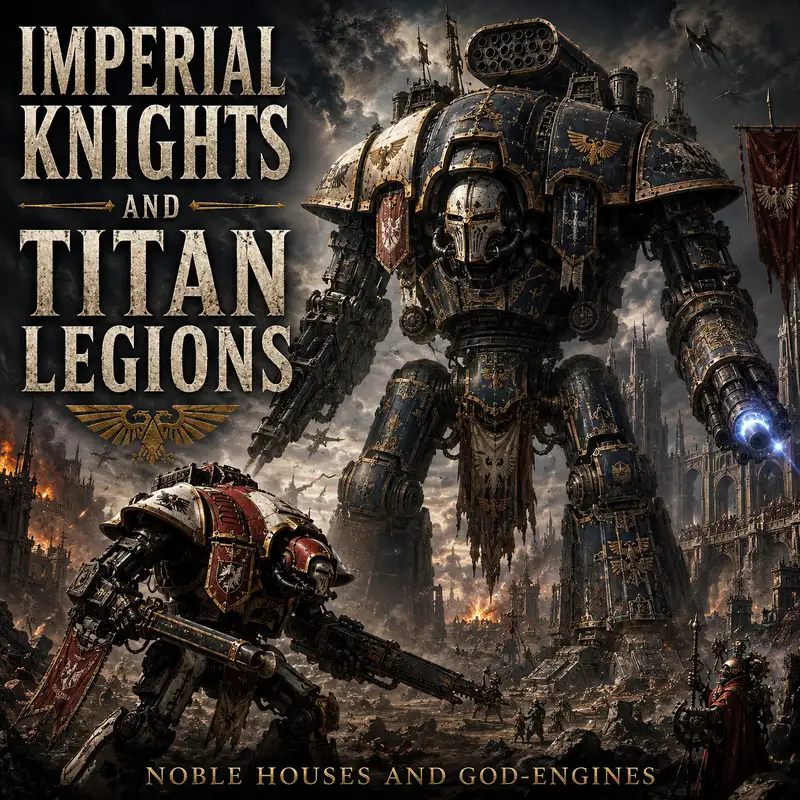
Imperial Knights and Titan Legions: Noble Houses and God-Engines
The Knight pilot feels the Warlord before its war horn reaches him. Dust jumps from the ruined road. Loose masonry slides from the walls. Then a shadow passes across the Knight’s vision, and the noble looks up through the machine’s sensors at a war engine so large that his own towering war engine suddenly feels like a cavalry mount beside a fortress.
The Titan’s weapons turn with the slow confidence of naval guns. Void shields shimmer around its armoured body. A lance of energy crosses the battlefield, and a distant bastion ceases to be a military problem. The Knight does not attempt to imitate this. It lowers its weapon, drives power into its legs, and charges through the smoke toward the survivors.
From a distance, the two machines appear to belong to the same family. Both walk on two legs. Both carry weapons normally found on tanks, fortifications, or particularly ambitious warships. Both are ancient, temperamental, and surrounded by people who regard correct maintenance as a religious duty. Yet an Imperial Knight is not merely a small Titan, and a Titan is not simply a Knight with a larger reactor.
The difference begins with the human being inside.
An Imperial Knight is a noble warrior mounted in a mechanical steed. A Titan is a warship standing upright, commanded by a princeps and served by a crew. One carries the history of a family. The other carries the identity of a god-engine. Their separate traditions explain why the Imperium can field armies that look medieval and futuristic at the same time, often within the same square mile.
The oldest Knight worlds trace their origins to humanity’s expansion during the Dark Age of Technology, long before the Imperium existed. Colony fleets travelled into dangerous regions in search of habitable worlds, minerals, and places where human civilisation could take root. The settlers brought powerful walking machines able to defend isolated communities and master hostile terrain. In time, those who controlled the Knights also controlled the survival of the settlement.
That arrangement had a certain political momentum. A person with access to a towering armoured war machine possessed a persuasive claim to leadership, especially when local wildlife regarded the colonists as food. Authority gathered around the pilots. Their families guarded the machines, the knowledge needed to operate them, and the right to choose successors.
Then came the Age of Strife. Warp storms severed worlds from one another. Human empires collapsed. Trade routes disappeared, and distant colonies learned that no rescue fleet was coming. Many were destroyed. Others survived because their Knights could defeat raiders, predators, mutants, and rival settlements. On those worlds, the pilots became more than military specialists. They became protectors, judges, landholders, and rulers.
Over generations, practical command hardened into hereditary nobility. The Knight household became a family, a military order, and a government at once. Many Knight worlds developed feudal societies built around oaths of service, martial honour, and obligations between rulers and subjects. The details vary enormously from world to world. Some houses rule fertile kingdoms. Others command industrial domains, nomadic strongholds, or settlements clinging to landscapes that appear personally offended by human habitation.
The result can look like a medieval court built around technology no one in that court could manufacture from first principles. There may be banners, heralds, sworn retainers, ancient rivalries, and a castle whose largest chamber contains a plasma-powered war engine. The contradiction is not accidental. It is the foundation of the society.
At the heart of a Knight is the Throne Mechanicum, the neural interface through which a noble commands the machine. The throne does more than translate thought into movement. It carries imprints left by former pilots, ancestral echoes that judge, advise, pressure, and sometimes overwhelm the new occupant. During the Ritual of Becoming, a prospective pilot must prove capable of bonding with this accumulated presence.
The noble therefore does not enter an empty cockpit. The dead are already waiting.
These echoes are not always clear personalities holding orderly conversation. They may be instincts, memories, emotional impressions, or inherited demands. They reinforce the household’s traditions and its preferred vision of honour. A scion raised to value courage, loyalty, and duty then bonds with a machine containing generations of ancestors who valued the same things. The arrangement is effective. It is also an unusually thorough way to ensure that family expectations survive even after the family is buried.
This bond helps explain both the strength and the rigidity of Knight culture. A pilot fights with the experience of predecessors close at hand, but also carries their prejudices. Old feuds can remain vivid. Ancient oaths can feel immediate. A decision that seems irrational to an outsider may be perfectly reasonable to a noble whose throne contains the remembered shame of an event five thousand years old.
The household supports this inheritance. Sacristans maintain the Knights, preserve their rituals, and repair damage that would leave ordinary machines as expensive scenery. Their craft is closely linked to the Adeptus Mechanicus, though its practice may be wrapped in local custom. Armour plates are blessed, weapons awakened, reactor systems appeased, and faults diagnosed through procedures that are at once technical and devotional. In the Imperium, these categories rarely stay politely separated.
A great house may field several classes of Knight, but the Questoris pattern forms the familiar core. It is large enough to carry devastating weapons, yet mobile enough to advance with an army and fight at close quarters. Taller or heavier suits provide specialised speed, siege power, or long-range destruction. Smaller Armigers fight as swift attendants, often linked by command protocols to a senior noble. Even here, social hierarchy appears inside the machinery. The lesser warrior follows the greater, and the circuit agrees.
Knights normally fight in lances and banners, groups whose pilots know one another’s habits and whose heraldry makes their loyalties visible through smoke, assuming enough of the armour remains attached. They can break armoured formations, hunt monstrous enemies, assault strongpoints, and provide a conventional army with a sudden concentration of violence. Their speed and relative independence allow them to respond more quickly than the largest god-engines.
Relative is doing considerable work in that sentence. A Knight is still a building-sized engine carrying weapons capable of erasing tanks and infantry formations. It simply inhabits a galaxy where something larger may step over it.
Not every household owes allegiance in the same direction. Questor Imperialis houses place their oldest loyalty with the Emperor, Terra, or Imperial institutions. Questor Mechanicus houses are more tightly bound to Mars and the forge worlds of the Adeptus Mechanicus. The distinction shapes their customs, equipment, and politics, but it does not make one group secular and the other religious. Imperial culture has no shortage of sacred language for either arrangement.
These allegiances were formed through survival and negotiation. When the Great Crusade rediscovered isolated Knight worlds, some welcomed the Imperium as the return of human unity. Others bargained carefully. The Mechanicum could offer technical knowledge, replacement parts, and access to forges capable of sustaining ancient machines. Terra could offer protection, status, and a place within the expanding empire. A Knight house might swear loyalty out of conviction, necessity, family interest, or some combination of all three presented afterward as destiny.
Titans emerged from a different history. The oldest reliable accounts place the Titan Legions within the wars of Old Night on Mars, where the Mechanicum fought for survival amid technological horror, environmental collapse, and rival powers. These engines were not frontier steeds. They were weapons of strategic dominance, created or preserved by an industrial priesthood able to treat a city-killing machine as both military hardware and sacred embodiment.
When Terra and Mars formed their alliance, the Titan Legions became part of the Great Crusade. They marched against fortresses, alien empires, rebellious civilisations, and threats that conventional armies could not readily destroy. Their appearance on a battlefield announced that the campaign had crossed a threshold. The Imperium was no longer asking whether a position could be captured intact. It was considering whether the surrounding geography was negotiable.
A Titan is operated through a command system centred on the princeps. The princeps does not simply use controls to direct the engine. Through a mind impulse interface and the Titan’s manifold, the princeps experiences the machine as an extension of the self. Sensors become sight. Weapon systems become limbs. Damage can be felt as pain. The Titan’s immense mass may feel as natural as a human body, at least until the link breaks and the human mind remembers how small it really is.
The princeps is supported by moderati and specialist crew who manage weapons, movement, sensors, communications, and reactor demands. Tech-priests, servitors, and maintenance personnel work within and around the engine. In a Warlord Titan, the command crew occupies the head, while deeper compartments contain systems and personnel required to keep the machine alive. Calling it a walking tank misses the point. A Titan is closer to a naval vessel, complete with command deck, engineering spaces, crew discipline, and the possibility that the reactor may turn a tactical setback into a regional event.
The machine itself is not passive. Titans possess ancient and powerful machine spirits, often aggressive, proud, and eager for battle. The princeps must impose direction without smothering the instincts that make the engine effective. A weak command can allow the Titan’s hunger to dominate. An excessively rigid one may fight the machine instead of the enemy.
Long service deepens the union. Some princeps eventually leave ordinary human life behind and are installed within amniotic caskets, sustained by life-support systems and permanently connected to their god-engine. To the Mechanicus, this may represent liberation from failing flesh and closer communion with the machine. To an outside observer, it resembles being buried alive inside a weapon and receiving a promotion for it. Both descriptions have merit.
This relationship is why the term god-engine is more than ceremonial exaggeration. The Mechanicus reveres Titans as manifestations of the Machine God’s power. Soldiers on the ground see an armoured giant walking through artillery fire beneath layers of void shields. Enemies watch buildings vanish when its weapons discharge. The princeps feels a vast predatory consciousness joined to their own. At that point, the distinction between religious interpretation and practical observation becomes rather narrow.
Titan Legions, or Legios, possess identities as strong as those of Space Marine Chapters or Knight houses. Each has its own colours, emblems, battle honours, rituals, preferred tactics, and inherited grudges. Individual Titans bear names and reputations accumulated across centuries. Their crews change. Their armour is replaced. Entire sections may be rebuilt. The identity of the engine continues.
This continuity creates another form of ancestry. A Knight pilot enters a throne shaped by a bloodline. A princeps joins a machine whose history may exceed any single family. Both inherit obligations from the dead. The difference is that the Titan’s lineage belongs to an institution and an engine rather than a dynasty.
Titan classes reflect different roles. Warhound Scout Titans move ahead of heavier engines, hunting in packs and using speed that seems almost graceful until one remembers the scale. Reavers combine mobility with enough firepower to kill other god-engines. Warlords form the monumental centre of many battle groups, carrying void shields, massive weapon systems, and the command presence to dominate a battlefield. Still greater engines exist, including the rare Warmaster, but size alone does not explain Titan warfare.
A Titan commander must manage position, firing arcs, shield strength, reactor output, and the temperament of the engine. Pushing the reactor can provide the power needed for speed, shields, or weapons, but excess heat can cripple the machine. Void shields can absorb punishment that would destroy lesser vehicles, yet once they collapse, concentrated fire can tear into armour, weapons, joints, and vulnerable systems. A wounded Titan rarely fails quietly. It may stagger, fall through friendly formations, or detonate with the enthusiasm of a small sun.
For all their power, Titans do not operate alone. They require landers or immense transport vessels, repair facilities, ammunition, fuel, replacement components, and armies of specialists. Secutarii and other supporting troops protect them from infantry, saboteurs, and enemies attempting to exploit blind spots. Conventional formations secure routes and objectives that a Titan can destroy but cannot sensibly occupy.
This is where Knight households become especially valuable. Knights can screen a Titan’s flanks, hunt enemy armour, move through terrain that constrains larger engines, and intercept threats before they reach vulnerable support elements. They can exploit the breaches a Titan creates. Against enemy god-engines, they may attack in groups, using speed and numbers to distract, encircle, or finish a damaged machine.
The arrangement resembles cavalry operating around a line of battleships that has somehow come ashore. It should not work. In the Imperium, it has had thousands of years to become doctrine.
Cooperation does not eliminate tension. A Knight noble may think in terms of honour, personal challenge, household obligation, and visible courage. A Titan princeps must consider battle group formation, reactor limits, shield overlap, target priority, and strategic orders issued from far above the concerns of a single warrior. The Knight may see an enemy champion and demand the right to face it. The princeps may see a target coordinate and fire a weapon capable of removing both champions from the discussion.
Yet each understands the other more readily than an ordinary commander might expect. Both live through machines that have personalities. Both inherit traditions embedded in metal. Both command forces that inspire reverence and fear among allies. Both know that a moment of mechanical failure can end a lineage, a legend, and several nearby infantry regiments.
The Horus Heresy exposed the darkest side of these traditions. When the Imperium divided, Knight houses and Titan Legions divided with it. Oaths to Terra, Mars, Warmaster Horus, forge worlds, family allies, and local rivals pulled ancient forces in opposing directions. Some households split within themselves. Legios that had marched together during the Great Crusade met as enemies.
At Beta-Garmon, during the campaign remembered as the Titandeath, god-engines fought on a scale that turned the battlefield into an industrial graveyard. Titan Legions advanced against machines built from the same sacred traditions. Knight households fought beneath them, their heraldry marking loyalties that had once belonged to a shared empire. The clash was not merely large. It was intimate. Every destroyed engine represented centuries of memory, irreplaceable technology, and crews who had spent their lives learning to think as part of a machine.
The Heresy also demonstrated that neither honour nor religious discipline guarantees loyalty. A Knight’s ancestral voices can preserve courage, but they can also preserve pride, resentment, and obsession. A Titan’s machine spirit can be disciplined, but it can also be fed hatred until war becomes its only identity. Chaos does not need to invent these weaknesses. It offers them permission.
Fallen Knights become tyrants whose bonds with their machines twist into domination, addiction, and cruelty. Corrupted Thrones Mechanicum fill with hostile echoes and predatory influence. Traitor Titans may become warped unions of engine, crew, and daemonic presence, their once-sacred forms reshaped around appetites that no reactor should possess. The horror lies partly in recognition. The corrupted machine still carries its name, its history, and traces of what it once defended.
In the era after the Great Rift, both Knights and Titans remain rare enough to be strategic assets and powerful enough to decide campaigns. Knight worlds may answer calls for aid by dispatching lances across the stars. Freeblades attach themselves to crusades and war zones where their private vows lead them. Titan Legions emerge from forge worlds only when the need justifies the immense cost and risk of deployment.
Their survival reveals how the Imperium preserves power. It does not maintain these machines through science alone, because much knowledge has been lost, fragmented, or monopolised. It does not maintain them through faith alone, because prayers without skilled maintenance produce only devout wreckage. It survives through a binding of knowledge, ritual, hierarchy, memory, and fear.
An Imperial Knight is warrior aristocracy made mechanical, a family’s authority and history sealed inside a walking suit of armour. A Titan is an industrial civilisation compressed into a single engine, crewed like a warship, revered like a cathedral, and armed well enough to alter maps.
They march together because each solves a different problem. The Knight can choose, manoeuvre, challenge, and pursue. The Titan can endure, dominate, and destroy on a scale that changes the meaning of resistance. One is personal war magnified until a noble can duel a tank formation. The other is total war given legs.
On the battlefield, the distinction becomes visible in motion. The Knight lowers its weapon and runs toward the enemy because duty, pride, and ancestral expectation demand action. The Titan advances behind it at the pace of a verdict, its crew joined through the will of an ancient machine.
One carries a house into battle. The other carries a god.