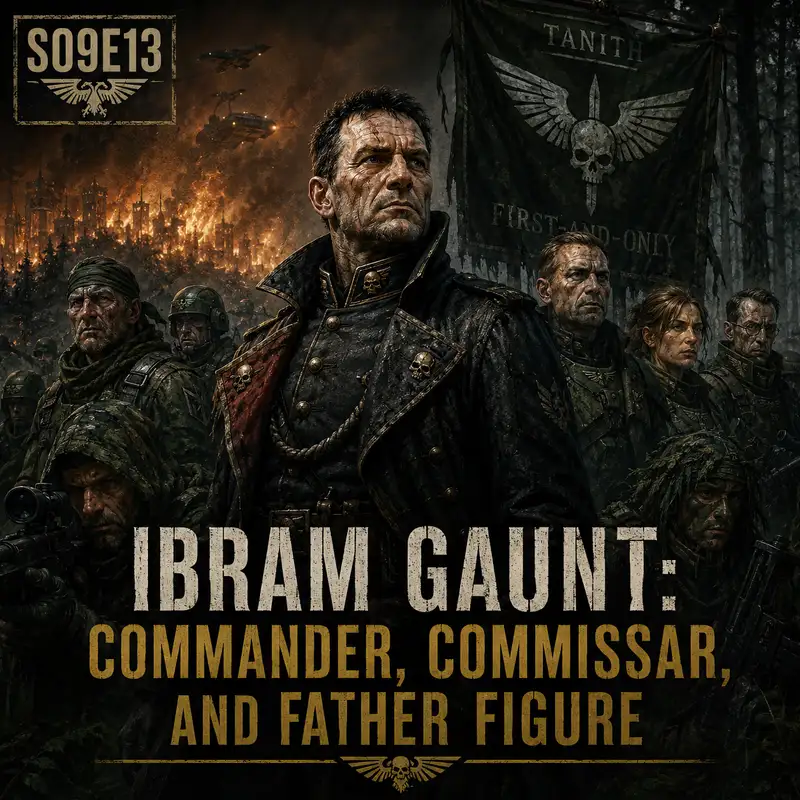
Ibram Gaunt: Commander, Commissar, and Father Figure
Tanith was already dying when Ibram Gaunt gave the order that would define his life. The newly raised regiments were preparing to leave when a Chaos fleet broke through and began the destruction. Gaunt could have ordered the soldiers to remain, defend their homes, and die in a gesture that satisfied every Imperial instinct about honour. Instead, he forced as many as possible aboard the transports and fled. He saved thousands of lives. The survivors hated him for it. In one night, Gaunt became their commander, their commissar, and the man they blamed for being alive.
That contradiction is the key to Ibram Gaunt. A commander must spend lives to achieve an objective. A commissar must enforce loyalty when fear or grief makes loyalty difficult. A father figure is expected to protect, guide, and preserve. In the Imperial Guard, those duties do not fit together neatly. The institution turns human beings into military strength, not a family. Gaunt never escapes that machinery. His achievement is that he creates something resembling a family inside it, while still ordering that family into battles from which many will not return.
Gaunt had been shaped for duty long before Tanith. Orphaned young, he passed through the Schola Progenium, where children of Imperial servants were trained for lives of service. It was an education built around discipline, faith, and the removal of softness. He later served with the Hyrkan Eighth and earned a reputation for courage in the opening years of the Sabbat Worlds Crusade. Warmaster Slaydo eventually granted him the rare rank of Colonel-Commissar and command of three new regiments from Tanith. It was extraordinary trust, followed almost immediately by extraordinary disaster.
The title Colonel-Commissar matters because the two offices normally stand apart. A colonel commands the regiment. A commissar watches its soldiers and officers, preserving morale and loyalty through inspiration, intimidation, or a bolt pistol applied with administrative finality. Combining the roles gives Gaunt enormous authority, but removes a useful distance. He cannot advise a commander and judge the result. Every order is his. If the troops break, he must restore discipline. If they die obeying a foolish plan, that plan may also be his. One man holds both the map and the execution warrant.
The destruction of Tanith made this authority personal. The soldiers came from a forest world whose moving nalwood trees had taught them stealth, patience, and an instinctive sense of terrain. They should have formed three regiments. After the evacuation, there were only enough for one. They became the Tanith First-and-Only, a name that sounded like pride and carried the weight of a funeral. Gaunt preserved their soldiers, but not their families, towns, forests, or future generations. They carried only a promised Right of Settlement, the hope that long service might someday earn them a new home.
Major Elim Rawne gave their resentment its sharpest edge. He believed Gaunt had stolen the regiment's chance to die defending Tanith, and for a long time regarded killing him as unfinished business. Colonel Colm Corbec was warmer, more approachable, and better able to speak to the rank and file. Between them, Gaunt faced two truths about leadership. Authority can be granted from above, but legitimacy must be built from below. The uniform made him their commander. It did not make him one of them. That would require battle, loss, and proof that he understood what their lives were worth.
Gaunt's first important act after saving the Tanith was to notice what they could do. They were not ideal heavy infantry. They were scouts, infiltrators, marksmen, and woodsmen who could disappear into terrain that stopped other regiments cold. The Imperial Guard has never lacked methods for solving tactical problems by adding bodies. Gaunt's better instinct was to use the Ghosts as the force they were, rather than punish them for not being something else. Their early victories came through stealth and initiative. Each success turned his decision on Tanith from an act of retreat into the beginning of a military identity.
This is where his role as commissar begins to change. Gaunt can be severe, and he is capable of imposing discipline. He is not a kindly schoolmaster wearing a black coat by clerical error. Yet he treats execution as a final instrument, not the first item on the morning schedule. More importantly, he uses commissarial authority upward as well as downward. He challenges officers who waste his troops, resists orders shaped by rivalry or vanity, and forces commanders to recognise that the Ghosts are soldiers rather than expendable woodland equipment. He cannot protect them from war. He can sometimes protect them from stupidity.
Gaunt is not a father figure because he keeps the regiment safe. The Ghosts are rarely safe for more than the time required to receive new ammunition. He becomes paternal because he draws a line between necessary danger and meaningless waste. He asks his troops to accept dreadful risks, but tries to make those risks serve a purpose. He also shares them. Gaunt leads from the front often enough that his courage is never theoretical. The soldiers may resent him or question his sanity, but they know he is not issuing orders from a distant bunker while someone else pays the bill.
The siege of Vervunhive on Verghast transforms that respect into something larger. The hive is trapped in a civil war against Ferrozoica, with Chaos corruption, political rivalry, and military incompetence making a bad situation worse. Gaunt arrives as one regimental commander among many, but gradually assumes control because he can see the battle as a whole. He coordinates defenders who do not trust one another, identifies threats others dismiss, and keeps fighting after formal command begins to fail. Vervunhive proves he is more than an excellent leader of scouts. He can command a city at war.
Victory at Vervunhive gives Gaunt a choice about what the First-and-Only will become. He could preserve it as a shrinking memorial, defined by bloodline and loss until attrition erased it. Instead, he opens its ranks to volunteers from Vervunhive. The new soldiers bring different accents, customs, experiences, and grievances. Women enter a regiment raised from Tanith's men. Survivors of another ruined home join survivors of the first. The decision causes friction, but prevents the Ghosts from becoming a sealed tomb. Gaunt does not replace Tanith. He allows Tanith to survive by becoming capable of change.
That is one of his most fatherly decisions, though it is not sentimental. A poor guardian preserves a child by refusing to let the child grow. Gaunt preserves the regiment by accepting that its future cannot copy its past. The Verghastites do not merely fill empty positions. They alter the unit's culture, relationships, and sense of itself. Later, soldiers from Belladon add another strand. The First-and-Only becomes less a regiment from one planet and more a community built from people who have lost worlds, cities, comrades, and certainty. Gaunt stands at the centre as custodian, not owner, of that identity.
He understands that a family cannot be held together by one voice. Corbec provides warmth and instinctive humanity. Rawne supplies aggression, suspicion, and the willingness to say what others will not. Doctor Dorden represents care without illusion. Scout Sergeant Mkoll embodies the Tanith craft at its most extraordinary. Brin Milo carries memory, music, and the last echoes of the world itself. Gaunt relies on these figures because command is not omniscience. He listens, delegates, argues, and sometimes has the good sense to recognise that a subordinate understands the immediate problem better than he does.
His relationship with Rawne is especially revealing. Rawne's hatred is not removed by a speech or a convenient act of forgiveness. It changes through repeated proof. Gaunt keeps trusting a man who once wanted him dead because Rawne is valuable, honest in his hostility, and fiercely committed to the regiment. Rawne learns that Gaunt's decision on Tanith was not cowardice. Their bond never becomes soft. It becomes stronger than softness because it is built from tested judgment. Gaunt does not demand affection as the price of loyalty. He gives responsibility and allows loyalty to become a choice.
Corbec represents a different bond. He can laugh with the troops, soften Gaunt's severity, and remind the regiment that morale is not produced solely by regulations. When the Ghosts lose Corbec, Bragg, and many others whose names become part of their shared memory, Gaunt cannot retreat into the clean language of casualty reports. He grieves, sometimes badly. The losses accumulate inside him. This is strength and weakness. A commander who feels every death may fight harder to prevent waste. He may also carry guilt for events no commander could have controlled.
The difference between protection and purpose becomes clearer across later campaigns. On Hagia, Phantine, Aexe Cardinal, and other worlds, the Ghosts enter situations designed by people who misunderstand their abilities. Gaunt repeatedly looks for a way to turn those assignments into missions the regiment can accomplish on its own terms. During the trench war on Aexe Cardinal, lightly equipped scouts are pulled toward a battle built around static lines and mass casualties. Gaunt cannot abolish the war. He can find an operation where stealth and initiative matter more than obediently occupying the next section of mud.
This is not indulgence. Gaunt expects the Ghosts to perform at a level that would break many units. His confidence can be merciless because it rests on knowledge of what they have survived. He sends small teams behind enemy lines, orders assaults under impossible conditions, and accepts plans with narrow chances of success. A father in civilian life might prove love by keeping children from danger. Gaunt exists where danger is the permanent address. His version of care is preparation, trust, and refusal to lie about the cost.
The mission to Gereon pushes this principle close to its limit. An Imperial general has fallen into enemy hands with knowledge that could damage the crusade. Gaunt leads a small infiltration team into a Chaos-occupied world to stop him. The objective is ruthless, the environment corrupting, and the local resistance has endured horrors that cannot be corrected by one operation. Gaunt goes with the team rather than sending them alone. He shares the contamination, hunger, fear, and moral compromise. This does not make the mission kinder. It makes his authority inseparable from the consequences.
Gereon also exposes the limits of promises. Gaunt sees the suffering of the occupied population and commits himself to returning with liberation. When Imperial forces finally come back, victory does not restore what was lost. The world has been damaged by Chaos, and Imperial suspicion treats that damage as evidence against the victims. Gaunt tries to save Gereon from the enemy and from the machinery of reclamation. His loyalty to the Imperium remains real, but so does his recognition that Imperial institutions can destroy those they claim to rescue. Bringing the army home does not necessarily bring anyone home.
After Gereon, Gaunt returns to find that he has been presumed dead and the Ghosts absorbed into another formation. Rank, reputation, and history do not instantly restore the old arrangement. He must confront suspicion that he has been tainted, operate under different command, and prove that a catastrophic deployment is exactly what it appears to be. The story tests whether the regiment is merely Gaunt's possession. It is not. The Ghosts have changed without him and served another respected commander. Their return matters because it is not automatic. The bond survives separation because it has become mutual.
That dependence becomes unmistakable when Gaunt is wounded, isolated, or brought close to death. The Ghosts rescue him, protect him, argue for him, and carry the burden when he cannot. A paternal relationship that only flows downward is control wearing a warmer coat. Gaunt's regiment becomes a family because care travels in both directions. He gives them identity and purpose, but they preserve his humanity. Without the Ghosts, he would still be a commissar and an officer. He would be less clearly Ibram Gaunt.
As the crusade expands and Gaunt rises toward senior command, the scale of responsibility becomes more dangerous. He moves from leading patrols and regiments to advising Warmaster Macaroth and influencing campaigns that decide worlds. The skills are related, but the moral distance is greater. At regimental level, he can know the names behind many decisions. At crusade level, lives become columns, reserves, and acceptable losses. His years with the Ghosts give him something strategic commanders often lose. He remembers that every symbol on a map contains people who will experience the plan at ground level.
It would be easy to make Gaunt the good Imperial officer surrounded by bad ones. The truth is less comfortable. He serves an authoritarian empire, enforces its wars, and accepts sacrifices that would be monstrous by ordinary standards. His compassion is genuine, but it operates inside a system built on conquest, obedience, and fear. He can become stubborn, controlling, and convinced that responsibility requires him to carry every burden. Loyalty to his soldiers can conflict with wider duty, while loyalty to the crusade can require him to hurt those closest to him. He is admirable partly because the choices remain compromised.
That tension keeps him from becoming a simple action hero. Gaunt wins fights with a chainsword and survives situations that reduce nearby architecture to fragments. Yet his important battles are arguments about value. Are soldiers merely resources? Is survival dishonourable when a home is lost? Can a regiment absorb outsiders without betraying its dead? Does loyalty mean obeying a commander, or trusting that commander to question a disastrous order? Can the Imperium liberate a world without treating its people as contaminated material? Gaunt rarely receives clean answers. He continues making decisions anyway.
The father figure in the First-and-Only is not Gaunt alone. Corbec, Dorden, Mkoll, and others provide forms of guidance that he cannot. Families emerge among the troopers, especially after Vervunhive, where adults and children carry private histories into the regiment's wandering life. Gaunt's role is broader. He creates the conditions in which those bonds can exist. He protects space for memory, loyalty, rivalry, grief, and renewal inside an organisation that would otherwise measure the Ghosts by combat strength and replacement schedules.
This is why the nickname Gaunt's Ghosts means more than ownership. The regiment bears his name because his choices made its existence possible, but the name also records an exchange. He gives the survivors a future, and they give him a home. He was not born on Tanith. He never walked its forests as a child or belonged to its clans. Yet he becomes responsible for carrying Tanith forward. Not as a planet, because the planet is gone. Not as a bloodline, because the regiment changes. He carries it as a set of remembered obligations.
For newcomers to Warhammer forty thousand, Gaunt brings the setting down from gods, primarchs, and planet-killing weapons. His stories concern ordinary human beings asked to endure an inhuman age. The Ghosts are skilled, but not invulnerable. They become tired, jealous, frightened, loyal, bitter, funny, and brave. Their deaths are not abstract demonstrations of darkness. They leave empty places in squads and friendships. Gaunt's attention to those absences tells us that individual lives still matter, even when the Imperium behaves as though it has an unlimited supply.
For established fans, his endurance offers a difficult form of heroism. Gaunt does not defeat the setting's cruelty. He cannot redeem the Imperium, restore Tanith, or save every soldier who trusts him. He can keep choosing between bad options without allowing necessity to become an excuse for indifference. Sometimes he succeeds. Sometimes his judgment fails. Sometimes the cost arrives years later. His decency is not purity. It is a discipline, maintained under pressure, damaged by grief, and renewed because other people depend on it.
Commander, commissar, and father figure are not separate masks. They are three demands placed on the same man. The commander gives the Ghosts direction. The commissar gives their service a moral and political frame, however harsh that frame may be. The father figure gives them continuity, the belief that they are more than another disposable formation in a crusade that can barely count its dead. Gaunt's greatness lies in holding these roles together without pretending they are painless. He protects by preparing. He loves by trusting. He leads by accepting that every order creates a debt.
The image that defines him is still Tanith burning behind departing transports. Gaunt saved the soldiers and lost their affection. Years later, after sieges, infiltrations, betrayals, promotions, and graves on worlds far from home, the survivors no longer follow because a Warmaster placed him in command. They follow because he has shown that their lives mean more than the next objective. Ibram Gaunt's greatest command was not to make the Ghosts die for Tanith. It was to teach them how to live after Tanith was gone.