Huron Blackheart: Pirate King of the Maelstrom
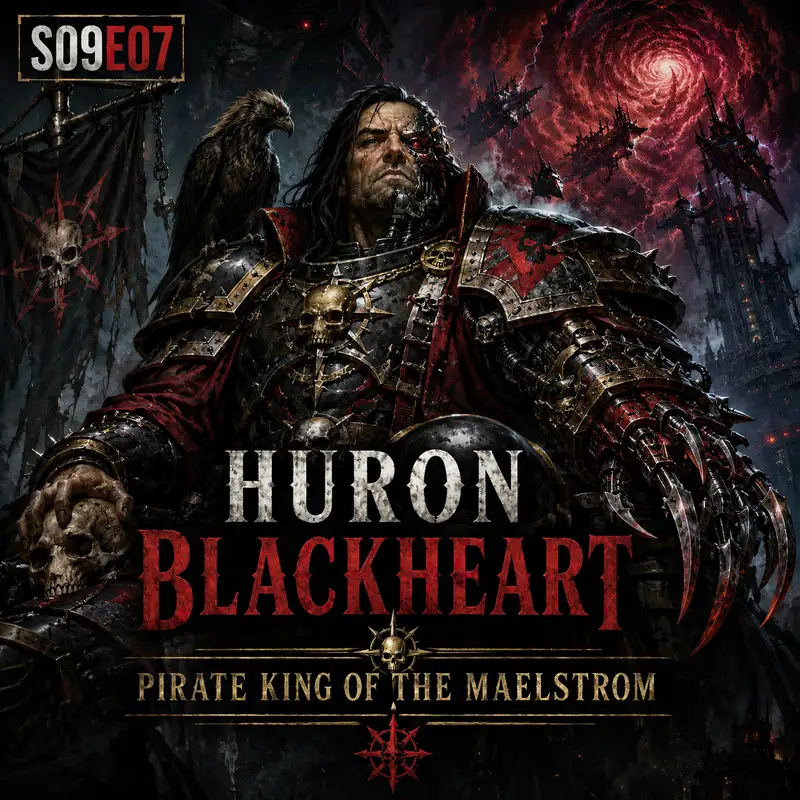
By the time the last Astral Claws landing craft clawed its way clear of Badab, Lugft Huron was barely alive. Half his body had been ruined by a melta blast. His fortress was falling, his allies were broken, and the empire he had built in the Emperor’s name was being dismantled room by room. Yet the men carrying him into the Maelstrom were not rescuing a defeated governor. They were preserving the beginning of something worse. The wounded Chapter Master would survive, take the name Huron Blackheart, and turn a military rebellion into one of the most dangerous pirate realms in the galaxy.
That transformation is the central contradiction of Huron’s life. He did not begin as a frothing devotee of the Dark Gods, nor as an ancient traitor nursing a grievance from the Horus Heresy. He began as an Imperial Space Marine with an enviable record, a talent for command, and a problem the Imperium had repeatedly failed to solve. The Maelstrom was a wound in reality surrounded by unstable routes, raider kingdoms, alien threats, and human worlds that could be attacked faster than distant authorities could respond. Huron looked at this frontier and concluded that only concentrated power could save it. Unfortunately, he also concluded that the power should be his.
The Astral Claws had been assigned to the Maelstrom Warders, a group of Space Marine Chapters charged with containing the region. Huron rose through his Chapter as an aggressive and gifted officer, particularly skilled at coordinating firepower and overcoming larger forces. He inspired loyalty because he produced results. That sounds ordinary until one remembers that Space Marines are already trained to regard hesitation as a medical condition. Among such warriors, Huron still stood out. He gathered followers, advanced rapidly, and eventually became Chapter Master after the death of his predecessor. The man who would later rule pirates first learned to rule professionals who believed competence was a form of moral authority.
His early service in the Maelstrom reinforced that belief. Huron fought the enemies of the Imperium, won important victories, and became a celebrated defender of local populations. He saw at close range how badly the region needed ships, soldiers, fortifications, and political unity. He also saw how slowly the wider Imperium moved. Requests crossed distances measured in months or years. Decisions were made by officials who would never see the worlds affected by them. Reinforcements were always required somewhere else, which in the Imperium is less an excuse than a permanent condition of government. Huron’s frustration was not invented. His answer to it was the beginning of his damnation.
Huron proposed a great campaign to pacify the Maelstrom Zone, with himself at the centre of the effort. The High Lords refused. Imperial forces were committed elsewhere, and the Maelstrom would have to endure. To Huron, this was proof that distant rulers lacked both vision and courage. To the High Lords, it was one more demand from one more frontier commander who believed his war was the only war that mattered. Both positions contained some truth. The Imperium was overextended, and Huron was ambitious. The disaster came because he treated those facts not as limits to be managed, but as permission to replace Imperial authority with his own.
He took control of Badab, first as protector and then as self-appointed master of the wider system. There was precedent for Space Marines governing territories. The realm of Ultramar offered the most famous example. Huron used the language of duty, security, and the Emperor’s service, and for a time the arrangement appeared effective. Badab became the centre of a hardened regional power. Local resources could be directed toward local defence instead of disappearing into administrative channels. The difficulty was that Huron did not regard this authority as temporary. Each emergency justified another expansion of his control, and each success made outside supervision look less necessary.
Then the tithes began to stop. Huron withheld gene-seed owed to the Adeptus Mechanicus. He retained planetary resources, restricted trade routes, and redirected wealth into his own military programme. He could argue that the material was being used to defend Imperial citizens. The trade lords beyond Badab could argue that he was strangling the system that supplied the wider Imperium. The Administratum could argue that a tithe is not a friendly suggestion. Everyone involved possessed a document explaining why everyone else was at fault. This is often how Imperial civil wars begin. The shooting merely provides a later opportunity to simplify the paperwork.
For roughly a century and a half, the crisis remained unresolved. That delay mattered. Huron had time to make his exceptional measures normal. He expanded the Astral Claws beyond the limits expected of a Chapter and concealed surviving members of the Tiger Claws within his ranks. He developed forces that answered to him, including human troops organised under the rule of the Tyrant of Badab. He built fortifications, fleets, and supply relationships. What had begun as a plan to secure a frontier was becoming a private war machine. Huron still claimed loyalty to the Emperor, but loyalty had been redefined to mean obedience to Huron’s interpretation of the Emperor’s needs.
The break came when an Imperial tithe fleet entered the Badab system and demanded what was owed. Huron’s forces ordered it to halt and follow local procedures. The fleet asserted Imperial authority and continued inward. The exact sequence remains disputed, which is fitting, because the important fact is not who issued the final warning. The tithe fleet was destroyed. Huron insisted that he had acted against a hostile force that ignored lawful navigation orders. His enemies saw the annihilation of Imperial ships by a commander who had already withheld taxes, gene-seed, and access. From that point, procedure was no longer going to contain the problem.
Huron answered the growing pressure with the Articles of Just Secession. He argued that the Maelstrom Warders possessed rights granted by the Emperor and should be free from the demands of neighbouring Imperial authorities. He did not initially declare war on humanity or kneel publicly before Chaos. He claimed that he and his allies would continue defending the region. This made his rebellion attractive to other Space Marines who believed they were protecting honour, autonomy, and an essential mission. The Lamenters and Mantis Warriors joined the secessionist cause, while the Executioners entered the conflict through bonds of obligation. Huron built his coalition from grievances the Imperium had helped create.
That does not absolve him. Huron was not merely the victim of a bureaucratic misunderstanding with unusually heavy artillery. He had hidden the growth of his forces, subverted Imperial systems, and made himself the final judge of what law applied within his domain. When investigation threatened his position, he did not submit to review. He escalated. His political argument depended on the claim that he alone could defend the Maelstrom, while his military preparations ensured that any challenge would become a war. By the time open conflict began, Huron’s cause and Huron’s power were almost impossible to separate. That was precisely how he preferred it.
At first, the secessionists fought well. They knew the region, possessed strong naval forces, and could exploit prepared defences. Huron’s coalition was not a rabble. It was a collection of Space Marine formations commanded by veterans who understood void warfare, rapid assault, and the politics of honour. Loyalist forces struggled to bring them to decisive battle. Yet Huron’s greatest strength contained a weakness. His alliance depended on personal obligations and shared resentment rather than a durable political order. The Imperium could replace losses, summon additional Chapters, and widen the war. Huron could not easily replace trust once his allies began to see what his rule had become.
The investigation also exposed the scale of his deception. Captured evidence revealed the hidden Tiger Claws and the unlawful expansion of the Astral Claws. Huron’s apothecaries had taken gene-seed from the dead. His forces had made arrangements with forbidden scavengers and resorted to weapons that stripped away any remaining appearance of a limited constitutional dispute. Each revelation narrowed the moral space available to his allies. The question was no longer whether local defenders had been mistreated by distant officials. It was whether they were prepared to follow a ruler who had built a secret army and would burn worlds rather than surrender it.
The loyalists tightened their grip. The Lamenters were isolated and crushed in a brutal fleet action. The Mantis Warriors were worn down and forced to surrender after the devastation of their territories. The Executioners eventually broke with Huron’s cause. Supply routes closed. Fortified worlds fell. The war that had begun with a claim of regional necessity became a retreat toward Badab itself. Huron’s empire contracted until its political philosophy could be measured in corridors, bunkers, and ammunition stores. He had once argued that no distant authority could protect the Maelstrom. Now the Imperium had brought enough authority to bury him beneath it.
The last stand came at the Palace of Thorns, Huron’s fortress on Badab. The Star Phantoms led the assault under the cover of immense orbital bombardment. Drop pods and gunships forced an entry into a position designed to survive conventional attack. Inside, Astral Claws used hidden routes, prepared ambushes, and intimate knowledge of the complex to slow the advance. Space Marines fought Space Marines through chambers built by men who had once expected both sides to call them loyal. The battle was close, methodical, and murderous. There was little room left for speeches about jurisdiction. At that range, history was decided by demolition charges and bolt rounds.
When loyalist teams destroyed the systems protecting the fortress, the defence collapsed. Huron attempted to escape with the remnants of his Chapter. Captain Zhrukal Androcles of the Star Phantoms caught him during the retreat and struck him with a melta weapon. The blast destroyed much of Huron’s right side and left him at the edge of death. More than two hundred Astral Claws still escaped into the Maelstrom carrying their ruined master. Badab was lost. The rebellion was broken. By every normal measure, Lugft Huron’s career had ended. The Maelstrom, as usual, was not especially interested in normal measures.
His survival marked the point where the Tyrant of Badab became Blackheart. Apothecaries and Techmarines rebuilt what they could, replacing ruined flesh with brutal machinery. The precise nature of his recovery is obscured, but the surviving accounts connect it to a bargain with the powers of the Warp. A strange familiar called the Hamadrya appeared at his side. The ruined side of his body became the anchor for the brutal weapon known as the Tyrant’s Claw. Huron did not emerge as a humbled exile. He renamed himself, renamed his followers, and converted defeat into a founding legend. The Astral Claws had failed to create an autonomous Imperial realm. The Red Corsairs would create a realm that no longer needed Imperial approval.
The new name mattered. A Chapter is defined by lineage, law, heraldry, and duty. A corsair band is defined by its captain, its ships, and the promise of reward. Huron discarded the institutions that had judged him and built an organisation around personal allegiance. Renegade Space Marines, traitors, mercenaries, human reavers, mutants, and alien auxiliaries could all find a place if they accepted his supremacy. He did not require a shared primarch or a common creed. He required usefulness, tribute, and obedience. This made the Red Corsairs less pure than a Traitor Legion, and in practical terms far easier to expand.
Huron’s rule combines freedom below with terror above. His captains are allowed to raid, plunder, and pursue their own ambitions so long as they do not obstruct his larger designs. They keep much of what they take, but a portion flows back to the master of the Maelstrom. Those resources buy weapons, maintain ships, reward followers, and secure further alliances. It is piracy organised as feudal government. Huron does not need to supervise every boarding action. He only needs to make rebellion against him more dangerous than service beneath him. The arrangement is flexible, profitable, and entirely dependent on the continued credibility of one very angry man.
This is why the title pirate king fits him better than it first appears. Huron is not simply a raider who owns an impressive coat. He controls territory, trade, military force, and access through a region that weakens ordinary Imperial power. The Maelstrom shelters his fleets and complicates pursuit. Captured vessels become additions to his armada. Defectors become recruits. Prisoners become bargaining pieces, slaves, or examples. Loot becomes ammunition and political capital. Every raid can strengthen the next raid. The Red Corsairs are not living outside civilisation. They are building a predatory civilisation whose economy begins when someone else’s airlock fails.
Their preferred style of war reflects that economy. The Red Corsairs excel at naval combat and boarding actions because ships are more valuable intact than destroyed. A captured cruiser is not merely a trophy. It is transport, firepower, living space, spare parts, and proof that Huron can take what the Imperium cannot protect. The seizure of loyalist vessels has sometimes brought their crews or Space Marines with them, whether through coercion, bitterness, or genuine defection. Huron offers renegades something the older Traitor Legions may not. He offers a place in a growing enterprise where recent betrayal matters more than ancient pedigree.
That distinction is important. Abaddon commands the Black Legion through the long memory of the Horus Heresy and a grand war against the Imperium. Huron commands many who have no place in that ancient story. They are Chapter outcasts, failed warlords, deserters, criminals, opportunists, and survivors of newer grievances. The Red Corsairs can absorb them without asking them to pretend they were present at Terra ten thousand years ago. Huron’s cause is immediate. The Imperium used you, condemned you, or abandoned you. Bring your ship, swear loyalty, and take payment from its bleeding frontier. It is recruitment by resentment, and the Imperium manufactures the raw material in abundance.
Huron’s relationship with Chaos is equally practical and equally dangerous. He uses the powers of the Warp, accepts their gifts, and commands followers who serve different gods or none with particular devotion. Yet he is not usually presented as a simple priest of one divine patron. He prefers to imagine that he is bargaining from strength, taking what he needs while preserving his own will. This belief is common among Chaos warlords and has an impressive record of ending badly. Huron’s scars, machinery, familiar, and survival all suggest that the bargain has already reached deeper than he admits. A chain does not become freedom merely because its wearer negotiated the length.
The Hamadrya deepens the unease around him. The creature is more than decoration, and some accounts imply that it helps Huron perceive threats and plots. Whether it whispers warnings, reflects his pact, or simply reminds every visitor that unseen powers attend him, its political value is obvious. The Red Corsairs are full of ambitious killers. Huron grants them autonomy because autonomy attracts talent, but he must also prevent talented followers from becoming independent rivals. His court therefore runs on reward, suspicion, sudden violence, and the occasional disappearance of someone who had recently begun speaking about succession.
This system should collapse. Its members are treacherous, its alliances transactional, and its ruler surrounded by people who would replace him if they believed they could survive the attempt. Yet it endures because Huron understands the population he governs. He does not demand virtue from villains. He designs incentives around appetite. Captains receive prey. Warriors receive battle. Merchants receive stolen goods. Sorcerers receive access to forbidden places. Those who want status can earn it, and those who challenge the throne provide educational material for everyone else. The Imperium often insists that loyalty is sacred while neglecting the loyal. Huron offers no such illusion. His loyalty has a price, a share, and an enforcement clause.
His power has grown far beyond the survivors who fled Badab. The Red Corsairs have become one of the largest and most dangerous renegade forces in the eastern reaches of the Imperium, with a fleet assembled from theft, defection, trade, and conquest. Huron has dealt with other great powers of Chaos without surrendering his identity to them. His forces have struck major Imperial targets, challenged famous Chapters, and played roles in wars that reach well beyond the Maelstrom. Even when a raid fails, the existence of his realm forces the Imperium to guard routes, escort shipping, and divert warriors from other fronts. A pirate king wins partly by making everyone else pay for the possibility of his arrival.
Huron remains dangerous because his original grievance never became entirely false. The Imperium does abandon frontiers. It does consume resources without explaining where they go. It does ask defenders to die while distant officials debate jurisdiction. A less compelling villain would simply lie about these things. Huron tells enough truth to make obedience seem reasonable, then places himself at the end of every argument. He offers the efficiency of tyranny to those exhausted by disorder. He offers freedom to raiders, provided that freedom pays tribute. He offers brotherhood to renegades, provided no brother forgets who owns the fleet.
That is the path from Chapter Master to pirate king. Huron did not abandon command when Badab fell. He stripped command of every restraint that had once made it service. Duty became possession. Protection became control. Autonomy became secession. Survival became proof of destiny. The Red Corsairs are the final shape of that logic, a war fleet held together by appetite and the will of a ruler who believes every betrayal committed against him excuses the betrayals he commits in return. Somewhere within the Maelstrom, the ruined man carried from the Palace of Thorns still sits at the centre of his stolen empire, demanding payment from a galaxy he insists has always owed him.