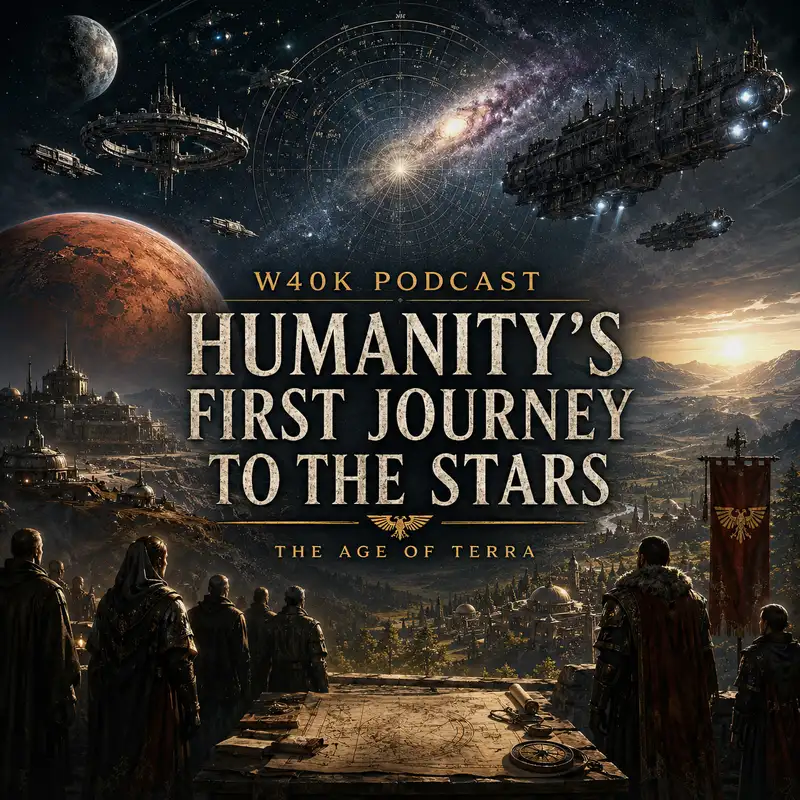
Humanity’s First Journey to the Stars
The first humans to reach another star may have arrived with no living memory of Earth. The people who chose the destination could have been dead for centuries. The children who opened the hatches may have been born between suns, raised inside machinery whose failure would have ended their entire world. When they stepped beneath an alien sky, they were not explorers in the familiar sense. They were the descendants of explorers, carrying a civilisation that had already begun to change before the voyage was complete.
No reliable archive preserves the name of their ship. No monument in the forty-first millennium records the face of its commander. The route, the destination, and even the exact century have been swallowed by wars, collapse, deliberate destruction, and the simple decay of time. Humanity remembers the Great Crusade in banners and blood. Its first departure from the cradle survives as fragments.
That absence is fitting, because humanity’s first journey to the stars was probably not a single heroic flight. It was a long transition from one world to many, from voyages measured in days to voyages measured in generations, and from a species with one shared home to a species divided by distance. The central question is not merely how human beings reached the stars. It is what they had to become in order to survive the journey.
Later Imperial chronologies call the earliest great period of human history the Age of Terra. It stretched from the beginnings of recorded history to roughly the fifteenth millennium, though surviving accounts disagree over where one age ends and the next begins. Fifteen thousand years is a generous margin of error, even by the standards of an administration that can misplace a planet and still demand its taxes.
For most of that age, humanity remained bound to the world we know as Earth and later generations would call Terra. Nations rose, prospered, fought, fragmented, and vanished. Civilisations that believed themselves permanent became names in damaged records. Technology advanced unevenly. Human beings learned to cross oceans, master the atmosphere, place machines in orbit, and finally send people beyond their world.
The first step was not toward another star. It was toward the nearest bodies in the Solar System.
Luna became the first proof that humanity could leave its birthplace and stand somewhere else. The achievement would become so ancient that, by the time of the Imperium, even its details had blurred into legend. That is the fate of almost everything familiar in Warhammer forty thousand. Our future is their prehistory, and their scholars have had ten thousand additional years of catastrophe in which to lose the paperwork.
From Luna, the horizon expanded. Orbital stations became permanent. Industry moved into vacuum. Mars was settled and became the first world humanity terraformed, transformed from a hostile planet into a place capable of sustaining human civilisation. It developed into a centre of science, engineering, and technological ambition long before the red robes of the Mechanicum or the rituals of the Cult Mechanicus gave later ages their particular combination of machinery and incense.
Human settlements spread farther. The moons of Jupiter, Saturn, and Neptune became notable centres of habitation. Mining, research, manufacturing, and the control of distant resources made the Solar System a connected human domain. By the end of the fifteenth millennium, humanity had colonised most of Sol.
Colonised did not mean comfortable. It did not mean that every moon possessed a pleasant city and reliable catering. It meant that human beings had learned to build enclosed worlds where nature had provided none. Air had to be made or preserved. Heat had to be controlled. Water had to be recovered. Food had to be grown inside systems that could not afford romantic failure. A settlement on an airless moon was not simply a town in an inconvenient location. It was a machine that happened to contain people.
That changed the societies living within it. On Earth, a political mistake might ruin a government. On a habitat, a maintenance mistake could ruin the atmosphere. Engineers, medical specialists, life-support technicians, and resource planners were not merely useful citizens. They stood between the population and immediate extinction. Technical knowledge carried political weight because physics did not accept appeals, exemptions, or speeches.
Distance also weakened the idea that Earth could control every human community directly. A message to an outer settlement could travel no faster than light. Ships moved more slowly still. Local leaders had to make decisions without waiting for permission. Colonies developed institutions suited to their environments, and those institutions produced different priorities. Terra remained the cradle, but it was no longer the only place where humanity decided what humanity should be.
This was the first quiet fracture. It was not rebellion. It was consequence.
As the Solar System filled with settlements, ships, and industry, the stars remained visible beyond it. They were no longer symbols. They were destinations. The same species that had crossed oceans and planetary space began attempting a greater passage, but the scale of the problem changed completely.
The distance between planets is severe. The distance between stars is another category of cruelty.
Without faster-than-light travel, a ship bound for even a nearby system could spend centuries in the void. Later accounts describe early colonising vessels separated from Earth by as many as ten generations of travel. The people who launched the ship might never see its destination. Their children would inherit the mission. Their descendants would complete it.
Such a vessel could not be treated as a vehicle carrying passengers. It had to function as a travelling state. It needed food production, medicine, education, industry, power, governance, and the ability to repair the systems on which every life depended. It needed enough people, knowledge, and biological continuity to establish a viable population at the far end. It also needed a social order capable of convincing people born inside the ship that a world they had never seen was worth reaching.
That last requirement may have been the most difficult.
The original crew could remember Earth. The second generation could remember those who remembered it. By the fifth or sixth generation, the homeworld was an inherited description. By the tenth, it was a story. The destination was another story. Between them lay only the ship.
The mission therefore depended on culture as much as engineering. Procedures had to become traditions. Training had to be passed down with precision. The reasons for the voyage had to survive changes in leadership, crisis, boredom, grief, and the ordinary human ability to reinterpret instructions when the people who wrote them are conveniently unavailable for comment.
The ship’s society also had to endure the knowledge that turning back was almost meaningless. A failure discovered decades after departure could not be corrected by returning to the launch platform. Rescue was not delayed. Rescue was impossible.
How many vessels failed is unknown. The successful colonies left descendants and records, however damaged. The lost left silence, which is history’s least informative source. What can be said is that the first expansion was small, slow, and faltering. Humanity moved outward in steps that later ages, accustomed to warp travel, would barely recognise as interstellar movement at all.
Those early colonies were isolated. Even if they survived, communication with Terra took years. Trade was rare or impractical. Each settlement had to become self-sufficient, and each became politically distinct by necessity. A charter issued on Earth might define the purpose of a mission, but it could not decide how the colony would respond to a failed harvest two centuries later.
The result was not one human empire spreading neatly across a map. It was a scattering of human worlds. Some may have preserved close loyalty to Terra. Others developed their own governments, cultures, and identities. Their inhabitants remained human, but human no longer meant culturally identical, politically united, or even shaped by the same environment.
The first journey to the stars therefore multiplied humanity before it unified the stars.
It also carried human beings into a galaxy that was neither empty nor waiting for them.
The Aeldari Empire stood at its height. Its civilisation had crossed the galaxy through the Webway and commanded powers that early humanity could scarcely have understood. To the Aeldari, the first human vessels were not the arrival of a rival civilisation. They were the uncertain movements of a young species at the edge of significance. Later accounts suggest that some Aeldari regarded nascent human culture with fleeting curiosity. That interest did not make humanity important. It merely meant someone had noticed.
Other encounters were less distant. Fragments of the surviving record indicate that early humans made accords with some alien peoples and fought wars against others. The exact identities and sequence remain unclear. Orks are often named among humanity’s earliest enemies, and may have been the first major alien civilisation encountered during interstellar expansion.
That possibility carries a certain grim symmetry. Humanity may have left its home system seeking new worlds and almost immediately met a species that regarded war as both social organisation and leisure activity. The galaxy had provided a welcoming committee. It was armed.
There is no reliable account of a first human and Ork battle from this era. No honest history can supply the speeches, fleet sizes, or heroic last stands that the sources do not preserve. What survives is the larger fact. Human expansion produced diplomacy and conflict from the beginning. There was no universal policy toward alien life, because there was no single human authority capable of enforcing one. Some colonies bargained. Some fought. Some were probably destroyed. Others endured.
This matters because the later Imperium would teach that humanity and the alien had always been natural enemies. The older fragments suggest a more complicated beginning. War was common, especially with species such as the Orks, but agreements also existed. Human attitudes hardened across later ages through conflict, betrayal, propaganda, and catastrophe. The xenophobia of the Imperium was not carried unchanged from the first starship. It was forged over millennia.
The slow expansion continued from roughly the fifteenth to the eighteenth millennium. Human ships reached nearby systems, established isolated colonies, and pushed the frontier outward. Yet sublight travel imposed a strict limit. A civilisation could settle the stars this way, but it could not easily remain one civilisation.
A government on Terra could send laws to a colony, but the answer might return after the government had fallen. A merchant could dispatch cargo, but market conditions would be slightly out of date by the time the buyer’s great-grandchildren received it. Military reinforcement moved too slowly to answer invasion. News became archaeology before it arrived.
Humanity had crossed interstellar space, but distance still ruled it.
Then human science found a way around distance, and discovered a more dangerous problem.
By approximately the eighteenth millennium, humanity developed the warp drive and the protective technology later known as the Gellar field. The warp was not simply another region of ordinary space. It was a parallel realm shaped by psychic force, emotion, and powers that human science did not fully comprehend. Distances within it did not correspond neatly to distances in reality. A ship could enter the warp, travel through that unstable medium, and return to realspace far beyond the reach of any conventional drive.
This was the breakthrough that changed the first journey from an extraordinary expedition into the beginning of a galactic expansion.
The Gellar field made the voyage possible by preserving a bubble of realspace around the vessel. Without that protection, the ship and everyone aboard it would be exposed to the warp itself. Later humanity would surround the field with prayer, ritual, and terror. Early engineers approached it as technology. The warp did not care which explanation the crew preferred.
The first warp voyages were short, uncertain, and dangerous. Humanity possessed drives before it possessed reliable guides. Early navigational methods varied, and many attempts ended in disaster. Ships could emerge far from their intended destination. Time could pass differently for those aboard and those waiting outside. A route that appeared open could become lethal. Faster-than-light travel had been achieved, but punctuality remained ambitious.
The solution was not merely a better machine. It was a new human lineage.
During the eighteenth or nineteenth millennium, the Navigator gene was created or cultivated. Navigators were stable human mutants able to perceive the currents of the warp and guide ships through them. Their abilities allowed longer and more accurate passages than blind calculation or short, cautious jumps.
The creation of the Navigators was one of the decisive transformations in human history. A warp drive could open the road. A Navigator could make the road usable.
Navigator families organised into Houses and accumulated immense influence. Their power did not rest only on wealth or ceremony. It rested on access. Colonies, trade networks, military expeditions, and political alliances depended on people who could lead ships through a dimension where maps behaved more like suggestions. A Navigator House could connect worlds. Refusing its service could reduce a distant planet to isolation.
The economics were uncomplicated. When civilisation depends on one group to arrive alive, that group rarely remains modest.
Warp travel compressed journeys that had consumed generations. The old colonising ship had been a sealed world moving through centuries. The new vessel could cross interstellar distances within the span of a human enterprise, though never with complete safety or predictable time. Trade became practical. Reinforcement became possible. News could travel while it was still news. Human worlds that had developed alone could be contacted, supplied, allied, absorbed, or conquered.
Expansion accelerated from cautious steps into a rush.
This is where the Age of Terra gives way to the Dark Age of Technology, also remembered as humanity’s golden age. The boundary is disputed because history seldom changes its name on schedule. Slow ships continued to exist. Isolated colonies remained isolated. New technologies spread unevenly. Some regions advanced while others were still waiting for a vessel launched centuries before.
Yet the direction was unmistakable. Humanity was no longer confined to Sol or a handful of nearby systems. It began to establish colonies across the galaxy. Stellar federations, trade networks, and rival human empires rose. Terraforming, genetic science, machine intelligence, and systems of standardised knowledge made settlement faster and more ambitious. The species that had once struggled to keep a habitat alive around Saturn now began altering entire worlds.
It is tempting to remember this as a smooth ascent. It was not.
Humanity’s progress carried old divisions outward. Every colony inherited choices about authority, survival, technology, and identity. Warp travel could connect worlds, but connection did not erase the centuries during which those worlds had lived alone. A human civilisation founded by generation voyagers might greet visitors from Terra as relatives, foreigners, or invaders. Shared ancestry did not guarantee shared government.
The galaxy filled not with one human culture, but with many.
This diversity explains much of what would happen later. When the Age of Strife shattered warp travel, human worlds did not all collapse in the same way. Some possessed resilient local institutions. Some depended on interstellar trade and starved when it failed. Some turned to tyrants, machine systems, psykers, or alien protectors. Some survived so changed that the Great Crusade would question whether they remained acceptably human.
It also explains the language of the Great Crusade itself. The Emperor’s armies claimed to be reuniting humanity, not discovering it. Thousands of worlds already held human populations because ancient voyagers had reached them first. Every compliance campaign, every lost colony, and every isolated human realm was an echo of those first departures.
The Imperium would later present unity as humanity’s natural condition. The older history suggests the opposite. Humanity became a galactic species through separation. Its first successful method of reaching the stars required communities to survive without Earth, without immediate help, and eventually without any living memory of the place from which they came.
That is the real meaning of humanity’s first journey to the stars.
It was not the moment one ship crossed an invisible line. It was the long surrender of a single human present. The people on Terra, Mars, the outer moons, the generation ships, and the first colonies no longer experienced history together. Distance divided time itself. By the time warp travel allowed humanity to build bridges between the stars, different human societies already stood on opposite sides.
The triumph was immense. Human beings had escaped the cradle, crossed the void, endured worlds never meant for them, and learned to travel through a realm more dangerous than space. They had entered a galaxy ruled by ancient powers and refused to remain insignificant.
The cost was equally profound. The species reached the stars by becoming many humanities.
Somewhere beneath an unfamiliar sun, the descendants of a forgotten crew opened their settlement to the sky. Earth was behind them, reduced to a point of light too faint to see. They had completed the voyage their ancestors began, but they had not carried the old world intact. They had carried only its inheritance, its ambitions, its divisions, and its stubborn refusal to stay home.