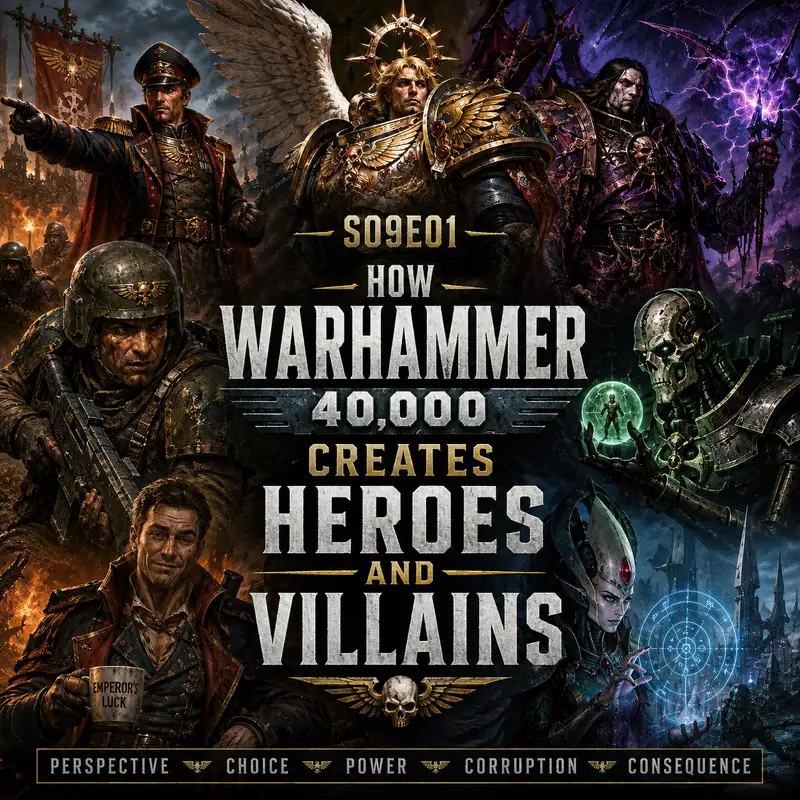
How Warhammer 40,000 Creates Heroes and Villains
A hero stands on a burning world and gives an order that will kill millions. A villain refuses to kneel before a god he believes is false. In another setting, those facts might settle the argument. In Warhammer forty thousand, they are only the beginning. The galaxy is built to make moral judgment difficult without making it meaningless. Its heroes can serve cruel institutions. Its villains can speak honestly about those institutions' crimes. Courage may defend a terrible regime. Rebellion may begin with a legitimate grievance and end in slavery to something far worse. The central question is therefore not which faction wears the white uniform. No one does. The question is how a setting so saturated with fanaticism, atrocity, and survival still persuades us that some people are heroic, others are villainous, and a dangerous number can be both before breakfast.
The first device is perspective. Warhammer forty thousand rarely shows the entire galaxy from a neutral height. It puts the listener beside a Guardsman in a trench, an Aeldari seer staring into possible futures, a Necron lord sorting through damaged memories, or a Chaos champion explaining why every betrayal was necessary. From inside a life, motives become visible. Fear has a face. Loyalty has a cost. The enemy stops being a coloured shape on a campaign map and becomes the thing coming through the smoke. This does not make every viewpoint equally moral. It does make every judgment depend on what the character can see. An Imperial soldier defending a hive city from Tyranids is plainly performing a heroic act for the people behind the walls. The fact that the hive itself may be oppressive does not make the soldier's courage imaginary. It makes the courage local, compromised, and recognisably human.
That distinction matters because a protagonist is not automatically a hero, and an antagonist is not automatically a villain. A protagonist is simply the person whose road we follow. An antagonist blocks that road. Heroism and villainy require another judgment, usually about choice. Warhammer uses this gap constantly. An Inquisitor may be the central character while becoming increasingly willing to sacrifice innocents, break laws, and employ the weapons of the enemy. A Chaos warlord may oppose that Inquisitor while possessing loyalty, discipline, and even a kind of honour. The story invites us close enough to understand both, then asks what each person does with power. Sympathy is not acquittal. Charisma is not innocence. Suffering does not automatically justify what someone inflicts on others. The setting gives nearly everyone a reason. It does not give everyone an excuse.
The Imperium is the great testing ground for this method because it is both humanity's shield and one of humanity's chief tormentors. It preserves worlds against daemons, raiders, devouring swarms, and ancient empires. It also consumes its own people through fear, dogma, brutal hierarchy, and permanent war. Stories told from within the Imperium do not need to pretend the system is good in order to create heroic Imperial characters. They only need to show a person choosing to protect someone when the system would find it cheaper to spend them. That is why so many memorable acts of Imperial heroism are small when measured against the galaxy. A squad holds a corridor so civilians can escape. An officer refuses a wasteful order. A medic returns for one more casualty. A pilot stays on station after the sensible moment to leave. The Imperium may count lives as ammunition. The hero notices that every round has a name.
This is why the Astra Militarum produces such powerful heroes. Its soldiers are not demigods. They are frightened people carrying ordinary weapons into wars that would make sanity submit a transfer request. Their courage is legible because the gap between them and the threat is so wide. Ibram Gaunt and the Tanith First and Only are heroic not merely because they win battles, but because their stories repeatedly connect command decisions to the lives beneath them. Leadership is shown as responsibility rather than possession. The soldier is not heroic because Imperial propaganda says that death in service is glorious. The soldier becomes heroic when death is understood clearly and the choice to stand is still made for someone else. This is an important difference. Blind obedience can be useful to an army. It is not, by itself, moral courage.
Warhammer also creates heroes by giving them the power to do terrible things and then watching for restraint. A commissar has lawful authority to enforce discipline with lethal force. An Inquisitor can condemn populations. A Space Marine commander can reduce a city to a tactical problem. The heroic version of such a character is not harmless. Harmless people do not survive long in this setting, and those who do are usually awaiting paperwork. The hero is someone who understands the weapon in their hand and refuses to use it casually. This is one reason mercy carries unusual weight in the far future. In a gentler world, mercy may be expected. In the Imperium, mercy can be insubordination, strategic risk, or evidence at a later trial. Choosing it can therefore reveal more character than another victory carved into a fortress wall.
Space Marines are built for a different kind of heroism. They are physically overwhelming, so simple survival is rarely enough to make them admirable. Their stories create heroism through burden, identity, and the uses of strength. Dante of the Blood Angels is compelling because his long service is not presented merely as a triumph. Longevity becomes weight. Command becomes the obligation to keep standing after friends, eras, and certainties have died around him. The Blood Angels themselves are noble in aspiration and dangerous in inheritance. Their struggle against the Red Thirst and the Black Rage turns heroism inward as well as outward. The enemy is not only the creature at the gate. It is the possibility that the protector may become another danger to those being protected. A hero in that tradition is not pure. A hero is disciplined enough to know what lives behind the armour.
Then there is Ciaphas Cain, whose reputation demonstrates that heroic action and heroic self-image are not the same thing. Imperial history celebrates him as an almost impossibly brave champion. His private memoirs insist that he was chiefly interested in staying alive, avoiding unnecessary danger, and finding the safest available assignment, which reliably turns out to contain a cult, an invasion, or something with too many teeth. The comedy works because Cain's stated motives and repeated actions do not quite match. He may seek safety, but when the crisis arrives he often acts with nerve, intelligence, and concern for others. The setting lets us doubt the official legend and Cain's own self-accusation at the same time. Perhaps he is not the immaculate hero of propaganda. Perhaps he is something better: a frightened man who keeps doing brave things without trusting the flattering story told about him.
That brings us to myth. In the Imperium, heroes are not only people. They are strategic resources. Saints, martyrs, legendary commanders, and last stands can stiffen resistance across worlds that never witnessed the original event. The state simplifies complicated lives into usable symbols. Doubt is removed. Failure becomes sacrifice. Contradiction is polished away until the statue can be seen clearly from the parade ground. This does not mean every hero is fabricated. It means remembrance is political. A genuine act of courage may be enlarged into propaganda, while an inconvenient hero may be erased because courage aimed in the wrong direction is called treason. Warhammer therefore asks two separate questions. What did the person do? And who benefits from the story later told about it? The gap between those answers is where many of the setting's most interesting heroes live.
Villains are created through a similar process, but the movement is usually from understandable desire toward unlimited permission. Horus is the great example. He begins as a conqueror, diplomat, beloved son, and Warmaster. His fall matters because he possesses virtues worth corrupting. Pride grows from achievement. Resentment grows from responsibility without trust. Fear grows from visions of a future in which he and his brothers are forgotten. Manipulation succeeds because it finds material already present. The wound on Davin and the ritual that follows are pivotal, but they do not turn a blank figure into a villain with the speed of a light switch. They push a powerful man toward choices he is increasingly willing to make. Tragedy requires that another road was visible. Villainy begins when he decides that grievance permits betrayal on a galactic scale.
Chaos is effective because it rarely offers evil as evil. It offers completion. Khorne promises strength without weakness, courage without fear, and justice without restraint. Tzeentch promises knowledge, control, and escape from helplessness. Nurgle promises relief from pain and terror through surrender. Slaanesh promises the perfected self, the perfected sensation, the perfected achievement, and then quietly removes the point at which enough might have been enough. These offers distort qualities that can begin as admirable. Martial honour becomes slaughter. Curiosity becomes manipulation. Endurance becomes acceptance of corruption. Excellence becomes appetite without boundary. The villain often believes they have finally become honest about what they always wanted. The horror is that the desire may remain recognisable even after everything human around it has been consumed.
Heroes and villains are often sharpened by placing them beside a mirror. Sanguinius and Horus are both beloved primarchs, both symbols as much as commanders, and both burdened by what others expect them to be. Their difference is not that one knows fear and the other does not. Sanguinius lives with foreknowledge, private doubt, and the curse carried by his sons. Horus lives with doubt as well, but increasingly turns it into a claim upon everyone around him. At Terra, Sanguinius advances toward a confrontation he has reason to believe will kill him. Horus advances believing the galaxy must validate his wounded sense of destiny. One gives himself to preserve a future he may never see. The other spends a future to prove that he deserved to rule it. Warhammer creates moral clarity not by removing similarity, but by making similar figures answer pressure in opposite ways.
Corruption does not erase responsibility. Warhammer stories are strongest when they preserve the moment of consent, even if that consent is pressured, deceived, repeated, or buried under years of self-justification. A villain may be wounded, manipulated, or trapped. Those conditions help us understand the fall. They do not make the victims of the fall less dead. Horus was deceived, but he also chose whom to trust and what to do with the visions shown to him. Fulgrim was influenced by a corrupted blade, but vanity and hunger for perfection provided the door. Magnus acted from desperation and pride, convinced that superior knowledge excused disobedience. Accounts differ in detail and emphasis, yet the recurring pattern is clear. The villain is not simply someone to whom darkness happens. The villain increasingly cooperates with darkness because it promises to make every prior mistake necessary.
Some villains require less sympathy, though even they benefit from coherence. Erebus is hated not because he is random, but because he acts with purpose. He deceives, recruits, corrupts, and sacrifices others in service to a cause he embraces. He treats people as pieces while understanding enough about them to move those pieces effectively. That is a useful definition of villainy in the setting: the conversion of persons into means. The Imperium does this bureaucratically. Chaos does it devotionally. Drukhari society does it economically and spiritually. Different factions provide different languages for the same moral collapse. A villain may love comrades, keep promises, or display courage. Those qualities can make the villain more dangerous, because trust grows around them. The decisive question is who is permitted to count as a person when the plan begins.
Charisma complicates the judgment further. Trazyn the Infinite is entertaining, cultured, curious, and often very funny. He values history in a galaxy that destroys archives as energetically as it destroys planets. He can even intervene against threats whose victory would ruin collections he would prefer to keep intact. None of that makes his galleries benign. He preserves by taking. Individuals, armies, relics, and moments become exhibits according to his judgment, not their consent. Trazyn works because the audience can enjoy his perspective while recognising its monstrosity. His charm is not a loophole in the moral argument. It is part of the test. Warhammer knows that villains who do nothing but snarl are easy to reject. Villains who make us laugh, admire their competence, or share one of their goals force us to separate pleasure from approval.
Alien factions reveal another technique: the setting changes the moral frame without abandoning consequences. An Aeldari seer may sacrifice thousands of humans to prevent the extinction of a craftworld. From the seer's perspective, this can be a grim calculation made for a people already close to annihilation. From the human world's perspective, it is murder committed by an arrogant stranger. A T'au commander may speak sincerely of order, cooperation, and the Greater Good while operating inside an empire that expects compliance and manages inconvenient truths. A Necron noble may seek the restoration of a dynasty, the recovery of memory, or revenge for a betrayal older than humanity, yet regard living populations as vermin occupying ancestral property. Each perspective has history behind it. Each can produce heroes for its own people. None is relieved of the need to answer for what it does to everyone else.
Not every enemy is a villain in the same moral sense. Tyranids are the clearest example. A hive fleet does not need hatred, ideology, or personal cruelty to become the antagonist of every world in its path. It consumes because consumption is what it is. Calling it evil may express the terror of its victims, but it does not explain a conscious moral fall. The distinction matters because Warhammer uses both villains and disasters. A daemon prince tempts, lies, and chooses. A Tyranid invasion advances like an ecosystem weaponised across the stars. Orks possess personality, culture, ambition, and delight in war, so they stand somewhere else again. Their violence is not an unfortunate deviation from their civilisation. It is the organising joy of that civilisation. The setting's antagonists therefore range from malicious persons to incompatible forms of life, and stories create different kinds of fear from each.
Scale changes moral appearance. From orbit, a city may become a coordinate, a population estimate, and a line in the ammunition forecast. A commander who destroys it to stop a planetary infection may save a system. To the people still inside, the same commander is the author of the end of the world. Warhammer creates moral tension by moving the camera between those distances. Strategic necessity is shown beside individual consequence. Sometimes the terrible order truly is the least terrible option. Sometimes necessity is a word used by powerful people who have stopped searching for alternatives. The setting rarely provides a clean instrument for measuring the difference. Instead, it shows who hesitates, who asks for evidence, who volunteers to share the risk, who enjoys the authority, and who records the dead as though the number were the whole truth.
This is also why unreliable records are so important. Imperial archives turn defeat into martyrdom and rebellion into heresy. Chaos accounts turn treachery into liberation. Aeldari prophecies may be sincere and still incomplete. Necron memories can be damaged, edited, or warped by pride across millions of years. Even eyewitnesses misunderstand what they see, particularly when the Warp is involved, which is often and rarely improves the paperwork. Contradiction does not merely hide the answer. It forces the audience to judge character through patterns rather than proclamations. What does this person repeatedly protect? What do they repeatedly excuse? Who pays for their ideals? What happens when no one is watching? In a setting filled with banners, titles, and official truths, behaviour is often the most reliable witness available.
Warhammer forty thousand therefore creates heroes without pretending they are spotless and villains without pretending they are incomprehensible. A hero is someone who retains a boundary in a universe designed to erase boundaries: this person will not be abandoned, this power will not be used casually, this lie will not be repeated, this duty will not become an excuse. A villain is someone who keeps moving that boundary outward until everyone else can be sacrificed to destiny, survival, perfection, vengeance, faith, or order. Faction determines the language. Circumstance determines the pressure. Choice determines the direction. The hero may still fail. The villain may still be brave. Both may be remembered incorrectly. Yet when the world is burning and every institution has a reason to spend another life, the difference remains visible in one question: who still sees a person standing in the fire?