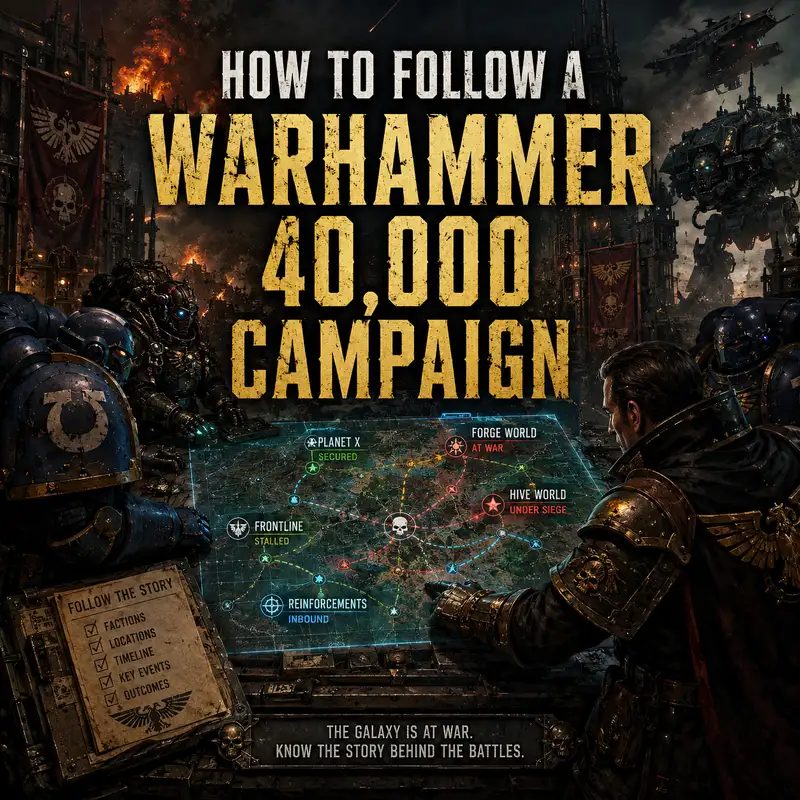
How to Follow a Warhammer 40,000 Campaign
The first report says the planet has fallen. The second says the defenders still hold three hive cities. The third was written two centuries later by an Imperial archivist who insists the relief fleet arrived on time, despite the inconvenient fact that half the fleet is recorded as being somewhere else. A novel follows one squad through a single night of fighting. A campaign book jumps ahead six months and announces a victory. Then a codex explains that the victory merely opened the way to a larger disaster. None of these accounts is necessarily useless. None is necessarily complete. This is the normal condition of military history in Warhammer forty thousand, where information is a weapon, propaganda is a civic duty, and the archives occasionally attempt to kill the people reading them.
Following a Warhammer forty thousand campaign therefore requires more than placing battles in order. A campaign is a chain of decisions made under pressure. Armies move because someone wants something. Commanders accept risks because time, fuel, reinforcements, politics, faith, or simple ignorance leave them few alternatives. Battles matter when they change what can happen next. The central question is not merely who fought whom. It is what each side was trying to accomplish, what prevented them from doing it, and how every major decision altered the shape of the war. Once that question becomes your guide, even a sprawling campaign stops looking like a pile of disconnected names and starts behaving like a story.
The word campaign can describe three related things. Inside the setting, it means a sustained military effort across a region, a planet, a star system, or sometimes a great part of the galaxy. In publishing, it can mean a sequence of campaign books, codices, novels, audio dramas, short stories, and articles that reveal the conflict from different angles. At the tabletop, it can mean a linked series of games in which armies gain experience, suffer losses, pursue agendas, and develop their own history. Large Warhammer campaigns often combine all three. The fictional war provides the setting. The published material explains and expands it. The games allow players to inhabit a small corner of it. Confusion begins when those layers are treated as though they are identical.
Begin with an anchor. Identify the name of the campaign, the broad era, the principal war zone, and the main opposing forces. Do not begin by collecting every character, regiment, chapter, dynasty, fleet, and warband mentioned in passing. That is how a simple research project becomes a second occupation. Instead, establish the campaign’s outer boundary. The Third War for Armageddon is anchored by the Ork invasion of Armageddon and the Imperial effort to keep the world from being conquered. The war for the Nachmund Gauntlet is anchored by control of one of the few relatively stable routes through the Great Rift. The Octarius conflict is anchored by the collision between an Ork empire and a Tyranid hive fleet, followed by the terrible consequences for everyone nearby. The anchor tells you what belongs in the main story and what is supporting context.
Next, draw the theatre in your mind before worrying about the battle sequence. A theatre is the physical and political space in which the campaign occurs. On a single world, it may include hive cities, orbital docks, deserts, polar fortresses, manufactorums, and supply routes. Across a star system, it includes translation points, void lanes, moons, stations, and the planets that make refuelling or repair possible. Across a sector, the distances become strategic facts. A force that appears close on a map may still be weeks away, assuming the Warp behaves itself, which it rarely does out of courtesy. Knowing the theatre helps explain why commanders defend apparently unimportant places. A moon with no civilian population may control an approach lane. A ruined city may sit above a water source. A minor system may be the only place a fleet can resupply.
Then ask what each side actually wants. The answer is often more complicated than destruction. An invading force may need a port intact. A defender may only need to delay the enemy until reinforcements arrive. Chaos forces may seek a ritual site rather than territorial control. The Aeldari may intervene to prevent a future catastrophe without explaining their purpose to anyone they are supposedly helping. Orks may seek conquest, challenge, loot, or simply the promise of a war large enough to attract more Orks. Tyranids seek biomass, but their operational behaviour still reflects adaptation, pressure, and the priorities of the Hive Mind. The Imperium may fight to preserve a world, protect a relic, maintain a transit route, conceal a scandal, or demonstrate that abandoning the world was never considered, especially after abandoning it has already begun.
A useful way to follow events is to separate the strategic, operational, and tactical levels of war. Strategy concerns the larger purpose. Why is the campaign being fought, and what outcome would serve the faction’s wider interests? Operations connect that purpose to a sequence of movements, sieges, raids, and offensives across the theatre. Tactics concern what happens in an individual battle. A Space Marine squad taking a bridge is tactical. Using that bridge to cut the enemy’s retreat is operational. Preserving the planet’s only functioning starport so an entire sector can be reinforced is strategic. Warhammer stories often linger at the tactical level because that is where courage, terror, and bolter fire are easiest to see. The campaign becomes clear only when you connect those scenes to the operational and strategic levels above them.
This is why you should track decisions rather than attempting to remember every engagement. Most battles are important because of a choice made before them or a consequence that follows. A commander divides a fleet. A governor refuses evacuation. A warboss changes direction because a rival has offered a better fight. A Chaos champion sacrifices a military advantage to satisfy a patron. An Imperial general commits reserves too early because the reports from the front are wrong. These are turning points. Record what the commander knew, what the commander wanted, and what risk the commander accepted. You do not need access to private thoughts. The available actions and consequences are usually enough. When the story is uncertain, say so. A good campaign history does not become weaker by admitting that the records fail. It becomes more honest.
Perspective matters because almost every source has a point of view. An Imperial account may call an orderly withdrawal a glorious defence in depth. A Chaos source may present corruption as liberation. An Ork account may remember the part of the war with the loudest explosions and lose interest in the administrative details. An Aeldari vision may be accurate about danger but uncertain about the route that leads to it. A novel follows characters who know only a fragment of the campaign. A codex may summarize decades in a page and omit the experience of ordinary soldiers entirely. Treat these accounts as witnesses, not omniscient narrators. Ask what the source can know, what it wants the reader to believe, and what it leaves unsaid. Contradictions are not always errors. Sometimes they are part of the setting’s design.
Different publication types also perform different jobs. A campaign book usually provides the broadest account of the war zone, major factions, stages of the conflict, and rules for representing it. A codex explains how a faction remembers the campaign and why the events matter to that faction’s identity. A core rulebook or setting book gives the wider galactic context. Novels and audio dramas narrow the view to individuals, units, and local consequences. Short stories fill gaps or illuminate one decision. White Dwarf articles and official online material may add scenarios, maps, timelines, or follow-up events. None should automatically be treated as superior in every respect. The broad source may be best for structure. The narrow source may be best for motive and experience. Use each for the kind of answer it is built to provide.
Publication order and chronological order are not the same. A story released later may occur earlier. A codex may revisit an old campaign with new emphasis. A novel may spend hundreds of pages inside a battle previously summarized in two sentences. Build a simple chronology using only firm points. Mark uncertain dates as uncertain. Avoid forcing every scene into an exact sequence when the sources do not support one. Warhammer timekeeping is especially vulnerable to Warp travel, damaged archives, different calendar systems, and deliberate revision. The goal is not to create false precision. The goal is to know what caused what. If the fall of a fortress forced a fleet to retreat, that relationship matters more than whether two sources disagree about the exact hour the walls were breached.
Characters should be tracked as decision makers, not as a parade of famous names. Introduce a character when that person changes the campaign. What authority does the character possess? What factional values shape the decision? What limitations apply? A Space Marine commander may possess extraordinary tactical freedom but lack the numbers to hold a continent. An Imperial governor may command millions yet be trapped by politics, fear, and unreliable subordinates. An Inquisitor may act with immense authority while concealing the true objective from allies. A warlord may win every duel and still lose the campaign by misunderstanding supply, timing, or the enemy’s purpose. When a character appears only to fight impressively and leave, the details may be enjoyable, but they are not always central to understanding the war.
Be careful with the word victory. A side can win tactically and lose operationally. It can win operationally and fail strategically. It can hold the battlefield but lose the population, the industry, the fleet, or the reason the world mattered. The Imperium often declares victory because a shrine remains standing, even while the surrounding system burns. Chaos may regard material defeat as success if a ritual was completed or faith was corrupted. The Aeldari may accept severe local losses to avert a future they consider worse. Orks may treat a retreat as temporary if the war has grown larger and more attractive. Tyranids do not require a ceremonial surrender. When reviewing an outcome, ask who controlled the ground, who preserved combat power, who achieved the original objective, and what condition the theatre was left in.
Exact numbers deserve similar caution. Warhammer forty thousand operates at immense scale, but published figures are often incomplete, symbolic, inconsistent, or focused only on forces relevant to a particular narrative. Do not allow a disputed troop total to become the entire campaign. Numbers are useful when they explain a decision. A garrison is too small to hold every wall. A fleet lacks enough escorts to protect its transports. Reinforcements will arrive after the enemy reaches the capital. Ammunition can sustain three days of fighting, not three weeks. Those relationships matter. A precise casualty figure copied from an unreliable report may matter less. When the sources disagree, use ranges or describe the imbalance qualitatively. The objective is to understand pressure, not to conduct an audit of a bureaucracy that may have misplaced the planet.
Consider the Third War for Armageddon. A newcomer can drown immediately in chapter names, regiments, warlords, hive cities, and individual battles. The campaign becomes easier to follow when reduced to its central structure. Ghazghkull Thraka returns to Armageddon with an enormous Ork invasion. The Imperium must prevent the loss of a vital industrial world and contain a war that threatens to expand. Armageddon’s hives, equatorial jungles, ash wastes, and orbital approaches create separate but connected fronts. The defence of Helsreach matters not only because of the fighting inside the city, but because the hive and its port are part of the world’s ability to resist. The arrival of famous Imperial forces adds power, but it also creates command problems, divided priorities, and uneven coverage across a vast theatre.
The result on Armageddon is not a clean final victory. The Imperium prevents immediate conquest of the world, but the war remains destructive, prolonged, and unresolved in the manner of many Imperial triumphs. The Orks are not erased. The defenders pay heavily. Later galactic events alter the context without making the earlier struggle meaningless. Following the campaign therefore means resisting the temptation to label every defended hive as strategic success or every Ork setback as final defeat. The better question is whether each event preserved Armageddon’s capacity to continue the war. A heroic last stand may buy time. A successful counterattack may reopen a supply route. A celebrated victory may merely restore the situation that existed before the previous disaster. War is often like that, even when the combatants are eight feet tall and carrying chainswords.
The Octarius conflict offers a darker lesson. Inquisitor Kryptman attempts to redirect Hive Fleet Leviathan into the Ork empire of Octarius, hoping the two threats will destroy or at least weaken one another. At the strategic level, the idea has a brutal logic. At the moral level, it condemns populated worlds and accepts devastation on a staggering scale. At the operational level, it creates a prolonged war in which both Orks and Tyranids adapt, gather strength, and draw more forces into the region. Individual battles can still be followed through planets, commanders, invasions, and counterattacks, but the central thread is the consequence of the original decision. The campaign is not merely Orks fighting Tyranids. It is a containment strategy becoming a greater danger than the problem it was meant to solve.
For an active or newly published campaign, use a controlled reading order. Begin with the broadest official overview available. Learn the war zone, the principal factions, the immediate crisis, and the current state of the galaxy. Then read the main campaign material in release order, because release order reveals how the narrative was intentionally disclosed. After that, reorganize the events into chronology for your own notes. Add the codex or faction material for the forces you care about most. Use novels and audio dramas to deepen particular fronts or characters rather than expecting them to summarize the entire war. Check later official material for consequences. This method preserves both experiences. You see the story as audiences first received it, and you also understand the sequence as it occurred inside the setting.
Tabletop campaigns add another layer, especially through Crusade play. A Crusade force develops across linked games as units gain experience, honours, scars, and a history. The published war zone provides the theatre, while players create local protagonists. Those results do not automatically become universal canon. Their value is continuity and consequence. A tactical battle changes the condition of a force, which affects the next operation. A squad becomes memorable not because its profile was efficient, but because it survived three disasters and captured the objective while everyone else was on fire.
A simple campaign log keeps this manageable. After each source, record the location, forces, objective, decisive event, immediate result, and consequence. If a major character appears, record the decision that makes that character relevant. If a battle does not change the wider situation, keep the note brief. If sources disagree, preserve both versions. Over time, the notes form a chain. One lost moon exposes an orbital route. The exposed route isolates a hive. The isolated hive forces a relief fleet to divert. The diversion leaves another system undefended. That chain is the campaign. Everything else is texture.
Several habits make campaigns harder to follow. Reading every source before establishing the basic war zone creates confusion. Treating every named battle as equally important hides the turning points. Assuming every official statement is objective erases the setting’s unreliable narrators. Demanding perfect consistency turns uncertainty into frustration. Following only one faction makes the enemy appear irrational. Following only the famous characters makes ordinary forces disappear, even when those forces hold the line, move the supplies, and absorb the losses. Most of all, focusing only on who won prevents you from seeing what the war changed. A campaign can end with the same banners flying over the same fortress while the surrounding region has become poorer, weaker, angrier, and far more vulnerable than before.
To follow a Warhammer forty thousand campaign, think like a historian standing beside a command table after the officers have gone. Begin with the theatre. Identify the objectives. Separate tactical action from operational movement and strategic purpose. Follow the decisions that change what becomes possible. Compare perspectives without demanding that one source explain everything. Treat victory as a claim that must be tested against consequences. Then carry the story forward until the final position is clear. The map at the end may resemble the map at the beginning, but the forces are depleted, alliances are strained, cities are empty, and a new threat is moving through the gap. That altered map is the real ending. A campaign is not a list of battles. It is the record of how choices turn geography into history.