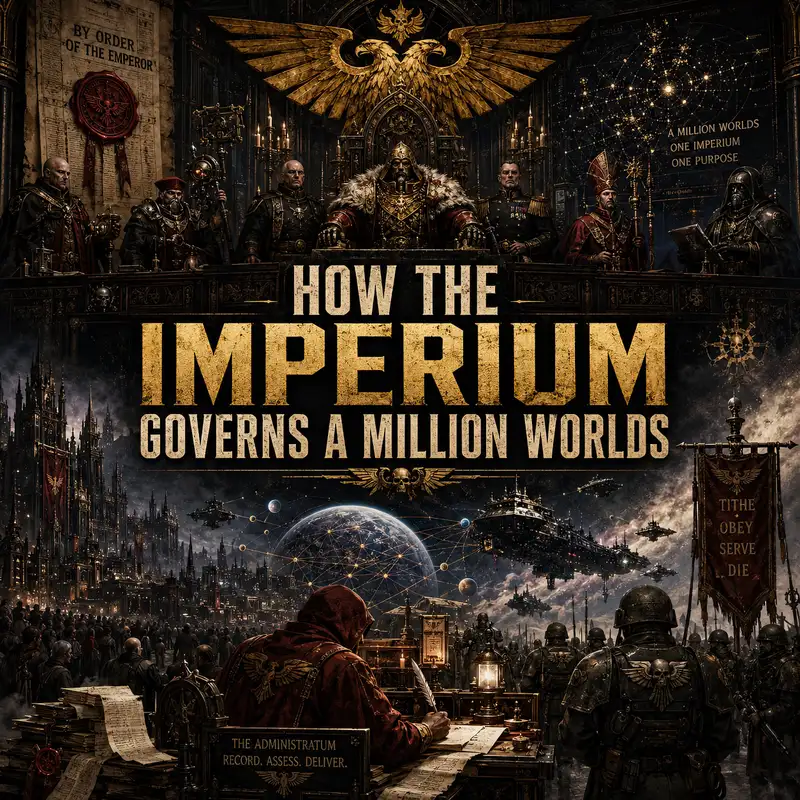
How the Imperium Governs a Million Worlds
An Imperial order can be lawful, sacred, stamped by a dozen departments, and a century too late.
By the time it reaches the world named on its cover, the governor who requested it may be dead. His dynasty may have fallen. The war may have ended, begun again, and acquired a different name. The clerk receiving the message may discover that it authorises reinforcements which arrived fifty years earlier by another route. None of this makes the order invalid. The seals are correct.
That small absurdity reveals the central problem of Imperial government. The Imperium claims dominion over roughly a million inhabited worlds, scattered across a galaxy where travel is dangerous, communication is unreliable, and time itself does not always behave. No ruler, council, army, or machine could supervise all of those worlds directly. Terra cannot know what every governor is doing. It cannot answer every distress call. It cannot even maintain a perfectly accurate list of the planets it owns.
So how does the Imperium govern a million worlds?
Mostly, it does not govern them in the way a modern state would. It does not provide uniform services, enforce one detailed civil code, or communicate daily instructions to every capital. The Imperium governs by setting a few immense obligations, delegating almost everything else, and punishing failure when failure becomes visible. It is less a single administration than a layered arrangement of oaths, taxes, religions, military commands, ancient privileges, and armed institutions that agree on very little except who is supposed to obey.
At the centre stands the Emperor, physically enthroned on Terra and worshipped across the Imperium as the master and protector of humanity. His authority is absolute. His day to day instructions are not available.
Government therefore takes place in his name. The Senatorum Imperialis, better known through its ruling members as the High Lords of Terra, brings together the heads or representatives of the Imperium’s most powerful institutions. The exact balance of seats and influence has shifted through history, but the council traditionally contains twelve High Lords. They speak for organisations that control administration, armies, fleets, faith, astropathic communication, assassins, law, technology, and other necessities of Imperial survival.
In the current age, Roboute Guilliman also exercises extraordinary authority as Lord Commander of the Imperium. A returned primarch can dismiss High Lords, launch crusades, reorganise commands, and force priorities through systems that have resisted change for thousands of years. Even Guilliman, however, cannot personally govern a million planets. He can point the machinery in a direction. He cannot stand beside every lever.
Beneath Terra stretches the Adeptus Terra, the enormous collection of departments that performs much of the Imperium’s central work. Its greatest administrative body is the Adeptus Administratum. Untold numbers of scribes, logisticians, archivists, assessors, messengers, savants, servitors, and minor officials record populations, calculate tithes, issue warrants, assign shipping, authorise troop movements, and preserve decisions whose original authors have been dead for generations.
The Administratum is often presented as a joke because it is slow, repetitive, and capable of errors on a planetary scale. That description is fair, but incomplete. The bureaucracy is also one of the strongest forces holding the Imperium together. A regiment can win a battle. A fleet can save a system. The Administratum decides where the regiment is raised, who is supposed to feed it, which fleet is assigned to carry it, and whether any of those orders survive long enough to matter.
Its records are not merely paperwork. They are the Imperium’s memory, however damaged that memory has become.
Distance is the first enemy of that memory. Most faster than light travel requires passage through the Warp, the hostile dimension beneath reality. Navigator houses guide ships through it, using the Astronomican as a psychic beacon radiating from Terra. Even with those advantages, a voyage can take weeks, months, or years, and its duration may not match the time experienced outside the Warp. Routes close. Storms rise. Ships vanish. A courier carrying a perfectly sensible command may emerge after the crisis has passed, or fail to emerge at all.
Astropaths allow messages to cross interstellar distances without waiting for a ship, but astropathic communication is not a clean stream of words. It is psychic transmission through the Warp, often encoded in images, emotions, symbols, ritual phrases, and fragments that trained choirs must interpret. Strong messages may require relays. Distortion is common. Secrecy is difficult. A warning can arrive incomplete, and an incomplete warning from three sectors away may compete with ten thousand other emergencies.
For an empire built on central control, this would be fatal. The Imperium survives because much of its control is not central.
The galaxy is divided into vast regions called segmenta, then into sectors, subsectors, systems, and individual worlds. The neatness of those divisions is greater on maps than in reality, especially after the opening of the Great Rift, but the principle matters. Authority is distributed through layers. A sector commander does not wait for Terra before responding to every pirate raid. A subsector fleet does not request permission from the High Lords before intercepting an invasion already entering orbit. Nearby officials, admirals, generals, bishops, inquisitors, and governors make decisions with the information and forces available to them.
Sometimes those decisions are wise. Sometimes they are contradictory. Quite often they are both.
The most important figure on an ordinary Imperial world is usually the planetary governor, sometimes called the Imperial Commander. Terra does not insist that every governor use the same title or political system. One world may be ruled by a hereditary king. Another may have a council of noble houses, a military dictator, a priesthood, an industrial combine, or an elected body whose elections have become a hereditary ceremony. The Imperium has room for considerable local variety, provided that the results remain acceptable.
The bargain is brutally simple. The governor may rule the world according to local custom, maintain local courts, collect local taxes, appoint officials, and command the Planetary Defence Forces. In return, the governor must keep the planet loyal, suppress rebellion and forbidden cults, recognise Imperial authority, protect essential resources, and deliver what the Imperium demands.
Imperial law exists above those local customs, but it is not a single practical rulebook carried into every village. The Lex Imperialis is vast, ancient, and interpreted through courts and officials separated by light years. Its highest concerns are loyalty, tithe, authorised worship, control of psykers, and the protection of Imperial institutions. Beneath that level, governors receive enormous freedom to decide what conduct is legal and what punishment follows.
This makes the governor less like a civil servant and more like a vassal whose entire world is held on condition. Privilege can pass through a family for generations, creating the appearance of an independent kingdom. The illusion lasts only while the obligations are met. A governor may own palaces, armies, and cities, but in the eyes of Terra, the governor is also the person whose name is written beside the planet’s failures.
That demand is the Imperial tithe.
Every tithed world is assessed according to what the Administratum believes it can provide. An agricultural world may owe food. A mining world may owe ore. An industrial world may owe weapons, vehicles, or manufactured components. Many worlds owe regiments for the Astra Militarum. Others provide fuel, ships, specialists, or other resources needed elsewhere. Psykers are gathered through a separate but equally feared levy and carried away by the Black Ships of the Adeptus Astra Telepathica.
In theory, the assessment reflects the world’s population, productivity, conditions, and strategic importance. In practice, assessments may be old, incomplete, manipulated, or based on reports written before a famine, invasion, industrial collapse, or change of government. The tithe remains due.
This is how Terra touches most lives without governing them directly. The Administratum does not need to know the name of a factory worker on a distant hive world. It needs the governor to deliver the required number of artillery shells. The Departmento Munitorum does not need to understand the customs of a frontier culture. It needs that culture to produce trained soldiers, on schedule, with uniforms if possible and bodies if not.
The pressure travels downward. The Imperium demands from the governor. The governor demands from regional rulers. Regional rulers demand from cities, clans, guilds, estates, and factories. By the time the obligation reaches an ordinary citizen, it may appear as a labour quota, a food seizure, a military draft, a new tax, or the arrival of officials carrying forms no one is permitted to question.
The tithe is not only economic. It is political proof. A governor who pays demonstrates control. A governor who cannot pay may be incompetent, rebellious, corrupted, or already dead. Imperial institutions are not always interested in distinguishing among those possibilities before sending armed investigators.
Failure can bring censure, removal, invasion, or execution. The Adeptus Arbites exists to uphold Imperial law and protect the authority of the Imperium itself. Arbites officers are not ordinary local police. They do not usually concern themselves with every theft, murder, or feud. Local enforcers handle local crime. The Arbites watch for sedition, treason, tithe evasion, attacks on Imperial institutions, and failures serious enough to threaten the wider order.
If a stolen herd was intended for a governor’s banquet, that is a local matter. If it was intended for the Imperial tithe, the paperwork becomes considerably more dangerous.
Religion provides another form of control. The Ecclesiarchy teaches that the Emperor is divine and that service, sacrifice, and obedience are sacred duties. Yet even the Imperial Creed is not identical on every world. The Emperor may be worshipped as a sun god, an ancestral king, a warrior in the heavens, a machine lord, or a distant judge, provided the local faith can be brought within acceptable doctrine. Missionaries often absorb local traditions rather than erase them completely.
This flexibility is practical. It is much easier to tell a population that its oldest god was always the Emperor under another name than to begin by burning everyone. Burning remains available if the explanation is rejected.
The shared creed gives the Imperium something its communication network cannot. A governor may wait decades for an answer from Terra, but the cathedral teaches the population who rules them. The double headed eagle, the images of saints, the rituals of sacrifice, and the language of duty repeat the same political message. Terra may be unimaginably distant. The Emperor is presented as present everywhere.
Faith also helps transform extraction into virtue. Grain taken from hungry people becomes an offering to humanity’s survival. Recruits sent to wars they have never heard of become servants of the Emperor. A factory shift that never ends becomes sacred labour. This does not mean every believer is cynical or deceived. Many are sincere, including those who suffer most. That sincerity is one reason the system endures.
No single institution controls all of this. The Imperium is crowded with overlapping powers.
The Adeptus Mechanicus governs its forge worlds and guards technological knowledge under ancient agreements with Terra. Space Marine Chapters possess broad autonomy and answer to their own traditions, oaths, and command structures. The Inquisition operates outside normal chains of authority when investigating threats it considers existential. The Ecclesiarchy commands wealth, influence, and armed devotees. The Imperial Navy operates the great war fleets of the central Imperium. The Astra Militarum fights planetary wars. Rogue Traders carry warrants granting extraordinary freedom beyond settled Imperial space.
These organisations cooperate because they must. They also compete for resources, jurisdiction, prestige, and survival. A planetary governor may receive demands from the Administratum, instructions from a sector lord, warnings from the Inquisition, requests from the Navy, sermons from the Ecclesiarchy, and an ultimatum from a nearby forge world. All may claim to speak with Imperial authority. None may agree on what should happen next.
This is not an accidental flaw that could be repaired with a better filing system. Divided authority is part of the Imperium’s history. After the Horus Heresy, power was repeatedly separated to make another galaxy wide military rebellion more difficult. Armies and fleets were divided. Institutions developed independent chains of command. Space Marine Legions became smaller Chapters. The result reduced the danger of one commander seizing everything, but it also created a government in which coordination is a permanent campaign.
When a world is invaded, the system reveals both its weakness and its strength.
The governor first relies on local forces. Planetary Defence Forces fight because help may be far away. Astropaths send distress calls. Nearby systems assess whether the threat will reach them. Sector authorities gather regiments and naval assets. The Departmento Munitorum attempts to match troops, transports, ammunition, food, and fuel. Messages move outward, often faster than certainty.
Reinforcements may arrive in fragments. A regiment suited for open desert warfare may be sent to an urban siege because it was available. Ammunition may reach a different port than the guns that use it. A fleet may receive three conflicting priorities, each marked urgent. Yet the Imperium can continue feeding forces into a war long after a smaller state would have exhausted itself. Its response may be clumsy, late, and appallingly expensive. It may also be enormous.
The plan is not to be efficient. The plan is to be too large to stop completely.
Fear ensures that local rulers do not mistake autonomy for independence. A governor may live like a sovereign, but the title is conditional. The Arbites can seal the palace. An inquisitor can declare the regime compromised. A naval squadron can blockade the world. The Administratum can redirect trade or raise the tithe. In extreme cases, the Imperium can replace the governor, crush the ruling class, or destroy what it cannot reclaim.
The threat does not need to be immediate to be effective. Imperial punishment is often delayed, but it is remembered. A dynasty that believes Terra has forgotten it must also consider the possibility that a fleet is already on the way and merely lost in the Warp. Uncertainty becomes a governing tool.
Corruption thrives inside this distance. Governors falsify production reports. Officials sell exemptions. Noble families divert supplies. Administratum clerks protect obsolete procedures because their authority depends on them. Entire populations can be worked to death to satisfy quotas while local elites claim perfect loyalty. The Imperium rarely asks whether a world is governed justly. It asks whether the world remains useful, obedient, and recognisably Imperial.
That distinction explains why daily life can vary so dramatically. One citizen may live under a competent administration with stable food and limited freedoms. Another may be born into debt, labour underground, and never see the sky. Both can be citizens of the same Imperium. There is no universal Imperial experience because there is no universal Imperial civil government reaching into every home.
What unites those lives is obligation. Pay. Produce. Worship. Fight. Report the witch. Fear the alien. Obey the proper seal.
The Great Rift exposed how fragile this arrangement had always been. When the galaxy was torn in two and the light of the Astronomican became difficult or impossible to see across vast regions, communication and travel collapsed. Worlds in Imperium Nihilus were not simply far from Terra. Many were effectively cut away from the systems that made Terra’s authority real. Local commanders, Chapter Masters, governors, and warlords had to act without reliable support.
Some remained loyal. Some became tyrants in the Emperor’s name. Some were destroyed before anyone learned they were in danger. The Imperium did not cease to exist on those worlds because its rule had never depended only on current orders from Terra. It survived wherever institutions, beliefs, supply networks, and armed loyalties survived. It failed where those things broke.
That is the answer to the apparent impossibility. The Imperium governs a million worlds by demanding relatively few things from each world, demanding them without mercy, and allowing local rulers to decide how the cost will be paid. It uses bureaucracy to turn worlds into entries, tithes to turn populations into resources, religion to turn obedience into faith, and military power to make examples of those who fall outside the system.
It is decentralised because distance leaves no alternative. It is authoritarian because trust has long since been replaced by fear. It is resilient because no single broken office can stop the whole machine. It is catastrophically wasteful because no one can see the whole machine clearly enough to repair it.
Somewhere, a tithe ship lifts from a world whose people have never seen Terra. Its holds contain grain, weapons, perhaps an entire generation of soldiers. The governor watches it depart and declares the obligation fulfilled. The Administratum records a successful delivery, perhaps years later, perhaps under the wrong date. The citizens return to work beneath statues of an Emperor who seems to know everything.
Terra may not know their names. It may not know their world is starving. It may not even know, with certainty, that their world still exists.
The Imperium’s greatest administrative achievement is not that Terra watches every planet. It is that every planet is taught to fear the moment Terra finally looks its way.