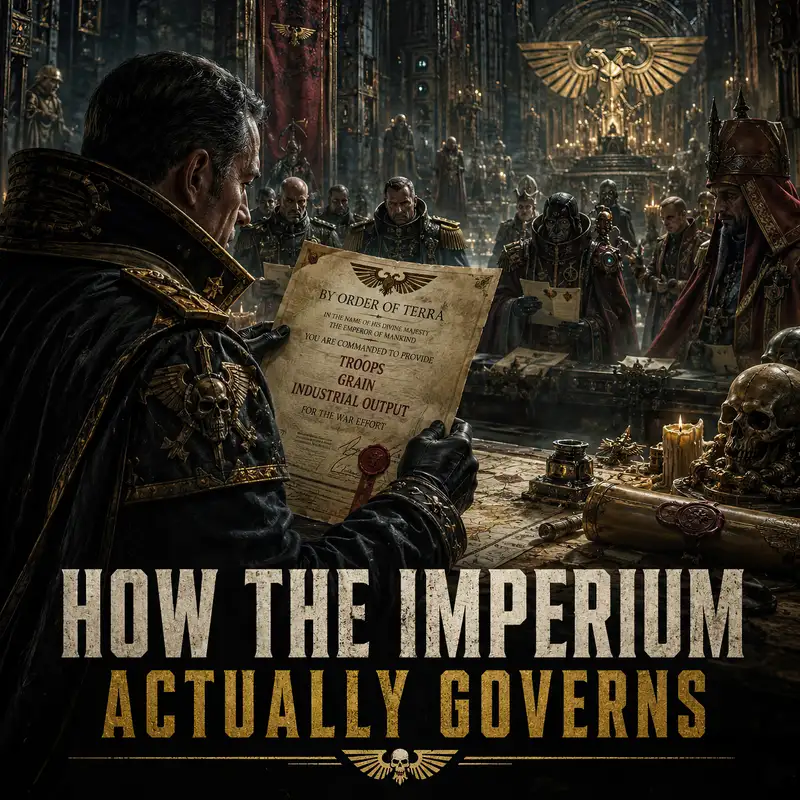
How the Imperium Actually Governs
Somewhere on the far side of the galaxy, a planetary governor breaks the seals on an order from Terra. The message demands troops, grain, and industrial output for a war whose name no one in the room recognises. The order is authentic. It is also eighty years old. The campaign may have ended, the requesting army may have been destroyed, and the clerk who calculated the tithe has certainly become dust. None of that makes the order less binding. The governor signs the levy, because the Imperium of Man is not governed by perfect information. It is governed by obligation.
That distinction explains almost everything. The Imperium calls itself a single realm ruled by the immortal Emperor from the throneworld of Terra. Its symbols are universal. Its armies fight beneath the same double-headed eagle. Its priests proclaim one divine sovereign, and its officials insist that every compliant world forms part of an unbroken political order. Yet the Imperium spans distances that make ordinary government impossible. Messages cross the void through psychic choirs. Ships travel through a dimension that resents timetables. Entire sectors can vanish behind storms. A law issued on Terra may reach one world in weeks and another in generations.
So who actually governs the Imperium? The honest answer is that many people do, often at the same time, under overlapping authorities that were never designed to fit together neatly. The Emperor reigns. The High Lords direct. The Administratum records. The Ecclesiarchy sanctifies. The Adeptus Mechanicus maintains its own ancient privileges. Governors rule their worlds. Inquisitors intervene when they choose. Admirals, generals, cardinals, chapter masters, and sector lords exercise power wherever distance makes consultation impractical. The result is not a modern state with a clear organisational chart. It is a civilisation held together by oaths, taxes, faith, monopoly, fear, and the occasional arrival of a very large fleet.
At the centre stands the Emperor, at least in law, religion, and political imagination. He is the sovereign from whom all legitimate authority is said to descend. For ten thousand years, however, he has remained upon the Golden Throne, sustaining the Imperium through means that are both sacred and terrible. He does not chair cabinet meetings. He does not review planetary budgets. His will is interpreted through ancient commands, religious doctrine, institutional precedent, visions, omens, and the claims of those powerful enough to say they understand it. This creates a useful arrangement for almost everyone in authority. The Emperor cannot be contradicted, and he rarely issues clarifications.
Government on Terra is conducted in his name by the Senatorum Imperialis, the ruling council better known as the High Lords of Terra. They represent the greatest institutions of the Imperium and decide matters that can still be decided from the centre. They direct immense campaigns, settle disputes between branches of power, assign resources, recognise offices, and defend the continuity of the state. Their membership changes with politics, crisis, death, and influence. A seat is not merely ceremonial. It gives an institution access to the machinery through which the priorities of one world may become the burdens of ten thousand others.
Beneath this council lies the vast structure commonly called the Adeptus Terra, the central apparatus of Imperial rule. Its most visible administrative engine is the Adeptus Administratum. The Administratum counts populations, assesses worlds, tracks obligations, records decrees, assigns tithes, archives petitions, and attempts to remember what the Imperium owns. Its scribes work in halls large enough to possess their own weather. Mountains of parchment pass through departments whose original purpose may have been forgotten, though their forms remain mandatory. A request can be denied because one box was left empty on a document created before the applicant’s civilisation discovered gunpowder.
It is easy to laugh at this, and the setting encourages us to do so. Yet the Administratum is not pointless. It is the memory of an empire whose parts cannot speak to one another directly. Without records, however inaccurate, Terra would not know which worlds could supply soldiers, which forge worlds produced engines, which agri-worlds fed nearby systems, or which routes remained open. The bureaucracy is monstrous because the problem is monstrous. Its failures condemn populations. Its successes are rarely noticed, because a successful shipment of grain is not as memorable as a famine caused by a misplaced decimal. The Imperium survives partly because clerks keep finding the correct forms often enough.
The most important unit of practical government is not Terra. It is the planet. Most human beings live and die under local authorities who possess enormous freedom. A planetary governor, sometimes called an Imperial Commander, may be a hereditary monarch, an elected official, a military dictator, a noble council, a corporate ruler, or something stranger. The Imperium does not require every world to use the same constitution. It does not have the ability to enforce such uniformity, and it rarely has the interest. A world may preserve tribal customs, industrial guilds, feudal houses, or bureaucratic ministries as long as those institutions remain loyal and useful.
Terra’s demands are severe but limited in scope. The world must acknowledge Imperial sovereignty. It must pay the Imperial tithe assigned to it. It must surrender or properly control psykers according to Imperial requirements. It must suppress rebellion, prohibited cults, and threats that could spread beyond local borders. It must provide troops, resources, food, manufactured goods, or other services according to its classification and capacity. It must not declare independence, embrace forbidden powers, or treat with the enemies of humanity in ways the Imperium considers treasonous. Within those boundaries, the governor may rule with a velvet glove, an iron fist, or several thousand pages of municipal regulation.
The tithe is the central bargain, though bargain may be too friendly a word. Worlds are assessed according to what they can provide. An agri-world sends food. A mining world sends ore. An industrial world sends weapons and machinery. Populous worlds may send soldiers in vast numbers. Some planets are exempt because they serve another essential purpose, while others owe unusual forms of service. The assessment is not always fair, current, or survivable. A world can be ruined by a tithe grade based on ancient productivity, and it may take generations for an appeal to reach anyone with authority to alter it. Imperial taxation has the confidence of mathematics without always enjoying the benefit of accurate numbers.
The planetary governor therefore stands between two dangers. Below are subjects who may revolt if demands become unbearable. Above are Imperial institutions that may interpret failure as incompetence, corruption, or treason. Governors maintain local armies known as Planetary Defence Forces, police populations, secure infrastructure, and prepare for threats that may arrive long before outside help. If a crisis exceeds local capacity, the governor requests aid. Whether aid comes depends on the message surviving astropathic transmission, the request being believed, forces being available, and someone deciding that the planet is worth saving. The last condition can be surprisingly competitive.
Astropathic communication is one of the hidden foundations of Imperial government. Trained psykers transmit messages across interstellar distances through the warp, often in symbolic, compressed, or emotionally charged forms that require interpretation. Important messages may be relayed through choirs and stations, accumulating delay and distortion along the way. This is not a secure video conference. It is closer to sending a nightmare through a storm and asking a distant civil servant to identify the procurement code. The miracle is not that messages fail. The miracle is that enough arrive for the Imperium to function at all.
Warp travel creates the same problem on a greater scale. Imperial ships enter the immaterium and navigate by means of the Astronomican, the psychic beacon projected from Terra. Voyages that appear short on a chart can take unpredictable amounts of time. A fleet may arrive late, early, scattered, or not at all. Governments built on rapid communication can issue precise instructions. The Imperium cannot. It relies on delegated authority because every commander, governor, and official may be cut off at the moment a decision becomes urgent. Imperial administration is decentralised not because it values local freedom, but because physics leaves it little choice.
The galaxy is divided into immense administrative regions, then sectors, subsectors, systems, and worlds. These divisions help organise taxation, defence, trade, and military response. Sector governors and other senior officials coordinate matters too large for a single planet but too immediate to await Terra. Naval bases guard routes. Administratum offices maintain regional records. Astropathic stations pass messages along chains. The system appears orderly from a distance. Up close, borders overlap, records disagree, and authority depends heavily on which institution has ships nearby. A legal claim backed by a seal is impressive. A legal claim backed by a battleship is easier to process.
Imperial law also operates in layers. Local authorities enforce local law, which may differ wildly from world to world. The Adeptus Arbites enforces the Lex Imperialis, the body of law concerned with obligations to the Imperium itself. Arbites are not ordinary police officers patrolling market disputes. Their fortress-precincts watch governors, investigate sedition, defend Imperial institutions, and preserve order when local government collapses. On many worlds, a small Arbites presence may be the only permanent representative of distant Terra. They are deliberately separate from local power, because the person collecting the tithe should not also be the only person reporting whether it was collected.
Religion provides another layer of unity. The Adeptus Ministorum, commonly called the Ecclesiarchy, teaches worship of the Emperor and maintains a vast network of priests, shrines, dioceses, missions, and charitable or military institutions. The Imperial Creed is universal in claim but flexible in practice. One culture may worship the Emperor as a sun god, another as an ancestral king, and another through traditions inherited from a forgotten colonisation fleet. The Ecclesiarchy can tolerate local forms if priests can interpret them as proper devotion. This flexibility is not liberalism. It is administrative survival wearing vestments.
Then there is the Adeptus Mechanicus, which is part of the Imperium and also distinct from it. The priesthood of Mars controls much of the knowledge, industry, and maintenance required to keep Imperial civilisation functioning. It governs forge worlds, follows the Cult Mechanicus, guards technological secrets, and preserves privileges rooted in the ancient alliance between Terra and Mars. A planetary governor may command millions of subjects and still lack authority inside a Mechanicus enclave that maintains the world’s reactors. This arrangement is awkward, but so is turning off the reactors to clarify jurisdiction.
The same pattern appears elsewhere. Navigator houses possess hereditary abilities essential to warp travel and defend ancient charters. Rogue Traders carry warrants that grant extraordinary freedom beyond Imperial frontiers. Space Marine Chapters are not ordinary units within a planetary chain of command. Many maintain their own worlds, while others roam in fleets, but all preserve distinct traditions and strategic priorities, answering to ancient obligations and to their understanding of service to the Emperor. The Inquisition stands even further outside normal administration. An inquisitor can investigate institutions, requisition resources, and pursue threats across boundaries that would stop almost anyone else.
The Inquisition is often imagined as the secret police of the Imperium, but it is not one unified agency with a single director and a tidy headquarters. It is a collection of powerful individuals, traditions, conclaves, rivalries, and specialised concerns. Inquisitors possess enormous theoretical authority, yet practical power depends on reputation, allies, evidence, and the forces they can call upon. One may condemn a governor. Another may dispute the judgment. A third may decide that both have missed the real threat. This is not efficient oversight. It does, however, make conspiracy a demanding profession.
All these institutions create a government of overlapping sovereignties. A governor answers to the Administratum for tithes, to the Ecclesiarchy for religious conformity, to the Arbites for Imperial law, to the Mechanicus for technical access, to military authorities during mobilisation, and to the Inquisition whenever an inquisitor decides the matter is no longer local. None of these organisations sees the whole picture. Each protects its mandate. Each maintains archives, ranks, rituals, and armed servants. Disputes may be settled by law, precedent, negotiation, bribery, political pressure, or violence. Frequently, they are settled by whichever method finishes first.
The Imperial military reflects the same deliberate fragmentation. Planetary Defence Forces protect individual worlds. The Astra Militarum draws regiments from planetary tithes and sends them to wars far from home. The Imperial Navy controls major void assets and transport protection. The Departmento Munitorum attempts to supply and coordinate armies across impossible distances. Authority is divided partly because the Horus Heresy demonstrated the danger of concentrating fleets and armies under a single ambitious commander. The Imperium learned from that catastrophe. It responded by building a system in which cooperation is essential and therefore never entirely reliable.
When the system works, a threatened sector can mobilise astonishing force. Governors raise regiments. Forge worlds increase production. Navy squadrons escort convoys. Administratum officials redirect supplies. Astropaths carry warnings. Priests preach endurance. Reinforcements arrive from worlds whose people will never see the place they are dying to defend. This is the great strength of Imperial government. It can convert the resources of thousands of disconnected societies into a common war effort. It is slow, wasteful, and brutal, but the scale of what it can assemble has crushed enemies that mistook disorder for weakness.
When the system fails, it often fails in stages. A governor conceals unrest to protect his position. An astropathic warning is delayed. A clerk assigns reinforcements to the wrong system. A cardinal denounces a practical compromise as heresy. A commander follows an obsolete order because disobedience carries greater personal risk than defeat. By the time Terra understands the situation, the planet may have fallen, recovered, rebelled again, and been entered twice in the same archive. The Imperium does not collapse because no one governs it. It suffers because too many authorities govern fragments of it without sharing the same reality.
The return of Roboute Guilliman exposed this contradiction with unusual clarity. As a primarch, Lord Commander, and regent acting in the Emperor’s name, Guilliman possessed authority few living officials could challenge openly. He reorganised leadership, launched the Indomitus Crusade, and tried to impose strategic purpose on a state drowning in accumulated custom. Yet even he could not simply replace the machinery of the Imperium. He needed the High Lords, the Administratum, the Mechanicus, the Ecclesiarchy, the Navy, the Guard, and countless local rulers. A demigod could issue an order. He still needed clerks to copy it and ships to carry it.
The opening of the Great Rift made decentralisation even more severe. The Imperium was torn between the realm still reached by Terra’s light and the darkness of Imperium Nihilus, where the Astronomican became difficult or impossible to see and reliable contact with Terra collapsed across vast regions. In those isolated territories, governance depended on whoever could preserve routes, defend worlds, and maintain legitimacy. Commanders and governors acted with little expectation of timely instruction. The Imperium had always relied on local judgment. The Great Rift removed much of the comforting fiction that local judgment was being closely supervised.
For an ordinary citizen, none of this may be visible. A factory worker on a hive world experiences the Imperium through shift bells, ration lines, local overseers, sermons, recruitment notices, and the occasional sight of an Arbites patrol. Terra is not a place that governs the details of daily life. It is a sacred direction in the sky. The Emperor is real through icons and ritual. The tithe is real when a sibling is drafted. The wider state appears only when it demands something, punishes something, or fails to stop something dreadful from arriving.
Calling the Imperium feudal is useful, provided the comparison is not pushed too far. It resembles a web of obligations more than a uniform nation-state. Power is personal as well as institutional. Distance encourages autonomy. Lords provide troops and resources in exchange for recognition and protection. Ancient privileges matter. Religion legitimises rule. Yet the Imperium also possesses enormous bureaucracies, industrial planning, interstellar law, and central institutions capable of mobilising resources on a scale no medieval kingdom could imagine. It is feudalism administered by ministries, supplied by forge worlds, and enforced from orbit.
The Imperium therefore governs by deciding what must remain common and abandoning much of the rest to local power. Loyalty must be common. The tithe must be paid. The Emperor must be worshipped in an acceptable form. Essential routes, military assets, psychic controls, and strategic industries must remain available. Secession, dangerous heresy, and threats to human survival must be confronted, at least when recognised. Beyond those red lines, diversity is tolerated because uniformity is impossible. The Imperium does not need every world to live the same way. It needs every world to answer when called.
That is how the Imperium actually governs. Not through continuous command from Terra, and not through a single chain of obedient officials, but through layered authority and enforced obligation. It delegates because it must, audits because it does not trust, sanctifies because force alone is too expensive, and punishes because delay makes prevention unreliable. Its government is both weaker and stronger than it appears. Weak in knowledge, slow in action, divided in purpose. Strong in ritual, endurance, mobilisation, and the deep belief of countless people that even a disastrous order bearing the proper seal is still an order from the Emperor.
Somewhere, another message is being opened. It has crossed the warp through storms and silence. It carries the correct seals. It names a governor who died before the recipient was born, and it demands aid for a world that may no longer exist. The officials present will consult precedent, calculate risk, summon priests, argue over jurisdiction, and begin assembling the tithe. The Imperium survives not because Terra controls every world, but because across the darkness, again and again, worlds obey a distant authority they may never hear from twice.