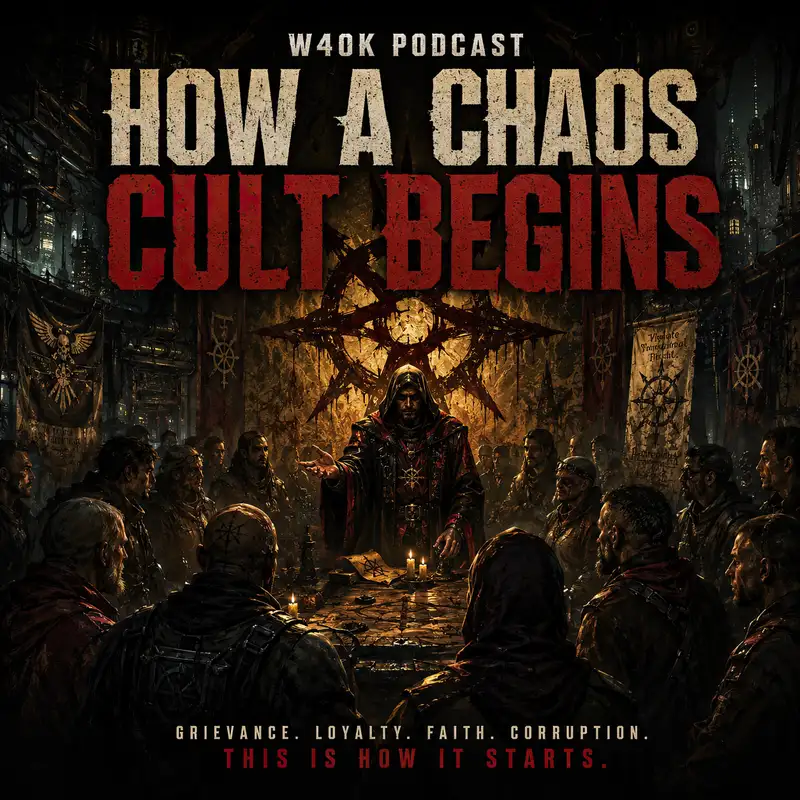
How a Chaos Cult Begins
A Chaos cult rarely begins with a horned idol, a blood-soaked altar, or a hooded congregation chanting in a language that makes the walls sweat. It begins with a locked door after a shift change. A ration card passed to someone whose children have not eaten. A foreman who quietly removes a worker's name from a punishment list. A grieving soldier told that the nightmares are not weakness, but proof that someone finally understands. By the time the symbols appear, the important work has already been done. The recruit has learned who offers help, who explains the pain, and who must never be trusted. The first act of worship may not feel religious at all. It may feel like loyalty. It may feel like survival. It may even feel like justice. That is how a Chaos cult begins. Not when a person first kneels before the dark gods, but when a private wound becomes a shared explanation, and that explanation becomes sacred.
The word cult suggests a clear boundary. Outside are the innocent. Inside are the corrupted. Warhammer forty thousand is rarely so considerate. Some cultists knowingly invoke the powers of the Warp and understand, at least in broad terms, what they serve. Others believe they have discovered a forbidden saint, an older form of the Imperial Creed, a protector spirit, a revolutionary philosophy, or a hidden truth suppressed by planetary authorities. Many begin with symbols they already know. The Emperor may remain in their prayers, though his image acquires strange companions and increasingly convenient interpretations. A local martyr becomes a prophet. A workers' lodge becomes a congregation. A veterans' circle becomes a brotherhood of blood. The line between grievance, heresy, and daemonic worship is crossed in small steps, often by people who would have recoiled from the final destination had they seen it clearly at the beginning.
The Imperium provides fertile ground because it is built upon pressure. Most of its citizens live under systems they cannot influence and barely understand. Their labor is demanded, their faith is compulsory, and their suffering is frequently described as duty. On a hive world, millions may spend their lives beneath polluted skies they never see directly. On an industrial world, a person can be born, work, and die within the same manufactorum district. A voidship crew may inherit a station from parents whose own parents held it before them. Soldiers return from campaigns carrying memories that official sermons cannot heal. Psykers hide symptoms that may bring execution. Minor nobles discover that privilege does not protect them from humiliation, jealousy, or fear. None of this makes corruption inevitable. Most people endure. Some resist without turning to Chaos. Yet every system that offers obedience without relief creates a market for anyone promising meaning, protection, vengeance, or change.
The first successful recruiter usually recognizes a need before offering a creed. Hunger is met with food. Loneliness is met with fellowship. Fear is met with certainty. Ambition is met with a secret path upward. Shame is met with absolution, though the price of that absolution will rise later. The recruiter may be a preacher, an agitator, a wounded veteran, a charismatic noble, a rogue psyker, a criminal patron, or simply the one person in a hab block who seems able to solve problems. They do not begin by explaining the metaphysics of the Warp. They begin by remembering names. They listen. They provide medicine that the official clinic withheld. They arrange work for a dismissed laborer. They make a frightened person feel chosen rather than disposable. The Imperium may have a million institutions devoted to authority, but authority is not the same as care. A cult grows in the space between those two things.
Its language is usually familiar. A Khornate recruiter may speak first of courage, brotherhood, and the right to strike back. A servant of Nurgle may promise relief from fear and the strength to endure what cannot be changed. A Tzeentchian circle may offer education, advancement, or the intoxicating belief that history can be rewritten by those clever enough to seize the pen. A Slaaneshi group may begin with art, discipline, sensation, refinement, or the pursuit of a standard no ordinary life can satisfy. Even a cult that will eventually worship Chaos Undivided may present itself as a movement for freedom, truth, or the restoration of a stolen inheritance. The words are not necessarily lies. That is what makes them dangerous. Chaos does not merely invent desires. It takes desires that already exist and removes the limits that keep them human.
The earliest meetings are small because intimacy is more persuasive than spectacle. Five workers sharing contraband food can build more trust than five thousand strangers listening to a sermon. Members exchange favors, stories, and secrets. They learn that the group can protect them from a foreman, a gang, an abusive officer, or an indifferent bureaucracy. The cult may use harmless rituals at first. A phrase spoken before a meal. A mark scratched beneath a bunk. A candle lit for the dead. A promise never to betray another member. These practices create identity before they create doctrine. They also create evidence. Each person knows something that could condemn the others, and soon the others know something that could condemn them. Mutual trust slowly becomes mutual captivity. Leaving would not only mean abandoning friends. It might mean exposing them, being exposed by them, or admitting that the sacrifices already made were for nothing.
The next step is rarely mass murder. It is a manageable transgression. A document is altered. A weapon disappears from an armory. A supervisor is intimidated. A body is hidden after a confrontation that was supposedly an accident. The act is justified as necessary and exceptional. No one is asked to become a monster. They are asked to help a friend, protect the circle, or punish someone who clearly deserves it. Once the group has crossed that line, the leader can point to danger outside and complicity within. The authorities would not understand. The Ecclesiarchy would call them heretics. The enforcers would execute them all. This may be entirely true. The cult has now created a problem for which continued membership appears to be the safest solution. It is a remarkably efficient arrangement, provided one overlooks the eventual arrival of daemons.
At some point, the movement needs proof that it is more than a conspiracy. That proof may be genuine, fraudulent, or a mixture of both. A hidden psyker produces a vision. A sick member recovers after a ritual. An enemy dies unexpectedly. A leader predicts an industrial accident that the cult secretly caused. Voices are heard in machinery. Dreams begin to repeat across several members. The Warp is shaped by thought and emotion, and sustained ritual can make the boundary between belief and manifestation dangerously thin. Yet the first miracle need not be spectacular. It only needs to answer a private question. Did my child survive because the patron heard me? Did the overseer die because our anger was righteous? Was that impossible coincidence actually a sign? Once a member accepts the supernatural explanation, later demands are no longer judged by ordinary standards. They become tests of faith.
Khorne's path often begins where humiliation meets violence. A laborer beaten by overseers, a soldier abandoned by commanders, or a gang forced to bow before a stronger rival may be told that rage is the one honest response left to them. The cult trains together. It punishes informers. It celebrates courage and condemns restraint as cowardice. At first, violence serves a practical goal. Then violence becomes proof of commitment. Finally, the goal becomes an excuse for violence. Khorne does not require subtle theology. Bloodshed itself is devotion, whether the killers understand that or not. The recruit who once wanted dignity discovers that every insult demands repayment, every hesitation invites contempt, and every bond is measured by willingness to kill. Brotherhood remains, but it is a brotherhood standing in a room where the doors have been removed and the floor is becoming difficult to see.
Nurgle's path can begin in places where suffering has lasted so long that hope feels cruel. A plague ward without medicine, a trench line abandoned by supply, or a lower hive district poisoned by industrial runoff creates people who are exhausted before they are corrupted. The cult does not always promise a cure. It may promise acceptance. Pain will continue, but fear can end. Disease will remain, but the sufferer will no longer be alone. There is real emotional power in that offer. Nurgle's followers often speak the language of family, endurance, and release from impossible expectations. The danger lies in what acceptance becomes. The cult stops resisting decay and begins to celebrate it. Infection becomes communion. Despair is rebranded as wisdom. Those who still struggle are accused of denying reality. The victim is offered peace, then taught that everyone else must share it.
Tzeentch finds openings wherever people believe the world is unjust because fools are in charge. This is not a difficult belief to acquire in the Imperium. A clerk discovers records that contradict official history. A junior officer watches incompetence rewarded. A sanctioned scholar is forbidden to ask the question that might solve a crisis. A mutant is told that birth has fixed the limits of an entire life. The cult offers knowledge, agency, and the possibility of transformation. Its members learn codes, gather secrets, and build plans within plans. Success confirms their brilliance. Failure can also be interpreted as part of a deeper design, which is convenient for leadership and less convenient for everyone else. Tzeentchian corruption thrives on the conviction that one more secret will make the whole pattern clear. The seeker keeps opening doors until there is no longer any corridor behind them.
Slaanesh enters through the refusal to accept enough. The beginning may be beautiful. An artist pursues a perfect form. A duelist seeks flawless control. A noble circle explores experiences unavailable to ordinary citizens. A medicae studies sensation in the hope of conquering pain. A commander demands ever greater precision from an elite unit. Excellence is not corruption, and pleasure is not automatically heresy. The danger comes when identity depends upon surpassing the last achievement. The music must be louder, the victory cleaner, the sensation sharper, the obedience more complete. Other people become instruments or obstacles. The cult praises liberation while making its members slaves to appetite and comparison. What began as refinement becomes compulsion. What began as self-expression becomes the inability to exist without an audience, a rival, or a new boundary to break.
A cult of Chaos Undivided may combine these paths or delay choosing among them. Such groups often begin with opposition to the Imperium itself. They collect forbidden texts, reinterpret local myths, and present the dark gods as liberators from a false emperor. For some members, this is political rebellion before it is worship. For others, it is a search for power without submission to a single patron. The leadership may speak of balance, unity, or the full truth of the Warp. In practice, unity among the servants of Chaos tends to last exactly as long as the common enemy remains more irritating than one another. Still, Undivided cults can be unusually flexible. They recruit the angry, the desperate, the ambitious, and the obsessed under one banner, allowing each member to imagine that the movement exists for their own reason.
As the cult grows, belief requires administration. Someone controls food and weapons. Someone recruits. Someone watches for informers. Someone handles messages, bribes officials, and decides which disappearances must look accidental. Charismatic prophets attract attention, but logisticians make uprisings possible. A mature cult may infiltrate manufactoria, planetary defense forces, shipping guilds, medicae facilities, noble households, or the local bureaucracy. It does not need to control an institution completely. One clerk can delay a warning. One engineer can disable a generator. One officer can issue an order that moves loyal troops away from the district where they are needed. Compartmentalized cells protect the wider network. Most members know only a few contacts, and many may not understand the scale of the organization. The cult can therefore survive arrests that appear decisive. The authorities clear one cellar while the real leadership is filing requisition forms two levels above them.
Inside the movement, information becomes increasingly controlled. New members hear that outsiders are blind, corrupt, or spiritually dead. Doubt is interpreted as fear. Criticism proves that the critic has been compromised. Failed prophecies are explained as tests, sabotage, or evidence that the faithful must sacrifice more. The group develops its own vocabulary, and ordinary moral language begins to lose authority. Murder becomes cleansing. Betrayal becomes revelation. Mutation becomes a gift. The leader may not need to lie about every event because the members learn to reinterpret events for themselves. This is one of the most important stages of corruption. The cult stops merely hiding from the outside world and creates a world in which outside judgment no longer counts. By then, even obvious disaster can strengthen belief. Persecution proves the enemy's fear. Casualties prove the importance of the cause. Survival proves divine favor. Death proves martyrdom.
The Imperial response can destroy a cult, but it can also complete the story the cult has been telling. Local enforcers may begin with informants and arrests. The Adeptus Arbites may become involved if rebellion threatens Imperial law or planetary stability. The Ecclesiarchy may denounce false doctrine. The Inquisition may intervene when evidence suggests daemonic influence, widespread corruption, or a threat beyond local control. These institutions can be terrifyingly effective. They can also be indiscriminate. A district sealed without food, a public execution based on rumor, or the punishment of an entire work gang may convince frightened citizens that the cult's warnings were correct. The Imperial response is often swift, decisive, and applied to everyone within convenient marching distance. Repression does not create Chaos by itself, but brutality can provide recruiters with martyrs, grievances, and proof that no peaceful future is possible.
A cult becomes an uprising when preparation and opportunity meet. The trigger may be a festival, a military deployment, a succession crisis, a famine, a Warp disturbance, or the arrival of an outside warband. Sabotage isolates loyal forces. Communications fail. Armories open. Crowds gather around symbols whose meaning has changed since they first appeared on cellar walls. Some participants understand that a ritual is intended to summon daemons. Others believe they are seizing food stores, overthrowing a governor, or defending their neighborhood. By the time the truth becomes visible, the distinction may no longer matter. Bloodshed, terror, ecstasy, and despair feed the Warp. A successful cult can turn a local rebellion into a psychic wound. A failed cult can still leave enough corruption behind to poison a regiment, a ship, or an entire generation of survivors.
The cultists usually imagine that victory will reward their faith. Chaos has a less sentimental accounting system. A few leaders may receive power, mutations, sorcerous knowledge, or the attention of a patron. That attention is not the same as affection. Many followers are used as soldiers, sacrifices, or fuel for rituals they were never permitted to understand. The liberators who promised freedom become tyrants shaped by their own appetites. The brotherhood fractures as the gods compete, champions rise, and mutations reveal that divine favor has no obligation to be attractive. Even genuine gifts carry a trap. Strength creates the need for greater violence. Endurance erases the desire to escape suffering. Knowledge produces new secrets and new dependence. Sensation destroys the ability to feel anything ordinary. Chaos grants what the cult asked for after removing the part of the request that once made it worth having.
Not every rebellion is a Chaos cult, and treating every grievance as heresy is one of the Imperium's more reliable ways of manufacturing additional grievances. People can resist oppression for practical, political, or moral reasons without serving the Warp. A labor movement is not automatically a daemonic conspiracy. A hidden faith is not necessarily Chaos. A mutiny may begin because officers are incompetent rather than because a blood god whispered through the ventilation system. The distinction matters because Chaos corruption is not defined simply by secrecy or violence. It is marked by the transformation of desire into absolute devotion, the surrender of moral limits, and the growing influence of powers that answer emotion with predatory purpose. The cult does not merely want change. It makes change sacred, and then makes every human life expendable to achieve it.
That is why the true beginning is so difficult to identify in retrospect. Investigators search for the first forbidden symbol, the first sacrifice, or the first recorded manifestation. Those are visible milestones, not the origin. The origin may have been a ration shared in secret, a grieving person listened to without contempt, or a frightened worker protected when official justice failed. None of those acts belongs to Chaos. The corruption begins when gratitude is converted into obedience, when pain is given one explanation, and when the group teaches that every limit on its cause is betrayal. The first altar may be a mess table. The first sacrament may be a stolen meal. The first sermon may be one honest sentence about how badly the world has treated someone. Chaos enters when that truth is used to close every door except the one leading deeper into darkness.