Horus and the Luna Wolves: The Favored Son
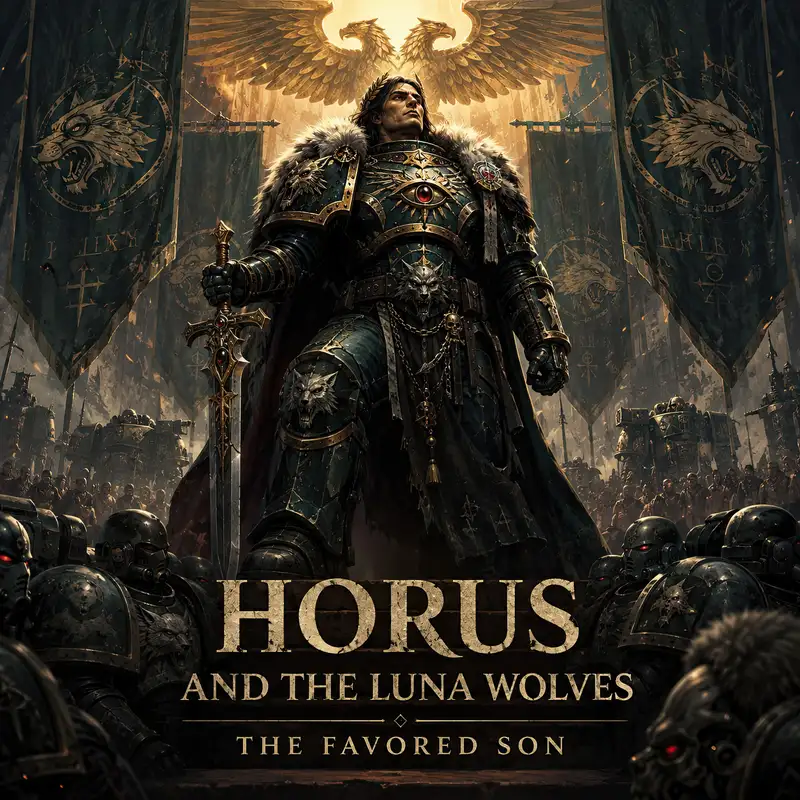
At Ullanor, beneath banners wide enough to shadow armies, the Emperor did something more dangerous than crown a general. He handed his unfinished conquest to his favorite son. Before millions of soldiers, Space Marines, Titans, and dignitaries, Horus Lupercal was raised above every other commander in the Imperium and named Warmaster. The title gave him authority over armies built by demigods and fleets spread across the stars. It also left him standing where the Emperor had stood, while the Emperor himself turned away and returned to Terra. The triumph looked like the highest reward a son could receive. It was also the moment when favor began to feel very much like abandonment.
Why Horus? The easy answer is that he was the best. That is also the least useful answer. Several of his brothers were more brilliant in particular forms of war. Rogal Dorn could build and break fortresses with grim precision. Roboute Guilliman could organize a conquered realm until even its tax collectors marched in formation. The Lion possessed a cold strategic genius, while Sanguinius inspired love without appearing to demand it. Horus was not simply stronger, wiser, or more gifted than all of them. His advantage was broader and more human. He understood how to win a battle, how to command proud men, how to soothe wounded egos, and how to make others feel that his victory was also theirs.
He had more time to learn those skills than any of his brothers. Horus was traditionally remembered as the first lost Primarch recovered by the Emperor. The surviving accounts place his early life on Cthonia, a brutal mining world close to the Sol System, although the details of his childhood are unusually uncertain. Some records present him as a gang-raised warrior transformed by reunion with his father. Others leave gaps large enough to march a Legion through. What matters is that Horus was found early and then spent decades as the Emperor’s only recovered son. Before the family became a council of rival kings, there were simply two figures at the head of the Great Crusade: the father who had designed the future, and the son permitted to stand beside him.
That closeness shaped Horus. He watched the Emperor negotiate with rulers, judge enemies, command armies, and present conquest as reunion. He learned that compliance could be won by a speech, a display of overwhelming strength, or the sudden removal of the one person keeping a war alive. He also learned the Emperor’s habit of revealing only what was necessary. Horus saw much more than most, but he was never shown everything. At first, that secrecy probably appeared to be part of command. Later, it would look like proof that even the favored son had never truly been trusted.
The Legion waiting for Horus already possessed an identity of its own. The Sixteenth had been raised from hard Terran populations, including hunter clans and the inhabitants of violent slums. During the conquest of Luna, the Legion struck the Selenar gene-cults with such speed and ferocity that its warriors earned the name Luna Wolves. They closed rapidly, found weakness, and tore directly into it.
Horus did not erase that character when he took command. He refined it. Cthonia supplied the Legion with recruits shaped by underground gang warfare, where loyalty was personal, status had to be defended, and hesitation could be fatal. Cthonian customs entered the Legion beside Terran traditions. Gang marks, oath bonds, ritual challenges, and an informal manner sat beneath the discipline of the Legiones Astartes. Their flexibility was useful. He did not need every warrior to look obedient. He needed them to understand who led the pack.
Their signature method became known as the speartip. The phrase sounds simple because the idea was simple. Find the point on which the enemy’s system depends, then strike it with enough force that the rest collapses. The target might be a command bunker, a flagship, a planetary ruler, an orbital defense nexus, or the heart of an enemy army. The Luna Wolves did not avoid large battles because they feared them. They avoided wasting strength on the parts of a war that no longer mattered once the head had been cut away. When the Legion attacked, elite formations such as the black-armored Justaerin drove into the decisive point, while fast assault units and supporting forces widened the rupture. A campaign that might have taken months could end in hours.
This was more than aggression. Horus had an unusual ability to identify the true center of a conflict. Some commanders see terrain. Others see formations. Horus saw relationships. He understood which general held an alliance together, which governor was bluffing, which enemy could be reconciled, and which proud brother needed to believe that an idea had been his own. That talent made him dangerous at a council table and on a battlefield. It also made him popular, because people often left his presence feeling understood.
The Luna Wolves reflected that talent in their command culture. Horus surrounded himself with capable officers and encouraged a degree of argument unusual in a force built around a Primarch’s authority. The best-known expression of this was the Mournival, an informal council of four captains. Its members could challenge one another, voice competing positions, and advise Horus without appearing to weaken his command. Near the end of the Great Crusade, the council included Ezekyle Abaddon, Horus Aximand, Tarik Torgaddon, and Garviel Loken. They were not equal in temperament. That was the point. Horus wanted different instincts near him, and he sometimes used their disagreement as political theater, allowing one captain to express the objection that the Warmaster himself preferred not to make.
There was wisdom in that arrangement, but also control. Horus listened. He charmed. He delegated. Yet the entire structure still curved toward him. The Mournival existed outside the formal chain of command, and its influence depended on his favor. The Legion’s brotherhood was genuine, but it was a brotherhood organized around a father figure who seemed to know every name worth knowing. Horus could laugh with captains, honor ordinary warriors, and remember the details of a campaign fought decades before. In an army of transhuman soldiers created to conquer worlds, recognition from a Primarch could become a form of gravity.
His brothers felt it as well. Horus had lived beside the Emperor before most of them were found, and he often acted as the bridge between a newly recovered Primarch and the strange family waiting for him. He could be generous, patient, competitive, and calculating in the same conversation. He knew when to flatter Fulgrim, when to respect Mortarion’s distance, and when to let a more difficult brother believe that no judgment had been made. Not every Primarch loved him, and some distrusted the polish beneath his warmth. Even so, few denied his authority. He had the rare skill of making rivalry feel like fellowship, at least while he remained in the room.
That skill reached its grandest expression during the Ullanor campaign. The Ork empire centered there was one of the greatest threats encountered during the Great Crusade. Defeating it required immense coordination among Legions, Imperial Army formations, fleets, and Titans. Horus played a central role, and at the climax he led a direct assault into the enemy’s command center with his Justaerin. The Ork warlord fell, the resistance fractured, and the Imperium transformed the victory into a spectacle on a scale that only the Imperium would consider restrained. A vast triumphal ground was prepared. Armies marched. Titans passed in review. The Emperor stood before the assembled power of his expanding realm and declared Horus Warmaster.
For Horus, the honor confirmed everything and unsettled everything. He had been chosen above his brothers, but the title came with an impossible assignment. He was to continue the Great Crusade, manage the rivalries of the Primarchs, coordinate distant expeditionary fleets, answer to the emerging civilian government on Terra, and preserve the momentum of an empire whose creator had suddenly withdrawn. The Emperor did not publicly explain the great work that demanded his return. Horus received command without confidence, responsibility without full knowledge, and the appearance of supreme power while remaining subordinate to decisions made far away.
The distinction mattered. Horus had been raised as a conquering son beside a conquering father. Now he found himself receiving instructions from human administrators and facing demands for taxation, compliance schedules, and political settlements imposed by the Council of Terra. Horus had worked with brilliant human officers and understood their value. The deeper wound was that the warriors who had built the Imperium appeared to be losing control of what they had created. Worlds were conquered in blood, then passed to officials who had never seen the battlefield. The process may have been necessary for governing an empire. Necessity has rarely made humiliation easier to swallow.
The Luna Wolves changed with him. After Horus became Warmaster, the Legion eventually took the name Sons of Horus and exchanged its pale armor for sea green. The new name was presented as honor, and it was. It was also a declaration that the Legion’s identity no longer rested on Luna, Terra, or even the Great Crusade. It rested on one man. Their old name had described what they did. Their new name described whom they belonged to.
That loyalty was not artificial. Horus had earned it through centuries of victory, attention, and shared danger. His sons had seen him make plans that worked. They had watched other Legions accept his command. They had heard the Emperor place the future of the Crusade in his hands. When Horus doubted the political direction of the Imperium, many of them did not see vanity. They saw their most trusted commander recognizing a threat. A Legion trained to strike the enemy’s center began to believe that the center of the enemy might be Terra itself.
Yet Horus did not fall because he woke one morning and decided that treason offered better promotion prospects. After Ullanor, he attempted to define what his own leadership might mean. His encounter with the Interex is revealing. The Interex were a human civilization shaped by contact with alien allies and by knowledge the Imperium considered dangerous. Horus hesitated. He considered negotiation and the possibility that compliance did not always require annihilation. This was partly statesmanship and partly independence. He wanted to prove that he could carry the Emperor’s vision forward without merely copying the Emperor’s methods.
The attempt ended in disaster. Erebus of the Word Bearers stole a deadly weapon from the Interex, suspicion erupted, and diplomacy collapsed into violence. Horus saw a possible future close in front of him. The lesson he drew was not necessarily the correct one, but it deepened his isolation. He was trying to rule as Warmaster while hidden powers manipulated events around him, and he did not yet understand how thoroughly the board had been prepared.
Davin provided the decisive wound. During a campaign to suppress rebellion, Horus was struck by a tainted blade and brought close to death. His sons, desperate to save him, carried him into the Serpent Lodge on Erebus’s advice. The decision violated the rational creed the Imperium claimed to uphold, but his sons would risk anything to save him. Inside the lodge, Horus was subjected to visions crafted to exploit every fear already present within him. He saw a future in which the Emperor was worshipped as a god while the Primarchs were forgotten. He was shown the secrecy surrounding his own creation. He was encouraged to believe that the Emperor intended to discard the warriors of the Great Crusade once their work was done.
The visions were deceptive, but effective deception rarely consists entirely of lies. The Emperor was secretive. He had withdrawn. Civilian institutions were rising. The Primarchs had been created through methods connected to powers the Imperial Truth denied. Horus had real questions, real grievances, and real reasons to feel excluded. Erebus did not invent the cracks. He drove wedges into them.
Horus still made a choice. Chaos did not simply replace him with a puppet in one instant. He accepted the possibility that he had been betrayed, then placed his immense confidence behind that interpretation. The same qualities that had made him the favored son now turned against him. He trusted his judgment. He believed he understood people. He had spent centuries finding the decisive point in every enemy system. Once he concluded that the Emperor was the obstacle at the center of humanity’s future, rebellion began to look like another speartip assault.
Pride was part of it, but pride alone is too small an answer. Horus wanted recognition, certainly. He also wanted agency. He feared that the future would be built without him and perhaps without any of the beings who had conquered it. He seems to have believed, at least in the beginning, that he could use the powers of the warp without being owned by them. That was a remarkably ambitious assumption, even by the standards of a Primarch. The gods of Chaos did not require him to become foolish. They required him to remain convinced that he was the cleverest figure in the room.
The Sons of Horus followed because their culture had prepared them to follow Horus personally. Warrior lodges created private bonds beneath the official chain of command. Cthonian traditions emphasized loyalty to brothers and leaders rather than distant institutions. The Legion had spent years hearing that it was first among equals, the Warmaster’s own force, the point of the spear. When Horus declared that the Imperium had betrayed its creators, many accepted his conclusion before examining the evidence. Their loyalty was admirable in form and catastrophic in direction.
Not all accepted it. Garviel Loken and Tarik Torgaddon remained loyal to the Emperor, as did other warriors marked for destruction on Isstvan Three. Horus’s rebellion therefore began with a purge of his own Legion. The Warmaster who had once built unity through fellowship now divided his sons into those who obeyed and those who had to die. On Isstvan, loyal Luna Wolves fought traitorous Sons of Horus wearing the same bloodline beneath different colors. The old Legion did not vanish when its name changed. It had to be murdered.
That civil war within the Legion reveals the limit of Horus’s charisma. He could inspire profound loyalty, but he increasingly demanded that loyalty replace conscience. The Mournival fractured. Brotherhood became surveillance. Informal warrior culture hardened into conspiracy. The speartip remained effective, but its purpose changed. Once it had ended wars quickly in service to the Great Crusade. Now it was aimed at the political and spiritual heart of the Imperium.
Horus remained a formidable commander throughout the rebellion. He assembled a coalition of Primarchs whose motives often conflicted, drew large parts of the Mechanicum and Imperial military into revolt, and drove his forces toward Terra. No lesser figure could have coordinated such a catastrophe. Yet the closer he came to victory, the less the rebellion belonged to him. Chaos magnified his power while consuming his independence. The leader who had feared becoming a discarded tool made himself the instrument of forces that viewed entire civilizations as fuel.
His Legion followed the same path. The Sons of Horus remained dangerous, disciplined, and tactically skilled, but corruption and ambition hollowed their old identity. Some clung to Cthonian honor. Others embraced cruelty, occult power, and personal advancement. Their devotion to Horus could not preserve the brotherhood he had already broken. By the Siege of Terra, the favored Legion had become the army of a dying rebellion gathered around a master who was becoming less recognizably himself.
The final confrontation ended where the relationship had begun, with father and son at the center of history and everyone else reduced to witnesses. Horus killed Sanguinius and faced the Emperor aboard the Vengeful Spirit. The precise details have been buried beneath legend, grief, and Imperial doctrine, but the result is clear. Horus died. The Emperor was broken. The Imperium survived in a form that fulfilled many of Horus’s darkest fears: authoritarian, religious, stagnant, and ruled through institutions that remembered the Primarchs as symbols more readily than as people.
The Sons of Horus did not inherit the galaxy. They fled. Their name became a burden, their failure an accusation. In time, Ezekyle Abaddon would reject Horus’s legacy and forge the Black Legion from the ruins, insisting that the old Warmaster had failed because he became a slave to the powers he thought he commanded. Even the Legion created around Horus could not continue to live entirely in his shadow.
Horus was the favored son because he was close to the Emperor, because he could command almost anyone, and because he turned conquest into a shared endeavor. He could see the weakness in an enemy line and the hunger in an ally’s heart. The Luna Wolves were his perfect instrument: fast, flexible, personally loyal, and trained to strike at the center. Their greatness was real, as was the flaw hidden inside it.
Favor taught Horus that he stood nearest to the source of authority. It did not teach him how to endure distance from it. When the Emperor withdrew, Horus experienced secrecy as rejection and responsibility as proof that he had been left alone. The Legion responded in the same way. Its identity had narrowed until loyalty to Horus seemed greater than loyalty to the cause that had created him.
At Ullanor, the light of the Imperium fell on Horus more brightly than on any other son. The armies saw a perfect heir, the Emperor saw a commander capable of carrying the Crusade, and the Luna Wolves saw the father of their brotherhood raised above the galaxy. None of them understood the danger in that arrangement. A spear is strongest when all its weight is driven toward one point. It is also lost when that point breaks.