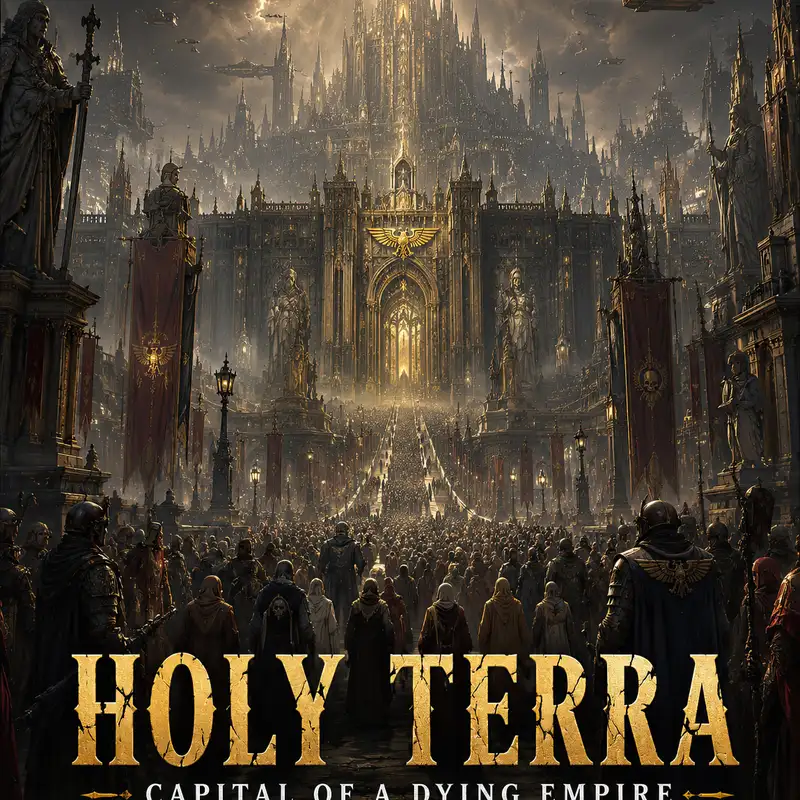
Holy Terra: Capital of a Dying Empire
The holiest road in the Imperium ends at a door that almost no one is permitted to cross. Pilgrims travel for years to reach Holy Terra. Some are born aboard transport ships and die in the queues outside its shrines. They pass through avenues broad enough for armies, beneath statues whose names have outlived the worlds that raised them, until at last they approach the Eternity Gate. Beyond it lies the inner sanctum of the Imperial Palace and the Golden Throne of the Emperor. For most, the journey ends well before that gate. A glimpse of a distant procession, a few seconds before a disputed relic, or the knowledge that the Emperor is somewhere beyond the walls must be enough. Terra is the most sacred world in the Imperium. It is also a place where access to holiness is managed by barriers, permits, armed guards, and queues long enough to develop their own hereditary nobility.
Seen from orbit, the birthplace of humanity bears little resemblance to the world that first sent people toward the stars. The old oceans are gone. The soil has been exhausted, buried, poisoned, or built over. Mountain ranges have been cut down, swallowed by construction, or hidden beneath layers of habitation. The atmosphere is a permanent veil of pollution and industrial discharge. Across almost the entire surface, cities have grown into other cities, one age piled upon another until geography has become archaeology. Orbital docks, defence platforms, cargo stations, warships, and pilgrim vessels crowd the space above it. Holy Terra is not a garden preserved in gratitude for giving birth to humanity. It is a machine wrapped around a grave.
That contradiction is the key to understanding the throneworld. Terra is the political centre of the Imperium, the spiritual centre of the Imperial Creed, the home of its greatest archives, and the location of the machinery that helps hold the empire together. Yet it produces little that its population can eat, drink, or breathe without assistance. It is defended more heavily than almost any other place in the galaxy, but its security depends upon systems that no living person fully understands. It governs a million worlds, while entire districts within its own cities may vanish from reliable records. Terra is the capital of the Imperium because everything important points toward it. It is the capital of a dying empire because almost everything on Terra is devoted to preserving what can no longer be replaced.
The world did not become sacred by accident. During the Age of Strife, Terra was divided among warlords, techno-barbarians, tyrants, and competing states. The Emperor conquered them during the Unification Wars and made the planet the launching point for his Great Crusade. His palace began as the seat of a new human order, built amid the Himalayas on a scale intended to announce that the nightmare of Old Night had ended. It was part residence, part administrative centre, part laboratory, and part fortress. Its walls enclosed chambers of marble, gold, glass, weapon batteries, transit routes, arsenals, and spaces vast enough to move armies. The Palace was never merely a large building. It was a city, a state, and a declaration that humanity had once again found a centre.
The Emperor’s project was not originally a religion. The Imperium of the Great Crusade officially rejected superstition and demanded a secular loyalty to human unity. Terra was meant to be the command post of that rational future. The irony is severe even by Imperial standards. The Emperor withdrew beneath the Palace to pursue a secret human Webway project, hoping to reduce humanity’s dependence on the warp. The Horus Heresy shattered that plan. Magnus the Red’s disastrous warning breached the protections around the project. Daemons entered the human Webway. The Emperor became trapped in a hidden war beneath his own capital while rebellion spread across the galaxy above him.
When Horus finally reached the Solar System, Rogal Dorn had already transformed the Imperial Palace. Works of beauty were removed, buried, or sacrificed to military necessity. Gates became killing grounds. Processional routes became avenues of fire. Towers became gun positions. The Palace that had symbolised the promise of the Great Crusade was converted into the fortress of its last defence. During the Siege of Terra, the armies of the Warmaster broke through the outer works and turned the throneworld into a battlefield. Whole districts were pulverised. Refugees crowded into shrinking pockets of safety. Loyalist forces fought over walls, spaceports, tunnels, and ruins that had once celebrated unity. By the end, the Imperial capital had survived, but the future it was built to house had not.
The Emperor was carried back from the final confrontation with Horus mortally wounded. He was placed upon the Golden Throne, where he has remained for more than ten thousand years. This changed the meaning of Terra. The planet ceased to be merely the headquarters of an expanding empire. It became the shrine surrounding an enthroned ruler who could no longer govern in any ordinary sense. The Imperial Palace became both government complex and reliquary. The Imperium claimed continuity, but its centre had become an emergency measure that was never allowed to end.
The Golden Throne is often described as though it were simply an elaborate life-support device. That is true in roughly the same way that a battleship is an unusually complicated chair. The Throne sustains the Emperor’s ruined body, anchors his presence, and remains connected to ancient systems beneath the Palace. It is also bound to the breached Webway project, where the Emperor’s power helps prevent the disaster below from becoming a disaster everywhere. The precise workings of the Throne are not fully understood. The Adeptus Mechanicus maintains it through inherited procedures, sacred diagnostics, replacement components, and a considerable amount of prayer directed at machinery that has become less cooperative with every millennium.
The price of that maintenance is paid in human lives. Psykers gathered by the Black Ships are brought to Terra. Some are trained for Imperial service. Others are consumed in the processes that sustain the Emperor and his throne. The number required has grown over the ages, and the mechanisms are failing in ways the Imperium cannot confidently repair. To admit this openly would threaten the central promise of Imperial civilisation. The Emperor protects. The Throne endures. Terra stands. Therefore, the truth is handled as the Imperium handles many dangerous truths. It is classified, compartmentalised, wrapped in ritual, and placed under the supervision of people who may kill anyone who asks the correct question too loudly.
Not far from the Palace lies another reason Terra matters to every Imperial world. Within the Hollow Mountain burns the Astronomican, the psychic beacon that Navigators use to cross the warp. Its light is generated by a choir of trained psykers whose lives are steadily consumed by the effort. The Emperor does not provide all of that raw power, but his will directs and focuses it across the galaxy. To a Navigator, the Astronomican is the fixed light by which a course can be judged through a realm where distance, time, and common sense are all treated as optional. Without it, long-range Imperial travel becomes slower, more dangerous, and in many regions nearly impossible.
This makes Terra more than a ceremonial capital. It is a navigational anchor for the entire Imperial system. Fleets carry soldiers because they can steer by its light. Tithe ships reach their destinations because the beacon gives Navigators a reference point. Astropathic messages, military deployments, commercial traffic, pilgrim routes, and the movement of the Black Ships all depend upon the same fragile civilisation of psychic sacrifice. Every Imperial commander may claim to serve Terra, but in a practical sense many of them can act at all because Terra is still burning.
The Imperium’s government also sits here, though the word government can be misleading. The Emperor remains sovereign, but the daily work of rule falls to the Senatorum Imperialis and the High Lords of Terra. The exact holders of the highest seats change as offices rise, fall, and compete for influence. The Master of the Administratum, the Ecclesiarch, the Fabricator-General of Mars, senior military leaders, representatives of the Navigator Houses, the Adeptus Astra Telepathica, the Arbites, and other great institutions may all shape policy. The Inquisition stands apart from ordinary authority while inserting itself wherever it considers ordinary authority insufficient, which is most places.
The High Lords do not direct every Imperial world as a modern central government might. They cannot. Messages may take months or years to arrive, if they arrive at all. Warp routes change. Astropathic communication is uncertain. Local governors possess broad powers because somebody must make decisions before the official answer reaches them three generations later. Terra sets law, assigns tithes, recognises authority, declares crusades, directs the great institutions, and defines the boundaries of acceptable belief. Much of the actual empire is governed by planetary rulers, sector authorities, military commands, shrine hierarchies, forge worlds, and ancient arrangements that no one on Terra would dare simplify without first locating the original paperwork.
That paperwork matters. The Administratum is easy to mock because its scale produces absurdity, but bureaucracy is one of the few tools capable of connecting a million unequal worlds. Terra’s adepts record populations, tithes, military obligations, shipping schedules, legal claims, genealogies, crusade warrants, and territorial rights. Archives extend through chambers, towers, vaults, and buried levels. Families may spend generations maintaining one category of record. Entire labour cultures develop around copying, sealing, carrying, sorting, and interpreting documents. Some records are obsolete. Some contradict one another. Some are accurate but arrive too late to be useful. A tithe demand can outlive the planet that received it.
This is not simply incompetence. It is the result of impossible scale, unreliable communication, institutional fear, and a civilisation that treats precedent as a form of armour. Every alteration risks disrupting some distant dependency. Every reform threatens an office whose privileges were granted by a saint, a primarch, or a clerk with unusually good handwriting eight thousand years ago. The system survives because countless adepts perform small tasks with discipline and because local authorities improvise around the gaps. It decays because those gaps become traditions, and traditions on Terra acquire guards.
The spiritual machinery is just as vast. The Ecclesiarchy teaches that Terra is the holiest point in creation because the Emperor dwells there. Cathedrals cover enormous districts. Relics draw processions from across the galaxy. Some may be genuine fragments of Imperial history. Others possess a provenance that becomes less convincing with every retelling. Their authenticity is often less important than the faith organised around them. Pilgrims sell possessions, abandon homes, and cross lethal distances for the chance to stand upon the soil of humanity’s birth. Their arrival feeds an economy of transport guilds, shrine officials, lodging houses, preachers, relic merchants, security forces, and charitable orders.
For the pilgrim, Terra represents certainty. Somewhere beyond the smoke and walls sits the Emperor. Somewhere beneath the ceremonies lies the origin of every oath, every tithe, and every prayer. The physical reality is harsher. Most pilgrims enter a world of overcrowding, hunger, disease, and regulation. The fortunate may complete part of the prescribed route. Many become stranded by lost documents, exhausted funds, closed transit corridors, or death. Their descendants may continue the pilgrimage as an inherited duty. Terra absorbs them into its population. A journey intended to end before the Emperor becomes another source of labour for the city surrounding him.
The ordinary inhabitants of Terra live under the shadow of institutions too large to perceive as a whole. Billions labour within the Palace complex alone, while uncounted masses occupy the hives, catacombs, hab towers, manufactoria, shrines, and service districts beyond it. Many inherit occupations and obligations. A menial may spend a lifetime carrying messages between departments located in the same administrative complex. A worker may never see open sky, assuming the local level still remembers what sky is. Wealth exists on a scale as extreme as poverty. Senior officials, Navigator houses, ecclesiastical princes, military commanders, and ancient families control spaces and resources that ordinary citizens could not approach.
Terra itself cannot naturally sustain this population. It depends upon continual imports of food, water, fuel, raw materials, replacement machinery, and everything else consumed by a planet-sized city. Convoys arrive through the Solar System and unload into a distribution network of astonishing capability and equally astonishing fragility. When the network functions, Terra appears eternal. When it falters, people die before the High Lords have finished deciding which department is authorised to acknowledge the shortage. The throneworld is therefore both the best-defended planet in the Imperium and one of its greatest hostages. It must be fed every day.
Its defences are proportionate to the risk. Battlefleet Solar guards the approaches. Orbital platforms and stations cover the world. The Imperial Palace is protected by immense walls, batteries, void shields, troops, and systems layered over ten thousand years of fear. The Adeptus Custodes watch over the inner sanctum and the Emperor himself. They are not merely ceremonial guards. Each is a work of individual genetic art, trained for war, statecraft, investigation, and the defence of a single irreplaceable life. Beyond them stand the Arbites, military formations, intelligence services, palace security forces, the Inquisition, and organisations whose names are omitted from records for reasons that are probably very reassuring.
Yet Terra’s greatest danger has never been only invasion from outside. Its tunnels contain forgotten communities, sealed vaults, forbidden laboratories, cults, mutants, and things placed under guard before the current guards’ languages existed. Political conspiracies unfold within the institutions of state. Religious movements can turn pilgrim masses into armies. Alien infiltration and Chaos corruption do not need to conquer the walls if they can grow beneath them. The Palace is so large that no complete map of it can be trusted. Defending Terra means watching not only the skies, but the archives, bloodlines, supply routes, choir chambers, maintenance shrines, and the miles of darkness below the places officially known to exist.
The opening of the Great Rift exposed how thin the claim of safety had become. The Astronomican went dark. On Terra, the blindness lasted thirty-three days. Astropaths screamed or died. Ships lost their guide. Communications failed. Riots, panic, cult activity, and political paralysis spread through the throneworld. Then daemonic armies struck near the Lion’s Gate. For the second time in Imperial history, the enemy reached Holy Terra in force. The Custodes, Sisters of Silence, Grey Knights, Space Marines, and other Imperial troops fought to prevent the assault from reaching the heart of the Palace.
Roboute Guilliman’s return helped break the attack and restored a living primarch to the councils of Terra. His presence was a rebuke to ten thousand years of accumulated custom. Here stood one of the architects of the post-Heresy Imperium, looking upon what that Imperium had become. He could command, purge corrupt officials, reorganise institutions, and launch the Indomitus Crusade. He could not make Terra young again. Even a primarch had to work through systems that had grown around the Emperor’s silence and learned to treat their own survival as sacred.
This is why Holy Terra cannot be understood as merely the Imperial capital. A capital is normally a place from which a state governs. Terra is also the object that the state exists to preserve. Its ministries direct the empire, but the empire’s armies, tithes, pilgrimages, and sacrifices flow back toward Terra. Its beacon enables movement, while its hunger consumes the produce of distant worlds. Its religion gives meaning to suffering, while its institutions produce more suffering in the name of maintaining that meaning. It is the heart of the Imperium, but hearts do not rule the body. They keep beating, and everything else is organised around the consequences.
The planet’s sacredness is real within the lives of those who believe in it. The Astronomican truly shines. The Emperor’s continued existence has consequences no sensible Imperial commander can dismiss. The Custodes truly guard dangers capable of destroying worlds. The archives truly contain the legal and logistical memory of an interstellar civilisation. The tragedy is that every genuine necessity has accumulated layers of privilege, ritual, terror, and decay. Terra is not a false centre. It is a centre made unbearable by how much depends upon it.
A healthy empire might have distributed its knowledge, reduced its dependence on one beacon, created reliable lines of succession, and built institutions able to change without declaring change a heresy. The Imperium did the opposite because its founding catastrophe taught it that survival meant holding the centre at any cost. The Siege of Terra never fully ended. Its walls were rebuilt, its dead were sanctified, and its emergency government became a permanent civilisation. Every generation inherited the same order. Guard the Throne. Feed the world. Maintain the beacon. Preserve the records. Do not ask whether the machine still serves humanity or humanity now serves the machine.
At the end of the pilgrim road, the Eternity Gate remains closed. Beyond it, the Emperor endures upon a failing throne. Around him, clerks write orders for wars they will never see, priests lead processions beneath poisoned skies, psykers burn so that ships may cross the dark, and soldiers watch walls raised against enemies both ancient and unborn. Holy Terra is the capital of a dying empire not because it has lost its importance, but because it has become too important to change. The Imperium survives by keeping its heart alive, even as that heart consumes the body built to sustain it.