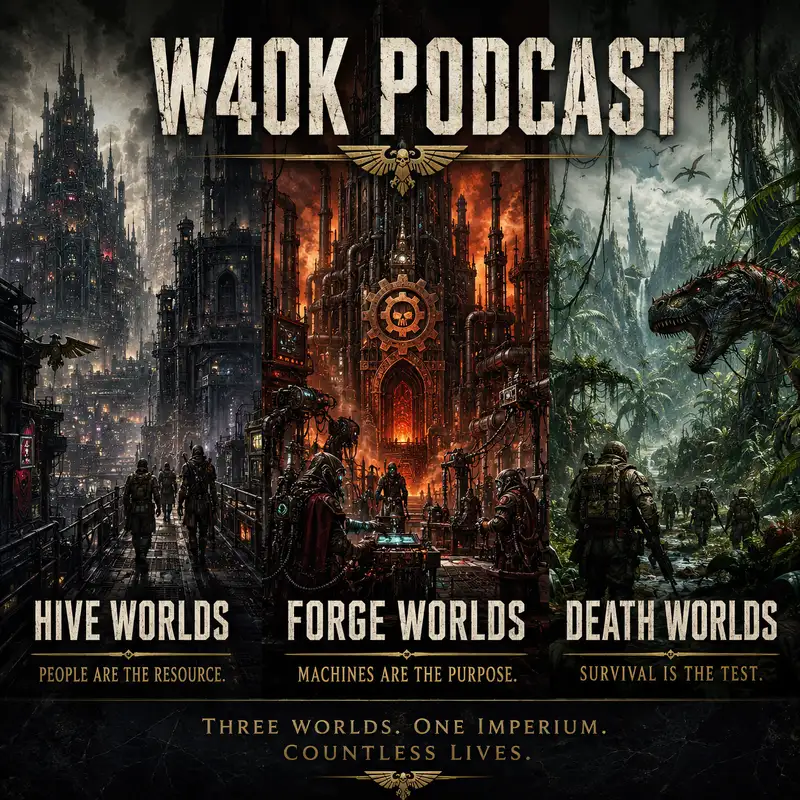
Hive Worlds, Forge Worlds, and Death Worlds
One child is born so far beneath the surface that the sky is almost a religious idea. Another opens his eyes beneath the red glare of furnaces that have burned for centuries. A third learns, before he can read, that the trees are dangerous, the water is worse, and anything brightly coloured is probably hungry.
All three are citizens of the Imperium of Man. All three live on worlds the Imperium considers useful.
The Imperium classifies planets with the cold practicality of a quartermaster sorting ammunition. A world may be agricultural, civilised, feral, feudal, shrine, fortress, hive, forge, or death. The labels are imperfect. They overlap. They are shaped by bureaucracy, history, and local politics. Yet they reveal something essential about how the Imperium sees the galaxy.
A planet is not primarily a home. It is a resource.
A hive world provides people, labour, manufactured goods, taxes, and soldiers. A forge world provides machines, weapons, vehicles, knowledge, and the sacred authority of the Adeptus Mechanicus. A death world provides whatever can be extracted from a place that appears determined to kill everyone involved.
These worlds are different in appearance, culture, and purpose. One is a city grown to planetary scale. One is a temple disguised as an industrial complex. One is an environmental hazard with a population attached. Together, they explain how the Imperium survives, and why survival in the forty-first millennium often looks disturbingly similar to consumption.
A hive world is defined by concentration. Human beings are packed into vast urban structures called hives, sometimes rising kilometres above the surrounding landscape and descending just as far into foundations, tunnels, sumps, and forgotten ruins. The world outside may be polluted, exhausted, irradiated, or simply unable to support the population. The city becomes the environment.
To someone born in the lower levels, the hive is not a building. It is the entire known universe.
The ceiling may be metal, stone, or layers of construction so old that no one remembers what purpose they originally served. Day and night may be marked by work shifts rather than sunlight. Air arrives through ducts. Water arrives through pipes. Food arrives in processed blocks, ration tins, fungal vats, or shipments from distant agricultural worlds. Almost everything is recycled, including things one would prefer not to examine closely.
A hive city usually reflects the social order of the Imperium in physical form. The powerful live higher. The poor live lower. At the summit are the spires, where noble houses, planetary officials, wealthy merchants, and senior administrators inhabit guarded estates above the worst pollution. They may see the sun. They may have gardens. Some may even breathe air that has not already passed through several million lungs.
Below them lies the great body of the hive, an immense vertical city of hab blocks, factories, transit lines, markets, shrines, barracks, warehouses, and administrative offices. This is where the majority labour, worship, raise families, join guilds, serve in local forces, and attempt to avoid attracting the attention of anyone with authority.
Farther down is the underhive. Here, formal control weakens. Infrastructure fails. Old districts collapse into newer ones. Gangs, scavengers, mutants, outcasts, prospectors, cults, and desperate communities occupy spaces abandoned by respectable society. The underhive is dangerous, but it is not empty. It has its own economies, loyalties, and traditions. It is often less lawless than officially claimed and more neglected than officials are willing to admit.
Beneath even that are the sumps and buried levels, where toxic runoff collects and the architecture may predate the current civilisation. In a setting where entire wars are fought over ancient technology, the lowest levels of a hive can contain forgotten machines, sealed laboratories, lost transit systems, and horrors that sensible people left locked behind very thick doors. Sensible people are rarely the ones sent to investigate.
Necromunda is the best-known example of the hive world idea taken to its brutal conclusion. Its great hives dominate a poisoned landscape. Noble houses rule from above while industrial clans and gangs struggle below. The planet produces weapons, goods, recruits, and wealth for the Imperium, but its social order is built on extreme inequality and constant competition.
The gangs of Necromunda are not merely criminals living outside society. Many are connected to the industrial houses that organise labour and production. Their feuds reflect economic rivalries, political ambitions, and inherited identities. Violence is part of the system, not an accidental failure of it. The hive does not eliminate disorder. It contains disorder, directs it, and occasionally recruits from it.
Hive worlds matter because the Imperium requires human beings in extraordinary numbers. Its armies consume regiments. Its fleets require crews. Its factories require workers. Its administration requires clerks, scribes, inspectors, couriers, and entire populations dedicated to recording what other populations have failed to deliver.
A densely populated world can raise enormous military formations, though quantity does not guarantee quality. Some hive-born regiments become excellent urban fighters because enclosed terrain, gang conflict, industrial hazards, and rigid social organisation have prepared them for war in cities. Others are poorly trained bodies handed uniforms and told that the Emperor has personally taken an interest in their survival. He has not.
The strength of a hive world is also its greatest weakness. A hive can hold billions of people, but it cannot necessarily feed them. Many depend on food imported across interstellar distances. Their water and air systems require constant maintenance. Their power grids must keep running. A broken supply route, failed reactor, civil uprising, or warp storm can turn a functioning hive into a mass grave with remarkable efficiency.
The population cannot simply walk away. Outside the hive may be poison desert, ash waste, industrial ruin, or territory controlled by rivals. Inside, the tunnels and transit systems become choke points. A city designed to concentrate labour also concentrates hunger, disease, panic, and rebellion.
This is why hive worlds are both prizes and traps during war. Capture one intact and an invader gains factories, labour, infrastructure, and political control over a vast population. Damage its life-support systems and the city begins killing its own inhabitants. Defenders may have endless streets and fortifications to use, but they are defending a machine whose smallest components are alive.
A forge world appears similar from orbit, but its purpose is different. Where the hive world concentrates humanity, the forge world concentrates industry, technology, and religious authority.
Forge worlds are ruled by the Adeptus Mechanicus, the priesthood of Mars. They are not simply Imperial factory planets. They are sovereign religious-industrial domains bound to the wider Imperium through ancient agreements, shared necessity, and occasional arguments conducted with fleets.
To the Mechanicus, a machine is not merely an object. Technology is approached through ritual, doctrine, inherited knowledge, and reverence for the Machine God. The exact beliefs of the priesthood are complex and sometimes contradictory, but the practical result is clear. Technical knowledge is sacred, dangerous, fragmented, and controlled.
A forge world is therefore part foundry, part monastery, part research archive, and part fortress.
Its surface may be covered by manufactoria, refineries, assembly lines, reactor complexes, data vaults, orbital docks, and cathedral-sized engines. Rivers are redirected for cooling. Mountains are excavated for ore. Atmospheres become thick with chemical exhaust. Entire regions may be devoted to producing a single category of weapon, vehicle, or component.
The people who labour there include tech-priests, adepts, menials, servitors, bonded workers, Skitarii soldiers, and countless specialists whose lives are organised around production cycles and sacred maintenance. A forge world may appear more orderly than a hive world, but order does not necessarily mean comfort. A worker can be perfectly accounted for, properly assigned, spiritually instructed, and still be worked to death.
The difference is that the forge world explains suffering as part of a sacred process.
Every furnace, data stack, assembly shrine, and engine hall exists within a system of ritual. Some rituals preserve genuine technical procedures whose original reasoning has been forgotten. Others express theology. Many do both. A maintenance sequence might include precise calibration, chemical treatment, prayer, incense, and the recitation of approved formulae. Removing the prayer may not stop the machine. Removing the calibration probably will. The difficulty is that the person performing the rite may consider both equally necessary, and may be correct for reasons no outsider understands.
This mixture of faith and engineering is not simply foolishness. The Imperium inherited technologies it can no longer reproduce consistently. Knowledge was lost through war, isolation, catastrophe, and deliberate secrecy. Machines may contain systems that are only partly understood. Artificial intelligence is feared because of ancient disasters. Innovation can be dangerous, politically threatening, or heretical.
The Mechanicus preserves what it can by turning procedure into doctrine. That makes the system conservative and inflexible, but it also allows machinery to survive across thousands of years. The ritual is a cage. It is also a memory.
Mars is the first and greatest forge world, the spiritual centre of the Cult Mechanicus and one of the foundations of Imperial power. Other forge worlds have their own traditions, specialties, rivalries, and political interests. Ryza is famed for plasma technology. Metalica is associated with relentless industrial order. Lucius, Graia, Stygies, and many others hold knowledge, military forces, and manufacturing capacity that can determine the outcome of wars far beyond their own systems.
A forge world does not merely build rifles. It may produce tanks, starship components, void shields, reactors, ammunition, Titans, and the infrastructure required to make more infrastructure. It may maintain patterns of technology unavailable anywhere else. If such a world falls, the Imperium does not lose only territory. It may lose the ability to replace an entire class of weapon.
This makes forge worlds among the most strategically important targets in the galaxy. Chaos seeks their engines and knowledge. Orks seek their weapons and the opportunity to fight near even larger weapons. Tyranids see biomass and industrial worlds stripped of natural defences. Necrons may awaken beneath territory the Mechanicus has spent millennia drilling into, which is an unfortunate way to discover that the planet already had owners.
Forge worlds defend themselves accordingly. Skitarii armies, combat servitors, orbital defences, automata, Knights, and Titan Legions may stand between an invader and the foundries. Yet the greatest defence is often the value of the world itself. An attacker wants the machinery intact. The defenders know this. Both sides may fight through production complexes filled with reactors, ammunition, toxic chemicals, and ancient systems that respond poorly to gunfire.
A death world is different again. It is not defined by population or industry, but by hostility.
The term covers planets where the natural environment makes human survival exceptionally difficult. That danger may come from predators, poisonous plants, extreme climate, unstable geology, radiation, disease, volcanic activity, or some combination arranged with admirable thoroughness.
Catachan is the classic death world. Its jungles contain aggressive flora and fauna, many of them lethal. Human settlements survive through discipline, local knowledge, constant vigilance, and a willingness to treat gardening as close combat. Catachan’s people are famous across the Imperium because merely reaching adulthood there is considered evidence of useful qualities.
The Catachan Jungle Fighters carry that reputation into the Astra Militarum. They excel in dense terrain, reconnaissance, ambush, survival, and irregular warfare. Their skills do not come from mystical toughness alone. They come from a culture in which reading tracks, noticing movement, identifying poison, and reacting quickly are ordinary parts of life.
Death worlds are often romanticised by outsiders. Imperial commanders admire the hard soldiers they produce and speak of harsh environments as if suffering were a training programme designed by a wise instructor. The people living there may have a less poetic opinion.
Fenris, the home world of the Space Wolves, is another kind of death world. It is a planet of violent climate, dangerous seas, unstable land, and fierce native life. Human societies survive in scattered tribal communities shaped by the world’s cycles and dangers. Nocturne, associated with the Salamanders, is marked by volcanic upheaval, radiation, and extreme geological instability. Different worlds produce different cultures because the dangers are not interchangeable.
A jungle hunter, a volcanic survivor, and an ice-world seafarer are all death-world inhabitants, but they do not become the same person simply because an Administratum clerk used the same category.
This is the limitation of Imperial classification. It identifies what matters to the state, not everything that matters to the people.
A death world may contain rare minerals, unusual organisms, strategic routes, recruiting populations, or religious significance. The Imperium continues to inhabit such places because abandoning a useful planet is considered wasteful, because relocation is difficult, or because someone once signed an order that no living official has the authority to reverse.
Some death worlds support only small populations. That limits their industrial output and the number of soldiers they can provide. Yet the regiments they raise may possess unusual endurance, fieldcraft, and local adaptations. The Imperium values these traits, then frequently deploys the troops into environments where none of their specialised knowledge applies. Bureaucracy has its own ecosystem, and it too is hostile.
The three world types depend on one another more than their labels suggest.
Hive worlds need food, fuel, raw materials, and machinery. Forge worlds need ore, labour, food, and protection. Death worlds may provide resources, specialist troops, or strategically placed bases, but often require equipment and supplies from elsewhere. None of these planets is truly independent.
The Imperium survives through movement between worlds. Grain crosses the void. Ore moves from mines to foundries. Engines move from forge worlds to armies. Regiments move from hive blocks and death-world settlements to battlefields they have never seen. Orders move through the Administratum, sometimes arriving after the crisis they were intended to prevent.
When the system functions, it can sustain wars across enormous distances. When it fails, whole planets suffer.
A hive world cut off from agricultural shipments can starve despite having factories capable of producing weapons for millions. A forge world denied raw materials becomes a cathedral of silent assembly lines. A death world isolated by warp storms may continue surviving much as before, which is less a compliment to its resilience than a comment on how little help it was receiving.
The categories also shape identity. A hive-born citizen may understand society as layers of authority above and danger below. A forge-world labourer may see production as sacred duty and technical knowledge as priestly power. A death-world inhabitant may judge competence through practical survival rather than rank or formal education.
These cultures do not remain confined to their planets. They travel with soldiers, pilgrims, workers, priests, and colonists. A regiment carries its home world into war through its habits, superstitions, command style, food, language, and ideas about courage. The Imperium appears uniform from a distance, but at ground level it is a collection of worlds that barely agree on what ordinary life should look like.
There is also a darker similarity between them.
A hive world consumes human beings through labour, crowding, pollution, and poverty. A forge world consumes them through production, augmentation, servitude, and devotion to machines older than their families. A death world consumes them directly.
The Imperium accepts all three forms of loss because each world produces something necessary.
This does not mean every hive governor is indifferent, every tech-priest cruel, or every death-world culture miserable. People create communities even inside terrible systems. Families survive. Workers take pride in skill. Soldiers defend one another. Faith can provide meaning. Tradition can preserve knowledge. A hive market can be lively. A forge shrine can be beautiful. A death-world settlement can be a beloved home.
The tragedy is not that life is impossible. It is that life continues, and the system takes that endurance as permission to demand more.
The Administratum records population, output, tithes, and compliance. The Mechanicus records production, maintenance, and access to knowledge. Military authorities record recruits and casualties. Each institution sees part of the truth. None is designed to ask whether the people beneath the numbers are living well.
That question has little administrative value.
So the difference between a hive world, a forge world, and a death world is not merely scenery. It is the form of pressure placed upon human life.
The hive world compresses humanity until people become a resource measured in billions. The forge world organises humanity around machines until work becomes worship and knowledge becomes authority. The death world exposes humanity to an environment that permits no weakness and offers no mercy.
One produces bodies. One produces weapons. One produces survivors.
Yet each category hides as much as it reveals. A hive world may be deadlier than a jungle. A forge world may be more crowded than a hive. A death world may contain stronger communities than either. The label tells the Imperium what it expects to extract. It does not tell us what the world means to those who live there.
Somewhere beneath a hive, a worker begins another shift without ever seeing the sky. On a forge world, a priest anoints a machine whose original makers have been forgotten. On a death world, a child listens to the night and learns which sound means danger.
None of them believes their world is merely a category.
Only the Imperium does.