Harlequins, Ynnari, and Aeldari Outcasts
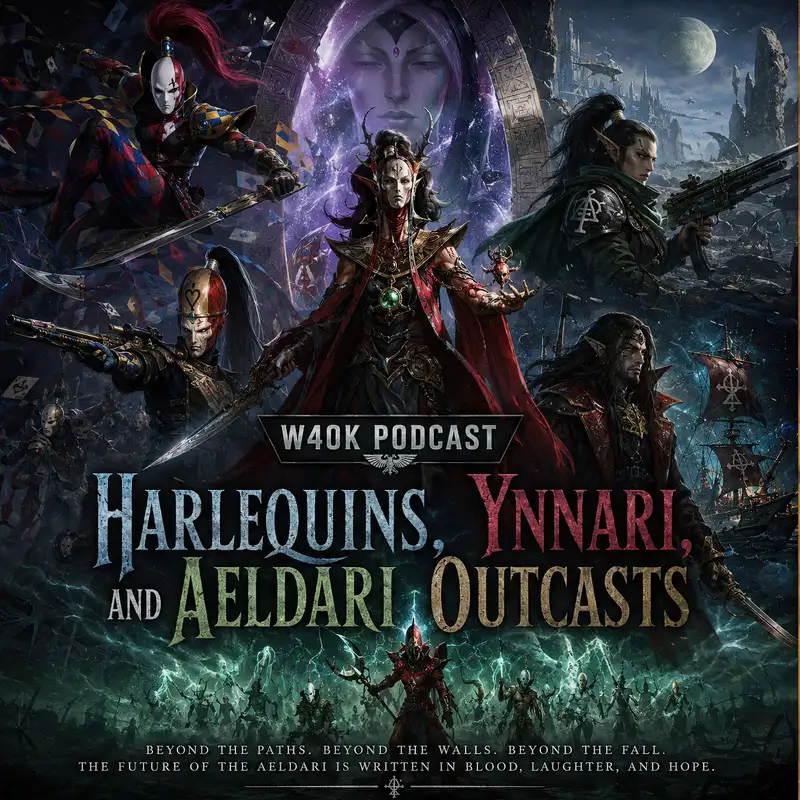
The masque enters while the dead are still being counted. No herald announces it. No permission is requested. Figures in mirrored masks step from a webway portal, bright as shards of stained glass against the dim halls of the craftworld. They do not offer condolences. They begin a play. Within moments, the audience is watching the birth of a god, the ruin of an empire, and the ancient crime that condemned every Aeldari soul to hunger. The performance is beautiful, cruel, and impossible to mistake for harmless entertainment. Beyond the stage, real enemies are moving. The Harlequins have come to change what happens next.
That is the place occupied by the Harlequins, the Ynnari, and the many Aeldari called Outcasts. They stand outside the great surviving societies of their species, yet they repeatedly appear at the moments when those societies can no longer save themselves. The craftworlds offer discipline. Commorragh offers predation. The Exodite worlds offer hardship and distance. These other Aeldari offer something more dangerous. They offer movement. Each group asks a different version of the same question. Can the Aeldari escape the doom inherited from the Fall without ceasing to be Aeldari, or must survival come from abandoning the structures that have preserved them for ten thousand years?
For the craftworld Aeldari, survival begins with restraint. Their ancestors possessed minds of extraordinary intensity. Those gifts helped create a civilisation of almost limitless accomplishment. They also helped destroy it. The excesses of the old empire fed the birth of Slaanesh, the Chaos God who still claims Aeldari souls. The Path system was created as a defence against that fate. An Aeldari devotes themselves to one discipline at a time, learns its forms, and then moves on before passion becomes imprisonment. It is not simply a career plan. It is a psychological fortress built around a soul that the Great Enemy is always waiting to consume.
Fortresses keep danger out, but they also keep people in. Some Aeldari find the Paths too narrow, too repetitive, or too carefully controlled. Others are driven by shame, restlessness, curiosity, or the need to experience a galaxy their seers describe only through warnings. They leave the craftworld and enter what is usually called the Path of the Outcast, although the name is almost a contradiction. It is not a true Path, because it rejects the discipline that makes the Paths safe. The Outcast trades protection for choice. For a species whose emotions can become catastrophes, this is rather more serious than taking an extended holiday.
Many Outcasts become Rangers. They travel through wilderness, ruined worlds, alien cities, and hidden passages of the webway. They learn to live without the craftworld’s constant guidance, and they become exceptional scouts, trackers, and marksmen. A Ranger may spend years observing an enemy that never knows it has been watched. When war comes, the first warning of an Aeldari attack may be an officer collapsing before the sound of the shot arrives. Yet the Ranger’s greatest value is not the long rifle. It is distance. Rangers see threats that craftworld councils cannot. They cross abandoned maiden worlds, map unstable routes, and bring home knowledge gathered beyond the seers’ chambers.
The phrase bring home matters. Most Outcasts have not rejected their people forever. Many return when a craftworld is threatened, and some eventually surrender their wandering lives to resume the Paths. The relationship is uneasy but necessary. Craftworld society regards Outcasts as dangerously exposed, and the Outcasts often regard craftworld society as suffocatingly certain of itself. Both views contain enough truth to be irritating. A Ranger may mock the rules that once confined them, then risk everything to defend the home that made those rules. The craftworld may disapprove of the wanderer right up to the moment it desperately needs someone who knows what lies beyond the next webway gate.
Others go farther and become Corsairs, the Aeldari star-rovers sometimes known as the Anhrathe. Their fleets are as varied as their origins. Some are led by former craftworld nobles or ambitious voidfarers. Others gather refugees, raiders, former Ynnari, and anyone able to survive life under a Corsair prince. They cross the void in swift vessels, strike isolated targets, trade when it suits them, raid when it does not, and occasionally hire their blades to causes that appear profitable, entertaining, or both. Imperial captains tend to call all of this piracy. The Corsairs might object to the lack of nuance, usually while removing the captain’s cargo.
Corsair freedom is real, but it is not innocent. Without the Path, an Aeldari can become trapped by sensation, pride, or violence. A raiding band may drift toward the habits of the Drukhari, especially when victory makes restraint seem unnecessary. A charismatic prince can turn a fleet into a kingdom of vanity. Feuds become wars, and adventure becomes appetite. Some Corsairs return to the craftworlds before that transformation is complete. Some discover they no longer can. The Outcast life therefore embodies the oldest Aeldari danger. Freedom can preserve the self from stagnation, but freedom without discipline can also recreate the conditions of the Fall on a smaller and more personal scale.
The Harlequins appear to be Outcasts of another kind, but their separation is more deliberate and far more mysterious. They belong neither to craftworld, Commorragh, nor Exodite clan. They move among all of them. A Harlequin masque may perform before an Autarch one month, bargain with a Drukhari Archon the next, and then emerge from the webway to slaughter a Chaos cult that had no idea it had become part of the programme. Other Aeldari may distrust them, fear them, or welcome them, sometimes all during the same performance. Yet even bitter enemies will often grant the Harlequins passage, because the servants of the Laughing God carry memories and warnings that no single Aeldari society can afford to ignore.
Their god is Cegorach, the trickster who survived the birth of Slaanesh. Aeldari myth says that while much of the old pantheon was consumed, shattered, or imprisoned, Cegorach escaped into the webway. That survival defines his followers. The Harlequins do not oppose Chaos through purity alone. They use misdirection, speed, and the ability to make an enemy see the wrong truth at precisely the right moment. Cegorach’s laughter is not carefree. It is the laughter of someone who has seen the trap, understands the executioner, and still believes there may be a way to steal the blade.
Every masque is both a military force and a company of sacred performers. Its players enact the myths of the Aeldari, above all the Fall and the long struggle against Slaanesh. These performances are not polite cultural events. They preserve history in a civilisation where memory can be dangerous, contested, and literally haunted by the dead. They also communicate prophecy. A changed costume, an unexpected role, or a familiar scene ending differently may carry a warning understood only by those prepared to notice it. The Harlequins rarely explain themselves afterward. Clarity is useful, but apparently not always theatrical.
On the battlefield, the performance continues. Harlequins strike with impossible speed, using holo-fields and acrobatic skill to turn their bodies into shifting fragments of colour and false position. A Troupe Master shapes the assault as both commander and lead performer. Shadowseers bend perception and cloud the enemy’s mind, making a killing ground appear empty until it is much too late. Death Jesters embody the cruel certainty of death, selecting victims with a performer’s sense of timing and a marksman’s complete lack of mercy. Their weapons are elegant, specialised, and appallingly intimate. Nothing about them is random. The laughter, the masks, and the dance are parts of a language the victim usually learns during the final lesson.
Then there are the Solitaires. Even among Harlequins, they stand apart. A Solitaire performs the role of Slaanesh in the great dramas, a role so spiritually dangerous that others will not attempt it. They may live anonymously for years before joining a masque for a single battle or performance. Their presence inspires dread among the Aeldari because the part they play reaches too close to the Great Enemy. Traditions concerning their souls are grim and not entirely consistent, but many accounts hold that Cegorach must personally trick Slaanesh to save a Solitaire after death. In combat, they move with such speed that witnesses struggle to describe a sequence of blows. The scene seems to jump directly from stillness to bodies on the floor.
The Harlequins are also bound to the Black Library, the hidden repository within the webway that contains knowledge of Chaos accumulated across ages. It is not a public archive, and overdue notices are unlikely to be the visitor’s greatest concern. Its guardians preserve truths capable of destroying minds or worlds. This gives the Harlequins a rare perspective. They know that the war against Chaos cannot be won by strength alone, because Chaos feeds on the motives behind strength. They also know that stories shape action. A civilisation that misunderstands its own Fall may repeat it. A warrior who believes the wrong prophecy may fulfil the right one for the enemy.
This is why the Harlequins cannot be reduced to colourful assassins. They are custodians of identity, but they preserve that identity by refusing fixed identities of their own. Their masks conceal the individual so the role can speak. Their loyalties cross the divisions between Aeldari kindreds, yet their true plans remain hidden even from those they aid. Some masques support the rise of Ynnead. Others appear more cautious, or perhaps simply follow a different movement in Cegorach’s design. A crystal tome in the Black Library is said to have revealed the possibility of a final jest, a way for the Laughing God to alter the ending of the Aeldari tragedy. Whether that jest supports the Ynnari, uses them, or merely runs beside them is unknown.
Ynnead is the Aeldari god of the dead, a divine presence believed to be forming from the souls held within the infinity circuits of the craftworlds. The old expectation was bleakly simple. When the last Aeldari died, Ynnead would awaken with enough power to destroy Slaanesh. Salvation would arrive at the exact moment there was almost no one left to enjoy it. For some seers, that was prophecy. For others, it was an unacceptable timetable. Eldrad Ulthran of Ulthwé attempted to force an earlier awakening through a vast ritual conducted with Harlequin assistance. The Deathwatch intervened, fearing an alien psychic catastrophe. The ritual failed, although failure in Aeldari prophecy often means the consequences have merely chosen a less convenient route.
The released power reached Yvraine as she hovered between life and death in the arenas of Commorragh. She was uniquely suited to become the emissary of a new god because she had already crossed the boundaries of Aeldari existence. She had known the craftworld Paths, the wandering life of a Corsair, and the lethal politics of the Dark City. In Commorragh, death was entertainment and souls were currency. When Yvraine died and rose again touched by Ynnead, that system reacted badly. Psychic power in the Dark City risks drawing Slaanesh’s gaze, and a prophet announcing that death itself might be turned against the Great Enemy was not likely to improve civic harmony.
Yvraine escaped with the Visarch, a silent and formidable warrior whose past is wrapped in deliberate ambiguity, and with a small company drawn from those willing to follow the impossible. Harlequins aided their passage through the webway. This was not merely convenient transport. The Laughing God’s servants had recognised that a new act had begun, though whether they knew its ending remains uncertain. Yvraine’s followers reached Biel-Tan as the militant craftworld faced daemonic corruption and invasion. Biel-Tan had long dreamed of restoring the Aeldari empire through force. Instead, it became the place where a radically different future tore its way into existence.
To save Biel-Tan’s infinity circuit from corruption, Yvraine drew upon the souls within it and awakened the Yncarne, the avatar of Ynnead. The act defeated the immediate daemonic threat, but the cost was immense. The craftworld fractured, its structure broken and its people scattered into surviving fleets. For Biel-Tan, whose identity rested on strength, purity, and restoration, the humiliation was profound. For the Ynnari, the event was revelation. Ynnead was no longer merely a god who might awaken after extinction. A fragment of that divine power could act now. Death had produced not only loss, but agency.
The Ynnari, also called the Reborn, grew around that promise. They recruited from craftworlds, Corsair bands, Harlequin masques, Exodite communities, and even Commorragh. This was extraordinary because the Aeldari kindreds did not merely disagree. They had built incompatible answers to the same catastrophe. The Asuryani restrained desire. The Drukhari fed on suffering to stave off Slaanesh. The Exodites embraced harsh lives far from the old empire’s decadence. The Ynnari declared that all of these divisions could be made secondary to a shared destiny. Predictably, many Aeldari found this inspiring. Others found it heretical, reckless, or suspiciously convenient for Yvraine.
Their power is closely tied to death. Ynnari warriors can be invigorated by the souls released around them, acting with sudden speed and ferocity as comrades and enemies fall. To believers, this proves that Ynnead transforms sacrifice into strength. To critics, it looks uncomfortably like a death cult discovering that casualties are useful. Both interpretations deserve attention. The Ynnari do not seek death for its own sake, and their central hope is to awaken Ynnead without exterminating their species. Yet every victory reinforces a spiritual system in which death is not merely endured. It becomes fuel. In the forty-first millennium, this is the sort of theological distinction that tends to attract sharp weapons.
The Ynnari’s influence extended far beyond Aeldari affairs. Yvraine and her followers helped bring Roboute Guilliman back from death, combining alien knowledge with the work of Belisarius Cawl during the desperate aftermath of Cadia’s fall. The alliance was temporary and deeply mistrusted, but it changed the balance of the galaxy. An Aeldari movement devoted to a god of death helped resurrect an Imperial primarch, who then became the principal organiser of humanity’s resistance. The Ynnari did not save the Imperium out of affection. They acted because the futures in which humanity collapsed were often worse for everyone else.
Their greater quest centred on the Croneswords, five mythic blades associated with the goddess Morai-Heg. Yvraine believed that bringing these weapons together could fully awaken Ynnead through what became known as the Seventh Path, avoiding the complete death of the Aeldari race. Four were identified or recovered, carried by Yvraine, the Visarch, the Yncarne, and Prince Yriel of Iyanden. The fifth became the cruel hinge of the entire plan. During a confrontation with the forces of Slaanesh, the greater daemon Shalaxi Helbane revealed, or claimed, that the final sword had been placed within the Palace of Slaanesh itself.
If true, the revelation turned a desperate quest into an apparent impossibility. Reaching the palace of the god that eternally hungers for Aeldari souls is not a difficult military operation. It is the spiritual equivalent of entering the predator’s stomach and asking it to return the knife. Yet the source of the claim was a daemon created to hunt the greatest prey. Deception cannot be ruled out. The safest conclusion is that the Seventh Path has been obstructed, not disproved. For a people ruled by prophecy, that distinction is enough to sustain both faith and argument for centuries.
The Ynnari therefore remain a minority rather than the united future of the species. Traditional craftworld leaders fear the destruction of infinity circuits and the loss of ancestral souls. Drukhari rulers see a threat to the system that keeps their subjects dependent and their rivals predictable. Some Harlequins support Yvraine, while others may be following purposes only Cegorach understands. Individual converts bring old loyalties with them, and a coalition of ancient enemies does not become harmonious because everyone has adopted tasteful red clothing. The Reborn are powerful precisely because they cross boundaries, and unstable for the same reason.
Seen together, the Harlequins, the Ynnari, and the Outcasts are not three minor branches hanging from the edge of Aeldari civilisation. They are three arguments about freedom. The Outcast says the self must sometimes leave the structure that protects it, because protection can become confinement. The Harlequin says the self must sometimes disappear into a role, because memory and purpose are larger than the individual. The Ynnari says the old divisions must be abandoned, because no surviving fragment of the species can defeat Slaanesh alone. Each answer contains hope. Each also contains the shape of a new disaster.
The Rangers and Corsairs discover what lies beyond the walls. The Harlequins remember why the walls were built and search for the hidden door. The Ynnari are prepared to break through the stone and trust that something better waits on the other side. None offers safety. Safety is what the Aeldari have been buying with discipline, cruelty, secrecy, and sacrifice since the Fall, and the price keeps rising. What these wanderers, performers, and prophets offer is possibility. In a dying civilisation, possibility can be more frightening than extinction, because it demands a choice.
That is why the future of the Aeldari so often arrives wearing the face of an outsider. The established societies know how to survive yesterday’s catastrophe. The Outcasts test whether life can exist beyond inherited fear. The Harlequins carry the ancient story forward while quietly changing the final act. The Ynnari gamble that death, the great certainty hanging over every Aeldari soul, can be transformed from a sentence into a weapon. They may fail. They may even hasten the doom they hope to prevent. Yet without them, the Aeldari have only perfected ways to endure their decline. At the edge of the webway, behind a laughing mask, the possibility remains that the ending has not yet been written.