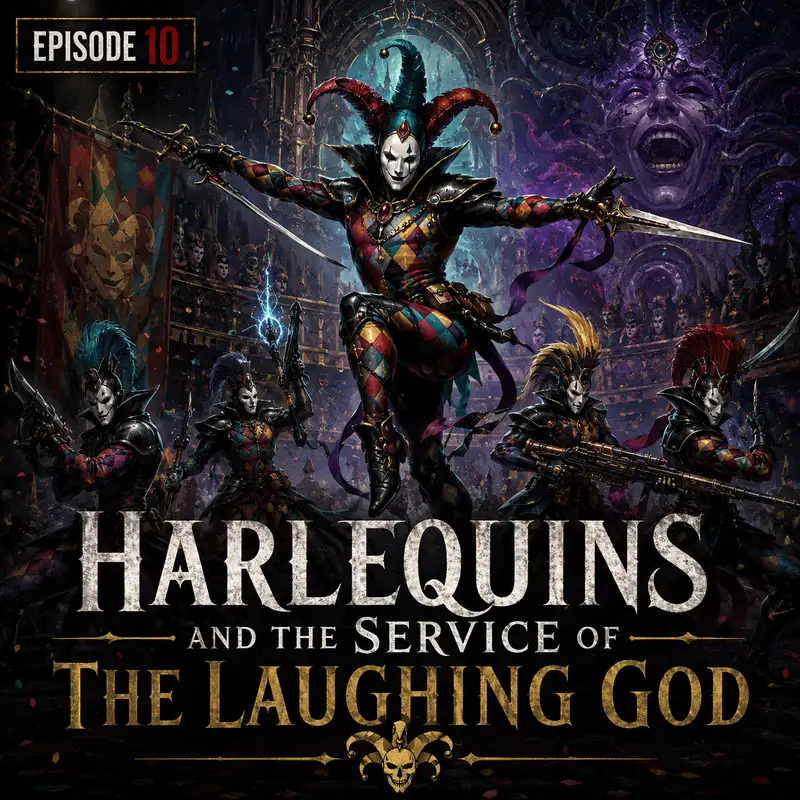
Harlequins and the Service of the Laughing God
The lights die inside a craftworld amphitheatre, and for one heartbeat the audience sits in perfect darkness. Then a figure steps into view wearing a mask that smiles too widely. Others follow in colours bright enough to seem insulting beneath the shadow of extinction. They dance the birth of a god, the murder of a civilisation, and the moment an entire species discovered that its own excess had learned to hunger. The performers are Harlequins, and the laughter that follows them is not relief. It is a weapon aimed at despair.
To outsiders, the Harlequins can look like the galaxy’s least sensible military order. They wear masks, speak in riddles, arrive without warning, and turn battlefields into stages. Yet almost nothing about them is frivolous. Their theatre is worship. Their stories are archives. Their performances are military plans, moral warnings, and fragments of prophecy carried from one scattered Aeldari people to another. Every leap, bow, and sudden act of violence serves Cegorach, the Laughing God. The question is why a dying people would entrust memory, war, and even their souls to a god who laughs.
The answer begins before the Fall, when the Aeldari empire dominated much of the galaxy and believed consequence was something that happened to lesser species. The earliest followers of Cegorach performed ancient mythic cycles before audiences sinking deeper into obsession and cruelty. Their purpose was remembrance. The old tales contained patterns of pride, betrayal, folly, and punishment, all of which were becoming inconveniently relevant. Many listeners responded with hostility, forcing the performers to become skilled fighters. It was a poor review by most theatrical standards, but it established the Harlequin tradition that art and violence could occupy the same movement.
Their warnings failed. The psychic corruption of the empire gathered until Slaanesh was born from it, tearing open reality and consuming uncounted Aeldari souls. Worlds died. The old empire vanished. Most of the Aeldari gods were destroyed, broken, or lost. Cegorach survived. Aeldari legend holds that while Slaanesh fought the war god Khaine, the Laughing God escaped into the Webway, whose secret paths he knew better than any other. It was not a triumph of strength. Cegorach slipped the blow, vanished behind the scenery, and remained alive to interfere with the ending.
That escape defines his servants. Cegorach represents wit against overwhelming power, movement against confinement, and the possibility that a story can be changed after everyone else accepts its conclusion. His laughter is not evidence that suffering is unimportant. It is refusal to let suffering dictate the only response. Slaanesh claims appetite, obsession, sensation, and the certainty that every Aeldari soul will eventually be consumed. The Laughing God answers with mockery. Certainty, after all, is vulnerable to anyone who knows where the trapdoor is hidden.
Harlequin laughter can sound joyful, cruel, mournful, or deeply unsettling. It is not one emotion. It is a discipline. They laugh at tyrants who believe themselves untouchable, at daemons who mistake terror for authority, and at allies who imagine they understand the plan. They also laugh at themselves and at the failures of their own people. That target matters. The Aeldari did not lose their empire because a foreign enemy appeared from nowhere. They created the power that destroyed them. Cegorach’s followers preserve that accusation before descendants who would often prefer a more flattering version.
No Aeldari is born into the motley. Harlequins are drawn from craftworlds, the dark city, Exodite worlds, and other branches of their scattered species. Stories of recruitment are deliberately uncertain. A chosen Aeldari may follow music through a Webway gate, vanish after a performance, or meet a masked figure no one else can see. Whatever the path, joining requires the destruction of the former self. Family, allegiance, profession, and personal name are surrendered. The new Harlequin receives a role, and that role becomes more than a part played before an audience. It becomes the centre of identity.
For the Asuryani of the craftworlds, the Path system contains dangerous emotion by directing it into one discipline at a time. A poet may later become a warrior, a seer, or a builder. The Harlequin transformation is more absolute. The player does not merely study a character. The character becomes the player’s moral compass, manner, instincts, and true face. The mask is not a disguise in the ordinary sense. It does not conceal a stable individual waiting underneath. It declares which ancient role now looks out through the eyes.
This surrender creates the strange order of a masque, both a travelling company and a military formation. Its troupes are associated with Light, Dark, or Twilight. Light roles tend toward heroes and figures of decisive action. Dark roles embody villains, murderers, and endings written in blood. Twilight belongs to change, contradiction, and moments when a story shifts beneath the audience. These are not simple divisions between good and evil. A heroic role may be reckless. A villain may reveal a necessary truth. Twilight may save a world by ensuring no one understands what happened until it is over.
Harlequin command follows the same logic. Troupe Masters lead through role and performance rather than a conventional chain of command. When a masque acts as one, its leading figure may embody an aspect of Cegorach while others take the parts of gods, heroes, monsters, and fools. The result appears anarchic to an enemy commander. There are no shouted orders or reassuring concentrations of soldiers where soldiers are expected to stand. Yet every player knows the rhythm, the next cue, and the purpose of the others. What looks like chaos from outside can be exact choreography within.
Their battle plans are known as Saedaths, performances so complete that story and strategy become difficult to separate. A feint may reenact a god’s deceit. A flanking attack may follow the journey of a mythical hunter. A withdrawal can represent death, transformation, or the close of one act before another begins. The symbolism is not decoration added after the plan is written. It is the plan’s organising language. Harlequins do not pause the battle to perform. The battle is the performance, although the enemy is rarely given a programme and almost never survives to complain about the casting.
Their wargear supports this union of illusion and murder. Holo-suits fracture the wearer into shifting colour and false movement. Flip belts allow impossible changes of direction and leaps that defy ordinary gravity. Masks alter with mood and role. Their close-combat weapons are elegant, specialised, and appallingly intimate. A Harlequin does not need to hold ground like a regiment. The masque strikes where the enemy’s certainty is most fragile, kills with theatrical precision, and disappears before weight of numbers becomes relevant.
The Webway makes this life possible. Its ancient tunnels pass between distant regions without requiring ordinary travel through the Warp, though safe is a generous word for any route built before human ancestors mastered fire. Harlequins know paths others have forgotten, sealed, or never discovered. They can emerge on a craftworld, within Commorragh, beside an Exodite settlement, or behind a supposedly secure enemy line. This mobility gives them a unique position among the Aeldari. They are not tied to one city, one craftworld, or one interpretation of survival.
That independence lets them act as messengers, diplomats, provocateurs, mercenaries, and judges. Craftworlders may distrust their riddles. Drukhari may resent their presumption. Both usually listen when the masks appear, because Harlequins cross divisions that have endured since the Fall. They perform before disciplined Asuryani, predatory nobles of Commorragh, wandering Corsairs, and isolated Exodites, changing details without surrendering the central memory. Their loyalty is not primarily to any surviving Aeldari state. It is to Cegorach’s design and, through it, to the survival of the species.
This does not make them neutral. Harlequins choose sides, manipulate allies, conceal information, and decide that one disaster must occur to prevent another. They may rescue an army from daemons and later lead a different force into an ambush. They can cooperate with humans when a shared enemy makes it useful, then vanish before gratitude becomes familiarity. Their interventions resemble fragments of a larger plan. Unfortunately, Cegorach has not provided the galaxy with the complete script. Even the Harlequins may know only the scene they have been assigned.
Their most sacred duty is tied to the Black Library, the hidden Aeldari repository within the Webway. It contains knowledge of Chaos gathered across ages, including records, prophecies, and dangerous works that would ruin less disciplined minds. Harlequins guard its approaches and strike against those who seek its secrets. The Thousand Sons sorcerer Ahriman has pursued the Library for millennia because knowledge is the currency of his ambition. The defenders understand the problem. A locked archive of forbidden lore attracts seekers with the reliability of an unattended ammunition dump attracting Orks.
The Black Library shows that Harlequin service is not merely ceremonial. They preserve information needed for war against powers shaped by thought, memory, desire, and symbolism. Chaos cannot be understood only through maps and ammunition counts. Its weapons include stories people tell about themselves. A cult begins with an explanation. Corruption grows through repeated justifications. Despair becomes doctrine. Harlequins answer on the same ground. They carry counter-stories, warnings, identities, and remembered consequences. Their art is strategy because the enemy itself is partly made from meaning.
The greatest of their performances is the tale of the Fall. It recounts the glory of the old empire, its descent, the birth of Slaanesh, and the destruction that followed. For an Aeldari audience, this is not remote mythology. It is ancestral guilt performed by people who surrendered their own names. The spectacle can inspire grief, fury, shame, and terror, but its purpose is more demanding than emotional release. It insists that the Fall remain understood. A civilisation that forgets the shape of its failure may repeat it, especially when it measures its lifetime in millennia and has ample opportunity to become impressed with itself again.
One role makes the performance truly dangerous. Only a Solitaire may embody Slaanesh. Solitaires travel apart from ordinary troupes, feared even by many Harlequins, and their presence changes any masque. They represent the predator waiting at the end of every Aeldari life. Traditions surrounding their souls are deliberately grim. When a Solitaire dies, Cegorach is said to contest that soul with Slaanesh, relying on trickery rather than certainty. The role is not a theatrical honour. It is exposure to the central horror of the species, carried by a performer who becomes the thing everyone else fears to portray.
Other specialist roles make the masque’s purpose clearer. A Shadowseer is mystic and narrator, using psychic illusion to shape what allies and enemies perceive. A Death Jester plays death with a heavy weapon and a sense of humour that tends to conclude before the victim finds it amusing. The Troupe Master directs action while embodying the character demanded by the performance. Each is a military function, sacred office, and dramatic role at once. Separating those categories would make the Harlequins easier to explain, but it would make them something else.
Service to Cegorach also offers what almost no Aeldari can ignore: protection after death. Craftworld Aeldari carry spirit stones to catch their souls before Slaanesh can claim them. The Drukhari prolong existence through the suffering of others, postponing the moment when the Great Enemy takes what it considers due. Harlequins trust the Laughing God. Their tradition holds that Cegorach snatches fallen players’ souls away from Slaanesh. No one outside the cult can prove how this works or what becomes of those souls. Faith is rarely offered with a warranty, particularly when the god is famous for deception.
That promise explains their commitment. A Harlequin places identity, purpose, and final fate in Cegorach’s hands. In return, the Laughing God provides no simple creed and no comfortable assurance that every sacrifice will make sense. His servants receive roles, signs, prophecies, and sudden demands. Some claim he walks among them in the guise of a Great Harlequin, though such stories are impossible to verify. A trickster god who clearly identified himself on arrival would be neglecting the central requirements of the position.
The obscurity is deliberate. Cegorach’s advantage is that Slaanesh cannot easily predict him. Open strength failed the old gods. Fixed institutions failed the empire. The Laughing God survives through hidden routes, divided knowledge, improvisation, and plans whose meaning appears only at the decisive moment. His followers mirror that method. A masque may preserve one performance for centuries because a single variation will matter on a battlefield not yet born. It may guide an enemy toward victory because that victory places the enemy where a later defeat requires them to stand.
This makes Harlequins poor candidates for uncomplicated heroism. Some masques will exterminate populations, sacrifice allies, or engineer catastrophes in pursuit of Aeldari survival. Their humour can be merciless. Their confidence can resemble the arrogance that ruined their ancestors. They oppose Chaos, but opposition to something monstrous does not make every method noble. Cegorach is a survivor and trickster, not a kindly guardian designed to satisfy human ideas of justice. His servants save lives, end lives, and sometimes treat the distinction as something to be resolved in the final act.
Their relationship with the Ynnari exposes these differences. The followers of Ynnead believe the awakening Aeldari god of the dead may offer a path to defeating Slaanesh. Some Harlequins aid that cause and incorporate new figures into their performances. Others remain suspicious or interpret Ynnead’s role differently. In some versions, the new god appears as saviour. In others, as fool, liar, interruption, or dangerous uncertainty. Harlequin tradition is preserved, but it is not frozen. A living performance can change when history introduces a character no previous cast expected.
Harlequin lore speaks of the Rhana Dandra, the final battle in which the fate of the Aeldari and their gods will be decided. Older expectations offer little comfort. Yet traditions associated with Cegorach describe an ultimate jest, a reversal in which Slaanesh may be tricked into spending its strength in a way that saves the people it meant to devour. The mechanism remains hidden, and perhaps it must remain hidden to work. For the Harlequins, this is not ordinary optimism. It is a commitment to preserve one impossible move until the board reaches the position where it can be played.
The Laughing God needs performers because gods do not fight only with armies. Cegorach fights with memory, timing, identity, and surprise. His servants carry those weapons into realspace. They keep routes open through the Webway, defend knowledge that Chaos would corrupt, remind the Aeldari of the crime that created Slaanesh, and place individuals where an unseen design requires them. Their service turns culture into infrastructure for survival. Remove the bright colours and theatrical gestures, and the mission is severe: maintain a civilisation’s ability to imagine an ending other than consumption.
The mask is essential to that mission. It frees the player from a former allegiance, but imposes a new captivity. A Harlequin can move between societies because the person who belonged to one has been erased. The masque gains unity because each member submits to an inherited role. The price of becoming a symbol is that private identity becomes difficult to recover, assuming recovery is desired. This is the quiet horror beneath the spectacle. Harlequins resist the god of excess by surrendering themselves to performance until the boundary between discipline and possession becomes very thin.
Their apparent absurdity is part of their strength. The galaxy expects power to announce itself with fortresses, fleets, titles, and enormous statues of important men pointing at things. Harlequins arrive with music, masks, and a vehicle that looks too delicate to survive a strong opinion. Then the command staff dies, the ammunition stores explode, and the survivors discover that their retreat was incorporated into a performance first staged before humanity existed. The laughter matters because it denies the enemy the dignity of believing brutality makes it profound.
For the Aeldari, that denial is also self-directed. Harlequins keep the old catastrophe visible without allowing it to become an excuse for paralysis. They do not claim the Fall was harmless, or that its victims can be restored by feeling sufficiently positive. They show the horror in full. Then they continue the dance. Remembrance without movement becomes mourning. Movement without remembrance becomes repetition. Cegorach’s servants hold both together, carrying guilt in one hand and a blade in the other.
That is why the Harlequins serve the Laughing God. He is the surviving possibility that doom can be outmanoeuvred, the patron of the hidden exit and altered ending. Service demands everything: former identity, unquestioning risk, mastery of ancient memory, and trust that a plan concealed even from its participants can still be worth completing. In return, the Harlequins receive purpose, protection, and the right to answer Slaanesh’s claim with something other than fear.
When the performance ends, the audience is left in darkness. The players are already gone, perhaps through a door that was not visible before they used it. Somewhere else, a commander will receive a warning disguised as a joke. A daemon will pursue prey into an ambush. A Solitaire will step onto an empty stage and wear the face no one else can bear. The Aeldari remain a dying people, and Cegorach has not promised an easy rescue. He has promised only that the final act is not fixed. In a galaxy built upon inevitability, the Harlequins keep laughing because uncertainty is the one weapon their enemy cannot swallow whole.