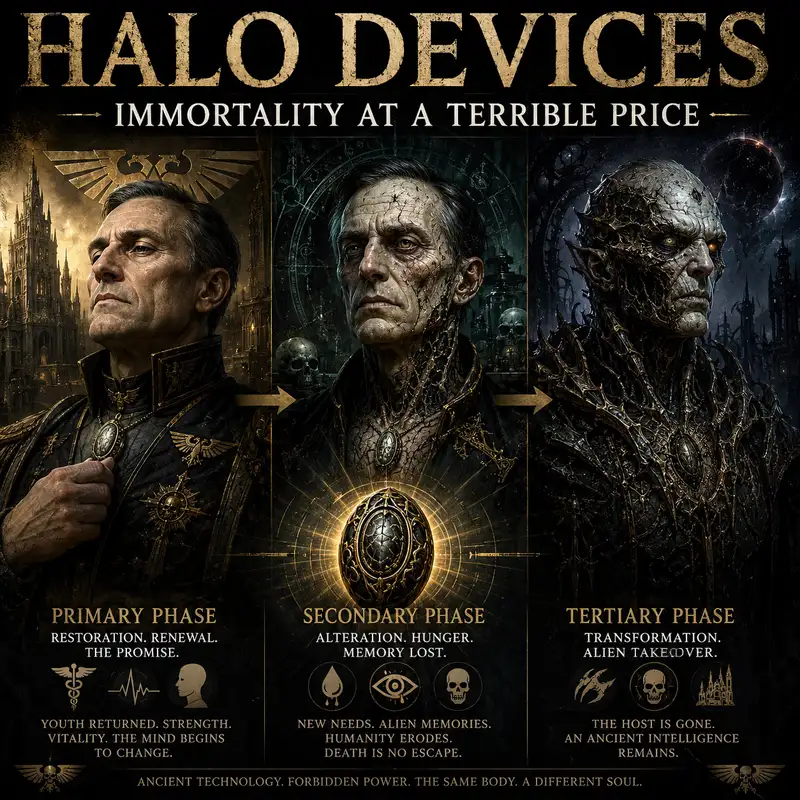
Halo Devices: Immortality at a Terrible Price
The first sign that the bargain has succeeded is not resurrection. It is relief. An old hand steadies. A failing heart settles into a younger rhythm. Eyes clouded by age sharpen, and pain that has ruled every waking hour simply withdraws. For the first time in decades, the owner of the strange little relic feels well. Not merely improved, but restored. The device has asked for no prayer, no oath, and no visible sacrifice. It has only remained against the skin. In the Imperium, that is enough to make a miracle deeply suspicious.
Halo Devices promise something the Imperium cannot reliably provide, even to its richest rulers. They promise freedom from age, disease, mutilation, and eventually death itself. That promise is real, which makes the danger far worse than a simple fraud. The device does not lure its victim with an empty claim. It works. The question is not whether the owner will live. The question is what, exactly, will still be living after the device has finished.
The name comes from the Halo Stars, the sparse and ancient stellar wilderness beyond the better charted reaches of Segmentum Obscurus. Imperial navigators speak of the region with the careful dislike reserved for places that swallow expeditions without providing useful paperwork. Its stars are old, its routes uncertain, and many of its worlds are dead. Among those dead systems lie ruins built by a civilisation whose name, form, and history have vanished.
The makers of the devices remain unknown. Xeno arcanists and Rogue Traders agree only on the broadest outline. The relics are found among cyclopean ruins, basalt tombs, and structures weathered beneath suns that burned out before human history began. Some authorities have suggested that the civilisation may have predated even the Aeldari. That claim cannot be proved, but the age of the sites is not seriously disputed. Whatever made the devices understood matter, biology, and the endurance of living tissue at a level the Imperium cannot reproduce.
A Halo Device rarely looks like a machine. It may resemble a piece of jewellery, a small gorget, a scarab, a fossil, a polished orb, or a smooth talisman. Its surface appears untouched by time. Auspex readings reveal little. Attempts to cut, burn, or analyse the material usually fail. The shape does not seem to determine the effect. A crude object and an exquisite one may produce the same transformation, which is inconvenient for collectors who prefer their forbidden immortality to match the dining room.
That small size is part of the threat. A starship carrying an alien weapon can be searched. A noble wearing a curious brooch is another matter, especially when the noble owns the starport, the customs office, and several generations of the customs officers. Halo Devices pass through the Cold Trade, the illegal traffic in xenos relics that links frontier explorers, corrupt brokers, ambitious scholars, and wealthy patrons. By the time an Inquisitorial cell identifies one, it may already have crossed sectors and changed hands through a dozen respectable intermediaries.
The buyers are usually not fools in the ordinary sense. They are powerful people who understand risk and have spent their lives making other people pay it. Imperial elites can extend life through rejuvenat treatments, organ replacement, sanguinary cleansing, augmetics, and elaborate life support. These methods can preserve authority for centuries, but they have limits. The body continues to decline. Treatments fail. Memories fray. Machines keep a ruler present without necessarily keeping that ruler alive in any generous meaning of the word.
For someone who has commanded worlds, fleets, or dynasties, death is more than a private fear. It is the loss of control. Heirs may be incompetent. Rivals may dismantle a lifetime of work. Enemies may survive long enough to rewrite the record. A governor who has treated a planet as personal property is unlikely to accept that mortality has a legitimate succession claim. The Halo Device enters this anxiety as an answer that seems brutal, illegal, and practical. Those are not disqualifying qualities in Imperial politics.
The Ordo Xenos and the Adeptus Mechanicus both condemn the devices. Possession is sufficient to bring a death sentence, and the Inquisition has maintained investigators devoted to finding the relics, their traders, and their users. Entire circles of Inquisitors have pursued them. Some have died doing so. The response is severe because a bonded host is not merely a heretic with unusual jewellery. It is the beginning of a biological takeover that becomes harder to stop with every passing year.
The devices are especially unsettling because they do not appear to be daemonic. Recorded examples refuse to bond with psykers, the possessed, and those already devoted to the Ruinous Powers. The reason is unknown. The relic may reject minds touched by the Warp, or it may refuse to share control with another influence. Either way, the pattern suggests purpose rather than random contamination. Even parasitic immortality, it seems, prefers an exclusive contract.
This distinction matters. Chaos corruption often arrives through desire, worship, revelation, or a bargain with something that can lie. A Halo Device requires no conversation. It does not explain itself. It offers no theology and demands no praise. Its horror is material, silent, and patient. The victim can tell themselves that there is no daemon, no sorcery, and therefore no spiritual danger. The argument is technically comforting and practically disastrous.
Bonding begins when the device remains in contact with living flesh. It gradually joins itself to the host and starts altering the body. Once the primary phase is established, the process cannot be reversed. The device is no longer being worn. It has become part of the owner, and the owner has begun to become part of it. This change unfolds through three recognised phases, although the exact pace varies and the surviving records are incomplete.
The primary phase is the reason anyone accepts the risk. The host returns toward the peak of youth and health. Chronic disease disappears. Deformities and lesser mutations may be corrected. Lost tissue can regrow, including parts of the body thought permanently gone, though the process may be slow and painful. Strength, speed, grace, and perception improve. Wounds that would cripple another person become temporary problems. The owner sees proof that the legends were true.
At first, the psychological changes can be hidden beneath triumph. Food loses some of its pleasure. Music becomes less moving. Old amusements feel thin. The host grows suspicious, irritable, and prone to violent changes of mood. Strange voices intrude at the edge of hearing. Sleep becomes less necessary, then unnatural. When sleep does come, it brings visions of alien cities and landscapes beneath unfamiliar stars. The owner may interpret these dreams as revelation. More likely, they are the first memories that do not belong to them.
This is the moment when intervention is still imaginable but recovery is not. A loyal servant may notice that the master no longer laughs. A physician may find impossible tissue growth around the relic. An heir may realise that succession has quietly been cancelled. Yet everyone near the host has reasons to remain silent. The servants fear punishment. The physician fears the Inquisition. The heir may fear being replaced before inheriting anything. A household can become an accomplice long before it becomes a cult.
The owner also has powerful evidence against every warning. They feel stronger each month. Old scars fade. Their face in the mirror becomes the face they remember from youth. Critics look envious, superstitious, or politically motivated. The device has delivered results while Imperial medicine offered decline. To surrender it would seem irrational. This is how the trap closes. The victim does not continue because the corruption is invisible. They continue because the benefits are undeniable.
Years later, the secondary phase begins to reveal what the device considers an improved human body. Flesh around the point of bonding may become cold and desiccated, or harden into a mottled shell like an insect's carapace. The host grows inhumanly fast and strong. Injuries close with frightening speed. Ordinary exhaustion disappears. The body no longer needs sleep in any recognisable pattern, and normal food and drink become unnecessary.
The loss of ordinary hunger does not mean freedom from appetite. New compulsions emerge, specific to the host and impossible to satisfy permanently. Some crave long immersion in darkness. Others need intense radiation. Some develop a hunger for blood or human flesh. These are not eccentric tastes adopted by a decadent aristocrat. Denial makes the host unstable and physically unwell. The body has acquired requirements that human society can meet only through secrecy, violence, or both.
At this stage, the household around the owner changes with them. Servants disappear. Restricted chambers are built. Medical staff become prisoners, collaborators, or corpses. Administrators learn to redirect questions. Security forces protect rooms they are forbidden to enter. The host's authority allows private monstrosity to become institutional routine. In the Imperium, bureaucracy can conceal almost anything, provided the correct seals remain on the door.
The most terrible change is not visible. Alien memories begin to merge with the host's own. Languages never learned appear in dreams or sudden speech. Images of dead worlds carry the emotional weight of childhood. At the same time, genuine human memories vanish. A face once loved becomes difficult to place. A victory remembered for a century loses its sequence. The host may still know their title, duties, and enemies, while forgetting why any of them mattered.
This is not simple madness. Madness leaves a person damaged, distorted, or lost within their own mind. The Halo Device appears to introduce something else. The host becomes a contested territory where an ancient pattern steadily replaces a human identity. The process may feel like enlightenment because unfamiliar knowledge arrives as personal memory. A person can mistake being overwritten for finally understanding the universe.
The distinction becomes undeniable when the host dies. During the secondary phase, a corpse left sufficiently intact may repair itself if the device remains attached. Flesh closes. Organs resume their work. The body rises. Resurrection forces the transformation forward and destroys what remains of the host's sanity. Death, which might have ended the process, instead becomes an acceleration. The device has learned enough of the body to rebuild it, but not enough of the person to care who returns.
After decades of bonding, or after such a resurrection, the tertiary phase begins. The separation between relic and host disappears. The body remains broadly humanoid, but no longer human. Reports describe radiant eyes, corpse-like flesh, gaunt and distorted features, armoured hide, fine carapaces, and fingers extended into exposed talons of bone. The creature can display immense strength, survive conditions that would kill an unprotected human, and recover from wounds with appalling persistence.
By then, the original personality is gone. An ancient alien intelligence occupies the transformed body. Whether that intelligence was stored inside the device, reconstructed through the host, or drawn from some other source is unknown. The relics have never explained their design, and no surviving maker has appeared to clarify the warranty. What remains behaves as a predator wearing the last outline of the buyer.
The transformation raises a question that Imperial scholars cannot answer. Were Halo Devices created as medical instruments, survival systems, weapons, prisons, or vessels for transferring identity? Their early benefits could have been normal functions for the species that made them. The later monstrosity may result from forcing alien technology to operate on human flesh. It may also be exactly what the devices were meant to do. The evidence supports several possibilities and settles none of them.
One interpretation is that the device does not corrupt its user at all. It repairs the host according to an alien definition of health, then restores the mind it recognises as the rightful occupant. From that perspective, the human personality is contamination. Youth, regeneration, new appetites, and recovered alien memories are not side effects. They are stages of restoration. The device is not turning a person into a monster. It is using a person to rebuild something that once existed.
That possibility explains the precision of the process. The host is not reduced to a mindless animal. Human tissue is reorganised into a stable, resilient form. Alien memory appears in sequence. The final creature possesses intelligence. The device rejects certain unsuitable hosts and preserves itself across ages. None of this proves conscious intent, but it suggests a system following ancient instructions with extraordinary patience.
The buyer, of course, never sees the process from that angle. They believe the body is theirs because it has always been theirs. They treat memory as proof of identity and continuity of flesh as proof of survival. The Halo Device exploits both assumptions. It keeps the body moving while replacing the memory that gives the body meaning. By the time the difference becomes obvious, the person capable of objecting may already be gone.
This is why the word immortality requires care. A tertiary host can be extraordinarily difficult to kill, but not absolutely indestructible. Complete physical destruction remains the surest answer. Even then, some ancient accounts claim that ruined remains exposed to blood, flesh, electrical force, or radiation can reform. Many within the Ordo Xenos dismiss such stories, and the records do not settle the matter. Sensible investigators tend not to test the optimistic interpretation.
The practical problem for the Inquisition is that every stage rewards delay. In the beginning, the host looks younger and healthier, not corrupted. Later, wealth and authority hide the physical changes. By the time violence becomes unavoidable, the target may be faster than a human, strong enough to tear bodies apart, and capable of returning after an apparently fatal wound. The device turns secrecy into time, and time into armour.
It also turns the owner's social power into a weapon. A planetary noble can control physicians, archives, and security. A Rogue Trader can cross jurisdictions under the protection of a Warrant. A senior adept can classify inconvenient evidence. The Inquisition may know that a Halo Device exists without knowing who wears it, and a false accusation against the wrong aristocrat can begin a sector-wide conflict. Investigation must therefore move quietly until it can end very loudly.
The Imperium's fear of Halo Devices is not hypocrisy, though hypocrisy is never in short supply. The devices threaten more than religious law. They create durable predators inside ruling institutions. A single host can survive generations of witnesses, accumulate wealth, and replace everyone who remembers their earlier appearance. If the transformation retains strategic intelligence, the result is not merely a monster in a cellar. It is an alien will sitting at the top of a human hierarchy.
Yet the demand continues because the device targets a weakness no decree can remove. The Imperium preaches sacrifice, martyrdom, and obedience to a divine order, but its powerful citizens are still human enough to fear the dark. Many have watched subordinates die by the million while treating their own survival as a strategic necessity. A Halo Device offers the final extension of that argument. The ruler must live for the dynasty, the world, the crusade, or simply because no one else could possibly be trusted with the furniture.
The tragedy is that the buyer may begin with motives that are not entirely selfish. A commander may believe only they can hold a frontier together. A scholar may want centuries to complete vital work. A parent may fear leaving a child unprotected. The device does not need vanity alone. It needs someone who can convert fear into justification. Once the first changes arrive, every good intention becomes another reason to continue.
That makes Halo Devices more disturbing than a conventional cursed relic. A curse punishes contact. A Halo Device collaborates. It gives the owner strength to defeat enemies, time to silence witnesses, and health to dismiss concern. Each benefit helps protect the process that will erase the beneficiary. The victim participates in their own replacement because, for many years, replacement feels exactly like recovery.
Somewhere beyond the charted routes, beneath the light of a dead star, the civilisation that made these objects is gone. Its cities have collapsed. Its history has been erased so thoroughly that even the species' name is unknown. Yet its devices continue to travel in human hands, enter human flesh, and awaken memories from a past older than empires. The makers did not achieve immortality as a civilisation. Their instruments may have found another method.
The terrible price of a Halo Device is therefore not the talons, the hunger, or the madness, dreadful as each may be. It is the false continuity between the person who accepts the gift and the creature that eventually rises. The same body walks. The same face may endure for a time. The same voice may issue orders. But survival of flesh is not survival of self. The human does not become immortal. The Halo Device does.