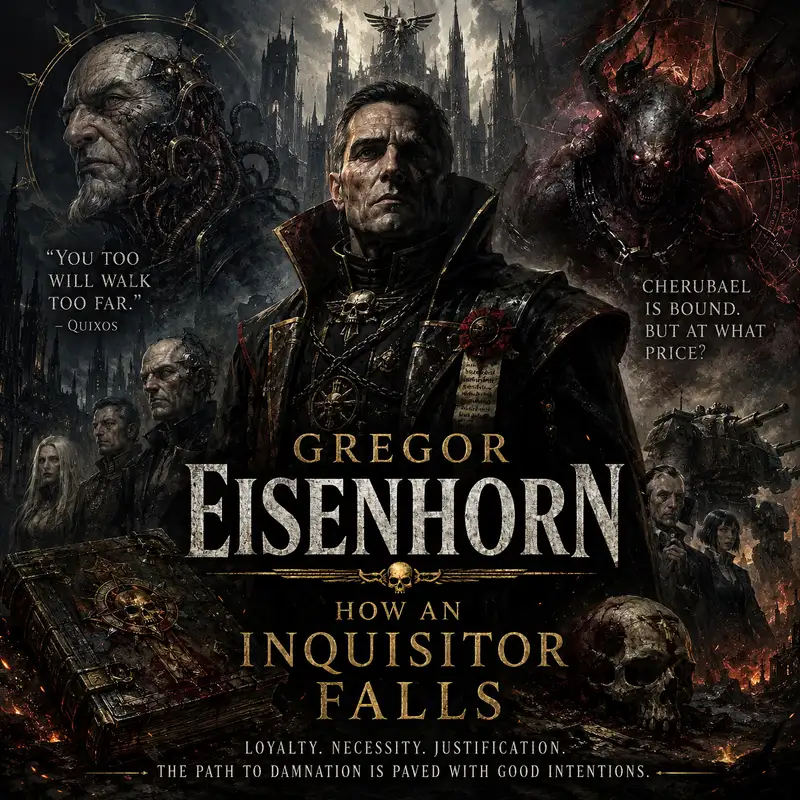
Gregor Eisenhorn: How an Inquisitor Falls
The dying man called Gregor Eisenhorn a heretic. It should have sounded absurd. The speaker was Quixos, once a celebrated inquisitor, now twisted by centuries of forbidden study, daemonic bargains, and absolute certainty. Eisenhorn had hunted him across worlds and finally driven a blade through his chest beside a machine intended to wound the Eye of Terror itself. Quixos died believing he had served the Imperium. Eisenhorn regarded that conviction as proof of madness. Then he took Quixos’s forbidden grimoire from the battlefield. Within two years, he had used it to summon and imprison the daemon Cherubael. The accusation had not been a verdict. It was a warning, and Eisenhorn understood every word except the part that applied to him.
An inquisitor does not fall like an ordinary servant of the Imperium. There may be no secret temple, no renunciation of the Emperor, and no moment when the uniform comes off and the horns go on. The Inquisition grants exceptional freedom because its enemies hide inside governments, churches, armies, and even the Inquisition itself. An inquisitor may requisition troops, condemn cities, erase records, and end lives on personal judgement. That authority is necessary in a civilisation where one cult can doom a planet. It also encourages the person making the decision to mistake power for wisdom. The danger is not merely corruption from outside. It is the conviction that one’s own purpose has become too important to be questioned.
Eisenhorn began as the sort of man least likely to imagine himself vulnerable. Born on DeKere’s World, trained under Inquisitor Hapshant, and elevated while still young, he entered the Ordo Xenos as a disciplined, sanctioned psyker and an Amalathian puritan. Amalathians believed that the Imperium, for all its cruelty and decay, represented the order established by the Emperor and had to be preserved rather than remade. Eisenhorn was controlled, methodical, and deeply loyal. He assembled evidence, cultivated agents, and understood that investigations were won by patient work long before anyone drew a weapon. His early strength was judgement. His later danger would be the growing belief that his judgement alone remained trustworthy.
The case that defined him began on Hubris, a world whose population spent its long winter sealed in cryogenic sleep. Eisenhorn arrived hunting the mass murderer Murdin Eyclone and found a conspiracy operating among frozen citizens who could neither resist nor testify. He killed Eyclone, but the trail led through noble houses, alien artefacts, and a forbidden text called the Necroteuch. Along the way he gained two companions who became measures of the man he was becoming. Godwyn Fischig was an officer of the Adeptus Arbites, practical and anchored to law. Alizebeth Bequin was a blank, a human absence in the Warp whose presence smothered psychic power. Eisenhorn was a psyker, so closeness to her caused genuine pain. He nevertheless came to love her. The relationship could not become simple, which in the Imperium is usually how one knows it is sincere.
On Gudrun, the investigation reached House Glaw, an ancient noble family whose refinement concealed generations of heresy. Eisenhorn infiltrated their estate, was exposed, and endured hours of torture under Gorgone Locke. The damage left his face largely incapable of expression. He could feel anger, affection, grief, and amusement, but could no longer show them normally. It became a fitting wound. His career would increasingly depend upon concealing what moved inside him while presenting the same fixed countenance to allies and enemies. He survived, helped break the conspiracy, and recovered a device containing the preserved mind of Pontius Glaw, a brilliant heretic whose body had died centuries earlier. The proper puritan response was destruction. Eisenhorn chose interrogation.
That choice did not yet make him a radical. Inquisitors question dangerous prisoners because dangerous prisoners know useful things. Pontius helped lead Eisenhorn toward the Necroteuch and the Saruthi, an alien civilisation deformed by Chaos. When the forbidden book came within reach, Eisenhorn destroyed it. He resisted colleagues who argued that such knowledge should be preserved, and he destroyed the Saruthi copy as well. He also refused Cherubael when the daemonhost offered survival in exchange for the text. By Inquisitorial standards, this was a puritan victory purchased at terrible cost. Eisenhorn had looked directly at a weapon of Chaos and burned it. Yet he kept Pontius. The book was too dangerous to exist, but the eloquent mind that desired it remained useful. The distinction was logical. That was precisely the problem.
Pontius Glaw was not merely an archive that answered questions. He was witty, patient, cultivated, and skilled at making his captor feel like the cleverer man. Eisenhorn returned to him across the decades, bargaining for information and gradually treating the imprisoned heretic as something close to a confidant. Pontius never needed to persuade Eisenhorn to worship Chaos. He only had to make continued conversation seem productive. This is one of the quietest steps in Eisenhorn’s fall. There is no lightning, ritual circle, or whispered oath. There is a locked room, a useful source, and an inquisitor who decides he controls the relationship. Most catastrophes in the Imperium arrive with alarms. The efficient ones begin as administrative exceptions.
Success then did what torture and temptation could not. Eisenhorn lived for centuries through rejuvenation treatments, accumulated victories, and built a formidable organisation. Bequin established the Distaff, a network of blanks who could support operations against psykers and daemons. Uber Aemos, the savant who had served Hapshant before Eisenhorn, became the memory of the household. Fischig remained its moral weight. Midas Betancore flew them through danger, and later his daughter Medea took his place. Gideon Ravenor became Eisenhorn’s student and then an inquisitor. These people were a family assembled by work, loyalty, and survival. Eisenhorn loved them. He also learned, little by little, to calculate what each could endure for the mission.
The Triumph on Thracian Primaris revealed how quickly triumph could become slaughter. A vast Imperial celebration was shattered by a psychic atrocity designed to free imprisoned alpha-level psykers. Ravenor was burned and broken, surviving only within a life-support chair. The investigation pointed toward daemonhosts and then toward Quixos, a legendary inquisitor thought long dead. Eisenhorn’s pursuit was obstructed by rivals who suspected him of the crimes he was investigating. He was arrested, escaped, declared an outcast, and forced to work beyond official protection. This experience taught him a dangerous but accurate lesson: the Inquisition could be wrong. Its courts could be manipulated, its puritans could be vain, and obedience could allow a greater enemy to escape. Eisenhorn saved lives by trusting himself instead of the institution. The lesson worked, so he kept it.
Quixos was the future waiting at the end of that lesson. He had once been revered for destroying daemons and cults. A fragment of a daemon’s claw lodged near his heart, and rather than accept weakness or death, he learned to draw power from it. He studied forbidden practices, bound daemons, cultivated compromised allies, and used the enemy’s weapons for Imperial ends. His great project was not petty conquest. He intended to replicate the blackstone pylons of Cadia and use immense psychic force to collapse the Eye of Terror. It was a plan aimed at humanity’s greatest wound. It was also built from abduction, sorcery, murder, and madness. When Eisenhorn confronted him on Farness Beta, Quixos still wore his rosette and believed himself loyal. That was what made him terrifying.
Eisenhorn killed Quixos, banished his daemonhosts, and was cleared of the charges against him. He had been right about the conspiracy. His accusers had been wrong about his guilt. The record could therefore be read as vindication, provided one stopped at the convenient moment. Eisenhorn recovered the Malus Codicium, the grimoire through which Quixos had mastered daemonic binding. He did not surrender it. He hid it. He later summoned Cherubael and imprisoned the daemon in a new host for interrogation and possible use. Eisenhorn could tell himself that Quixos had been consumed by Chaos while he remained in command of it. He could point to motive, discipline, and results. The distinction was not imaginary, but it was much smaller than he believed.
This is how an inquisitor falls: not through one obviously indefensible decision, but through a chain of defensible exceptions. The forbidden prisoner is retained because he has information. The forbidden book is hidden because it may explain the prisoner. The daemon is bound because an unbound daemon is worse. The truth is concealed because less capable colleagues might interfere. Each step answers an immediate problem. Each success becomes evidence that the method was justified. Failure might have forced reconsideration, but Eisenhorn was exceptionally capable. Competence protected him from consequences long enough for compromise to become habit. Chaos did not need to make him foolish. It benefited from allowing him to remain brilliant.
His companions understood different parts of the change. Aemos valued knowledge and could explain why one more fact mattered. Bequin saw the lonely man beneath the authority, but her nature placed a painful barrier between them. Ravenor admired his master while developing radical methods of his own. Fischig remained the hardest test because his loyalty had never depended upon fascination. He believed law mattered precisely when breaking it seemed useful. Eisenhorn treated him as a conscience, but a conscience is useful only if permitted to say no. Over time, Eisenhorn’s companions became both the reason he fought and the resources with which he fought. Love did not prevent him from using them. It made every use easier to name as sacrifice.
The decisive crisis came during the pursuit of Fayde Thuring, the heretic who had murdered Midas Betancore. On Durer, Eisenhorn’s team discovered that Thuring had restored a Chaos-corrupted Warlord Titan called Cruor Vult. Their first plan attempted to turn Bequin’s null power against the god-engine through a psychic link. It failed catastrophically. Bequin was struck down and left in a coma, the gun-cutter was destroyed, and the survivors faced a machine built to erase armies. Eisenhorn opened the Malus Codicium and released Cherubael. The daemon destroyed the Titan. Then, when its host failed and the creature threatened to escape, Eisenhorn bound it into the dying body of the newly elevated Inquisitor Bastian Verveuk. The battlefield was saved. The line had been crossed in full view of those who trusted him.
Eisenhorn’s defenders can make a formidable case. Without Cherubael, Cruor Vult might have killed everyone present and gone on to slaughter thousands. Verveuk was already dying. The daemon was contained rather than released. An inquisitor is expected to spend lives to protect worlds, and the Imperium conducts arithmetic in units larger than one unfortunate colleague. Yet the moral issue is not that Eisenhorn chose between a clean victory and a dirty one. There was no clean victory. The issue is that he had prepared this option in secret, using a book stolen from a man condemned for the same practice. Necessity explains the decision. It does not erase the path that made the decision possible.
Pontius Glaw then returned to collect the debt of every earlier exception. Eisenhorn had promised the imprisoned intelligence a body in exchange for information, and Magos Geard Bure constructed one. Pontius escaped, gathered agents, and launched coordinated attacks across Eisenhorn’s organisation. Estates burned, operatives died, safe houses vanished, and the inquisitor who had mastered conspiracy found his own life dismantled with professional care. Eisenhorn had preserved Pontius because he was useful. Pontius used that preservation to become dangerous again. The disaster did not prove that every radical method must fail. It proved something personal: Eisenhorn’s confidence in his ability to contain exceptional threats was no longer supported by the evidence. He continued anyway.
As Eisenhorn pursued Pontius, his methods grew harsher and his remaining allies grew uneasy. He used psychic coercion, forbidden knowledge, and warp-born weapons while Inquisitors Osma and Heldane closed around him. Those pursuers were not spotless guardians of principle. Their motives included power, rivalry, and an interest in possessing Cherubael. The Inquisition’s politics ensured that almost everyone judging Eisenhorn carried a compromised blade. This matters because Eisenhorn was not persecuted by saints. It changes nothing about what he had done. An unjust accuser can identify a real crime. The Imperium is capable of being hypocritical and correct at the same time, which may be its most reliable administrative achievement.
Fischig finally refused to follow. He had been with Eisenhorn since Hubris, through alien worlds, daemon attacks, political hunts, and years when loyalty meant standing beside a condemned man. What broke that loyalty was the discovery that Eisenhorn had hidden Cherubael and the Malus Codicium for decades. Fischig reported him because he believed his friend had become the danger they once hunted together. At Jeganda, the confrontation ended in violence. Medea shot Fischig while protecting Eisenhorn. Then Eisenhorn used Fischig’s dead body as the new host for Cherubael. No argument about battlefield necessity can make that act small. He turned the corpse of his oldest moral witness into a weapon.
Aemos paid the next price. His mind had been altered by a meme-virus that compelled him to gather and retain information. It made him an extraordinary savant and left him uniquely vulnerable to a book that should never be read. Eisenhorn allowed him to study the Malus Codicium while they searched for Pontius’s destination. Through it, Aemos learned of Ghül and the ancient barque of the daemon-king Yssarile, but Cherubael also reached into him. During the Inquisition’s assault, Aemos used the knowledge to summon the daemon and then held it within himself long enough for Eisenhorn to bind it elsewhere. The strain killed him. The grimoire produced the intelligence Eisenhorn needed, and the friend who provided it did not survive. The transaction was successful. That is what makes it unbearable.
On Ghül, Pontius Glaw stood inside a mechanical body and sought the power preserved within Yssarile’s barque. Eisenhorn stopped him. He burned the Malus Codicium and killed Pontius with Barbarisater, ending the heretic whose voice had followed him since the beginning of his great career. The world was later destroyed. Read in isolation, it resembles purification: the villain slain, the forbidden book consumed, the daemonic prize denied. Yet Eisenhorn left with Cherubael still bound to his service. He had destroyed the text only after using its secrets, and defeated the consequence of one radical bargain through the products of several others. Fire can remove a book. It cannot restore the people spent learning what was inside.
Did Eisenhorn fall to Chaos? The answer depends upon what the word means. He did not kneel before the Ruinous Powers. He did not abandon humanity, seek personal apotheosis, or decide that cruelty was its own reward. He continued fighting enemies who would have destroyed worlds. Some victories were real, and some who condemned him were less principled than he was. Calling him a simple traitor misses the central horror. Eisenhorn remains loyal. He remains capable of friendship, grief, courage, and sacrifice. He falls because loyalty becomes the argument that excuses everything else. The Emperor’s service is no longer a duty measured by standards outside himself. It becomes proof that whatever Gregor Eisenhorn chooses must serve the Emperor.
The Inquisition makes that failure possible because it gives extraordinary people authority without ordinary restraint. A weak inquisitor may be checked by incompetence, rivals, or early death. A brilliant one can survive long enough to build a private system of exemptions. Puritans are not automatically righteous. Their rigidity can waste lives, blind them to evidence, and turn doctrine into vanity. Radicals are not automatically damned the first time they touch a forbidden tool. The problem begins when an inquisitor assumes only lesser minds need boundaries. Eisenhorn believes he can walk where Quixos walked because his intentions are purer and his will stronger. Quixos almost certainly believed something similar about the radicals who fell before him.
After Ghül, Eisenhorn passes into the shadows as an outcast, a rumour, and occasionally a saviour. He continues hunting threats the Imperium scarcely understands, often accompanied by the daemon whose existence proves why it fears him. Later events do not provide a tidy verdict. He remains too useful to dismiss, too compromised to trust, and too determined to stop. That ambiguity is the point. A conventional villain can be recognised and opposed. Eisenhorn is harder because the galaxy is safer after some of his actions and more endangered by the means he preserves for the next emergency. He is both warning and weapon, and the Imperium has always struggled to discard a weapon merely because it points in several directions.
Gregor Eisenhorn does not fall when he ceases to care. He falls while caring intensely, grieving every loss, and insisting the next terrible act will prevent a greater one. Quixos’s final accusation mattered because it came from a man who had followed the same logic to its conclusion. Eisenhorn saw the corruption in Quixos’s body and failed to recognise the shared structure of their beliefs. Both placed the survival of the Imperium above law, friendship, and their own souls. Both believed unique insight justified forbidden power. The difference was that Eisenhorn remained more lucid, disciplined, and successful. That did not make him safe. It made his descent slower and his excuses better.
An inquisitor falls when service becomes self-approval, when every boundary is treated as an obstacle for lesser people, and when surviving the last compromise becomes permission for the next. Eisenhorn still carries the rosette in spirit, still names humanity as the cause, and still faces horrors most citizens could not comprehend. He also walks beside Cherubael through the dark, holding a daemon’s chain with hands that once burned the Necroteuch. He did not exchange loyalty for corruption in one dramatic bargain. He made loyalty the language in which every corruption could be justified. Gregor Eisenhorn fell one necessary decision at a time, and he never stopped believing he was standing.