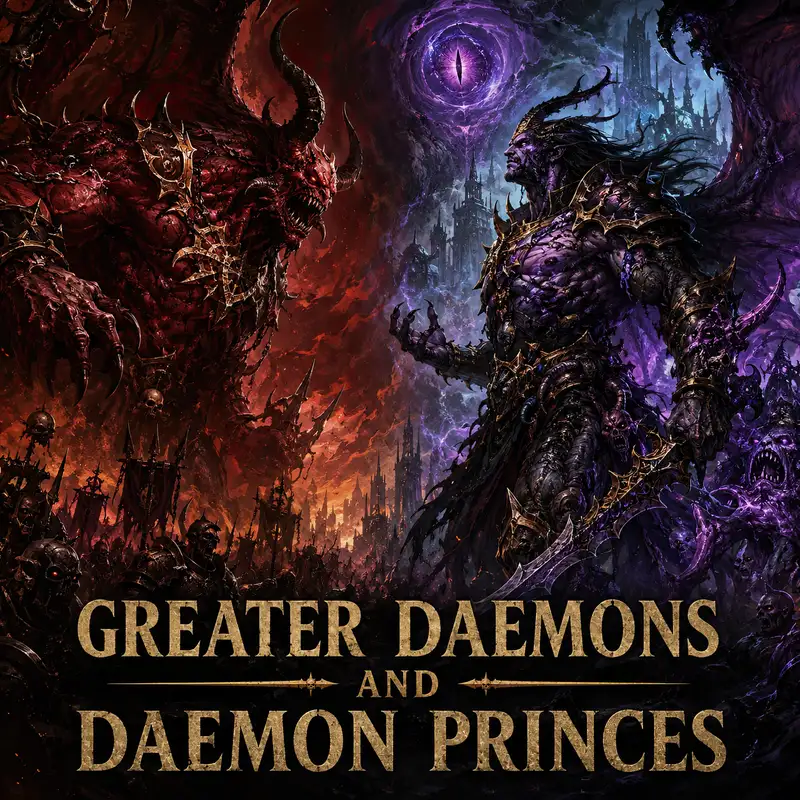
Greater Daemons and Daemon Princes
One of them was never born. The other remembers being human.
On the battlefield, the distinction can seem academic. Both may tower above tanks. Both can tear through armoured warriors, bend the air around them, and make ordinary soldiers feel that reality itself has lost confidence. Both may lead hosts of daemons beneath skies split open by the Warp. Yet a greater daemon and a daemon prince are not two ranks in the same army. They are two different answers to the same terrible question. What does it mean for a personality to belong to Chaos?
A greater daemon begins as Chaos. A daemon prince arrives there by transformation.
That difference shapes everything. It affects how they think, what they want, how they serve, and whether the word freedom has any useful meaning when applied to them. One is an expression of a god that has learned to speak in its own voice. The other is a mortal voice that has been remade until it can speak with the power of a god behind it.
The Warp is not simply another place hidden beyond the stars. It is a realm shaped by emotion, thought, memory, terror, desire, and belief. The Chaos Gods are the greatest concentrations within it, vast intelligences formed around recurring forces in sentient life. Khorne is not merely a person who likes violence. He is wrath, bloodshed, martial pride, and the urge to answer injury with force, gathered into an entity capable of purpose. Tzeentch is change, ambition, hope, conspiracy, and the refusal to accept the present. Nurgle is decay, despair, endurance, affection, and surrender to the cycle of ruin and renewal. Slaanesh is excess, obsession, sensation, perfection, and appetite without a natural stopping point.
Their daemons are made from the same power.
A greater daemon is a concentrated manifestation of its patron. It possesses immense power, a strong identity, and authority over lesser daemons. It is often described as a shard of its god, though Chaos does not divide as neatly as metal cut into pieces. It is divine power given shape, memory, appetite, and agency.
That agency creates a paradox. Greater daemons are part of their gods, yet they are not mindless extensions. They scheme, compete, resent, boast, deceive, and occasionally rebel. Their individuality is real enough to cause trouble. It is not real enough to free them from what they are.
A Bloodthirster may hate another servant of Khorne. It may seek glory, command legions, and pursue a vendetta across centuries. It cannot sincerely decide that violence has become tiresome and take up quiet gardening. The boundaries of its personality are drawn inside the nature of Khorne. Its choices are genuine, but the field on which those choices occur belongs to its maker.
The four great families of greater daemon reveal this clearly.
Bloodthirsters are the greater daemons of Khorne. They are enormous winged killers armed with weapons capable of breaking fortifications and champions alike, but they are not merely creatures in a permanent rage. Many are disciplined commanders who understand hierarchy, martial reputation, fear, and the psychology of violence. They may be brutally direct, but directness is not stupidity.
Their intellect is shaped by the world they embody. They value strength proved through conflict. They despise weakness, sorcery, hesitation, and insult. Even their strategy tends to seek a decisive answer. A Bloodthirster does not negotiate because negotiation risks admitting that something other than force might determine the outcome.
Skarbrand shows how far a greater daemon’s individuality can go, and where it ends. Once among Khorne’s most favoured servants, he was manipulated into striking at his own god. The blow failed. Khorne’s punishment shattered Skarbrand’s standing and cast him into disgrace, but it did not transform him into something outside Khorne’s nature. His shame became more rage. His rejection became more violence. Even rebellion fed the power he had tried to defy.
Lords of Change are greater daemons of Tzeentch. They appear as towering, avian sorcerers surrounded by shifting symbols, flame, impossible colour, and the sense that several different futures are trying to occupy the same moment. They are prophets, manipulators, magicians, and planners. Some command armies. Others arrange events from a distance, allowing mortal rulers to believe they are acting independently until the final consequence closes around them.
A Lord of Change may pursue a plan within a plan because change itself is the objective. A stable victory can be less satisfying to Tzeentch than a conflict that produces ten new ambitions. His greater daemons are brilliant and unreliable, including to one another. Every alliance is temporary, and every prophecy selective.
Kairos Fateweaver embodies the cruelty of that knowledge. According to the best-known accounts, Tzeentch cast him into the Well of Eternity, a mystery even the god would not enter directly. Kairos returned altered, with one head able to perceive the past and the other the future, while the present remained difficult for him to grasp. It is a perfect gift from Tzeentch. Immense knowledge, paired with a flaw that ensures certainty never becomes peace.
Great Unclean Ones are greater daemons of Nurgle. Their appearance is one of swollen decay, open wounds, rusted blades, flies, filth, and diseased abundance. Yet their manner is often disturbingly warm. They may laugh, offer encouragement, and address lesser daemons with something resembling affection. To followers of Nurgle, this is not necessarily mockery. Grandfather Nurgle’s love is presented as acceptance without condition.
The condition, unfortunately, is decay.
A Great Unclean One embodies the point at which resistance collapses into relief. Pain remains, but the fear of pain fades. Disease remains, but the sufferer is told to welcome it. Failure becomes inevitable, and therefore no longer shameful. This is why Nurgle’s daemons can be both hideous and comforting. They do not promise that suffering will end. They promise that struggling against it will.
Their humour and apparent kindness make them no less dangerous. A city conquered by a Great Unclean One may become a garden of contagion. Its people may continue moving long after their bodies should have failed, smiling because the god has taken away the part of them that objected. The tenderness is real within Nurgle’s logic. So is the destruction.
Keepers of Secrets are greater daemons of Slaanesh. They are swift, graceful, terrifying, and often beautiful in ways that become less reassuring the longer one looks. They understand desire with intimate precision. A Keeper of Secrets does not always need to threaten. It may simply identify what a person wants, then remove the limits that once kept that desire from consuming everything else.
Their name is not decorative. They collect vulnerabilities, ambitions, shame, longing, and concealed appetite. On the battlefield, they are devastating. Away from it, they can be corrupters, patrons, advisers, and mirrors. They offer perfection according to one chosen measure. The trap is that perfection moves each time it is approached.
A warrior seeks the perfect victory. An artist seeks the perfect work. A ruler seeks perfect obedience. A scholar seeks perfect understanding. The Keeper needs only to encourage the pursuit until every other loyalty becomes an obstacle. Slaanesh rarely begins by asking someone to love ugliness. The more effective offer is to love one beautiful thing so completely that nothing else is permitted to matter.
These greater daemons are not equal copies issued from a divine workshop. Each develops a reputation, preferred methods, rivalries, servants, and grudges. Some become legendary even among their own kind. Their names carry power because a true name is tied to the structure of a daemonic being. To know it can provide leverage in ritual, binding, or banishment. In the Imperium, scholars who investigate such matters usually work under conditions of extreme secrecy. This is partly because the knowledge is dangerous, and partly because the Inquisition has never regarded curiosity as a strong legal defence.
When a greater daemon enters the material universe, it forces a creature of the Warp into a reality that resists it. Ritual, sacrifice, psychic catastrophe, mass violence, corrupted artefacts, and unstable regions of space can weaken the barrier. Once present, the daemon may draw strength from surrounding emotion. A battlefield soaked in rage is welcoming ground for Khorne. A collapsing society full of plots offers Tzeentch a thousand open doors.
Destroying the body does not usually destroy the daemon. It banishes the entity back into the Warp. The period of exile may be brief or immense, depending on the circumstances, the power used, and the nature of the binding. Permanent destruction is possible in rare cases, but ordinary weapons generally solve the immediate problem rather than the eternal one. This remains useful. Soldiers have often preferred temporary survival to permanent metaphysical victory.
A daemon prince reaches the same battlefield by a different road.
The prince was once mortal. It may have been human, xenos, or something from a civilisation long erased from reliable history. It possessed a body anchored in material reality, a finite life, personal memories, and choices made under mortal limitations. Through devotion, conquest, corruption, service, or some combination of all four, it attracted the favour of Chaos and achieved apotheosis.
The word achieved requires caution.
Chaos presents daemonhood as the highest reward. Mortal champions are encouraged to believe that every sacrifice brings them closer to immortality. They gather warbands, overthrow rivals, dedicate victories, recover relics, spread plagues, perform rituals, and reshape themselves according to the will of their patron. Some become terrifyingly powerful long before ascension. Most never reach it. They die, fail, are betrayed, lose favour, or mutate into Chaos Spawn when the gifts of the gods overwhelm what remains of their identity.
The gods are generous with promises and economical with successful transformations.
When ascension occurs, the mortal does not merely receive a stronger body. The mortal is remade as a being of the Warp. Flesh, soul, memory, and identity are drawn into a new existence. The resulting daemon prince may remember childhood, humiliation, triumph, comradeship, betrayal, and the exact face of an enemy who died ten thousand years earlier. Those memories give the prince a continuity that greater daemons do not possess in the same way.
This is the daemon prince’s greatest distinction and one of its most useful weapons.
A greater daemon understands mortals through the nature of its god. A daemon prince remembers being one. It knows the weight of hunger, rank, fear, loyalty, exhaustion, and ambition. It may understand how armies are supplied, how officers lie to themselves, how political institutions protect their own failures, and how a promise sounds to someone who still believes death can be avoided.
That memory does not guarantee sympathy. More often, it produces contempt.
The prince may view mortals as weak versions of what it once was and old loyalties as embarrassments. It may seek revenge against descendants who no longer remember the original grievance. Yet the past remains. A daemon prince carries the scar tissue of a previous life.
Its form often reflects both patron and history. A prince of Khorne may become a winged engine of battle, but the shape of its armour, weapons, or scars may preserve elements of the warlord it once was. A prince of Tzeentch may become a sorcerous figure of shifting anatomy while retaining symbols of an old dynasty or legion. A prince of Nurgle may display the diseases, wounds, or instruments that defined its surrender. A prince of Slaanesh may become an idealised and monstrous version of the perfection it pursued in life.
Ascension grants immortality of a kind, immense power, and a place within the hierarchies of Chaos. It also completes the champion’s dependence upon the powers it served. A daemon prince is no longer merely a worshipper. It is made from the power of its patron and sustained by the same realm. The reward and the chain are forged from one substance.
This is why daemonhood is not freedom from death so much as enlistment without release.
Princes may feud with greater daemons, command daemonic armies, rule worlds within Warp-tainted regions, and pursue campaigns across millennia. Some retain considerable independence in method. None can become innocent of the force that remade them. A prince of Khorne may choose where to wage war, but not to become a creature of peace. A prince of Nurgle may choose which world to corrupt, but not to reject decay as a principle. The mortal personality remains, yet every path now curves toward the god.
The rare princes of Chaos Undivided make the problem even more complicated. Rather than belonging wholly to one patron, they draw power from several gods or from Chaos as a broader force. Such elevation is difficult because the gods cooperate poorly. Each wants the champion’s victories and resents the others’ claim.
Be’lakor is the great warning.
He is remembered as the first daemon prince, raised by the combined favour of the Chaos Gods. Their gifts made him immensely powerful. They also made him the property of rival masters. Be’lakor has spent ages scheming for independence, manipulating champions, building armies, and trying to turn divine competition to his advantage. His ambition is extraordinary. So is his captivity. He may defy one god by serving another, but the game itself still belongs to them.
The daemon primarchs show the transformation on a scale large enough to scar galactic history. Angron, Mortarion, Magnus, and Fulgrim did not become interchangeable monsters when they ascended. Their old selves remained recognisable, then expanded into something worse.
Angron’s rage had been forced into him by suffering, enslavement, and the Butcher’s Nails. Under Khorne, that rage became cosmic and self-renewing. Mortarion’s hatred of weakness, tyranny, and sorcery curdled into service to Nurgle, the very kind of supernatural master he once despised. Magnus pursued knowledge and mastery, believing intellect could control forces others merely feared. His ascension to Tzeentch preserved the brilliance and the fatal confidence. Fulgrim’s search for perfection became submission to Slaanesh, where every achievement creates the need for a more extreme one.
Their stories matter because ascension does not erase contradiction. It preserves contradiction forever.
A daemon primarch can still command armies according to habits formed during the Great Crusade. It can remember brothers, defeats, vows, and insults. It can act with strategic purpose far beyond the immediate appetite of a lesser daemon. Yet the old personality is no longer standing outside corruption and struggling against it. The corruption has become part of the personality’s structure.
This helps explain why a daemon prince and a greater daemon can occupy similar positions without being the same thing. Both may lead invasions. Both may possess vast psychic or physical power. Both may be worshipped by mortal cults. Both may be banished when defeated. The difference is not simply strength.
A famous greater daemon may overpower most princes. An exalted daemon prince may rival or surpass many greater daemons. Patronage, ritual conditions, symbolism, and divine attention all matter. Asking whether every greater daemon outranks every daemon prince is like asking whether every general can defeat every king. The title does not fight the battle for them.
Their methods often reveal their origins.
A greater daemon enters a war as an embodiment. When a Bloodthirster appears, the conflict itself seems to become more direct and murderous. When a Great Unclean One manifests, decay acquires intention. When a Lord of Change arrives, certainty begins to fracture. When a Keeper of Secrets steps into view, hidden desire becomes operational terrain.
A daemon prince enters with a biography.
It may want a specific fortress because it failed there as a mortal. It may hunt a bloodline, a Chapter, a regiment, or a world connected to an ancient humiliation. It may understand an enemy’s doctrine because it once taught that doctrine. It may preserve the patience to wage a campaign whose purpose is personal rather than purely divine.
The gods benefit from both. Greater daemons bring concentrated expressions of their nature. Daemon princes bring mortal experience, proven ambition, and the persuasive example of reward. Every prince is propaganda. Its existence tells living champions that ascension is possible.
Chaos rarely advertises the full terms.
The champion imagines becoming a god. The result is a being of enormous power that can no longer exist apart from the power that elevated it. The champion imagines escaping mortality. The result is an eternity in which old wounds never need to heal. The champion imagines perfect self-realisation. The result is a self enlarged until its dominant obsession crowds out every competing possibility.
Greater daemons face a different tragedy, if tragedy is the right word for creatures that were never mortal. They possess identity but not origin beyond their god. They can rebel, yet rebellion expresses the same force they oppose. They can seek favour, though favour means becoming a more effective version of what they already are. They can fear punishment, humiliation, exile, and true destruction. They cannot imagine freedom in a form that lies outside the emotional universe of their patron.
The prince remembers another life and cannot return to it.
The greater daemon never had one.
That is why these beings are more than oversized enemies at the end of a battle. They are two models of corruption made visible. The greater daemon shows Chaos generating personality from appetite. The daemon prince shows personality surrendered to appetite until the distinction between servant and principle begins to disappear.
One is a fragment of a god that has learned to say I.
The other is a mortal who said I so fiercely, so ambitiously, and for so long that nothing remained except the god answering through the same mouth.