Gork, Mork, and the Culture of the Waaagh!
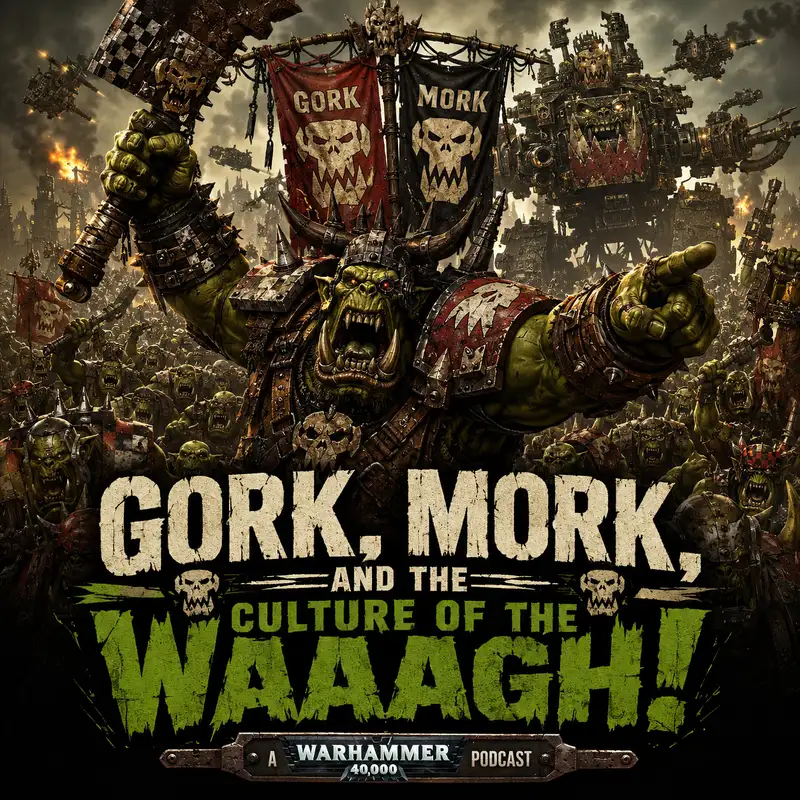
On an Imperial defensive line, the first sign of a Waaagh is often not an Ork. It is a vibration in the earth, then a low mechanical growl beyond the horizon. Vox channels fill with static. Engines begin to scream. Somewhere in the advancing mass, a Weirdboy starts laughing because the pressure inside his skull has become unbearable. Then the sound arrives. Millions of green throats seize upon the same word, and for a few seconds the battlefield feels less like a place where armies are fighting than a place where reality itself has chosen a side.
That word is Waaagh. It can be a war cry, an army, a migration, a campaign, a psychic force, and an entire way of life. Imperial savants try to separate these meanings because Imperial savants are professionally uncomfortable when one word does six jobs. The Orks see no difficulty. To them, the cry, the horde, the energy, and the war are not different things. They are different moments in the same process. A Waaagh begins as an urge, gathers around strength, becomes a movement, and finally crashes into the galaxy as history.
At the center of that process stand Gork and Mork, the twin gods of the Orks. One is brutal but cunning. The other is cunning but brutal. Which is which depends on the Ork explaining it, the Ork listening, and whether either has already reached for a weapon. The distinction is precise enough to begin a theological dispute and vague enough that the dispute usually ends before anyone completes the argument. Yet the apparent joke conceals something important. Gork and Mork embody the two qualities Orks most admire, direct strength and violent cleverness.
Human cultures often separate the warrior from the trickster. One wins by force, the other by deception. Orks do not accept the division. A perfect victory may involve charging through the front gate because nothing can stop you. It may also involve pretending to charge the front gate while Kommandos crawl through the fuel pipes. Both are properly Orky because both prove superiority. Brutality without cunning can be wasteful. Cunning without brutality is merely suspicious. Gork and Mork represent the union of the two, while also spending eternity trying to batter one another senseless, which makes them unusually faithful reflections of their worshippers.
Ork religion has no need for a quiet sanctuary. Its temples are battlefields, workshops, fighting pits, and the decks of overloaded spacecraft. Its icons are leering faces, iron jaws, crude idols, and towering war machines built in the image of the gods. Its acts of devotion include fighting, building, boasting, looting, racing, shouting, and following a boss toward an enemy who appears difficult to kill. An Ork sermon is therefore less likely to involve a pulpit than a raised choppa and a target of opportunity.
This does not mean Orks lack belief. Their faith is so complete that they rarely need to discuss it. Gork and Mork are not philosophical possibilities. They are facts as obvious as gravity, except louder. Orks may argue about which god is stronger, which one favors a particular clan, or whether a spectacular explosion was divine approval. They do not generally pause to wonder whether the gods exist. Doubt requires a kind of distance from belief, and Ork culture provides very little distance from anything.
The same is true of political authority. Ork society follows strength. A Nob dominates a mob because he can defeat the Boyz beneath him. A Warboss rules because he can defeat the Nobs, intimidate rivals, distribute loot, choose good enemies, and survive the consequences of his own decisions. This is not a written constitution, but it is perfectly clear to everyone involved. Leadership must be demonstrated physically and repeatedly. A boss who stops winning soon discovers that the succession process has begun, usually from immediately behind him.
As a Warboss grows in reputation, more Orks gather. Some arrive because they expect loot. Some want better fights. Some have heard that the boss is favored by Gork, Mork, or both. Others simply sense that something large and violent is forming and decide that standing elsewhere would be a waste of time. Mobs become warbands. Warbands become armies. Rival clans arrive with their own colors, customs, and grudges, then accept temporary unity under a leader strong enough to keep their attention pointed outward.
That unity is never tidy. Goffs still value hard fighting. Evil Sunz still want speed. Deathskulls still regard unattended property as a personal invitation. Bad Moons still display wealth with the subtlety of an artillery strike. Blood Axes remain willing to use plans, camouflage, and other practices that many Orks consider dangerously sophisticated. Snakebites favor older ways and living beasts. A Waaagh does not erase those differences. It harnesses them. The clans compete over who can fight best, loot most, drive fastest, shoot loudest, or reach the enemy first. Competition becomes momentum.
Momentum matters because every Ork is psychically connected to the presence of other Orks. Individually, most are not trained psykers and could not explain the Warp in any useful fashion. Collectively, they generate a growing field of psychic energy. The more Orks gather, the stronger it becomes. Excitement, aggression, confidence, and expectation feed it. A large Waaagh therefore possesses more than numbers. It creates an atmosphere that affects the Orks inside it, sharpening their sense of purpose and driving them toward still greater violence.
Weirdboyz experience this power most directly. They are living conduits for the energy generated by the horde, and they often suffer for the privilege. As nearby Orks become excited, psychic pressure builds inside the Weirdboy. Green lightning may erupt. Enemy skulls may burst. The Weirdboy may be hurled through the Warp, vomit impossible energies, or explode with enough force to inconvenience everyone in the immediate area. Other Orks treat this as dangerous, impressive, and excellent entertainment. Their standards for workplace safety are admirably consistent.
The cry itself concentrates that shared certainty. When a Warboss calls the Waaagh, he is not merely giving an order to advance. He is releasing tension built across the horde. Boyz surge forward, engines accelerate, weapons rise, and the psychic field peaks as millions act on the same impulse. The moment is social, military, and supernatural at once. A disciplined human army tries to make many individuals behave like one machine. An Ork Waaagh makes many violent individuals feel like one enormous animal, then points that animal toward the nearest fortified position.
The psychic field is sometimes exaggerated into the claim that Orks can make anything true merely by believing it. That is too simple. An Ork cannot pick up a wooden box, call it a plasma cannon, and expect the enemy to disappear. Ork weapons and vehicles are real machines assembled by Meks who possess deeply embedded technical instincts. They have engines, ammunition, fuel, wiring, and moving parts, even when those parts seem to have been arranged during an argument. The Waaagh field appears to encourage reliability, coordination, and improbable performance. It supports Ork technology. It does not replace it with wishful thinking.
That distinction makes Ork culture stranger, not less strange. A Mek may not understand engineering through human mathematics, but he knows what should fit together. He can build a functioning weapon from scrap because Ork knowledge is partly instinctive, partly practical, and partly reinforced by the expectations of the surrounding horde. The result may violate every safety regulation the Imperium has ever written, including several that have not yet been issued. It will still fire, most of the time, and the Mek will regard the explosion on the third attempt as useful information.
A Waaagh becomes possible when these elements begin reinforcing one another. A successful boss attracts Boyz. More Boyz generate more psychic energy. More energy inspires greater confidence and draws out more Meks, Painboyz, Weirdboyz, drivers, pilots, and ambitious Nobs. Victories produce loot. Loot produces larger weapons and faster vehicles. Larger victories spread the boss's reputation farther. Soon the movement is no longer confined to one settlement or one world. Ships are built. Space hulks are boarded. Roks are launched. The horde goes looking for a war large enough to justify its existence.
This is why a Waaagh is not simply an invasion fleet. It is an expanding Ork civilization on the move. The armies bring spores, squigs, grots, workshops, rivalries, markets, fighting pits, and all the rough machinery of Ork life. Worlds struck by a major Waaagh are not merely attacked. They are seeded. Even if the fleet is destroyed, the surviving ecosystem may continue beneath ruins, in ash wastes, or inside abandoned industrial zones. Years later, the enemy may discover that the war ended only in the administrative sense.
The gods give this movement meaning. Gork and Mork do not demand moral improvement, restraint, sacrifice for its own sake, or obedience to a complicated code. They reward Orks for being more fully Orky. Strength should be used. Cunning should lead to victory. A good fight is not a distraction from life. It is the clearest proof that life is being lived correctly. The Waaagh is therefore both military campaign and religious fulfillment. It brings the Ork into alignment with the gods by bringing the Ork into collision with everyone else.
No figure demonstrates this more clearly than Ghazghkull Mag Uruk Thraka. His rise began after a bolt round tore into his skull and Mad Dok Grotsnik rebuilt what remained. Ghazghkull emerged changed. He experienced visions that he understood as messages from Gork and Mork, and he began gathering followers with a combination of physical dominance, strategic instinct, and absolute certainty. Whether those visions were direct divine speech, psychic revelation, or the mind of an Ork interpreting the Waaagh through the only language that mattered is not a question the surviving evidence can settle.
For Ghazghkull, the uncertainty is irrelevant. He acts as the prophet of both gods, and his followers respond because his prophecies lead to war on a scale few other bosses can provide. At Armageddon, he found an enemy worthy of return. The wars there became more than attempts to take a world. They became proof of his calling, tests of Imperial endurance, and a furnace in which his own legend grew. Commissar Yarrick mattered to Ghazghkull not because Orks admire humanity in general, but because a persistent enemy makes the fight better.
Ghazghkull eventually looked beyond even Armageddon. A true prophet of the Waaagh cannot remain satisfied with one battlefield, however famous. His ambition is not to administer a stable empire in the human sense. It is to ignite a conflict vast enough to draw the Ork species together. This is the Great Waaagh, a war that becomes self-sustaining because every victory, defeat, rumor, vision, and migrating horde adds to it. Ghazghkull's power lies not only in commanding Orks, but in giving their scattered impulses a shared direction.
His title as prophet also reveals how Ork religious authority works. He does not lead because he possesses a sacred text unavailable to ordinary Boyz. He leads because he is enormous, successful, persuasive by Ork standards, and capable of turning divine claims into visible results. His body itself becomes evidence. Each wound survived, each reconstruction, and each larger suit of armor demonstrates that the gods have not finished with him. In a culture where size follows success and authority follows size, revelation acquires considerable muscle.
The Ork attitude toward defeat strengthens the same cycle. Victory is obviously good. Death in battle is also acceptable because the Ork died fighting. Retreat can be interpreted as preparation for another attempt. This logic sounds ridiculous until one considers its military effect. Orks are difficult to demoralize because their culture can transform almost any outcome into a reason to continue. They may flee, quarrel, or abandon a failed boss, but they do not easily conclude that war itself was a mistake. The conclusion is usually that the next war should be bigger.
Gork and Mork make that violence coherent. The gods are often described as fighting one another, and Orks mirror them through constant rivalry. Left alone, mobs brawl. Nobs challenge one another. Clans feud. Bosses test their strength against neighbors. Ork society generates conflict even without an external enemy. A Waaagh solves this instability without eliminating it. A sufficiently powerful Warboss redirects internal aggression toward a shared target. The Orks remain competitive, but now they compete by destroying someone else more effectively.
Imperial commanders who understand this often target the Warboss, but decapitation is not a simple cure. Killing a leader may fracture a Waaagh, or it may create a martyr, a succession struggle, and several smaller invasions moving in different directions. Destroying the fleet may strand millions of Orks on a world where they immediately begin building another fleet. Exterminating the visible armies may leave spores beneath the soil. The Ork way of war survives failure by making failure fertile.
Are Gork and Mork real? In a galaxy where thought can wound reality, the question is less useful than it appears. The Warp is shaped by thought, emotion, and belief. The Orks generate psychic power collectively, direct it through their culture, and experience it through visions, Weirdboy phenomena, impossible momentum, and gods who embody their deepest instincts. Gork and Mork may be distinct beings in the Warp, the divine faces of the Ork gestalt, or both at once. Human categories demand a boundary. Ork experience supplies a fist coming through the wall.
The culture of the Waaagh is therefore not an addition to Ork society. It is the system that joins every part together. Biology produces a species built to spread and fight. Hierarchy concentrates authority in the strongest. Competition creates constant motion. Meks turn instinct into weapons. Weirdboyz turn collective excitement into psychic force. Gork and Mork turn violence and cunning into sacred ideals. The Warboss turns all of it toward a horizon, and the word Waaagh gives the movement a name that is also an order, a prayer, and a promise.
That is why the Orks can appear crude while remaining one of the galaxy's most resilient civilizations. They do not require peace to build, centralized law to cooperate, or safety to reproduce. Their religion does not restrain their destructive instincts. It organizes them. Their gods do not offer escape from the brutality of existence. They assure the Orks that brutality is existence, and that cunning is simply knowing where to strike.