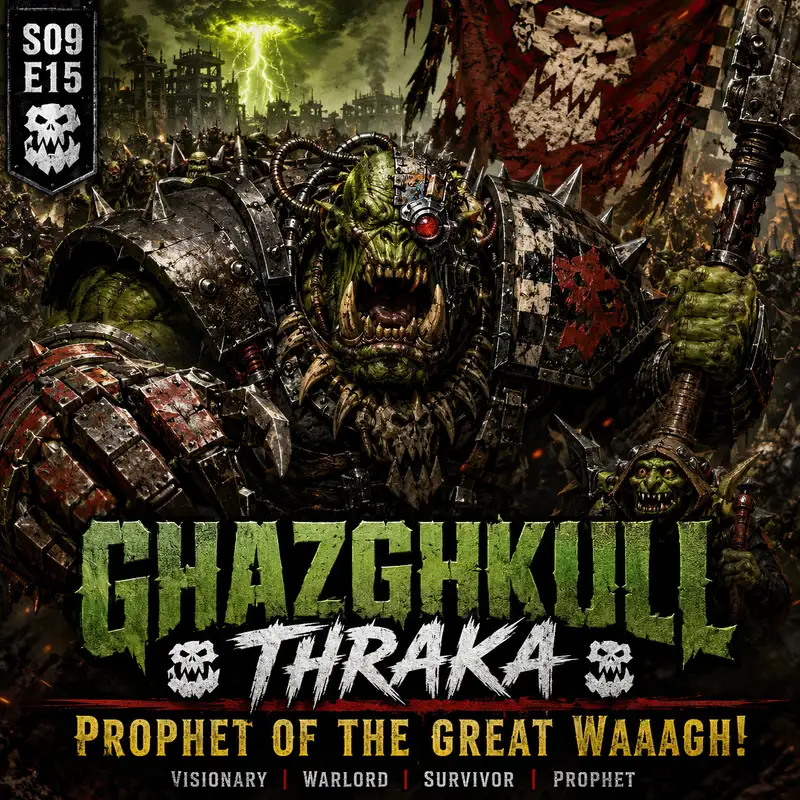
Ghazghkull Thraka: Prophet of the Great Waaagh!
The shot should have killed him. It tore through the side of an Ork’s skull, destroyed an eye, removed part of his brain, and left him bleeding in the snow of a forgotten world. His own comrades abandoned him because carrying the wounded was not a custom they considered worth developing. Yet the creature they left behind did not die in any permanent sense. He was rebuilt with metal, wire, and whatever else Mad Dok Grotsnik believed belonged inside a head. When he awoke, he claimed that Gork and Mork had shown him the future. The Orks would stop wasting themselves in small wars. They would unite, cross the stars, and drown the galaxy in one enormous, unending Waaagh. The wounded nobody would become Ghazghkull Mag Uruk Thraka.
That origin contains the central problem of Ghazghkull’s story. Is he genuinely a prophet, chosen by the Ork gods, or is he simply the most dangerous warlord ever to discover the military value of certainty? The surviving accounts do not settle the question. Most of them come from Orks, who rarely allow consistency to interfere with a good story. Some versions say Ghazghkull walked hundreds of miles while holding his damaged skull together with his hands. Others say he was carried, sold, or operated upon where he fell. Makari, the small Gretchin who became his banner bearer, reportedly insisted that all the versions were true. This is not useful historical method. It is, however, very Orkish.
Ghazghkull began on Urk, an isolated Ork world where rival clans fought over territory, scrap, prestige, and the privilege of fighting again tomorrow. Before his transformation, some accounts call him only the Newcomer. He was a Goff, which meant he belonged to the Ork culture that most openly values strength, discipline by Ork standards, and the direct application of overwhelming violence. Even among Goffs, he was not yet exceptional. He was another young fighter trying to become larger, tougher, and more important by surviving battles. Then came the raid on an ancient monitoring station and the bolter round that opened his skull. For most beings, this would have ended the career. For Ghazghkull, it provided a beginning and a rather durable piece of head armour.
Grotsnik’s surgery was neither delicate nor entirely medical. Metal plating replaced shattered bone. Crude mechanisms repaired what flesh could not. The operation failed, at least according to the conventional definition, because Ghazghkull died on the table and was thrown onto a rubbish heap. There, a Gretchin searching the body for anything valuable found the dead Ork suddenly awake. Ghazghkull seized him, looked into his eyes, and shared the vision that had come to him. He named the Gretchin Makari and made him carry a banner announcing the new revelation. The relationship between the towering warlord and the terrified little servant would become one of the strangest constants in his life. Ghazghkull needed a witness, and Makari needed to remain useful enough not to be stepped on.
The vision was simple enough for every Ork to understand. Orks had been made to fight and win, but they had forgotten the scale of their purpose. They fought each other because no greater enemy stood before them. Ghazghkull promised to correct that. He challenged the ruler of Rustspike, a warlord named Dregmek, and accused him of insulting Gork and Mork by squabbling over scraps instead of seeking a proper war. Dregmek was far larger and better armed, but Ghazghkull wore him down, tore apart his armour, and finished the duel with his metal skull. Green lightning struck the city’s central spike at the moment of victory. Coincidence remained an available explanation, though it was not the explanation most Orks preferred.
Winning a duel made Ghazghkull a boss. What he did afterward began to make him something more. He opened Rustspike to Orks from every clan, provided they accepted his authority. He allowed them to fight one another, because attempting to prohibit Orks from fighting is less a policy than a method of being ignored, but he imposed a rule that the brawling should not waste useful warriors. The population grew. Workshops multiplied. Meks built weapons and vehicles. Rival clans competed within a structure that strengthened Ghazghkull instead of tearing his domain apart. His achievement was not peace. Orks would have regarded that as a punishment. His achievement was directing violence so that it produced power.
He then brought the other rulers of Urk beneath his banner. Some were defeated in campaigns. Some lost challenges designed around their own strengths. A speed-obsessed boss could be beaten in a race. A proud Goff could be broken in a headbutting contest. A cunning Blood Axe could prove his cleverness by sneaking close enough to kill Ghazghkull, then decide that following him promised better wars than attempting the murder. Ghazghkull understood that Ork unity could not be built by making every clan identical. Each clan needed to believe that its own virtues had earned a place in the coming conquest. He did not erase Ork rivalry. He recruited it.
This is the first reason Ghazghkull is more dangerous than an ordinary warboss. Most Ork leaders dominate those immediately beneath them. Ghazghkull creates a purpose large enough to attract leaders who would normally rather kill him. His strength matters, because Orks respect size and violence. His victories matter, because success generates followers. Yet his true gift is interpretation. He tells Orks what their instincts mean. Their anger becomes divine impatience. Their desire for battle becomes a sacred duty. Their inability to remain peacefully organised becomes evidence that they require a galaxy-sized enemy. Ghazghkull does not ask Orks to become something different. He promises that being completely Orkish will finally be enough.
Urk itself then began to die. Its star was failing, and radiation and solar violence were destroying the world. Ghazghkull declared that the disaster was another message from Gork and Mork. The Orks were not meant to perish on their birthplace. They were meant to leave it. Under his direction, they prepared for years, gathering machines, weapons, transports, and whatever else could be welded to something larger. When a vast space hulk emerged from the warp, Ghazghkull seized the opportunity. Billions of Orks were carried aboard the drifting mass of wrecked ships. The vessel was infested, unstable, and not meaningfully steerable. By Imperial standards, it was unsuitable for migration. By Ork standards, it had room, enemies, and a chance of crashing into somewhere interesting.
The hulk became the Wurld Killa. During its passage through the warp, its Ork population expanded, its Meks stripped old technology, and its warbands turned the interior into a moving civilisation. Accounts of the journey include daemons, impossible battles, and Ghazghkull confronting a greater daemon before forcing shut a warp rift with a blast of green power. Whether every detail happened exactly as remembered is uncertain. What matters is that the voyage transformed his followers. They had escaped a dying world because Ghazghkull told them they would. They had entered the warp and emerged stronger. Every survival made his next prophecy easier to believe.
The Wurld Killa eventually reached Armageddon, one of the Imperium’s great industrial worlds. Armageddon produced weapons, vehicles, and soldiers on a scale that made it valuable to humanity and irresistible to Orks. Ghazghkull’s forces descended in the Second War for Armageddon and tore through defenders who were poorly prepared, badly led, or both. The planetary governor’s response achieved the rare Imperial combination of confidence and delay. The Orks captured cities and drove toward complete conquest. Then they reached Hades Hive, where an old commissar named Sebastian Yarrick organised a defence that refused to collapse.
Yarrick became the enemy Ghazghkull had preached about. He was not physically equal to an Ork warlord, and he commanded soldiers from a species Ghazghkull generally considered weak. Yet he understood fear, morale, fortification, and the brutal arithmetic of holding ground. Hades resisted long enough for Imperial relief to gather. Ghazghkull’s advance slowed, then failed. For the first time since his visions began, events did not seem to follow the path he had promised. He withdrew from Armageddon, leaving masses of Orks to cover his departure. The Prophet had found a worthy opponent, but he had also discovered doubt.
That doubt is important because Ghazghkull is not merely a machine that converts belief into victory. His faith can falter. After Armageddon, headaches and frustration troubled him. He wanted to return and defeat Yarrick, even when the messages he associated with Gork and Mork seemed to point elsewhere. Makari challenged him, and Ghazghkull killed the Gretchin in anger. The details of Makari’s later returns are tangled in Ork superstition, replacement, reincarnation, and the fact that many Grots look less distinguishable when viewed from the height of a warboss. Ghazghkull nevertheless treated Makari as more than a disposable servant. The banner bearer was the first witness to the vision, and without a witness, even a prophet can begin to sound like a large patient with an unusual medical history.
On Golgotha, Ghazghkull met Yarrick again and captured him. He could have killed the commissar. Instead, after imprisonment and torment, Yarrick was allowed to escape, or was released, depending on which participant’s pride is being protected. Ghazghkull understood something his human enemies often did not. A great Waaagh needed a great enemy. Yarrick gave the Orks a name to hate, a face to remember, and a reason to believe that the next battle would be better than the last. The commissar was not merely an obstacle. He was part of the story Ghazghkull was building around himself.
The years that followed were not idle. Ghazghkull attacked Imperial worlds, tested tactics, gathered warbands, and learned from setbacks. At Piscina, his forces used teleportation technology developed with the Bad Moon warlord Nazdreg. The invasion did not secure the world, but the technology worked well enough to prove its value. This is another quality that separates Ghazghkull from the stereotype of a mindless brute. He experiments. He studies. He accepts a local failure if it prepares a larger success. Many commanders claim to learn from defeat. Ghazghkull has the advantage of defining nearly any surviving experience as proof that the gods remain interested.
Fifty-seven years after the first invasion, he returned to Armageddon on the same date, now at the head of a far greater force. The Third War for Armageddon was not a raid. It was a planetary catastrophe delivered by fleets, space hulks, asteroid fortresses, armoured columns, and warlords from across Ork society. Ghazghkull had learned how the Imperium defended the world. He destroyed Hades Hive rather than repeat the old siege, using orbital bombardment to erase the place where Yarrick had once stopped him. There was a practical logic to this. There was also the unmistakable logic of a grudge.
The war spread across hive cities, deserts, jungles, ash wastes, and orbital space. Imperial Guard regiments, Space Marines, Titan Legions, militia, and civilians fought to keep the planet from becoming an Ork empire. The Orks captured enormous regions but could not finish the conquest. Armageddon became what Ghazghkull had wanted and then discovered he had outgrown: a permanent battlefield. Orks poured in because the fighting was magnificent. Imperial reinforcements arrived because the world could not be surrendered. Neither side could easily end the war without first becoming someone else. Ghazghkull had created a machine that produced battle faster than either empire could consume it.
Then he left. To human observers, this looked like another failure or an inexplicable loss of interest. To Ghazghkull, Armageddon had become proof of concept. One world could sustain an enormous war, but his vision was no longer about one world. He wanted every Ork to feel the call. He wanted rival warlords defeated, persuaded, or absorbed. He wanted the psychic force generated by Ork aggression to rise until the species moved as one. Armageddon was not the destination. It was the furnace in which he tested the idea of a war without end.
The nature of the Waaagh makes this ambition more than political. Orks generate a collective psychic energy through excitement, aggression, and shared belief. Weirdboyz channel it, usually with spectacular results and uncertain life expectancy. Large gatherings of Orks intensify it. A successful warboss becomes physically larger and socially stronger as more Orks gather around him. Victory attracts followers, followers increase the Waaagh, and the Waaagh makes further victory more likely. Ghazghkull stands at the centre of this cycle. He is not simply commanding an army. He is becoming the focus of a species-wide feedback loop made from faith, violence, and biology.
That helps explain reports that Ghazghkull appeared in widely separated war zones, gathering fleets and challenging powerful bosses. It also explains why Imperial attempts to measure his strength produce alarming numbers without producing understanding. A Waaagh is not a conventional military formation. It is migration, crusade, festival, ecosystem, and armed disaster. Destroy one fleet and other mobs may continue toward the same promise. Kill one boss and another may claim to have received the same vision. Ghazghkull’s greatest weapon is not his power claw or his armour. It is the idea that all Orks are participating in one sacred campaign even when they are light years apart.
His journey took him through the Haunted Gulf and into the Octarius war zone, where Orks fought the Tyranids of Hive Fleet Leviathan. For most strategists, a conflict between two enemies on that scale would be something to avoid. Ghazghkull saw recruitment. Orks who survived battles against the Tyranids became larger, harder, and more eager to follow the warlord who promised still greater wars. He did not need to conquer and administer territory in the human sense. He needed to arrive, dominate the story of the battle, gather the strongest survivors, and move on before victory became routine.
On Krongar, the Space Wolf Ragnar Blackmane confronted him. The duel left Ragnar close to death, but the Wolf Lord managed to sever Ghazghkull’s head. For a brief time, the great Waaagh began to fracture. This should have answered the question of Ghazghkull’s divinity in the negative. Prophets, after all, generally benefit from remaining attached to themselves. Yet Grotsnik recovered the remains and constructed a massive new body around them. Makari and other followers helped restore the warlord through surgery, machinery, and a violent discharge of green energy. Ghazghkull returned larger than before.
His resurrection mattered more than the physical improvement. Every Ork who heard the story received a simple lesson. The greatest human warriors could cut down the Prophet, but they could not end the Waaagh. Death had become another ordeal confirming his mission. The event also revealed the dependence beneath his apparent invincibility. Ghazghkull survived because followers recovered him, believed in him, rebuilt him, and held his armies together. A prophet creates a people, but the people also create the prophet.
That relationship is clearest in Makari. A Gretchin occupies the lowest, most abused levels of Ork society. Makari can be frightened, treacherous, boastful, loyal, and entirely sensible about the dangers of standing near Ghazghkull. Yet he carries the banner that turns a warlord into a symbol. He remembers the origin when Ghazghkull doubts it. He tells the story when outsiders demand an explanation. The mighty Prophet and the tiny witness form a complete political structure: power above, narrative below. One crushes opposition. The other explains why the crushing was inevitable.
In the present age, Ghazghkull’s ambitions have again drawn him toward Armageddon. New teleportation engines and allied warlords have enabled Ork forces to strike the system with terrifying suddenness. The old battlefield has become the centre of another expanding war, and Yarrick has returned to oppose him once more. Ghazghkull’s interest is no longer limited to taking factories or settling an old grievance. Armageddon has become sacred because Orks believe it is sacred, and because the greatest stories of the Prophet were forged there. A world can acquire religious importance through revelation. It can also acquire it through repeated invasions until everyone agrees that leaving would feel anticlimactic.
So, is Ghazghkull truly the chosen prophet of Gork and Mork? The evidence permits several answers. His visions have led him to impossible opportunities. Psychic events gather around him. He has survived wounds that should have ended any ordinary creature. The collective power of the Orks appears to answer his presence. Yet every miracle also has a material partner: Grotsnik’s surgery, Makari’s testimony, Mek invention, military planning, and the willingness of countless Orks to make the prophecy real with their bodies.
The more useful answer is that the distinction may not matter. Ghazghkull is a prophet because he understands the deepest desire of his people and gives it a shape larger than any single battle. He turns instinct into doctrine, rivalry into hierarchy, defeat into preparation, enemies into sacred opponents, and death into proof of return. Other warbosses promise loot, territory, or a better fight. Ghazghkull promises that Orks can become what they were always meant to be, provided the entire galaxy is willing to serve as the battlefield.
That is why the Imperium should fear him more than it fears a merely gigantic Ork. Bodies can be destroyed. Fleets can be scattered. Worlds can be retaken at a cost no clerk will ever calculate honestly. Ghazghkull’s true empire exists in the expectation that somewhere ahead lies the greatest fight of all, and that every Ork has a place in it. As long as that expectation survives, the Great Waaagh does not require a final victory. It requires only another horizon, another enemy, and the sound of billions of voices discovering that they are shouting the same name.