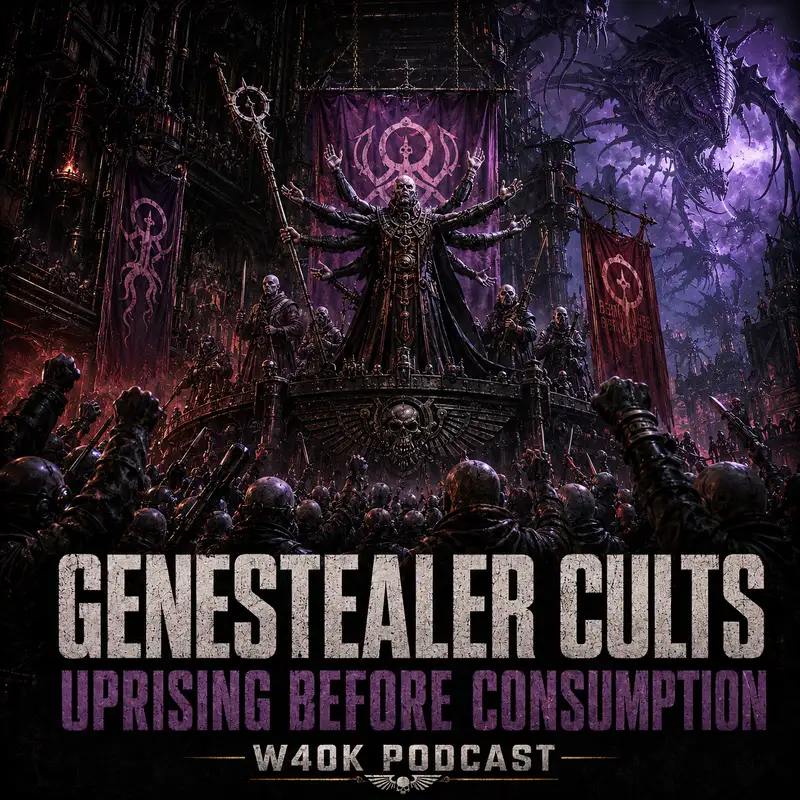
Genestealer Cults: Uprising Before Consumption
The workers did not storm the governor’s palace when the uprising began. They stopped feeding the machines.
Ore lifts halted halfway to the surface. Refinery furnaces went cold. Freight haulers blocked the avenues between the manufactorums. The planetary defence force received orders to restore production, only to discover that several of its own companies had already changed sides. By the time the alarm reached the capital, the rebels controlled the power grid, the rail tunnels, the water processors, and most of the weapons meant to suppress them.
To the authorities, it looked like a revolt that had erupted overnight.
It had actually begun generations earlier, in a forgotten tunnel where one human being survived an encounter that should have killed them.
That is the essential horror of a Genestealer Cult. Its rebellion is not merely an invasion disguised as politics, and it is not merely a political movement corrupted by aliens. It is both at once. The cult grows inside real grievances, families, workplaces, and institutions. It offers loyalty, protection, purpose, and hope. Then, at the moment of apparent liberation, it delivers the entire world to the Tyranids.
The uprising is not the end of the cult’s struggle. It is the final preparation for consumption.
A Genestealer is one of the Tyranids’ most effective infiltrators. Unlike the vast organisms of a hive fleet, it does not need to arrive beneath a sky full of living warships. It can hide aboard a derelict vessel, a merchant freighter, a space hulk, or a damaged military transport. It can wait in darkness until a ship docks or scavengers come aboard.
When a Genestealer reaches a populated world, it hunts differently from an ordinary predator. It does not always kill. Through what Imperial records grimly call the Genestealer’s kiss, it implants alien genetic material into a victim. The infected person may return home convinced that they escaped. In reality, their loyalties, instincts, and future bloodline have been altered.
The victim protects the first hybrid child with a devotion that no law, creed, or fear can easily break. A family forms around that secret. The family becomes a brood. The brood becomes a congregation. As the generations pass, the cult’s descendants appear progressively more human, allowing them to move beyond hidden chambers and enter the wider society.
The earliest hybrids are unmistakably alien. They possess ridged skulls, clawed limbs, and the powerful bodies of their Genestealer ancestor. They remain below ground, guarded by relatives who see holiness where an outsider would see mutation. Later generations can pass for ordinary workers beneath robes, respirators, heavy coats, or the forgiving darkness of an Imperial factory. By the fourth generation, many hybrids can move through human institutions with little more than a shaved head, an unusual complexion, and the good fortune to live in a civilisation where medical examinations are often reserved for people the state considers important.
The cycle can eventually produce new purestrain Genestealers. These creatures can be sent away aboard ships, refugee transports, military deployments, or pilgrim vessels. One hidden cult can therefore become several. The Tyranid invasion spreads before the hive fleet itself is even visible.
At the centre of the growing brood is the original Genestealer, transformed by age and psychic connection into a Patriarch. It becomes larger, stronger, and more than animal. The cult experiences its presence as sacred. Its thoughts press gently, and sometimes not so gently, upon the minds of its descendants and infected followers.
This psychic communion is often called the broodmind. It does not make every cultist a puppet without personality. Members still possess habits, ambitions, rivalries, skills, and memories. What the broodmind does is bind those individual lives around an unquestioned centre. The family is good. The Patriarch is holy. The coming star gods will bring deliverance. Doubt becomes difficult because doubt feels like betrayal not only of belief, but of blood.
The cult’s religion grows around that biological bond. Many worship the Tyranids as children of distant stars, divine beings who will descend to free the faithful from oppression. The Patriarch becomes a prophet, saint, or living incarnation. The extra arms of the Genestealer become sacred symbols. Human religious language is retained, repurposed, and turned toward something that has no interest in human souls.
The most famous expression of this faith is the Cult of the Four-Armed Emperor. Its imagery is powerful because it steals a familiar Imperial promise. The Emperor protects. The cult replies that the true Emperor has four arms, lives among the faithful, and will soon send his children from the heavens. On a world where the official Emperor is represented by tax collectors, overseers, recruitment officers, and public executions, the alternative can appear surprisingly persuasive.
That does not mean every cult looks the same. Some resemble labour brotherhoods. Others hide within noble houses, medical dynasties, criminal networks, merchant clans, or the machinery of the Adeptus Mechanicus. The Twisted Helix turns genetic manipulation and industrial medicine into tools of infection. The Bladed Cog grows among augmented workers and tech-priests, blending alien flesh with the rituals of the Machine God. The Rusted Claw survives through mobile mining communities and wasteland convoys. Each cult reflects the society it has entered because successful infiltration requires more than claws. It requires understanding where people gather, whom they trust, and what they need.
This is where Imperial conditions become part of the Genestealer weapon.
A hive city may contain billions of people beneath layers of bureaucracy that barely acknowledge their existence. Workers can be born, labour, reproduce, and die without leaving the same industrial district. Mining colonies maintain settlements so remote that officials visit only when production falls. Void stations accept crews from dozens of worlds, often with records that are incomplete, forged, or lost between departments. Entire populations live behind masks, rebreathers, protective suits, and radiation scars.
These are ideal places to hide mutation.
They are also ideal places to build loyalty.
A cult family may feed its members when an employer will not. It may protect workers from gangs, corrupt foremen, or predatory officials. It may arrange marriages, find jobs, conceal illness, care for children, and bury the dead with dignity. Its kindness is not necessarily insincere. Members often love one another. That love has been engineered to serve a purpose none fully understands.
This makes Genestealer Cults more disturbing than an enemy that merely wears human skin. They do not always replace society from the outside. They become the part of society that functions.
The Imperium often notices a cult only after it has begun entering institutions. A hybrid who can pass as human joins a mining guild. A cousin takes work at the starport. Another becomes a clerk in the Administratum. A trusted family member enters the planetary defence force. A charismatic preacher gathers the exhausted and tells them their suffering has meaning. A physician quietly alters medical records. A communications worker learns which relay must fail when the signal is given.
No single appointment looks decisive. Together, they form an invasion plan.
A mature cult develops leaders suited to different tasks. The Magus gives language to the Patriarch’s will, turning psychic influence into doctrine, ceremony, and public conviction. The Primus prepares the military struggle, identifying targets, training cells, and deciding where violence will achieve the greatest effect. Other specialists manage signals, intelligence, mutation, logistics, and the movement of people through the underworld.
These figures are not a conventional government, but they form the beginnings of one. Long before the uprising, the cult possesses its own priesthood, command structure, intelligence service, family law, and supply network. It does not need to seize a state from nothing. It has been building a rival state in the shadows.
The world of Ghosar Quintus became an infamous example. It was a mining world whose population appeared to continue its assigned labour beneath Imperial rule. Behind that appearance, the Cult of the Four-Armed Emperor had spread through families and workforces until the distinction between community and conspiracy had almost disappeared. The danger was not a few monsters in tunnels. The tunnels, mines, households, and local loyalties had become the cult’s territory.
A visiting official might have seen disciplined labour and strong family bonds. The cult saw a population awaiting ascension. The difference was visible only if one knew where to look, and Imperial administration has never been famous for looking closely at people who continue to meet their quotas.
The uprising begins when secrecy is no longer useful.
Sometimes an approaching hive fleet provides the signal and strengthens the Patriarch’s call. Sometimes Imperial investigation threatens exposure, forcing the cult to strike early. On other worlds, war, famine, or civil disorder creates an opportunity too valuable to ignore. The Day of Ascension may therefore be a carefully selected moment or a desperate act launched before the cult is ready.
Either way, the first objective is not glory. It is paralysis.
The cult cuts communications so that local commanders cannot coordinate. It attacks astropathic facilities to delay pleas for help. It sabotages power stations, defence lasers, fuel stores, transit hubs, and orbital controls. Brood brothers within the planetary defence force redirect patrols, open armouries, disable vehicles, or fire upon loyal units at the worst possible moment. Workers who spent decades learning the infrastructure now use that knowledge to dismantle it.
The weapons reflect the cult’s origins. Mining lasers burn through armour. Rock saws become close-combat weapons. Industrial charges collapse tunnels and fortifications. Heavy machinery becomes mobile cover. Civilian haulers transport fighters through routes unknown to the military. The Imperium built these tools to extract wealth from the planet. The cult uses them to extract the planet from the Imperium.
Then the hidden generations emerge.
Acolyte hybrids rise from shafts and maintenance tunnels. Purestrain Genestealers attack command posts, communications centres, and isolated strongpoints. Neophytes in work clothes or stolen uniforms seize intersections and hab-blocks. Cult icons appear above crowds who believed themselves alone in their resentment. What seemed like scattered unrest reveals itself as a coordinated army.
The psychological effect can be as important as the damage.
A planetary governor may know how to answer an external invasion by declaring emergency powers and mobilising regiments. A rebellion is harder. Every unit becomes suspect. Every delay might be sabotage. Every civilian crowd may contain armed cells. The officer giving an order may serve the cult. A reinforcement transport may deliver attackers instead.
The defender is forced to fight the population and the invader simultaneously, without knowing where one ends and the other begins.
This is insurgency perfected by patience. The cult has spent decades studying the battlespace because its members live inside it. They know which bridge carries ammunition, which tunnel bypasses a checkpoint, which foreman can be intimidated, which officer can be isolated, and which district will rise once someone proves resistance is possible.
The uprising also feeds upon genuine anger. Workers do not need alien infection to hate a regime that treats them as replaceable components. Prisoners do not require psychic influence to resent their jailers. Soldiers do not need a broodmind to recognise that their commanders spend lives carelessly. The cult takes those truths and gives them a false destination.
That is why the Day of Ascension can attract people who are not direct members of the brood. Some join because they believe the revolution is human. Some seize the chance to settle old scores. Some fight because the authorities respond with collective punishment, transforming suspicion into rebellion. The cult’s promises do not need to be entirely false. They only need to conceal what happens after victory.
Imperial countermeasures often make the situation worse. Collective executions, district purges, and indiscriminate bombardment may kill cultists, but they also confirm every accusation the cult has made about Imperial rule. A governor who destroys three hab-blocks to eliminate one cell may consider the operation efficient. The surviving population may reach a different conclusion.
The Imperium does possess organisations capable of identifying the threat. The Inquisition, the Adeptus Arbites, specialised Space Marines, and experienced military commanders understand that a Genestealer Cult cannot be treated as ordinary unrest. They search for genetic anomalies, family clusters, unexplained disappearances, contaminated medical systems, and patterns of sabotage. Yet detection remains difficult because the cult’s greatest camouflage is normal life.
A worker with a hidden third arm is suspicious. A respected clerk with twenty loyal cousins is merely well connected.
Once the uprising is underway, the cult’s military strength varies enormously. Some possess little more than stolen weapons and industrial equipment. Others control defence regiments, armoured vehicles, aircraft, and sections of the planetary government. A cult that has infiltrated for a century may be able to contest entire continents. A cult discovered after a decade may be crushed in a single district.
Victory is not measured only by territory. If the cult delays reinforcements, disables orbital guns, or forces defenders to exhaust themselves in urban warfare, it has served the approaching hive fleet. Even a defeated uprising can leave a world weaker. Every regiment lost in the underhive is a regiment unavailable when Tyranid spores begin falling from the sky.
The cult is therefore best understood as a living advance operation. It gathers intelligence, disrupts command, seizes infrastructure, and prepares the population for collapse. The Patriarch is both religious leader and biological transmitter. The Magus is both prophet and instrument of psychic warfare. The faithful are both revolutionaries and a reserve of biomass.
Then the star gods arrive.
The first sign may be silence. Astropathic communication fails as the Shadow in the Warp closes around the system. Navigators feel the pressure of an approaching psychic immensity. Panic spreads through those who understand what it means. Among the cult, the same presence is experienced as fulfilment.
The heavens darken with living ships. Spores descend. The Tyranid invasion begins in earnest.
For the faithful, this is the promised moment. Their gods have answered. Their sacrifices were accepted. The old rulers are falling. The Patriarch’s revelation was true.
It is true in the narrowest and most terrible sense.
The Tyranids have come because the cult called them. The psychic signal generated by the Patriarch and broodmind has acted as a beacon, announcing that the world is populated, compromised, and ready to be harvested. The cult’s uprising has stripped away defences and gathered people into dense zones of conflict. From the hive fleet’s perspective, the revolution is not liberation. It is food preparation.
Accounts differ on how cultists respond when the full Hive Mind takes control of the invasion. Some continue fighting in ecstasy, interpreting Tyranid organisms as angels and saints. Some march willingly toward digestion pools, believing consumption to be union with their gods. In other accounts, the broodmind falls silent or changes as the Patriarch returns completely to the greater Tyranid consciousness. Cultists suddenly confront the creatures before them without the comforting veil of shared belief.
The moment of recognition, when it occurs, is brief.
The star children do not distinguish between faithful and enemy. Hybrid, worker, priest, soldier, child, and governor are all biological matter. The Tyranids do not reward the cult because reward is a human concept. They do not betray it because betrayal requires a promise understood by both sides. The cult invented a covenant with hunger, and hunger kept only its own nature.
There are exceptions in the details. Some cults send purestrain Genestealers or infected followers offworld before the final invasion, ensuring that the cycle continues elsewhere. Some cult forces escape aboard ships during the confusion. Some uprisings occur without an immediate hive fleet nearby. A cult can become a wandering infection, carrying its Day of Ascension as a future promise from world to world.
This makes exterminating a cult after an uprising even more complicated. Refugees must be screened. Military units that fought beside the rebels may carry hidden bloodlines. Merchant crews may have accepted desperate passengers. A victory on one planet can export the threat to ten others.
The cult’s tragedy is not that every member is innocent. Its leaders plan assassinations, sabotage life-support systems, manipulate the desperate, and murder those who discover the truth. Its armies can be ruthless, and its faith can justify almost any atrocity. Yet the cult is also composed of people born into a community they did not choose, taught from childhood that their family is sacred and their gods are coming.
Many have never encountered a Genestealer as a monster. They know the Patriarch as a holy presence. They know fellow cultists as parents, siblings, spouses, comrades, and protectors. Their beliefs are reinforced by psychic influence, inherited loyalty, and the undeniable fact that the cult often treats them better than the state they are overthrowing.
That is the contradiction at the heart of the uprising. The cult can reveal real injustice while serving something worse than tyranny. It can create genuine solidarity in the service of collective annihilation. It can free a mine from its overseers, a district from its enforcers, and a planet from its governor, only to remove every living thing from the planet shortly afterward.
The Imperium describes Genestealer Cults as contamination, and biologically that description is accurate. Politically, it is incomplete. Contamination spreads fastest where the social body is already wounded. The cult thrives in abandoned places, among populations counted as labour but not treated as human, inside institutions that mistake obedience for loyalty and production for stability.
A world can meet every tithe, suppress every public protest, and still be lost beneath the surface.
The rebels rise because they believe consumption is ascension. They believe the hive fleet is salvation, the Patriarch is family, and the destruction of the old order will reveal their true place in the cosmos. Their belief is engineered, but the courage with which they act can be real. Their enemy is monstrous, but often deserves to be overthrown. Their victory is genuine, but it lasts only until the feeding begins.
That is why a Genestealer uprising is more than the opening phase of a Tyranid attack. It is the conversion of hope into a weapon. By the time the first living ships appear, the planet has already been conquered in homes, bloodlines, workplaces, barracks, shrines, and dreams.
The hive fleet merely arrives to collect what the cult has prepared.