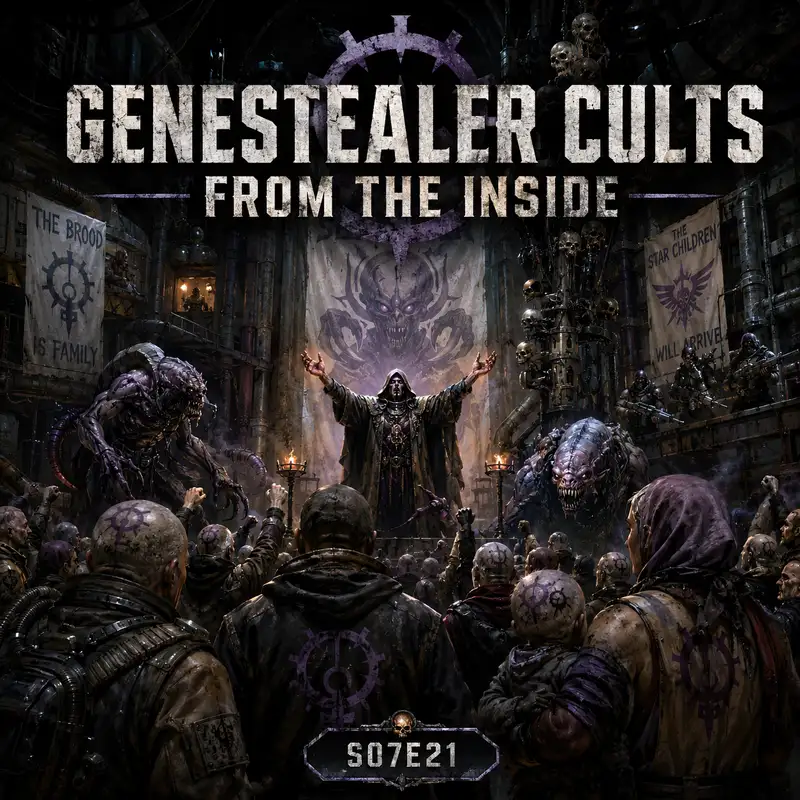
Genestealer Cults From the Inside
A Genestealer Cult does not begin with a banner, a sermon, or a mob in the streets. It begins with one person returning home changed. The wound may be hidden. The memory may be blurred. What remains is a new certainty that family matters above everything, that a presence waits in the darkness, and that the old life was colder than it ever needed to be. The victim still reports for work. They still lower their eyes before the overseer. They simply stop believing that the overseer has any rightful claim upon them.
That is the central horror of a Genestealer Cult. From the outside, it is an alien infestation wearing human faces. From the inside, it can feel like the first honest community a person has ever known. Its members do not usually see themselves as traitors preparing a world for consumption. They see workers, parents, children, preachers, soldiers, and neighbours bound together against a system that has ground them down for generations. The cult lies about its destination, but it often tells the truth about the road that brought people to it.
The Imperium provides fertile soil. On a hive world, forge world, mining moon, or industrial colony, human beings may spend their entire lives beneath authorities they will never meet. Work is inherited. Debt is inherited. Disease is common, privacy is rare, and mercy tends to require paperwork that was lost three departments ago. A population treated as replaceable learns to survive through private loyalties. When a hidden congregation offers food, protection, medical care, and the promise that suffering has meaning, suspicion must compete with hunger.
The first infection is not a philosophical conversion. A Genestealer isolates a victim, subdues them, and implants its own genetic material. Psychic influence alters the victim's loyalties and instincts. The victim does not return thinking that an alien monster has violated them. They are drawn instead toward the creature and toward others touched by the same corruption. Fear becomes reverence. Secrecy feels natural. The need to build a family becomes urgent. What began as predation is experienced as revelation, which is a very efficient arrangement for the predator.
As the infected bring partners and children into the hidden community, the cult becomes a bloodline as well as a conspiracy. Its earliest hybrid offspring may be visibly alien, with clawed limbs, ridged flesh, and bodies that cannot pass among ordinary citizens. They are hidden in sealed chambers, abandoned workings, forgotten hab levels, and deep industrial warrens. Their relatives do not regard them as shameful mistakes. The Broodmind teaches the family to see them as blessed children, closer to the sacred source from which the entire congregation draws its purpose.
Across successive generations, many hybrids appear increasingly human. Some can move through Imperial society with little more than a high collar, a hood, or a willingness to avoid thorough medical inspection. These Neophytes take jobs, form households, enter guilds, and learn which clerks can be bribed. In the traditional cycle, later generations can also produce Purestrain Genestealers, allowing the infection to begin again or travel elsewhere. The cult therefore grows in two directions at once. It reaches upward into society and outward toward new worlds.
Children born into the cult learn secrecy before they understand why it is necessary. They know which relatives may be seen in public and which must remain below. They learn that an extra limb is a blessing at home and a death sentence at an Imperial checkpoint. Older members teach them work skills alongside coded prayers, escape routes, and the names of safe households. The result is not merely indoctrination delivered at meetings. It is an entire childhood in which the brood is the source of affection, truth, identity, and survival.
Holding this expanding family together is the Broodmind. It is not quite the vast Hive Mind of the Tyranid swarms, and it does not reduce every member to a thoughtless drone. Cultists retain personality, initiative, skill, jealousy, courage, and ambition. What the psychic bond supplies is orientation. Each member feels the presence of the whole and an instinctive place within it. Doubt becomes harder when everyone you love shares the same conviction, and harder still when that conviction presses gently from inside your own skull.
The Broodmind does not need to issue detailed commands to every labourer and sentry. It shapes priorities, intensifies trust, and draws useful individuals toward useful work. Leaders can still plan, argue, improvise, and occasionally fail. Different cults develop different temperaments because local history and human personality remain present. Their individuality makes them more dangerous, not less. A machine can repeat an order. A devoted person can notice that the patrol changed route, invent a new approach, and believe the idea was entirely their own.
This is why the cult can be warm without being free. A mother may genuinely love her children. A miner may risk death to save a wounded cousin. A hidden congregation may feed families that the planetary authorities would gladly let starve. None of those acts must be false. The corruption works through real affection, not in place of it. It turns kinship into infrastructure and compassion into a security system. An infiltrator who would betray an employer for money may hesitate. One defending the brood is defending every person who has ever made life bearable.
Religion gives that feeling a language. The Patriarch, once an infiltrating Genestealer, grows in psychic stature as the cult expands and becomes the divine centre of the congregation. To outsiders it is a crouched xenos predator. To its descendants it may be the blessed sire, a prophet, or the living image of the Four-armed Emperor. The coming Tyranids become Star Children, angels, liberators, or distant kin. Imperial symbols are not always discarded. They are reinterpreted until the old faith points toward a very different salvation.
The details vary from cult to cult because human culture supplies much of the disguise. A mining congregation may treat the Patriarch as the first ancestor beneath the stone. An industrial sect may describe flesh and machine as incomplete parts awaiting sacred reunion. A desert cult may preach endurance and deliverance from a dying world. This flexibility is one reason Genestealer Cults spread so effectively. The alien core does not need to invent a complete society. It occupies the stories already present and bends them toward reproduction, secrecy, and revolt.
Daily life inside the cult is therefore less exotic than an Inquisitorial report might suggest. Most members work. They repair pumps, haul ore, drive cargo rigs, process food, maintain generators, or stand watch in uniforms issued by the same regime they intend to overthrow. They attend hidden gatherings after shifts. They memorize routes through service tunnels. They pass messages through family networks and labour crews. The revolution is prepared between inspections, ration queues, births, funerals, and twelve-hour shifts. Galactic doom has always depended on someone finishing the inventory.
This ordinary rhythm is part of the protection. A cult household may look more stable than the hab around it. Wages are pooled. Orphans are absorbed into extended families. Injured workers are cared for instead of abandoned. A member who loses a job may find another through the congregation. Such support is practical, affectionate, and strategically useful. Every kindness deepens loyalty. Every shared meal makes the official world seem more distant. The cult does not have to demand sacrifice every day. It can spend years proving that it will not leave its own behind.
Mutations shape status as well as danger. A third arm, a heavy brow, or patches of chitin may be concealed from strangers but honoured among kin. Traits that Imperial society would punish with exile or death become signs of belonging. The cult does not merely hide the outcast. It reverses the verdict. The malformed are chosen. The sterile bureaucracy above is corrupt. The body condemned by the Imperium becomes evidence that the Star Children have already touched the world. That reversal can be more persuasive than any sermon.
Not every member occupies the same place. The Magus interprets the cult's faith and channels psychic power. The Primus directs war and prepares the uprising. A Nexos coordinates intelligence, routes, and timing. Iconwards preserve sacred symbols and communal memory. Biophagi experiment upon bodies, cultivating useful mutations with a degree of medical enthusiasm that sensible patients might find alarming. Assassins and saboteurs remove threats. These figures are not simply officers assigned from above. They emerge as specialised expressions of the brood's needs.
The same system can be brutally exploitative. Aberrants, whose bodies have developed into massive and distorted forms, are valued for strength and obedience. They may labour in the worst conditions before being unleashed as living battering rams. Other hybrids are bred, altered, or directed toward roles that serve the whole. The cult promises belonging, but belonging does not mean equality. It means purpose. In a society where purposeless people are discarded, that can feel merciful, even when the purpose is to carry a mining hammer into gunfire.
Recruitment extends beyond those directly implanted or born into the bloodline. A mature cult can attract ordinary converts, sympathisers, and fellow travellers. Some are manipulated psychically. Some are persuaded by charismatic preaching. Some simply hate the governor, the overseer, the guild master, or the local priest more than they fear rumours about mutants below. The cult need not manufacture every grievance. It needs only to organize them, give them a sacred explanation, and ensure that anger serves the Patriarch's long design.
This produces one of the setting's darker political truths. A Genestealer uprising may be founded upon alien control, yet its complaints can be entirely accurate. The workers may truly be starving. The security forces may truly be murderous. The priesthood may truly preach sacrifice while living in guarded luxury. When Imperial authorities dismiss all unrest as corruption, they often preserve the conditions that make corruption attractive. Their preferred cure is usually collective punishment, which is excellent for ending conversations and less reliable for ending cults.
Secrecy is maintained through family loyalty, compartmented cells, hidden routes, and careful control of appearances. The most obviously alien members remain below. Human-passing Neophytes deal with outsiders. Trusted agents enter unions, transport offices, hab administrations, manufactorums, and supply depots. Records disappear. Work details are reassigned. A condemned tunnel remains open on a private map. A shipment of blasting charges is counted twice and delivered once. No single act proves a planetary conspiracy, which is precisely the point.
The cult also seeks institutions with weapons. Members of planetary defence forces can be infected, recruited, or born within families that guide them toward military service. These Brood Brothers may spend years wearing lawful uniforms, learning procedures, and earning access to armouries. On the appointed day, they do not need to defeat the entire defence network from outside. They are already inside the barracks, the motor pool, and the communications room. The sentry knows them. The quartermaster signed their requisition. The tank was serviced yesterday.
The long game often reaches the void docks as well. Cargo crews, pilgrims, merchants, and military musters can carry infected people or hidden Purestrains beyond the planet. A cult facing exposure may regard escape not as defeat but as sacred dispersal. One cell can be destroyed while another establishes itself aboard a transport or distant colony. Imperial quarantine therefore arrives with characteristic delicacy, meaning armed inspections, sealed districts, and a willingness to burn thousands in case one survivor is carrying tomorrow's rebellion.
Violence begins long before open rebellion. An investigator vanishes in a transit accident. A foreman who noticed unusual birth records is found beneath a collapsed gantry. A preacher with the wrong suspicions is discredited, then silenced. Saboteurs map power lines and structural weaknesses. A Sanctus studies a target for weeks. A Kelermorph becomes a folk hero by killing a hated official in public and escaping into the underhive. Every act is wrapped in a story that presents the cult as defender of the people.
Those stories matter because the cult is not held together by psychic pressure alone. It creates heroes, martyrs, relics, anniversaries, and family legends. A worker who died hiding a hybrid child becomes a saint. A smuggler who carried Purestrains off-world becomes a pilgrim. A gunfighter who embarrassed the enforcers becomes proof that the oppressors can bleed. The official authorities call these figures terrorists and criminals. The hidden congregation remembers them as the first citizens of a world that does not yet exist.
By the time outsiders recognize the pattern, the cult may have become a parallel society. It has its own authority, welfare, intelligence network, military arm, faith, and vision of the future. Members still move through Imperial life, but their deepest loyalty is elsewhere. This is more than infiltration. It is a state growing underneath another state, using the host's mines, factories, roads, and weapons to prepare its replacement. The Imperium built the machinery. The cult has merely changed who receives the production schedule.
The Day of Ascension is the moment concealment ends. It may come because the cult believes the promised time has arrived, because its leaders judge the world ready, or because discovery forces an early revolt. Hidden armouries open. Mining lasers are turned against bunkers. Rock drills breach secure foundations. Cargo vehicles become troop carriers. Power fails in loyal districts while cult-held districts remain lit. Signals travel through routes established over generations. What appears to defenders as chaos is, at its best, the release of a plan rehearsed for decades.
From inside the uprising, the experience can be ecstatic. The shame of secrecy is gone. Blessed bodies are uncovered. Sacred icons rise above the crowds. Family members who seemed scattered across unrelated jobs reveal that they were part of the same design. The quiet cousin is a squad leader. The old mechanic has keys to the depot. The clerk in the governor's tower has already opened the doors. For once, the machinery of the world appears to belong to the people who actually kept it running.
Their military strength comes from surprise, local knowledge, and coordination. Cultists emerge from tunnels thought sealed, strike isolated commands, and surround defenders with crossfire. Civilian tools become anti-armour weapons because industrial equipment in the Imperium is built for tasks only slightly less dangerous than battle. Atalan outriders race through wastelands and service roads. Saboteurs collapse bridges and substations. Purestrain Genestealers, hidden until subtlety is no longer useful, are released against the hardest targets. The cult fights like a city discovering that its foundations have claws.
Victory does not end the faith. It confirms it. If the cult seizes the planet, the old authorities are destroyed, converted, or driven into shrinking enclaves. The congregation prepares for the arrival of the Star Children. Beacons are raised. Remaining defences may be dismantled or redirected. The psychic presence of the brood reaches outward, helping guide the distant Hive Fleet toward a world already weakened from within. The revolution has accomplished exactly what its alien origin required, while its human participants believe they have earned deliverance.
Then the sky answers.
The approaching Tyranids do not arrive as benevolent relatives. The greater Hive Mind overwhelms and assimilates the more intimate Broodmind that shaped the cult. Some cultists may die from the psychic shock. Some may find the old compulsion stripped away and understand, in the worst possible instant, what their gods truly are. Others remain driven forward as expendable auxiliaries, fighting beside the first Tyranid organisms while the invasion consumes the world. Their devotion earns no exemption from hunger.
Accounts and circumstances differ, and some cult elements escape before the final consumption, carrying the infection to ships, refugee columns, or neighbouring systems. That does not make the promise true. It means the reproductive strategy continues. Even the cult's survival can serve the same purpose as its destruction. A Purestrain hidden aboard a transport is not a refugee in any human sense. It is the first sentence of the same story, waiting for another world to supply the rest.
It would be easy to describe every cultist as a puppet and leave the matter there. That explanation is comforting because it puts the horror entirely outside humanity. The lore points toward something more unsettling. Psychic control is real. Genetic corruption is real. The Patriarch's influence is not a metaphor. Yet the solidarity within the cult can also be real, and so can the injustice it opposes. The alien infection succeeds because it builds with human needs that the Imperium has neglected or crushed.
From the inside, a Genestealer Cult is a family before it is an army, a congregation before it is an insurgency, and a promise before it is a trap. Its members may experience more care, dignity, and shared purpose beneath the Patriarch than they ever received from lawful society. That is not evidence that the cult is harmless. It is evidence that domination works best when it offers something its victims were denied. The brood gives them a home, then quietly decides what that home is for.
The final cruelty arrives when the faithful stand beneath a darkening sky and hear the first distant cries of their saviours. Around them are the people who fed them, hid them, raised their children, and fought beside them. Their revolution was not imaginary. Their love was not imaginary. Their liberation from one tyranny may even have been real for a few brief hours. Only the destination was false. From the inside, the end of the world feels like coming home.