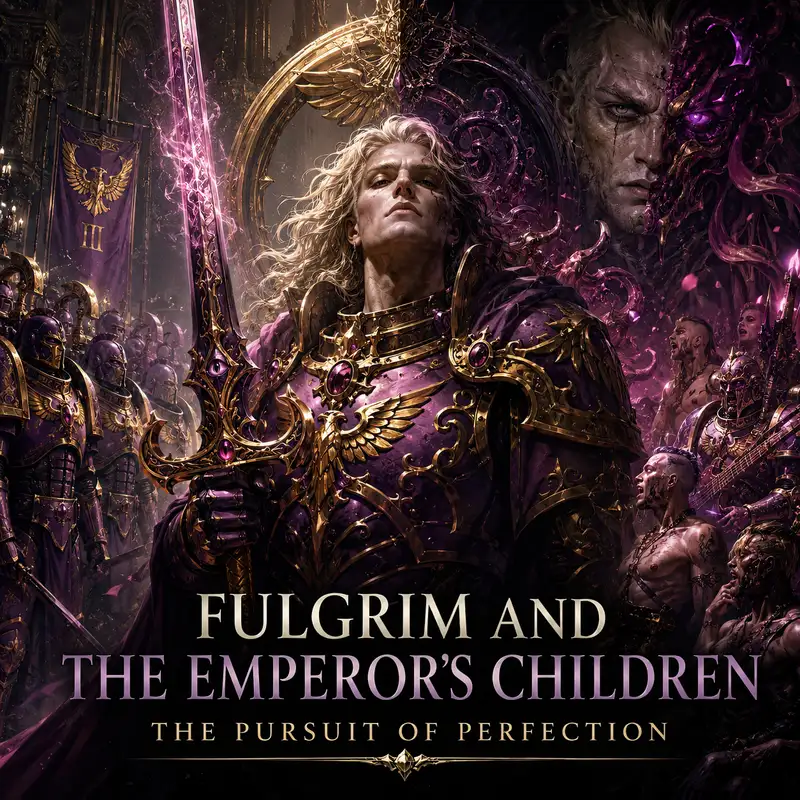
Fulgrim and the Emperor’s Children: The Pursuit of Perfection
The first sign that something had gone wrong was not ugliness. It was beauty without restraint. The warriors of the Third Legion still marched in flawless formation. Their armour still gleamed beneath the lights of their flagship. Their primarch was still one of the most graceful and accomplished beings ever created. Yet every victory left them less satisfied than the one before it. Every work of art demanded a stronger sensation. Every improvement revealed another imagined defect. Fulgrim and the Emperor’s Children did not fall because they stopped caring about excellence. They fell because excellence ceased to be enough.
Long before Fulgrim met his Legion, the Third had already learned to measure itself against impossible standards. Its earliest recruits came largely from the noble houses of Terra, young aristocrats offered to the Emperor during the wars that unified humanity’s home world. They regarded leadership as a natural duty and discipline as a mark of breeding. They served as warriors, escorts, and heralds, and they earned an honour few other Legions could claim. After members of the Third died protecting the Emperor during the Proximan Betrayal, the Legion received the right to bear the Palatine Aquila, the Emperor’s own eagle. It was not decoration. It was a declaration that these warriors had been judged worthy to represent him.
Then the Legion began to die. Gene-seed reserves were lost, corrupted, or rendered unusable, and a wasting condition known as the Blight spread through its ranks. New warriors could not be created fast enough to replace the dead. The Third Legion, once marked by imperial favour, dwindled to only a few hundred Space Marines. Survival encouraged a dangerous conclusion. If the Legion could not possess the numbers of its brothers, then each surviving warrior would have to be better than the warriors of every other Legion. Precision became necessity. Necessity became identity. Pride, as it often does, arrived wearing the uniform of professionalism.
Fulgrim had learned a similar lesson on Chemos. The world upon which he landed was exhausted, industrial, and close to collapse. Its people laboured to keep failing machines alive while resources diminished and the future narrowed. Fulgrim was taken in by workers who recognised that the strange child might be more valuable alive than surrendered to frightened authorities. He matured with impossible speed. He mastered Chemos’s industries, improved production, restored damaged systems, and helped draw the world back from extinction. Once survival was secured, he encouraged the return of art, culture, and beauty. To Fulgrim, civilisation was not complete merely because its people continued breathing. They had to create something worth breathing for.
That achievement reveals the best of him. Fulgrim was not born as a shallow peacock obsessed with mirrors. He understood labour. He understood hunger. He had seen a society stripped down to function and had rebuilt more than its machines. His belief in perfection began as an insistence that humanity could rise above mere endurance. When the Emperor found him, Fulgrim encountered the being whose approval could validate everything he had accomplished. He also discovered brothers whose victories, worlds, and Legions gave him endless standards against which to compare himself.
Only a small remnant of the Third Legion waited for him. Fulgrim did not greet them as a disappointment. He saw survivors who had preserved their honour while disease consumed their ranks. Fresh genetic material from their primarch allowed the Legion to recover, and recruits from Chemos and Terra filled its formations. Because it remained small for much of its rebuilding, the Emperor’s Children fought beside Horus and the Luna Wolves. Fulgrim and Horus became close. The relationship gave Fulgrim a powerful ally, a model of military command, and eventually a trusted voice capable of leading him into ruin.
Under Fulgrim, the Emperor’s Children became genuinely exceptional. They studied strategy, swordsmanship, logistics, diplomacy, ceremony, and the arts. Their officers were expected to master not only how to win, but how to win in the correct manner. Battles were analysed in precise detail. Formations were drilled until movement became instinct. Warriors competed to refine every technique. Fulgrim led from the front, and his sons followed leaders whom they believed embodied the standards expected of them. At their best, they were not merely splendid duelists. They were disciplined soldiers who treated war as a craft requiring constant study.
Their culture also contained the mechanism of its own collapse. Perfection was defined from above. Every warrior looked to his superior, every officer looked to Fulgrim, and Fulgrim looked toward the Emperor while glancing sideways at his brothers. Success therefore depended not only on accomplishing a mission, but on receiving recognition from someone higher. A victory could be brilliant and still feel inadequate if another Legion’s triumph seemed greater. A work of art could be beautiful and still be discarded if its creator imagined criticism. The Emperor’s Children became skilled at pursuing excellence, but increasingly unable to decide when excellence had been achieved.
Fulgrim’s closest friendship among his brothers was with Ferrus Manus of the Iron Hands. They were an unlikely pair. Fulgrim cultivated beauty, refinement, and graceful mastery. Ferrus valued endurance, strength, and the honest certainty of metal under the hammer. Yet each recognised ability in the other. They forged weapons as gifts, testing their own craftsmanship through an act of mutual respect. Ferrus created the sword Fireblade for Fulgrim. Fulgrim created the warhammer Forgebreaker for Ferrus. Their friendship mattered because Ferrus offered something Fulgrim desperately needed: admiration from a brother who could not be impressed by appearance alone.
The Great Crusade gave the Emperor’s Children opportunities to prove themselves, and they repeatedly did so. The danger lay in what proof became. Fulgrim wanted achievements that could not be questioned. When the Twenty-Eighth Expedition encountered the Laer, an alien civilisation judged extremely difficult to conquer, the prudent estimate suggested a long campaign. Fulgrim promised a victory in a fraction of that time. He was not merely choosing an aggressive military plan. He was setting a stage upon which his Legion could demonstrate that limitations applied to other people.
The Laer were formidable and profoundly altered by biological engineering. Their society had reshaped bodies according to role, desire, and environment. To the Imperium, they were xenos to be destroyed. To Fulgrim and some of his officers, they also represented a disturbing possibility. The Emperor had created the primarchs and Space Marines as engineered beings, but the Laer treated biology as material for continuous revision. If an organism could always be modified, then perhaps the Emperor’s work was not a finished masterpiece. Perhaps it was only the first draft.
The Emperor’s Children conquered the Laer with astonishing speed and paid heavily for it. Fulgrim received the triumph he had demanded, but the campaign did not satisfy him. It opened a door. Chief Apothecary Fabius Bile examined Laer biology and argued that its techniques could enhance the Legion. Fabius was brilliant, ambitious, and already shaped by the Blight that had nearly destroyed his brothers. He had spent his life watching supposedly perfect transhuman bodies fail. His answer was not reverence for the original design. It was experimentation. Fulgrim allowed him to proceed.
This decision is one of the clearest turning points in the Legion’s history. The Emperor’s Children had once pursued perfection through discipline, education, and practice. Now they began seeking it through alteration. Fabius modified organs, nerves, and senses. Lord Commander Eidolon received enhancements that transformed his voice into a weapon. Other warriors followed. Each successful change made the next one easier to justify. The language remained noble. They were refining themselves, correcting weaknesses, surpassing old limits. The practical result was that the Legion’s own bodies became laboratories, and restraint became evidence of insufficient ambition.
On the Laer home world, Fulgrim entered a temple dedicated to a power he did not understand. There he claimed a magnificent sword. A daemonic presence was bound to the weapon, associated with Slaanesh, the Chaos God of desire, excess, obsession, and the hunger for experience without end. The sword did not replace Fulgrim’s personality with a stranger overnight. Its influence was more patient and more effective. It encouraged suspicions already present. It transformed advice into insult, caution into cowardice, and self-doubt into the certainty that others were jealous. Fulgrim’s virtues were not erased. They were bent until they pointed toward destruction.
That distinction matters. Chaos rarely needs to invent a desire from nothing. It can work with love, ambition, loyalty, anger, fear, or the sincere wish to improve. Slaanesh did not tempt the Emperor’s Children to become careless. It tempted them to become more exacting, more sensitive, more accomplished, and more alive than anyone had ever been. The price was that no experience could remain sufficient. Satisfaction would have ended the pursuit, and Slaanesh offers many things, but never an ending.
There was still an opportunity to turn back. The Aeldari seer Eldrad Ulthran attempted to warn Fulgrim that Horus had been corrupted by powers beyond the material universe. It was hardly an ideal conversation. The Aeldari spoke from a position of ancient superiority, Fulgrim arrived with the confidence of a conqueror, and neither side possessed much talent for trusting the other. Yet the warning was real. Fulgrim rejected it, interpreting the accusation against Horus as an insult to his friend and to his own judgment. The meeting collapsed into violence. In a Legion built around the certainty of its own discernment, inconvenient truth had become indistinguishable from disrespect.
The corruption spread through the Expedition Fleet as much by culture as by sorcery. Artists attached to the crusade found their work becoming increasingly extreme. The composer Bequa Kynska sought sounds capable of producing sensations ordinary music could not reach. The sculptor Ostian Delafour struggled to preserve honest beauty while those around him demanded novelty and intensity. Serena d’Angelus, a gifted painter, became consumed by the need to capture experiences beyond conventional art. Their descent mirrored that of the Legion. Technique remained. Purpose rotted.
The performance called the Maraviglia brought that decay into the open. Presented aboard Fulgrim’s flagship, it began as an artistic triumph and became a ritual of sensory violence. Music, altered instruments, psychic corruption, and the reactions of the audience combined into catastrophe. Space Marines who had once prided themselves on disciplined control surrendered to sensation. Some discovered that conventional weapons no longer produced the experience they craved. Sound itself became an instrument of destruction. From this environment emerged the warriors later known as Noise Marines, soldiers for whom battle was performance and agony merely another form of music.
By then Horus had turned against the Emperor. Fulgrim’s long friendship with the Warmaster made him both valuable and vulnerable. Horus understood his brother’s pride, his need for recognition, and his fear that the Emperor had withdrawn from the Great Crusade without trusting his sons with the truth. The influence of the sword deepened every grievance. Fulgrim accepted Horus’s rebellion and then attempted to bring Ferrus Manus with him. It was a revealing choice. He did not merely want another Legion for the coming war. He wanted his closest friend to confirm that he had chosen correctly.
Ferrus refused. Their confrontation became violent, and the weapons they had forged in friendship became instruments of division. Fireblade was broken. Fulgrim escaped with Forgebreaker, leaving behind a brother who now understood the scale of the betrayal. The scene exposed what Fulgrim’s pursuit had become. Ferrus would not admire his decision, so Fulgrim treated disagreement as blindness. A man who had once rebuilt a world through persuasion and example could no longer tolerate the existence of a judgment he did not control.
The Emperor’s Children also contained warriors who remained loyal to the Emperor. At Isstvan the traitor Legions attempted to remove such elements from their own ranks before the wider rebellion began. Loyalists were sent into battle and then marked for extermination by their brothers. The purge did not eliminate every dissenter, but it destroyed the Legion’s ability to pretend that its transformation was merely philosophical. The Emperor’s Children were no longer debating how best to serve humanity. They were murdering their own sons and brothers so that Horus’s war could proceed without inconvenience.
The greater reckoning came at Isstvan Five. Loyalist Legions descended upon the apparent rebels, unaware that additional forces arriving behind them had also joined Horus. The result was the Drop Site Massacre. Amid the collapse, Fulgrim and Ferrus Manus found one another. Their duel was not simply a contest between primarchs. It was the final argument between two visions of strength. Ferrus remained brutal, proud, and deeply flawed, but his loyalty gave him a boundary he would not cross. Fulgrim had spent years removing every boundary that might suggest he was incomplete.
Fulgrim killed Ferrus and took his head. In that instant, the enormity of what he had done broke through the layers of pride and corruption. The victory he had imagined would prove his superiority instead destroyed the one relationship that could not be replaced by applause. Fulgrim recoiled from himself. The daemon in the sword exploited his despair and took control, offering escape from the unbearable knowledge of his own act. It was the perfect conclusion to his corrupted logic. When reality failed to match the image he wished to preserve, he surrendered reality.
The possession was not the end of Fulgrim’s agency. Later accounts make clear that he eventually overcame the daemon and reclaimed control of his body. This does not redeem him. It removes an easy excuse. Fulgrim did not remain a helpless prisoner while another being committed every later atrocity. He embraced Slaanesh, pursued transformation, and eventually ascended into a serpentine daemon primarch. The distinction is uncomfortable but essential. A monster made entirely by outside control would be tragic. Fulgrim became something worse: a man who saw what corruption had cost and chose to continue.
His Legion followed the same path. During the Heresy, the Emperor’s Children remained deadly, but their strategic reliability deteriorated. Rivalries intensified. Warriors chased personal experiences, trophies, sensations, and displays of superiority. At the Siege of Terra, they possessed the strength to contribute decisively, yet large elements abandoned military purpose for predation among the population. The Legion that had once believed every action should reflect honour upon the Emperor now treated a civilisation’s suffering as material for private gratification. Their standards had not vanished. They had become completely detached from any purpose beyond appetite.
After Horus fell, the Emperor’s Children fled into the Eye of Terror with the other traitors. There their excesses helped ignite wars among the defeated Legions. They raided for slaves, resources, and stimulation, then turned upon allies when external victims were insufficient. The unified Legion fragmented into warbands led by champions with competing visions of perfection. Fabius Bile continued his experiments, pursuing biological mastery with the patience of a scientist and the ethics of a plague. Eidolon and others attempted, at various times, to gather the scattered sons of Fulgrim. Cooperation remained difficult. Every would-be leader believed he was the obvious centre of the composition.
In the forty-first millennium, the Emperor’s Children are both recognisable and grotesquely transformed. They remain fast, skilled, theatrical warriors. Many still value artistry, personal mastery, and intricate plans. Yet all of these qualities serve Slaanesh’s endless demand for more. Some seek the perfect duel. Others pursue the perfect sensation, the perfect performance, or the perfect act of domination. Fulgrim himself has returned to more active involvement in the material galaxy, calling his scattered gene-sons toward renewed action. Whether they can truly become a Legion again is uncertain. A force built from individuals who each regard themselves as the masterpiece has certain command difficulties.
The name Emperor’s Children survives, and that may be the darkest detail of all. It was once an honour earned through sacrifice. It recalled warriors who stood between the Emperor and death, a Legion trusted to bear his symbol, and survivors who rebuilt themselves from near extinction. The traitors keep the name as mockery, but also because they cannot fully escape the need for the approval it once represented. Even in rebellion, they define themselves through the father they claim to despise.
Fulgrim’s tragedy was not that he desired beauty, culture, skill, or improvement. Those desires helped save Chemos and rebuild a dying Legion. His failure was the belief that worth depended upon being beyond criticism, beyond limitation, and beyond comparison. Once perfection became proof of personal value, every flaw became an enemy. Every warning became humiliation. Every boundary became an insult. Slaanesh offered him an eternity in which he could keep pursuing the next improvement, the next sensation, and the next triumph, while ensuring he would never feel complete.
The Emperor’s Children therefore achieved the opposite of what they sought. They wanted to become flawless instruments of civilisation and became creatures ruled by appetite. They wanted beauty that would outlast history and produced spectacles that consumed their creators. They wanted victories no one could question and destroyed the bonds that made victory meaningful. Beneath the noise, perfume, silk, blood, and polished armour lies the same frightened hunger that began with a few hundred survivors trying to prove they were not lesser than their brothers. They pursued perfection until nothing remained except the pursuit.