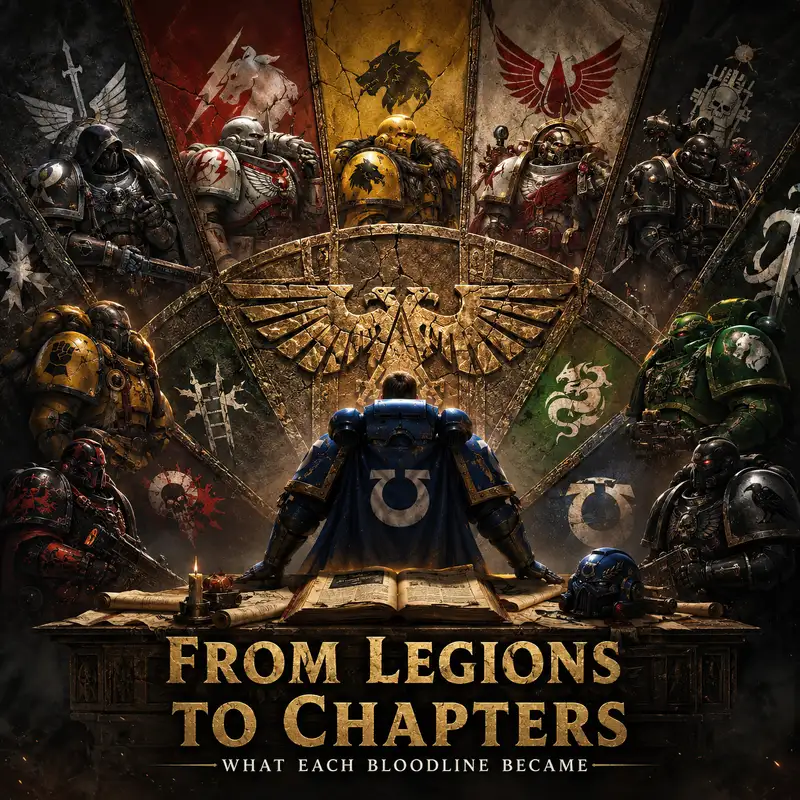
From Legions to Chapters: What Each Bloodline Became
The Legion banners were still hanging over the ruins of Terra when the victors began arguing over whether those banners should ever be raised again. Horus was dead. The Emperor had been carried from the Vengeful Spirit and sealed within the Golden Throne. The traitor fleets were retreating toward the Eye of Terror, and the loyal sons of the Emperor stood amid a victory that looked remarkably like the end of civilisation. Then came the most dangerous question of the peace. Should any one commander ever again possess tens of thousands of Space Marines, their fleets, their armouries, and the loyalty of entire worlds? The Legions had conquered the galaxy. One of them had also brought the Imperium to the edge of extinction. The weapon had worked exactly as designed, right up until it was pointed inward.
Roboute Guilliman’s answer was the Codex Astartes. It was not merely a manual describing where to place a heavy weapon or how many squads should fit inside a company. It was part of a wider effort to prevent another Horus Heresy by breaking military power into smaller institutions. The surviving loyalist Legions would be divided into Chapters, each normally containing about a thousand Space Marines. One Chapter would retain the old Legion’s name and principal legacy. The others would become successor Chapters, independent commands led by veterans who had once served beneath the same banner. This Second Founding was meant to ensure that no future Warmaster could seize vast armies with a handful of oaths and a persuasive smile. Considering the previous results, the proposal possessed a certain practical charm.
A Chapter inherited more than gene-seed. It received officers, ships, relics, battlefield customs, and memories of the Heresy. Its first Chapter Master often shaped it as deeply as its Primarch had shaped the Legion. Then the Chapter departed for another fortress, another recruiting world, and another set of wars. Local culture altered initiation rites. Enemies changed doctrine. Isolation turned habits into sacred traditions. Genetic quirks became stronger, weaker, or better hidden. Two Chapters descended from the same Primarch could eventually resemble distant relatives who agree on the family name and little else. The Second Founding did not produce neat copies. It produced bloodlines, and each bloodline became an argument about what the original Legion had truly meant.
The change was neither peaceful nor complete. Rogal Dorn regarded the breaking of the Imperial Fists as a rejection of the loyalty they had demonstrated at Terra. Leman Russ had never shown much interest in organising Fenris according to Guilliman’s preferences. The Salamanders were so depleted that dividing them further would have required a very generous definition of a Chapter. The Dark Angels obeyed in public while preserving connections that made their independence rather theoretical. The Legions vanished from Imperial records, but not from memory, habit, or blood.
The Dark Angels became the clearest example of a Legion that divided without entirely separating. Caliban had been destroyed. Lion El’Jonson was missing. Worse, part of the Legion had rebelled under Luther, and many of those renegades had been scattered through time and space. The Dark Angels and their successors called themselves the Unforgiven because they carried the shame of that hidden betrayal. Chapters such as the Angels of Absolution, Angels of Redemption, and Angels of Vengeance possessed their own heraldry and commanders, yet their inner circles shared the same secret and the same hunt for the Fallen. Information, prisoners, and orders moved through a private network concealed from the wider Imperium. On ordinary campaigns, they operated as separate Chapters. When a trace of the Fallen appeared, the legal distinctions sometimes became noticeably thin. The First Legion had become a family of knightly orders, each guarding part of the same locked chamber.
Not every Unforgiven Chapter interpreted that burden alike. Some believed their service had already absolved them. Others pursued repentance so fiercely that allies became secondary concerns. Their colours and rituals changed, but the structure of secrecy survived. The return of the Lion has complicated that inheritance. He has encountered some warriors once condemned as Fallen and judged that not all were the same kind of traitor. To a bloodline built around ten thousand years of guilt, that distinction is not a minor administrative update. The Dark Angels became Chapters, but their deepest identity remained Legionary. Their division concealed their unity rather than destroying it.
The White Scars became something looser. Jaghatai Khan had never valued rigid control for its own sake. His Legion fought through speed, initiative, deception, and the ability of commanders to act without waiting for permission from several light-years away. Successor Chapters such as the Marauders, Rampagers, Destroyers, and Storm Lords carried portions of that tradition into new regions. Some preserved the warrior culture of Chogoris. Others adopted the customs of new recruiting worlds. Many retained a preference for rapid strikes, but speed was never the whole inheritance. The deeper legacy was freedom of action. A son of the Khan was expected to understand the hunt well enough to choose his own path through it.
That freedom produced descendants who could be proud, competitive, austere, or unexpectedly methodical. The Storm Lords developed a fierce rivalry even with the White Scars themselves. Later branches moved far from the open steppes of Chogoris, yet the instinct to refuse static warfare remained. After the Khan disappeared, his successors did not gather around a secret command structure. They carried his absence differently. The White Scars bloodline became a collection of hunters who shared a direction of travel rather than a single road. Guilliman wanted independent Chapters. In this case, he received them.
The Space Wolves turned the reorganisation into a prolonged negotiation. Their Legion became the Space Wolves Chapter, but it did not adopt the standard Codex structure. It remained divided into Great Companies of changing size, each centred upon a Wolf Lord and bound to the Great Wolf. The one early successor created from Russ’s Legion, the Wolf Brothers, suffered catastrophic genetic instability and was eventually disbanded. The Canis Helix that gave the sons of Russ their distinctive strength also carried the danger of bestial mutation, and for millennia the Space Wolves appeared unable to establish stable descendants beyond Fenris. The intended family of Chapters became one unruly household, heavily armed and entirely convinced that the problem lay with everyone else’s paperwork.
The arrival of Primaris Space Marines changed that history. New methods allowed Chapters such as the Wolfspear, Icefangs, and Mooneaters to bear Russ’s gene-seed without repeating the immediate failure of the Wolf Brothers. Even then, genetic success did not settle the cultural question. Were warriors created far from Fenris truly sons of Russ? The Space Wolves eventually recognised these successors as kin, while expecting them to prove themselves through battle and tradition. The Wolves resisted the original pattern more successfully than any other loyalist Legion, but ten thousand years later the Chapter system finally reached them by a very long route.
The Imperial Fists produced almost the opposite result. Rogal Dorn resisted the division bitterly, yet once it occurred, his Legion separated into Chapters that expressed sharply different parts of his character. Sigismund led the Black Templars into an eternal crusade, carrying Dorn’s devotion into a form more zealous, aggressive, and far less interested in numerical limits. Alexis Polux became the first master of the Crimson Fists, whose discipline and practical courage preserved the Legion’s steadier side. The Excoriators embodied endurance so severe that suffering became almost a language. Other successors carried traditions of siegecraft, fortification, duelling, and relentless defence into their own cultures.
Together they reveal that Dorn’s legacy was never simply stubbornness. It was duty under pressure, and different warriors answered that pressure in different ways. Some built walls. Some became the weapon sent beyond them. The secret Last Wall protocol later allowed the sons of Dorn to reunite in defence of Terra during the War of the Beast, briefly restoring something close to the old Legion. That contingency exposed the compromise beneath the Second Founding. Dorn obeyed the law, but also prepared for the day when it might prove inadequate. The Imperial Fists bloodline became a fortress whose stones had been scattered across the galaxy, each separate until the alarm was sounded.
The Blood Angels divided beneath the shadow of a dead Primarch. Sanguinius had fallen aboard the Vengeful Spirit, and his death did not remain a memory confined to history. The Red Thirst had already haunted his sons, driving them toward bloodshed and loss of control. After his death came the Black Rage, a psychic wound in which a warrior may believe himself to be Sanguinius facing Horus in the final moments before death. Every successor Chapter inherited some version of this burden. The Second Founding did not merely distribute the Blood Angels’ strength. It distributed their curse.
The Flesh Tearers, founded under the fierce captain Nassir Amit, embraced a brutally direct style of war and became notorious for how narrowly they controlled their fury. Other successors placed greater emphasis on ritual, art, secrecy, or self-denial. Some concealed the flaw. Some sought cures. Some treated inevitable madness as a sacred debt. Their differences could be profound, yet the bloodline remained united by the same impossible standard. They were expected to resemble the noblest Primarch while carrying an urge that could reduce nobility to slaughter. When Hive Fleet Leviathan descended upon Baal, successor Chapters returned from across the Imperium to defend their shared father’s world. They did not arrive because one Chapter Master commanded a hidden Legion. They arrived because every son of Sanguinius understood where the family wound had begun. The Blood Angels became many Chapters, but grief remained their common home.
The Iron Hands emerged from the Heresy with a different wound. Ferrus Manus had been killed at Isstvan Five, and the Legion had shattered around the fact of his death. His sons had admired strength, discipline, and the union of warrior and machine. After the massacre, those ideals hardened into an obsession with eliminating weakness. The Iron Hands Chapter developed its clan companies and rule by the Iron Council. The Red Talons carried vengeance against the traitors with exceptional severity. The Brazen Claws followed another path, more recognisably organised according to Codex patterns while retaining the bloodline’s mechanical inheritance.
Across these descendants, augmentation became more than equipment. It became an answer to trauma. Flesh had failed Ferrus. Emotion had led the Legion into fury. Therefore flesh and emotion were treated as faults to be controlled, replaced, or denied. Not every successor pursued that conclusion equally, but the argument shaped them all. The Iron Hands bloodline became mechanised grief, each Chapter attempting to prove that Isstvan could never happen again if only enough vulnerable parts were removed. It is a powerful doctrine. It is also the sort of solution one develops when admitting sorrow would be considerably harder.
The Ultramarines became the great branching tree of the Adeptus Astartes. Their Legion survived the Heresy in greater numbers than most, and records traditionally describe twenty-three successor Chapters created during the Second Founding. The Genesis Chapter remained closely tied to Macragge. The Novamarines carried the Codex into distant campaigns. The Aurora Chapter became renowned for armoured warfare. The Iron Snakes developed traditions shaped by the ocean world of Ithaka. The Mortifactors built a severe culture of death and prophecy that would have looked distinctly unfamiliar in the polished halls of Ultramar.
This diversity matters because the Ultramarines are often mistaken for a single template repeated in different colours. Guilliman’s legacy was a system intended to adapt. The Codex offered principles and structures, not an instruction to stop thinking. Some descendants treated it as a living military text. Others treated it with near-religious reverence. Stable gene-seed and reliable administration made Guilliman’s line especially valuable in later Foundings, so a large portion of all Space Marine Chapters trace their ancestry to the Thirteenth Legion. Guilliman broke his own Legion more thoroughly than any of his brothers, and in doing so spread its influence more widely than it had ever reached while whole.
The Salamanders barely had enough survivors to become one Chapter. Isstvan Five destroyed much of the Legion, and the remaining force was organised into seven companies. No confirmed successor Chapters were created from them during the Second Founding. This was less a philosophical exception than grim arithmetic. The Salamanders retained an unusually close connection to the people of Nocturne, living among their clans and preserving the Promethean Cult’s emphasis on endurance, craft, self-mastery, and protection of ordinary human lives. Without an early family of successors, those traditions remained concentrated within the original Chapter.
Later records hinted at possible descendants, but many claims remained uncertain. The Ultima Founding finally produced confirmed sons of Vulkan, including the Dark Krakens, Dragonspears, Covenant of Fire, and Black Vipers. They do not all reproduce Nocturne’s culture. They carry the same gene-line into different worlds, where Vulkan’s ideals can become oceanic hunts, quests for knowledge, fierce self-sacrifice, or more troubling interpretations of strength. The Salamanders bloodline spent most of Imperial history as a single guarded flame. Only in the age of the Great Rift did it begin scattering sparks across the darkness.
The Raven Guard had also been ruined at Isstvan Five, then wounded again by the failure of Corvus Corax’s attempt to rebuild the Legion rapidly. Alpha Legion sabotage corrupted the accelerated gene-seed project, leaving Corax with another disaster and another burden of guilt. The survivors nevertheless produced successor Chapters, including the Revilers and Black Guard, while other descendants carried Raven Guard methods into later Foundings. Records concerning the exact origins of some Chapters are inconsistent, which is hardly unusual in an Imperium that can misplace a planet and then demand its overdue taxes.
What endured was not merely a preference for black armour and quiet entrances. Corax had taught his sons to strike tyrants where strength could not protect them. Reconnaissance, infiltration, sabotage, decapitation strikes, and carefully chosen violence became the language of the bloodline. Some successors remained patient and surgical. Others became harsher, more vengeful, or more willing to employ overwhelming firepower once the hidden approach was complete. The Raven Guard line became a school of asymmetric war, built on the belief that a smaller force could defeat a larger one by understanding where power was weakest.
The Second Founding was only the beginning. In later millennia, the High Lords authorised new Foundings using gene-seed tithed by existing Chapters and maintained under the supervision of the Adeptus Mechanicus. A new Chapter might descend directly from a First Founding line or from a successor that had already developed centuries of separate tradition. The family tree branched again and again. Records were lost, sealed, altered, or deliberately obscured. Some Chapters know their Primarch with certainty. Others possess only a tradition. A few have lineages that remain classified or disputed, and claims of loyal Chapters secretly descending from traitor gene-seed remain unconfirmed unless the evidence says otherwise.
Gene-seed does not dictate personality with mechanical precision. It can carry physical traits, organ failures, psychic echoes, and dangerous mutations, but culture gives those traits meaning. A child taken from a death world, a hive, a feudal kingdom, or a void-born clan enters the same transformation with a different understanding of honour and survival. The Chapter’s first masters decide which memories of the Legion deserve preservation. Over ten thousand years, those decisions become rites, taboos, and doctrine. The Primarch provides the inheritance. History decides what grows from it.
The traitor Legions followed no comparable system. The Word Bearers, Death Guard, Iron Warriors, and Thousand Sons retained strong identities through old structures, new cults, or powerful lords. The World Eaters, Emperor’s Children, and Night Lords fragmented into warbands whose loyalties could be temporary and violently revised. The Alpha Legion became a maze of cells and competing claims. The Sons of Horus were hunted, diminished, and overshadowed by Abaddon’s Black Legion, which welcomed warriors from many origins rather than simply restoring Horus’s command. Their gene-lines survived, but not as lawful Chapters. Loyalist division was imposed to limit rebellion. Traitor division came through defeat, rivalry, madness, and the generous administrative influence of the Chaos Gods.
Ten thousand years later, Guilliman returned to an Imperium filled with the descendants of his decision. The Primaris project and Ultima Founding created new Chapters from the loyalist gene-lines, reinforced old ones, and revived bloodlines that had rarely produced successors before. During the Indomitus Crusade, the Unnumbered Sons fought in formations grouped by genetic ancestry before being assigned to established Chapters or formed into new ones. For a brief moment, the old idea of Legionary brotherhood appeared again, then was deliberately dispersed. Guilliman had not forgotten why he broke the Legions, even if the galaxy had become dangerous enough to make their power tempting.
So what did each bloodline become? The sons of the Lion became secret orders bound by guilt. The sons of the Khan became independent hunters. The sons of Russ remained a great household before becoming a wider kinship. The sons of Dorn became crusaders, sentinels, and living walls. The sons of Sanguinius became guardians carrying a shared curse. The sons of Ferrus became different answers to weakness and grief. The sons of Guilliman became the broad architecture of the Adeptus Astartes. The sons of Vulkan remained close to humanity before sending new sparks into the Imperium. The sons of Corax became masters of war from the shadows.
The Legions were broken because the Imperium feared what might happen if too much power answered to one voice. That fear was justified. Yet the Second Founding could divide fleets, armouries, and chains of command more easily than it could divide memory. Every successor carried a fragment of an ancient triumph, failure, or wound. Over time, those fragments became new identities strong enough to stand alone. The Legions died as institutions, but their bloodlines endured as families, rivalries, secrets, and obligations scattered across the stars. The banners no longer march together. Their shadows still do.