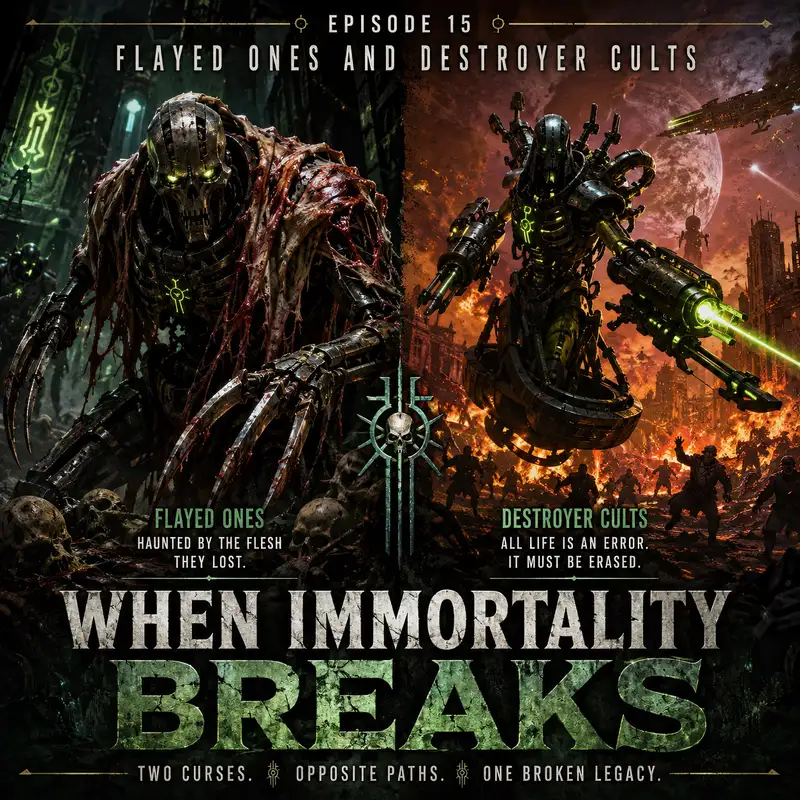
Flayed Ones and Destroyer Cults: When Immortality Breaks
A sealed door opens deep inside a Necron tomb, and something steps through wearing the remains of a creature that died only minutes before. Its metal hands end in long blades. Its shoulders are draped with wet skin that can neither warm it nor make it whole. Far above, another Necron form crosses the surface at impossible speed, scanning not for armies, fortresses, or commanders, but for life itself. It will kill the soldiers first, then the refugees, then the animals, and if nothing interrupts its work, it may continue until even the smallest living trace has been burned away. The first horror is a Flayed One. The second belongs to a Destroyer Cult. They are often placed together because both are violent outcasts feared by their own species, but their madness points in opposite directions. One reaches desperately toward the flesh the Necrons lost. The other has decided that flesh, and perhaps all life, must cease to exist. Together they reveal the weakness hidden inside Necron immortality. A body can be repaired forever. A damaged purpose can be repaired into forever as well.
The Necrons began as the Necrontyr, a mortal species whose short and painful lives were shaped by disease, radiation, resentment, and an immense talent for turning grievance into public policy. Their bargain with the star gods known as the C’tan promised release from failing flesh. Through biotransference, the Necrontyr entered vast furnaces and emerged as minds housed in bodies of living metal. The process gave them endurance beyond biological limits, weapons that could humble gods, and the ability to return from injuries that would leave almost any other soldier as a cautionary stain on the ground. It also cost them far more than they understood. Their souls were lost. Their bodies, senses, and ordinary rhythms of life vanished. Most of the common population retained little more than obedience and fragments of personality, while nobles and specialists received minds capable of memory, ambition, and regret. That last gift was not necessarily a kindness. A Necron Warrior can endure eternity by scarcely understanding it. An Overlord may remember enough to know exactly what has been taken.
Necron consciousness is not a perfect jewel sealed safely inside an indestructible shell. It is a pattern, an engrammatic identity carried by ancient systems that have suffered war, hibernation, damage, repeated reconstruction, and the simple discourtesy of sixty million years. Tomb complexes fail. Translation systems decay. Reanimation can return a warrior to battle, but repeated loss and restoration may erode what remains of the mind. Even among the nobility, memory is selective, contradictory, or shaped by pride. Two Necrons may recall the same ancient event differently, and both may be entirely certain that the other is defective. This is usually treated as a political inconvenience, which is convenient because Necron courts have considerable practice with those. Yet the deeper problem is more serious. Their immortality preserves continuity without guaranteeing health. Biological creatures can heal, change, forget, or die. Necrons can become trapped inside a damaged mental pattern while the body around it continues to repair itself. The machine does not ask whether the identity it restores should have been allowed to rest. It simply restores it.
The Flayed Ones are the most grotesque expression of that trap. Their origin is tied to Llandu’gor the Flayer, one of the C’tan against whom the Necrons eventually rebelled. When the star god was slain, the surviving accounts say that his final curse passed into his killers and began to spread among their kind. Some records call it a curse. Others describe a virus or a contamination of the mind. The precise mechanism remains uncertain, and Necron testimony is hardly improved by the fact that those most directly affected are often busy removing someone’s skin. What is consistent is the result. The afflicted begin to experience a hunger that their bodies cannot satisfy. They crave blood, meat, warmth, and the sensation of inhabiting flesh. Their metal forms hunch and distort. Fingers become or are reshaped into long cutting talons. They stalk battlefields, charnel pits, and tomb corridors in search of bodies they can tear open and wear. The curse does not return them to life. It gives them an endless awareness of what life felt like, then denies them every means of reaching it.
That is why the skin matters. A Flayed One does not wear flesh as armour, because rotting tissue offers poor protection against a lasgun and makes maintenance considerably more awkward. It wears flesh as an answer to an impossible bodily memory. The victim’s skin is stretched across cold necrodermis. Blood is smeared over a mouth that cannot taste. Meat is pushed toward a body that has no stomach and no need to eat. The act is repulsive, but it is not random. It resembles a ritual performed by a mind trying to make an absent body reappear through repetition. The more it fails, the more urgently the ritual must be repeated. Some Flayed Ones seem reduced to hunting instinct and broken sensation. Others retain fragments of former identity, status, or speech, making the condition more disturbing rather than less. Somewhere within the monster may remain a Necron who understands what it has become. Immortality has not saved that individual from bodily terror. It has removed the mercy of exhaustion, healing, and death.
Other Necrons react to the Flayer curse with fear that is both practical and deeply personal. The afflicted are shunned, driven away, sealed behind barriers, or destroyed when that can be managed. Many dynasties treat contact itself as dangerous, because the curse appears capable of spreading and no reliable cure is known. Flayed Ones gather in the Bone Kingdom of Drazak, a nightmare realm associated with their kind, and they can emerge from tears in reality when bloodshed draws them. Their arrivals often feel less like a military deployment than a wound opening in the world. One moment a battlefield contains two armies attempting the usual civilised business of mass killing. The next it contains hunched metal ghouls wearing the recent dead. The distinction between sides rapidly loses importance. Drazak gives the Flayed Ones a place beyond ordinary dynastic society, but not peace. It is a kingdom built around an appetite that cannot end, populated by immortals who can harvest bodies forever and never possess one of their own.
On the battlefield, Flayed Ones are terrifying partly because their behaviour is difficult to control and partly because Necron commanders are perfectly willing to use what they publicly condemn. They can appear close to the enemy, rush into formations with keening cries, and keep advancing through wounds that would stop living attackers. Their grisly coverings break morale before their blades finish the work. Some Necron rulers have even used bloodswarm nanoscarabs to mark fleeing victims, turning living bodies into signals that draw Flayed Ones toward them. It is a ruthless piece of operational planning. It also amounts to releasing a contagious cannibal nightmare behind enemy lines and trusting that the details will arrange themselves. Flayed Ones are therefore treated as expendable shock troops when their movement can be predicted, which is not often and never as confidently as the commander’s official account later suggests. Their utility does not make them accepted. It makes Necron society complicit in preserving the very horror it claims to quarantine.
Destroyer Cults begin from a different wound. A Destroyer does not seek the return of flesh. It rejects the value of flesh entirely. Those who succumb become obsessed with eradicating organic life, not merely defeating enemies or reclaiming territory. Dynastic conquest normally has a political purpose. A phaeron wants worlds, subjects, tribute, ancient borders, or recognition of a claim that was considered tedious even before humanity’s ancestors had learned to sit upright. Destroyers want a silence in which no living thing remains to contest anything. Their condition has appeared across many tomb worlds and among different levels of Necron society. Warriors, specialists, and nobles can all fall. No single cause has been confirmed. Some accounts describe a spreading madness or virus. Others suggest degradation during the Great Sleep, damage within command protocols, or a flaw buried in biotransference itself. The uncertainty is part of the fear. A dynasty can guard against an external enemy. It is harder to defend against a conclusion that may already be forming inside its own immortal minds.
The madness of a Destroyer is often misunderstood because the word suggests wild rage. Some Destroyers are violently aggressive, but the cults are frightening precisely because their hatred can be cold, patient, and technically sophisticated. They do not always charge the nearest target without thought. They calculate firing lanes, select efficient methods, and alter their bodies for specialised forms of killing. In the most extreme accounts, their campaigns do not end when the opposing army is dead. They continue against civilians, animals, forests, oceans, spores, and microscopic life. A world is not cleansed when resistance stops. It is cleansed when biology stops. This can take years, and Destroyers do not become bored. Boredom is a luxury of minds that still possess competing desires. A Destroyer has one purpose, refined until every other value becomes irrelevant. There is a terrible elegance to that logic. It is also strategically useless to anyone hoping to rule the territory afterward, because sterilised ash produces disappointing tax revenue.
Their bodies display the same narrowing of purpose. Lokhust Destroyers replace the ordinary humanoid form with hovering weapon platforms designed to hunt and shoot. Skorpekh Destroyers reshape themselves for close assault, carrying immense blades and moving with a speed that makes their heavy frames seem briefly impossible. Ophydian Destroyers adopt serpentine forms suited to sudden subterranean attack, combining Necron engineering with the silhouette of something that should not be moving beneath your feet. Hexmark Destroyers become multi-armed gunfighters, built to deliver precise storms of fire at close range. Destroyer Lords preserve enough authority and intellect to direct others of their kind, although command within a cult is closer to shared obsession than ordinary discipline. These changes are not random mutations. They are choices, compulsions, or imposed modifications that make the body serve the fixation. The Necrons once abandoned flesh to escape its limitations. Destroyers abandon even the memory of the Necrontyr shape because two legs, two arms, and a recognisable face are inefficient concessions to a life they despise.
This separates the Destroyer Cults from ordinary Necron brutality. A normal dynasty may exterminate a population because it occupies a sacred world, refuses submission, or has become inconveniently attached to land claimed sixty million years earlier. Such violence is monstrous, but it remains connected to politics. The dynasty expects something to exist after the killing. Destroyers have no meaningful after. Their objective consumes the future that victory is supposed to create. This is why other Necrons do not truly command them. They unleash them. A Destroyer can be pointed toward an organic enemy, but once the target is gone, the obsession remains. Commanders must consider what the cult will attack next and whether the answer includes allies, servants, captive populations, or anything else that happens to register as alive. Necron nobles value control above almost everything, and Destroyers turn control into a temporary arrangement. They are useful in the way a reactor breach is useful when it occurs beneath someone else’s fortress.
Recent Necron accounts give this fear a name in the figure of Nekrosor Ammentar. The surviving legends describe a Destroyer whose advanced mind remains capable of strategy, whose presence can spread murderous psychosis, and whose followers may include victims converted by enthralled Crypteks. Some claim Ammentar was the first Destroyer, although the evidence does not settle that question. What matters is the possibility represented by the story. Most Necrons can comfort themselves by imagining Destroyers as broken tools, dangerous but simple. Ammentar is dangerous because it may be broken and intelligent at the same time. Its fascination with the Nightbringer and its campaign against organic life give the Destroyer impulse leadership, memory, and a plan. A mind narrowed to one purpose is already lethal. A mind that can persuade, infect, organise, and pursue ancient strategic objectives is something worse. The Necrons do not fear only that Ammentar will kill their enemies. They fear that its vision could become a rival future for their species.
Flayed Ones and Destroyers are sometimes deployed together, and the pairing makes practical sense in the limited manner that anything involving either group can be called practical. Both are outcasts. Both can break enemy formations through terror and extreme violence. Both are difficult to restrain once released. Yet treating them as two varieties of the same madness misses the deeper contrast. The Flayed One is dominated by absence. It wants blood because it has none, warmth because it cannot feel it, and skin because its own body no longer confirms that it is alive. The Destroyer is dominated by rejection. It has concluded that life is a contamination, an error, or an accusation that must be removed. One tries to cross the distance back to the Necrontyr. The other tries to destroy everything on the far side of that distance. The first says, in effect, that the lost body must be recovered. The second says that no body should exist. Both responses are impossible, so both become eternal.
This is also why their fellow Necrons fear them more than they fear ordinary enemies. An Ork invasion can be fought. An Imperial crusade can be outmanoeuvred, at least until its commanders misread the map and arrive somewhere unexpected. Even a C’tan shard can be contained with sufficient technology, preparation, and confidence bordering on blasphemy. The Flayer curse and Destroyer madness threaten the story Necron civilisation tells about itself. The dynasties claim that biotransference made them superior to life. Many nobles still dream of reversing the process, restoring their people, or at least ruling the galaxy in proof that their sacrifice had meaning. Flayed Ones reveal an undying longing for the flesh they supposedly transcended. Destroyers reveal that a Necron mind may respond to immortality by declaring war on the very existence of life. These are not merely criminals at the edge of the empire. They are evidence from inside the machine.
There is a political reason to call them cursed, infected, or defective. Those words place the failure in the individual. The dynasty remains sound. The great bargain remains defensible. The noble court can seal the afflicted behind a door and continue discussing succession disputes that began before the first mammals looked particularly ambitious. Yet the distribution of these conditions makes that reassurance difficult to maintain. Destroyer madness has appeared on many tomb worlds. The Flayer curse has crossed dynastic boundaries and endured across ages. Nobles are not immune. Intelligence is not immunity. Rank may even make the result more dangerous, because an afflicted ruler retains access to armies, Crypteks, and command systems. The Necron hierarchy was designed to preserve order forever. Its greatest nightmare is not rebellion by the powerless. It is corruption of the minds authorised to define what order means.
The tragedy becomes clearer when compared with ordinary mortality. A living soldier can be traumatised, obsessed, or broken, but time changes the body around the wound. Sleep, companionship, age, treatment, and even imperfect forgetting can alter the pattern. None guarantees recovery, but change remains possible. Death, terrible as it is, eventually ends the experience. Necron existence removes many of those boundaries. They do not sleep in the human sense. They do not age toward release. Their bodies do not produce the ordinary sensations that anchor a mind inside daily life. Reanimation returns them to service, and long hibernation can preserve a damaged consciousness without resolving it. If the pattern itself has become diseased, flawless repair may simply rebuild the disease. That is the central horror of an immortal machine. The system can function exactly as intended while the person inside it becomes less able to live with every successful restoration.
The Flayed Ones show what happens when memory of the body survives without the body. Their hunger is not satisfied because no meal can repair the original loss. Each victim becomes another failed attempt to solve biotransference with flesh taken from someone else. The Destroyer Cults show what happens when purpose survives without any human or Necrontyr need to limit it. Hatred becomes efficient, self-justifying, and free from fatigue. Each extermination proves only that more life remains elsewhere. Neither condition has a natural stopping point. That is why the word madness is accurate but incomplete. These are feedback loops built from grief, disgust, memory, and ancient machinery. Their victims are dangerous not because they have no logic, but because logic has been trapped inside a single impossible demand.
Necron immortality therefore breaks long before the living metal body finally fails. It breaks when continuity outlasts identity, when repair preserves damage, and when a mind can no longer create a future different from its wound. The Flayed One bends over the dead and tries to dress itself in a life that cannot be restored. The Destroyer looks across a living world and sees only the material of an unfinished execution. One is haunted by the body it lost. The other is enraged that bodies still exist. Both are products of a civilisation that defeated death without understanding what death had once ended. In the darkness of a tomb world, their footsteps may sound very different. One scrapes forward beneath stolen skin. The other advances with weapons aligned and calculations complete. The warning carried by both is the same. Immortality does not prevent ruin. It can make ruin permanent.