Ferrus Manus and the Iron Hands: The Flesh Is Weak
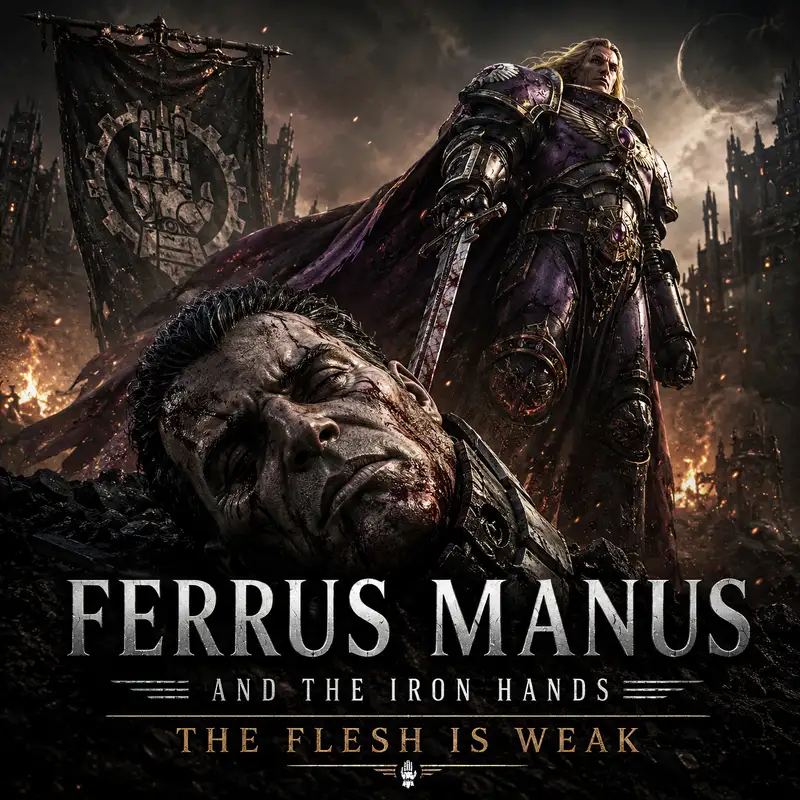
Ferrus Manus died on black sand beneath the blade of the brother he had once trusted enough to arm. The two primarchs had exchanged masterpieces from their own forges, gifts made in admiration and rivalry. On Isstvan Five, that friendship ended with Fulgrim standing over the severed head of the Gorgon. For the Iron Hands, the lesson seemed obvious. Their father had been strong, but not strong enough. His temper had ruled him. His flesh had failed him. From that wound grew the belief that would define them for ten thousand years: the flesh is weak. Yet the tragedy of Ferrus Manus is that his sons may have learned the wrong lesson from his death.
Before they were the Iron Hands, the Tenth Legion were known as the Storm Walkers. Their first warriors came from several regions of ancient Terra, including the industrial strongholds of Old Albia. Even among the early Legiones Astartes, they developed a reputation for discipline, endurance, and a certain shortage of patience for anyone unable to keep pace. Their preferred method of war was brutally practical. They would draw an enemy into attack, absorb the blow, and then answer with an armoured counterstroke of tanks, Dreadnoughts, and massed infantry. They were an anvil that could suddenly become a hammer. It was not subtle, but subtlety is often less important when one has brought enough tanks.
Their primarch landed on Medusa, a world that appeared to have been designed by someone who regarded stable ground as a moral weakness. Its surface was torn by tectonic violence, poisoned skies, brutal cold, and roaming machines left from forgotten ages. Human clans survived in vast mobile crawlers and fortified caravans, constantly moving, scavenging, trading, raiding, and fighting. No central kingdom united them. No great city promised safety. Medusa taught the same lesson every day: survival had to be earned again before nightfall.
Ferrus grew without a family or kingdom to raise him. The surviving legends describe a young giant wandering the wastes, breaking ancient machines, exploring buried vaults, and mastering technologies that the Medusan clans treated with awe or fear. The best-known story concerns Asirnoth, a silver wyrm or machine-serpent whose exact nature remains uncertain. Ferrus is said to have fought the creature and drowned it in molten rock. Its living metal flowed around his hands and forearms, binding itself permanently to him. The tale may have grown in the telling, as tales involving primarchs usually do, but the silver arms were real. They could crush metal, endure terrible heat, and shape weapons at the forge without ordinary tools.
Those hands made him famous, but they also created a misunderstanding that would outlive him. Ferrus did not become powerful because he replaced weak limbs with machinery. He defeated Asirnoth with the body and will he already possessed. The metal was a consequence of victory, not its cause. To the clans of Medusa, however, the distinction was easy to lose. They saw a warlord with hands of living steel, a figure who could tear apart the monsters of their world and build wonders from their remains. They named him for what they could see. Ferrus Manus. Iron Hand.
He did not unite Medusa by ending its clan wars. He believed conflict was useful. Competition exposed weakness, sharpened skill, and prevented comfort from becoming decay. Under his influence, the clans became stronger and better armed, but Medusa remained harsh by design. Ferrus did not want followers protected from hardship. He wanted them tempered by it. This was the first great contradiction in his rule. He was a builder who preserved the conditions that destroyed people. He could create extraordinary weapons, yet he believed the struggle to obtain strength mattered more than the safety strength might provide.
When the Emperor found him, Ferrus accepted his place in the Great Crusade and took command of the Tenth Legion. The reunion suited both primarch and sons almost too well. The Storm Walkers already valued endurance, heavy armour, and decisive counterattack. Ferrus brought Medusan clan culture, greater technological ambition, and an almost physical contempt for failure. The Legion became the Iron Hands, organised around powerful clans that competed for honour, resources, and their father’s approval. Rivalry was not an unfortunate side effect. It was part of the system.
Under Ferrus, the Iron Tenth became one of the Great Crusade’s most formidable engines of conquest. Their armouries tested advanced weapons and protective systems. Their commanders excelled at mechanised war, siege-breaking, and battles in which the enemy had to be crushed rather than persuaded. Ferrus understood machines with an instinct that rivalled the finest minds among his brothers. He was a master smith as well as a general, able to create objects of both elegance and appalling lethality. He did not decorate weapons merely to make them beautiful. He made them beautiful because mastery should be visible.
That same desire for mastery could become pride. Ferrus wanted to be counted among the greatest of the primarchs, and there are accounts suggesting he wished to be considered for the position of Warmaster. During the campaign against the human empire of Gardinaal, he assumed control of a faltering compliance and chose to make an example so decisive that the Emperor could not overlook it. Ferrus won, but the method revealed the danger inside his philosophy. Weakness was not merely a condition to be corrected. It could become a crime deserving destruction. He expected armies, allies, and entire societies to meet standards designed by a primarch. Most did not.
The flaw in that doctrine was visible long before the Heresy. The Iron Hands respected courage, but they often treated ordinary human soldiers as tools whose value could be measured by whether they kept pace. Ferrus was capable of recognising exceptional bravery in mortals, yet his usual standard remained the standard of a primarch commanding transhuman warriors. That is not a generous basis for personnel policy, even by Imperial standards. The Legion became superb at destroying fortified enemies, but far less interested in preserving the armies and populations expected to survive the victory. Isstvan did not create their contempt for weakness. It removed the one authority powerful enough to decide what strength was supposed to serve.
Ferrus was not cold in the way his later sons tried to become cold. He possessed fierce loyalties, a powerful sense of honour, and a temper that could move faster than his judgement. He laughed, competed, admired skill, and formed genuine attachments. His severity came not from an absence of feeling, but from feelings so strong that he tried to master them through discipline. This is why his closest friendship seems surprising only at first glance. Fulgrim, primarch of the Emperor’s Children, appeared to be his opposite. Fulgrim loved ceremony, art, beauty, and applause. Ferrus preferred the forge, the battlefield, and results that required no speech afterward. Beneath the difference, both men were perfectionists.
Their friendship was expressed through craft. Ferrus forged the sword Fireblade for Fulgrim. Fulgrim created the warhammer Forgebreaker for Ferrus. Each recognised in the other a standard few of their brothers could meet. Fulgrim could appreciate the beauty in Ferrus’s brutal precision. Ferrus could respect the discipline hidden beneath Fulgrim’s splendour. Their bond also fed their pride. Each man saw the other as proof that excellence could be recognised by someone worthy of judging it. That made the betrayal more than political. When Fulgrim turned against the Emperor, Ferrus did not merely lose a brother. He discovered that his own judgement had failed at the point where he trusted it most.
By then, the Iron Hands had already begun replacing healthy flesh with augmetics. Some changes repaired battlefield injuries. Others were elective, intended to improve strength, resilience, perception, or control. The Legion’s warriors looked at Ferrus and saw living metal. They looked at the Mechanicum and saw bodies rebuilt into instruments of function. They concluded that self-improvement meant removing anything organic that could be replaced by something harder. Ferrus tolerated the practice because it produced effective soldiers, but surviving accounts suggest he understood that his sons were mistaking imitation for strength. One account even implies that he intended to address their obsession after the Great Crusade, perhaps by having his own silver arms removed if the Emperor could accomplish it. The war ended that possibility before it began.
The rebellion of Horus struck Ferrus at every vulnerable point. Horus had been a trusted brother and commander. Fulgrim had been something closer. When Fulgrim approached him and attempted to win his allegiance, the meeting collapsed into violence. Ferrus rejected the rebellion immediately, but rejection did not protect him from the emotional force of it. He was enraged by treason, humiliated by Fulgrim’s deception, and determined to prove that neither his judgement nor his Legion had been made weak. He did what the Iron Hands always did when confronted by failure. He sought a harder blow.
The loyalist response gathered at Isstvan Five. Ferrus pushed ahead with the fastest elements of his Legion, eager to reach the traitors and punish them. Much of the Iron Hands’ full strength had not yet arrived when the assault began. Alongside the Salamanders and Raven Guard, Ferrus led the first attack into the Urgall Depression, where the openly rebellious Legions waited behind prepared defences. The loyalists fought their way forward through trenches, gun lines, armour, and fortifications. Ferrus drove toward Fulgrim with the directness of a man trying to settle a war as a personal debt.
His anger mattered, but it should not be used to excuse the trap. The Drop Site Massacre was not simply the result of Ferrus losing control. Four additional Legions arrived as apparent reinforcements, then opened fire on the loyalists when they withdrew to regroup. Iron Warriors, Night Lords, Word Bearers, and Alpha Legion turned the landing zone into a killing ground. The Salamanders, Raven Guard, and Iron Hands were caught between the enemy they had attacked and the allies who had never been allies at all. Better patience might have preserved more of the Iron Hands. It would not have made betrayal disappear.
At the centre of the collapse, Ferrus found Fulgrim. The two fought with the strength of primarchs and the hatred of former friends. Their exchanged weapons had become symbols of everything ruined between them, but it was the corrupting power behind Fulgrim that decided the end. Ferrus appeared capable of overcoming his brother. Fulgrim, driven and empowered by the daemonic blade he carried, struck the fatal blow and severed the Gorgon’s head. The death was immediate. Its consequences were not.
For ordinary soldiers, the death of a commander can break an army. For Space Marines, the death of a primarch was something deeper. Ferrus was not merely the Iron Hands’ general or father in the ceremonial language of the Legions. His genetic legacy lived within them. His presence had shaped their identity, organisation, and idea of strength. Many had believed a primarch could not truly fall. Then they watched the strongest figure they knew die in a moment of rage and betrayal. Some survivors refused to accept it. Others turned denial into vengeance. Almost all searched for a weakness to blame.
The Iron Hands shattered into independent forces. Some joined survivors of the Salamanders and Raven Guard in the formations later called the Shattered Legions. Shadrak Meduson emerged as one of the most capable leaders among them, waging a bitter war of raids, ambushes, sabotage, and assassination attempts against the traitors. Other commanders pursued their own campaigns with methods that ranged from ruthless to catastrophic. They remained dangerous. They hurt Horus’s war effort. Yet they no longer fought as the unified Iron Tenth. Ferrus had built a Legion whose clans competed beneath his authority. With that authority gone, rivalry became fragmentation.
The survivors could have concluded that Ferrus died because treachery defeated trust. They could have blamed Horus, Fulgrim, or the elaborate deception at Isstvan. Instead, many turned the accusation inward. Ferrus had allowed emotion to rule him. The Legion had failed to protect him. Their bodies had not endured. Their judgement had not been pure. Grief itself became evidence of weakness. The solution was not to mourn, because mourning admitted injury. The solution was to amputate the part that could be hurt.
This is the real meaning of the Iron Hands’ obsession with machinery. A bionic arm is stronger than flesh in obvious ways. It does not tire as easily. It can carry weapons a human limb cannot. It can be repaired, replaced, and improved. The Iron Hands extend that practical truth into a moral one. If metal is stronger than flesh, then calculation must be stronger than emotion. If a machine obeys function, then a warrior should suppress fear, affection, sorrow, and doubt. The doctrine offers certainty. It also allows a grieving Legion to insist that it is not grieving.
After the Heresy, the Iron Hands preserved their clan structure and resisted placing permanent authority in a single Chapter Master. Their Iron Council and clan leaders govern collectively, appointing war leaders as required. Iron Fathers combine technical, spiritual, and command responsibilities, reflecting the Chapter’s close relationship with the Adeptus Mechanicus. Warriors replace increasing portions of their bodies with augmetics. Dreadnoughts are revered as ancient minds carried within armoured machines. On the battlefield, the Chapter favours heavy firepower, armoured spearheads, precise calculation, and relentless endurance. Their wars often resemble industrial processes conducted at artillery range.
The system works. Iron Hands are exceptionally difficult to kill, expert in the use and repair of war machines, and capable of continuing operations after losses that would cripple other forces. Their discipline can resist panic, corruption, and pain. Their cold assessments can identify the point where a battle will be won. The difficulty lies in what those calculations omit. Human allies may be treated as expendable inputs. Civilian lives may be discarded because rescuing them is inefficient. A world can be saved in a manner that leaves its survivors wondering whether salvation was simply a more organised form of destruction.
Their close ties to the Adeptus Mechanicus deepen the problem. The Machine Cult offers knowledge, augmentation, and a theology in which the mechanical appears pure while organic existence appears disorderly. For the Iron Hands, that language fits an old wound perfectly. Yet they are not machines. Their anger remains. Their pride remains. Their grief remains. Suppressed emotion does not vanish. It returns through contempt, inflexibility, sudden fury, and the need to prove strength again and again. A warrior who has removed half his body may still be ruled by the pain he insists he no longer feels.
Not every Iron Hand accepts the most extreme version of the creed. Later leaders, including Kardan Stronos, have argued that emotion must be mastered rather than erased. That distinction sounds small, but for the sons of Ferrus Manus it is revolutionary. A machine cannot be courageous because it does not fear. It cannot be loyal because it cannot choose betrayal. It cannot endure grief because it cannot love what was lost. Strength without a soul may produce an effective weapon, but the Imperium already possesses a great many effective weapons and very few of them are qualified to decide what is worth saving.
There is also a longer version of the Legion’s famous phrase. One account remembers Vulkan telling Ferrus that the flesh is weak, but deeds endure. In that telling, the words were not a condemnation of the body. They were a reminder that life ends, even for the mighty, and that what a person creates can outlast them. The Iron Hands preserved the first half and built a culture around it. The second half was harder. Deeds cannot be measured only by survival. Ferrus’s finest deeds were not the blows he endured, but the things he made, the warriors he inspired, and the loyalty he gave even when that loyalty made betrayal unbearable.
Ferrus Manus was never the emotionless machine his sons tried to become. He was proud, creative, loyal, impatient, generous to those he respected, and merciless toward those he judged weak. His strength was real, and so were his flaws. He did not die because flesh alone was weak. He died because treachery exploited love, because anger narrowed his choices, and because even a primarch could be overwhelmed by a disaster designed to destroy him. The Iron Hands answered that loss by cutting away everything that reminded them of it. Their metal made them harder to kill, but not easier to heal. The flesh is weak. It bleeds, grieves, errs, and dies. Ferrus knew all of that. What his sons forgot was the rest. Deeds endure. Ten thousand years after Isstvan, the Iron Hands are still deciding whether their father’s true legacy was the metal on his arms, or the strength required to remain more than metal.