Family, Childhood, Education, and Leisure
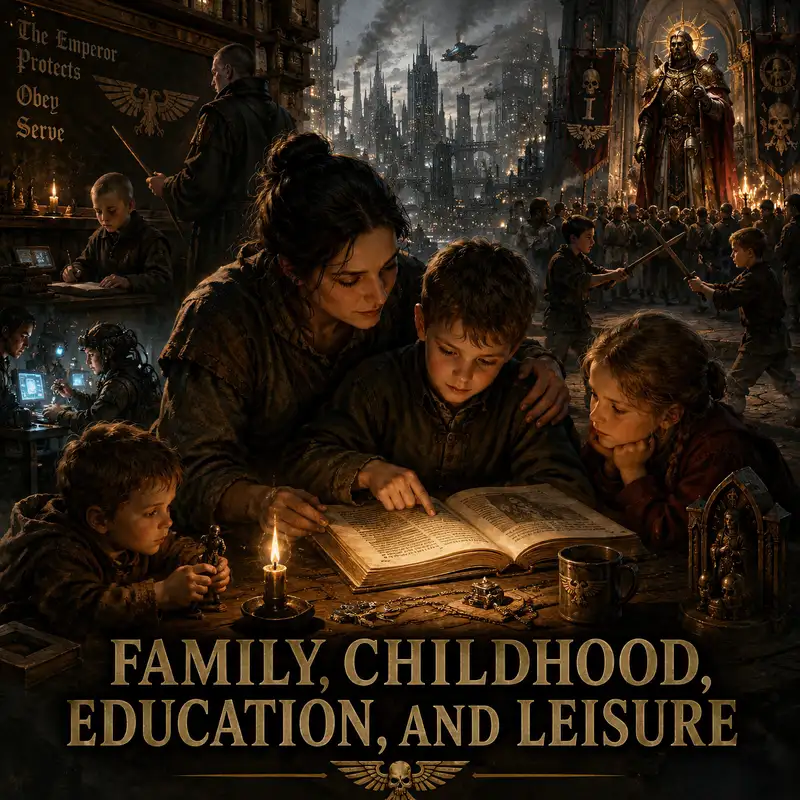
A child in the Imperium may learn the Emperor’s name before learning why the ceiling shakes. In a hive city, the vibration might come from machinery older than the family’s recorded history. Aboard a voidship, it could be a reactor adjustment, a weapons drill, or something the adults have agreed not to discuss until after supper. On a death world, there may be no ceiling at all, only the warning call of a predator beyond the firelight. Childhood exists across the Imperium, but it is not protected by one law, shaped by one school, or lived according to one pattern. It is local, class-bound, and often brief. The important question is not whether Imperial children have families, lessons, games, and dreams. They do. The question is how much of those things remains truly theirs once duty, faith, labour, and war begin making demands.
The Imperium is too vast, too slow, and too indifferent to standardise private life. It rules worlds separated by distance, time, culture, and sometimes several centuries of administrative confusion. At the highest level, it usually demands loyalty, tithes, obedience to Imperial law, and acceptance of the Emperor’s supremacy. Beneath that layer, planetary customs can differ almost beyond recognition. One world may organise society through noble houses. Another may rely on guilds, clans, tribes, corporations, temple estates, or hereditary workforces. A marriage blessed on one planet might be arranged very differently on another. A child regarded as an adult at thirteen in one culture might still be studying under tutors years later somewhere else. The Imperium does not need every household to look alike. It needs every household, eventually, to point upward toward authority.
That means there is no single Imperial family. There are small households crowded into hab units, extended families sharing work and rations, noble dynasties treating bloodlines as political weapons, and shipboard clans whose ancestors have served the same vessel for generations. On some worlds, family and profession are nearly the same thing. A mining family may belong to one guild, live in one district, worship at one shrine, and inherit the same hazardous trade. On others, kinship is less important than membership in a work cohort, gang, regiment, convent, or temple community. Even then, human beings tend to build families from whatever remains available. A squad may become a family. A gang may offer protection that relatives cannot. A crew may remember its dead more faithfully than any distant bureaucracy. The Imperium is very good at creating orphans. People are equally stubborn about finding new names for belonging.
It would be easy to imagine that affection has been erased by all this machinery, but the setting gives us little reason to believe it. Parents protect children. Siblings quarrel, compete, and grieve. Couples form attachments that may be tender, practical, political, or all three at once. Communities celebrate births, mourn deaths, preserve recipes, repeat jokes, and keep small heirlooms whose value would not impress an Administratum clerk. That ordinary humanity is not a soft exception to the darkness. It is what gives the darkness weight. A conscription order matters because someone is left at the door. A hive collapse matters because homes existed inside it. A planetary evacuation is not tragic merely because a population number declines. It is tragic because millions of private worlds vanish at once. The Imperium can count bodies with impressive dedication. It is less accomplished at counting what those bodies meant to one another.
The shape of childhood depends first on where a child is born and second on who their parents are. A noble child in an upper spire may have nurses, tutors, imported food, filtered air, and a future negotiated before they can read. A labourer’s child several kilometres below may grow up learning shift horns, ration queues, hazard symbols, and which corridor belongs to which gang. A child on an agri world may learn seasons, machinery, animal care, and the local rites that surround planting and harvest. On a feudal world, education may come through household duty, oral tradition, temple instruction, and apprenticeship. On a death world, survival itself becomes the curriculum. The forest, desert, swamp, or frozen waste corrects mistakes promptly and without an appeals process. None of these children experiences the same Imperium, though all may be taught that they serve the same divine ruler.
Hive worlds are often used as the picture of ordinary Imperial life because their populations are immense and their contrasts are brutal. Yet even a hive is not one continuous factory floor. It contains homes, markets, shrines, workshops, transport systems, drinking houses, criminal territories, and entire communities that may never see natural daylight. Families can remain in the same district for generations. Children learn local geography with the seriousness of military reconnaissance because one wrong stairwell may lead into another clan’s territory or into infrastructure that has not been safe since anyone kept reliable records. In places such as Necromunda, clan houses, guild families, gangs, traders, workers, and outcasts form overlapping layers of identity. Violence is common, but so are commerce, routine, neighbourhood loyalty, and ambition. The underhive is not empty chaos. It has rules. Most of them are simply enforced by people holding weapons.
Elsewhere, childhood has different pressures. On forge worlds, biological family may compete with the discipline of the work unit and the spiritual authority of the Adeptus Mechanicus. A promising child may be assessed for technical aptitude, while another is directed toward repetitive labour whose rituals are learned by sound and gesture. Aboard great voidships, children can grow up inside inherited occupations, deck traditions, emergency drills, and stories about compartments no sensible person enters alone. On shrine worlds, processions, relics, pilgrims, and religious commerce may dominate the calendar. Frontier families may depend on every available pair of hands. Feral and death world societies often teach through demonstration, memory, and ordeal rather than formal classrooms. These lives are harsh, but harsh does not mean disorganised. Each culture develops ways to transmit the knowledge needed to remain alive. The Imperium usually notices only when that knowledge stops producing soldiers, food, ore, faith, or tax revenue.
For many children, responsibility begins early. They carry messages, watch younger siblings, assist in workshops, sort materials, tend animals, clean machinery, or learn the family trade. On poorer worlds, the line between helping and labour may barely exist. Childhood ends when the household, guild, temple, or overseer decides the child is useful enough to be counted as an adult. Then larger institutions may intervene. A recruiting world can surrender adolescents to the Astra Militarum. A Space Marine Chapter may take promising youths for trials that few survive. The discovery of psychic ability can bring the Black Ships and a separation more absolute than death in any family record. War, industrial disaster, disease, and political purges create children without parents, while conscription and transportation create parents who will never return. The Imperium rarely describes this as breaking families. It prefers terms such as service, levy, necessity, and compliance.
The Schola Progenium is the famous exception that can be mistaken for the rule. It is not a universal school system and not a charitable orphanage for every abandoned child. Its academies take selected orphans of Imperial servants, officials, officers, and other valued families, then shape them through discipline, faith, and relentless training. From these institutions come commissars, Tempestus Scions, members of the Adepta Sororitas, administrators, clergy, and other servants expected to display exceptional loyalty. The Schola offers education, food, status, and a path into power, but it does so by replacing the lost parent with the Emperor and the household with the institution. Its graduates are taught that sacrifice is not an interruption of life. Sacrifice is life’s proper purpose. For the Imperium, this is considered an excellent educational outcome.
Most education is far less centralised. Some children attend local schools, temple classes, guild academies, noble colleges, or technical scholams. Others learn entirely through family instruction and apprenticeship. Literacy varies enormously. Low Gothic, in countless local forms, is the language of daily life across much of the Imperium. High Gothic belongs more often to ceremony, law, scholarship, senior administration, and people who enjoy making simple orders sound ancestral. A worker may recognise numbers, warning sigils, prayers, and machine instructions without being able to read an official decree. A scribe may possess extraordinary command of one bureaucratic register while knowing almost nothing outside it. Education is designed less to produce a broadly informed citizen than a reliable person fitted to a place. The Imperium does not ask what a child wishes to become until after it has decided what the child is needed for.
Faith is woven through that education, though its exact form changes from world to world. The Imperial Creed is flexible enough to absorb local festivals, ancestral customs, warrior traditions, and older myths, provided they can be redirected toward the Emperor and the accepted order of humanity. A solar deity may be reinterpreted as an image of the Emperor’s light. A legendary founder may become a saint or loyal servant. A harvest rite may continue beneath new prayers and new symbols. Children therefore learn both a local religion and an Imperial one, often without seeing any distinction between them. The essential lessons remain familiar. The Emperor protects. Humanity has a divinely ordered place. Authority deserves obedience. The alien is dangerous. The witch must be feared. The heretic threatens everyone. These teachings do more than explain the universe. They define which questions may safely be asked about it.
Imperial education is not simply ignorance dressed in robes. The Imperium requires competent medicae, pilots, navigators, engineers, logisticians, armourers, clerks, architects, and officers. Its problem is not that knowledge never exists. Its problem is that knowledge is guarded, divided, ritualised, and distributed according to rank. The Adeptus Mechanicus preserves enormous technical expertise while surrounding access with initiation, monopoly, and religious law. A child in a manufactorum may learn the correct sequence for restarting a pump without ever being taught why the sequence works. A guild apprentice may become highly skilled while remaining forbidden to inspect the secrets of another trade. A noble student may study strategy, history, rhetoric, genealogy, languages, and command, yet remain astonishingly ignorant of how ordinary people live. Everyone knows something. Very few are encouraged to know enough to challenge the structure that assigned it.
The result is an education system that sorts as much as it teaches. Aptitude, class, family influence, faith, physical ability, and simple luck determine which doors open. A gifted child born in the wrong district may never be noticed. A mediocre heir may receive the finest tutors available because dynasties are not famous for allowing merit to interfere with succession. Some institutions genuinely cultivate talent. Others refine obedience and call it excellence. Yet even within strict systems, teachers can care about students, apprentices can surpass masters, and curiosity can survive. The Imperium could not function without people who solve problems. It simply prefers them to solve approved problems inside approved boundaries. An officer may question a route, a scribe may question a calculation, and an enginseer may question a pressure reading. Questioning the social order that issued the route, demanded the calculation, or owns the machine is a more advanced course, usually followed by a short examination conducted by armed officials.
Leisure also survives, because no civilisation can run entirely on exhaustion and sermons. Even brutal work schedules include shift changes, rest periods, feast days, and moments stolen between obligations. Ordinary people drink, gamble, sing, dance, argue, court one another, watch pict entertainments, listen to stories, attend sporting contests, and gather in markets. Soldiers play cards and dice, trade rumours, write home when transport and censorship allow, and invent regimental traditions that make service bearable. Void crews tell stories about famous captains and unfortunate deckhands. Hive workers follow local fighters, racers, performers, or gang champions. Some entertainment is cheap and communal. Some is illicit. Some is dangerous enough that the distinction between recreation and casualty reporting becomes administrative rather than practical. Warhammer Crime’s view from the streets is useful here. The people of the Imperium are not abstractions waiting to be recruited into an army. They are ordinary people trying to get through a day.
Religion and leisure often overlap. A saint’s day can mean worship, spectacle, food, commerce, music, family gatherings, and a rare break from work. A pilgrimage can be an act of devotion and the only journey a person ever makes beyond their district. Processions turn streets into theatres of incense, banners, relics, uniforms, and controlled emotion. Authorities understand the value of such occasions. Festivals reinforce loyalty, approved stories provide approved heroes, and public punishment can be presented as moral instruction with refreshments available nearby. The Ecclesiarchy does not merely command belief. It gives communities a calendar, shared rituals, and language for grief and hope. That power is not entirely cynical, because many priests and worshippers are sincere. It is also not politically innocent. In the Imperium, the line between celebration and mobilisation is often one loud sermon wide.
Children play within these cultures, even when they have little. They turn scrap into toys, invent races through corridors, imitate soldiers, saints, workers, monsters, and local heroes, and transform dangerous places into temporary kingdoms. Games teach the rules adults have already accepted. A hive child may learn territory and loyalty through play. A noble child may learn command by ordering servants and competing with cousins. A voidborn child may know emergency routes before understanding the stars outside the hull. Stories told at bedtime or beside a workbench carry family memory, local prejudice, religious instruction, and warnings disguised as entertainment. Some of those stories preserve fragments older than the Imperium, though the names may have changed. Childhood imagination does not escape the culture around it. It rearranges that culture into something small enough to hold.
Leisure becomes more extravagant as wealth rises. Imperial nobles may enjoy banquets, private theatres, collections, duels, hunting, imported luxuries, and journeys to pleasure worlds whose beauty is maintained by labour kept carefully out of sight. Some use art and patronage to build genuine culture. Others treat boredom as a justification for cruelty. On Necromunda, wealthy Spyrers descend into the underhive in advanced hunting rigs to kill the poor for sport and status. It is an unusually direct expression of a wider Imperial habit. The lower classes gamble their wages on danger. The upper classes can gamble other people’s lives. Family is present here too, but as dynasty, inheritance, rivalry, and succession. A noble child may have every comfort and very little freedom, raised as an alliance, an heir, or a potential obstacle. Poverty can crush childhood through need. Wealth can crush it through expectation.
War eventually reaches into nearly every form of private life, even when no battlefield is visible. Tithes take food, goods, labour, and people. Regiments depart and may never see their home world again. Refugees arrive with customs that unsettle established communities. Veterans return altered, when they return at all. Rumours of invasion change games into drills and festivals into recruitment rallies. The appearance of a cult, an Inquisitorial investigation, or a planetary purge can turn neighbours against one another with remarkable speed. Yet families continue because they are among the few institutions capable of surviving below official notice. They hide food, pass down skills, arrange care, remember the missing, and create private loyalties stronger than distant law. This can make them stabilising. It can also make them suspicious. The Imperium values family when family produces obedient workers and soldiers. It becomes less sentimental when family loyalty competes with state loyalty.
So there is such a thing as a normal Imperial childhood, but there are millions of different normalities. Family is not abolished. Education is not limited to chanting. Leisure is not reserved entirely for the rich. People love, learn, celebrate, waste time, make mistakes, and tell stories in the shadow of institutions built for war. The defining cruelty is subtler than constant misery. Humanity is permitted, even required, because the Imperium needs populations that reproduce, work, remember, and endure. Yet every private joy is conditional. The household may remain intact until the levy arrives. The apprenticeship may continue until the factory changes quotas. The game may last until the sirens sound. The lesson may encourage curiosity until curiosity reaches the wrong subject. The Imperium allows people a life, then reminds them that the life was never fully theirs.
Somewhere in that immense realm, a child falls asleep beneath a ceiling that trembles. Beside the bed lies a toy cut from scrap, a saint’s token, or a tool they are not yet old enough to use. A parent says the machinery is ancient but dependable, the Emperor is watching, and tomorrow will be much like today. It is a small promise, repeated across hives, farms, ships, fortresses, and shrine cities. The Imperium survives because people keep making that promise. Its tragedy is how often the galaxy proves them wrong.