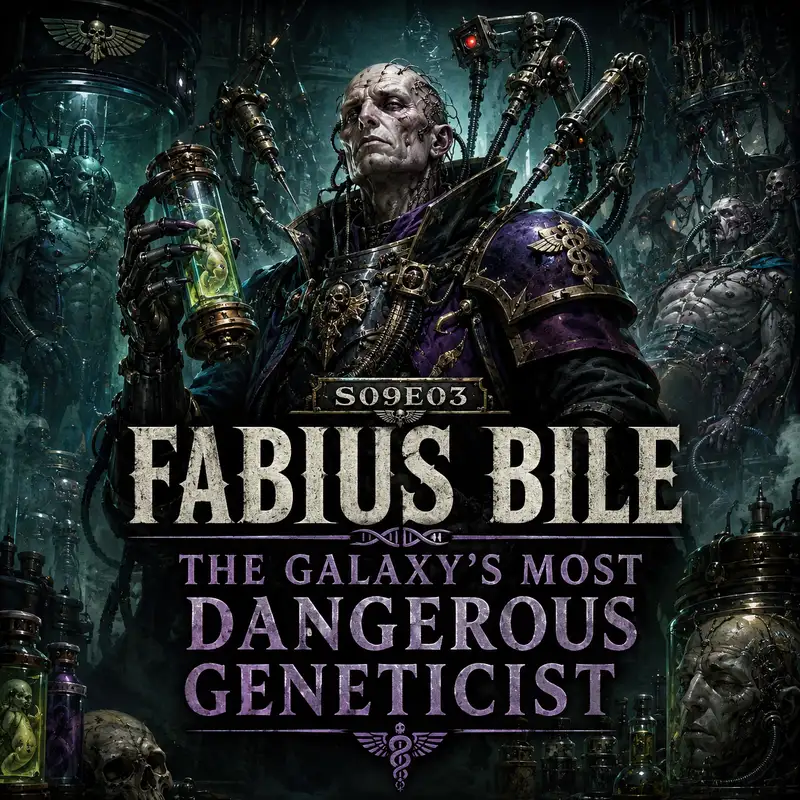
Fabius Bile: The Galaxy’s Most Dangerous Geneticist
The surgeon was dying again, and the instruments on his back continued working as though this were merely an inconvenience. Needles entered ruined flesh. Mechanical limbs opened fresh incisions. Servitors prepared another body nearby. Fabius Bile had endured this scene in one form or another for thousands of years, because his greatest experiment had always included himself. He was a Space Marine whose altered biology was failing, a physician who treated death as a technical defect, and a traitor who believed the gods of Chaos were no more worthy of worship than a fever. In a galaxy crowded with planet killers, daemon princes, and ancient machines, that may not sound especially alarming. Yet Fabius is dangerous for a reason many warlords never understand. He does not merely kill what exists. He tries to decide what deserves to exist next.
Long before he became the Clonelord or the Manflayer, Fabius was an Apothecary of the Third Legion, the Emperor’s Children. An Apothecary is more than a battlefield medic. He maintains the biological inheritance of a Space Marine force, recovers gene-seed from the dead, and preserves the chain by which new warriors can be created. That work demands discipline, secrecy, and a certain comfort with opening one’s comrades after they have stopped objecting. The early Emperor’s Children also suffered a terrible genetic blight that reduced their numbers and threatened the Legion’s survival. Fabius devoted himself to studying that failure. The experience taught him a lesson he never abandoned: flesh was not sacred. Flesh was a system, systems could be repaired, and anything that could be repaired could also be improved. The Legion’s survival made experimentation feel like duty, and duty is an excellent solvent for moral hesitation. The same habits that saved lives would later make atrocities efficient.
When the Emperor’s Children were reunited with their primarch, Fulgrim, they found a leader obsessed with perfection. At first, this ideal could sound almost noble. Fulgrim wanted his sons to master war, art, discipline, and culture. Fabius supplied the biological version of the same promise. If training could sharpen a warrior, surgery might sharpen him further. If the human form contained weaknesses, those weaknesses could be removed. The distinction between healing and redesign began to collapse. By the final years of the Great Crusade, Fabius had risen to become the Legion’s Chief Apothecary, and his skill gave him access to wounded bodies, gene-seed stores, and the confidence of commanders. The Legion saw a gifted physician. What it possessed was a man learning that authority often arrives disguised as expertise. Fulgrim rewarded results and viewed limitation as an insult. Fabius learned that an ambitious patron rarely asks how a miracle was achieved until the miracle begins screaming.
The Horus Heresy removed the remaining restraints. Fulgrim and his Legion turned against the Imperium, while their pursuit of excellence decayed into the worship of sensation and excess. Fabius did not simply follow that descent. He interpreted it. Where many Emperor’s Children sought stronger experiences, more exquisite pain, or louder forms of war, Fabius sought control over the machinery that produced sensation in the first place. Nerves could be rerouted. Organs could be replaced. Hormones could be altered. A warrior’s body could become a laboratory in power armour. Some of his brothers welcomed the changes because they promised advantage. Others accepted them because refusing the Chief Apothecary while lying on his table required unusual confidence and excellent timing. The battlefield gave Fabius subjects, and treason gave him permission.
His work during and after the Heresy showed that he was not limited to improving ordinary warriors. Fabius studied the genetic architecture of the primarchs, beings created by the Emperor through sciences that had become almost mythical even before the Imperium began forgetting how its own machines worked. He produced clones of primarchs, including copies of Ferrus Manus for Fulgrim. The achievement was staggering. The result was also a lesson in the limits of manufacture. A copied body could carry familiar strength, appearance, and instinct, yet it did not become obedient merely because its creator expected gratitude. Fulgrim wanted a brother restored on his own terms. The clones remained themselves enough to refuse him, and they died for it. Fabius learned that creation did not guarantee ownership. Character was not a switch hidden behind the ribs.
After the Traitor Legions fled into the Eye of Terror, the Emperor’s Children shattered into rival warbands. Fabius became a renegade among renegades. Even Chaos Space Marines who decorated their armour with human remains could find his laboratories excessive, which is a demanding professional standard. They despised him, feared him, and still needed him. He could repair corrupted gene-seed, create new warriors, restore damaged champions, and provide biological weapons or enhancements that no conventional Apothecary would consider. Fabius traded his services for rare specimens, protection, equipment, and access. He did not need to command a Legion. Every warlord who purchased his work extended his influence, and every student who learned part of his craft carried a fragment of his method elsewhere.
The bargains spread more than equipment. A champion altered by Fabius might found a warband whose recruitment depended on his procedures. A cache of treated gene-seed could sustain a force that should have dwindled into extinction. A tailored organism could escape the campaign for which it was designed and become a problem for people who had never heard of its maker. Fabius understood that biology multiplies. A bolter round destroys one target and is then spent. A viable bloodline, pathogen, or method can cross generations. This allowed him to turn isolated commissions into long consequences. His clients usually wanted an immediate advantage. Fabius watched for what the bargain allowed him to test, recover, or seed elsewhere. The warlord believed he had purchased a weapon. The geneticist had purchased a field trial.
His own failing body made that method urgent. The ancient blight that haunted the Emperor’s Children had never truly released him. Tumours, degeneration, and age repeatedly consumed the bodies he inhabited. The spider-like Chirurgeon mounted across his back cut, injected, sampled, and sustained him while he worked. Replacement bodies offered another answer. Fabius cultivated clones and transferred his memories, knowledge, or identity into prepared flesh. The precise nature of continuity in these transfers is deliberately uncomfortable. Whether each body is the same man, a faithful successor, or one more experiment convinced it is Fabius may not have a clean answer. From a military perspective, the distinction is less comforting than philosophers might hope. Killing him could remove a body without removing the project.
This is the first reason Fabius is so dangerous. He made himself difficult to reduce to a single target. Most tyrants build a fortress, a fleet, or a chain of command. Destroy the centre and the system may collapse. Fabius built laboratories, disciples, cloned vessels, hidden archives, and independent lines of research. His followers formed a loose network often called the Consortium, drawing Apothecaries and flesh-workers from different Traitor Legions. They competed, betrayed one another, and pursued private ambitions, but they also preserved knowledge outside Imperial control. It was a scientific community in roughly the same sense that a nest of scorpions is a cooperative housing project. Unpleasant, unstable, and surprisingly difficult to eradicate.
The second reason is that Fabius does not regard Space Marines as the final form of humanity. To him, the Legions are magnificent weapons but evolutionary failures. They are sterile, dependent upon complex implantation, and tied to the genetic legacy of the primarchs. They cannot become a self-sustaining species. Fabius wants something that can. His Homo Novus, commonly called the New Men, are engineered humans designed to survive the galaxy that humanity has created. Different strains possess enhanced strength, speed, senses, aggression, resilience, and intelligence. The Gland Hounds among them are pack hunters capable of bringing down prey far stronger than an ordinary human. Their real advantage, however, is not a single dramatic mutation. It is that they can learn, cooperate, reproduce, and pass their altered inheritance forward.
That goal separates Fabius from the common image of a mad scientist producing monsters for amusement. He certainly produces monsters, and amusement occasionally appears to survive the procedure, but his central project is ideological. He believes baseline humanity is too weak for the future and that the Imperium has mistaken preservation for survival. The Imperium tries to hold humanity in a sacred form inherited from the past. Fabius intends to replace it with a form capable of inheriting the future. He does not ask permission because he regards consent, law, and morality as sentimental obstacles imposed by inferior minds. A population is material. A generation is a trial. Suffering is data. When the experiment fails, he does not see victims. He sees a result that narrows the next set of choices.
The New Men also reveal the contradiction at the centre of their creator. Fabius says he wants them to surpass humanity, yet he engineers their bodies, guides their cultures, selects their environments, and judges their worth. He claims to free them from old masters while making himself their father. Some call him Pater Mutatis, the Father of Mutants. The title contains both reverence and accusation. He wants children strong enough to escape every cage, including his own, but he repeatedly reaches for the bars when they choose a direction he dislikes. This is not a small inconsistency. It is the familiar problem of every ruler who insists that freedom will begin immediately after everyone learns to obey the correct person.
Nothing exposes that problem more clearly than the clone of Fulgrim. Among Fabius’s surviving works was a clone of his primarch, restored not as the serpentine daemon Fulgrim had become, but in the beautiful form of the Legion’s earlier father. The clone possessed the presence that made primarchs more than large warriors. People looked at him and wanted to follow. The New Men responded to him. Emperor’s Children saw the possibility of a Legion reborn. For a moment, Fabius appeared to hold a second chance in his hands: Fulgrim without ten thousand years of corruption, a genetic masterpiece who might restore what had been lost.
Fabius rejected that possibility. He saw pride growing in the clone and recognised the same gravitational pull that had once drawn the Emperor’s Children into disaster. More importantly, the clone threatened to turn the New Men into servants of another primarch. Fabius had built them to replace the old order, not kneel before its most beautiful survivor. On the Necron world of Solemnace, he surrendered the clone to Trazyn the Infinite in exchange for a cache of pure Emperor’s Children gene-seed. It was a cruel decision, though cruelty had long ceased to trouble him. He gave away a living son to a collector’s vault because the son might become a rival idea. Fabius could create a primarch’s body. He could not tolerate losing control of the story that body would tell.
The exchange also shows his practical genius. Trazyn is an ancient Necron collector who preserves people, armies, relics, and entire moments of history inside vast galleries. Bargaining with him is rather like negotiating museum access with a monarch who considers visitors part of the exhibition. Fabius survived the encounter and gained material that could support enormous new projects. He understood when to abandon a wonder in order to acquire a resource. That cold flexibility makes him more dangerous than a fanatic. Fanatics may die for symbols. Fabius will dissect the symbol, sell the remains, and use the proceeds to fund the next experiment.
His search for knowledge eventually carried him into Commorragh, the hidden city of the Drukhari. Their Haemonculi are masters of fleshcraft who treat anatomy as art, punishment, entertainment, and industry. They can reshape bodies into grotesque forms, preserve life through torments that make death seem charitable, and restore the wealthy from carefully retained remains. Fabius entered their world because human and Space Marine science could no longer teach him enough. He studied under the Coven of the Thirteen Scars, learning techniques from creatures who had refined cruelty across ages. He then escaped, taking what he had learned with him. His hosts did not regard this as an encouraging example of academic exchange.
The Haemonculi pursued him, and their vengeance threatened the New Men themselves. This conflict mattered because Fabius could replace laboratories, bodies, and servants, but the long development of his engineered populations could not be recreated quickly. For perhaps the first time, his enemies found something he valued beyond his own continuation. He gathered allies he disliked, appealed to former brothers he distrusted, and used every reserve of cunning he possessed. When those measures proved insufficient, he confronted the power he had spent millennia dismissing. Fabius had insisted that the Chaos Gods were vast warp phenomena rather than true deities. That distinction may satisfy an atheist during a lecture. It becomes less sturdy when the phenomenon knows your name.
To preserve the future of the New Men, Fabius was willing to sacrifice himself, bargain with Fulgrim, and accept obligations he had long denied. Accounts of his identity become especially tangled after this point because his bodies, copies, memories, and creations no longer fit neatly into one biography. That confusion serves the story. Fabius wanted to defeat death through replication, but replication makes the word self increasingly difficult to defend. A copied scientist may continue the work perfectly while becoming something the original would have considered a tool. His victory over mortality therefore resembles many victories in the forty-first millennium. It functions, it is horrifying, and the invoice remains open.
The New Men survive in scattered populations, sometimes hidden within human societies and sometimes building cultures of their own. Their exact numbers and locations are uncertain, which is part of the danger. An army can be seen by orbital augurs. A species can disappear into birth records, frontier settlements, slave populations, pilgrim fleets, and underhives. Fabius does not need every experiment to flourish. He needs enough of them to endure long enough for selection, adaptation, and inheritance to continue the work without him. The Imperium is prepared to fight invasions. It is much less capable of recognising that the people living inside one of its worlds may no longer be quite the humanity its laws were written to govern.
Fabius remains active in the era after the Great Rift, still pursuing knowledge and still placing himself where the galaxy’s rarest secrets can be stolen. His confrontation with Belisarius Cawl is revealing because Cawl is one of the few minds who can meet him on comparable ground. Both are ancient, brilliant, difficult to kill, willing to violate accepted limits, and convinced that humanity’s survival justifies decisions lesser minds cannot be trusted to make. Cawl works, however imperfectly, within the Imperium and seeks to preserve it. Fabius owes allegiance only to his vision. When he intrudes upon Cawl’s gathering at Pontus Avernes, where Imperial thinkers study the Necron pylon network and the Great Rift, he behaves as he always has. Every crisis is also an unlocked laboratory door.
Calling Fabius the galaxy’s most dangerous geneticist does not require declaring him the wisest scientist alive. Others possess knowledge he lacks. The Emperor created the primarchs. Cawl transformed the armies of the Imperium. The Haemonculi can perform acts of fleshcraft that appear supernatural. What distinguishes Fabius is the combination of brilliance, mobility, patience, and moral emptiness. He will work with Chaos warlords, steal from Necrons, learn from Drukhari, infiltrate Imperial projects, and sacrifice his own creations when they threaten the larger design. He is not confined by faction, tradition, species, or a need to be loved. Even his hatred of religion does not prevent him from bargaining with gods when the experiment demands it.
His greatest weapon is therefore not the Chirurgeon, a plague, a clone, or a vat-grown soldier. It is the idea that humanity is unfinished material and that he alone has earned the right to edit it. That idea can survive a destroyed laboratory. It can survive a dead body. It can survive inside students, copies, hidden populations, and descendants who may never know the name of the hand that shaped them. Abaddon can break worlds. Tyranids can consume them. Fabius Bile wants to ensure that whatever walks from the ruins carries his design in its blood.
That is why the dying surgeon is more dangerous than he first appears. Every replacement body proves that death has failed to stop the work, but immortality was never the true objective. Fabius has spent ten thousand years trying to make himself unnecessary. If the New Men become strong enough to inherit the galaxy, then his laboratories may vanish, his enemies may finally kill every body bearing his face, and his name may be forgotten. The experiment would still be alive. The most frightening future Fabius Bile can create is not one in which he rules humanity forever. It is one in which humanity is gone, his children believe they evolved on their own, and no one remains who remembers there was ever another design.