Ethereals, the Greater Good, and the Farsight Enclaves
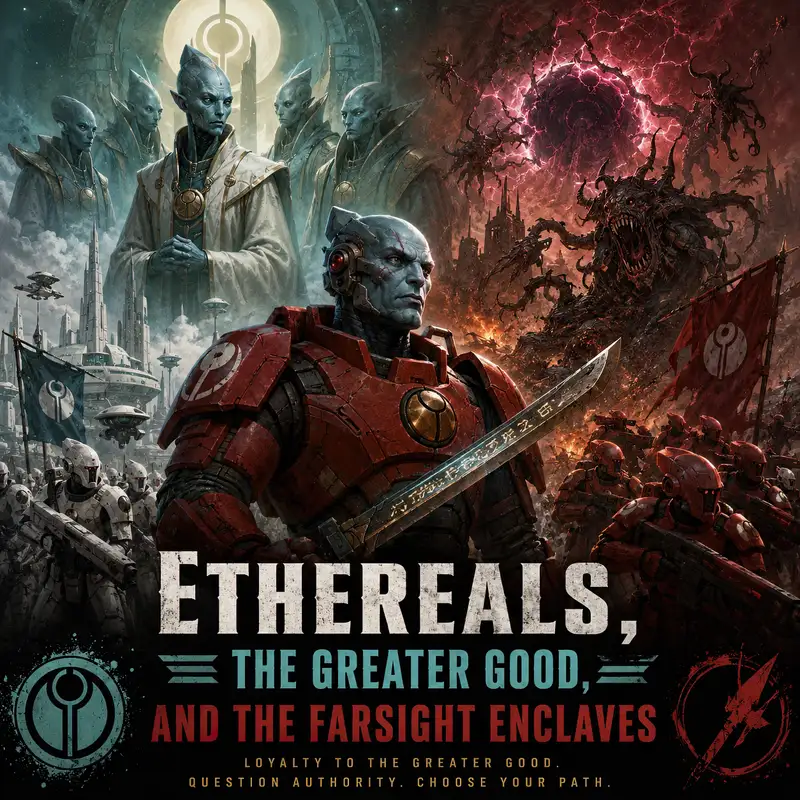
On Arthas Moloch, the commanders of the T’au expedition discovered what their civilisation looked like without an Ethereal standing at its centre. The answer arrived in blood. Creatures no T’au doctrine could adequately name poured from a wound in reality. The Ethereals accompanying the expedition were killed. Commander Farsight survived, found an ancient blade, and helped seal the breach. When the firing stopped, his warriors did not collapse into madness or turn upon one another. They regrouped, obeyed orders, treated their wounded, and prepared for the next attack. The Greater Good had not vanished with its appointed guardians. That quiet fact was more dangerous to the T’au Empire than the daemons had been.
The question raised by Farsight’s rebellion is often reduced to a comfortable choice. Either the Ethereals are wise shepherds and Farsight is a proud traitor, or the Ethereals are tyrants and Farsight is the lone T’au who saw through them. The surviving accounts support neither simple version. The Ethereals helped rescue the T’au from self-destruction, then built a political order that claimed the right to define truth. Farsight rejected that right, yet continued to fight for the people and principles that order had shaped. His Enclaves did not abandon the Greater Good. They forced a far more unsettling question. Does the Greater Good belong to the T’au people, or to the rulers who speak in its name?
Long before the T’au possessed starships, battlesuits, or diplomatic missions backed by railguns, their home world was divided by violent conflict. Different peoples had adapted to different environments and ways of life. Some built and cultivated. Some traded. Some ranged through the skies. Others made war. T’au tradition remembers this era as the Mont’au, the time of terror, when rivalry threatened to consume a young species advancing faster than its wisdom. The future castes were already emerging, but they were not yet parts of a harmonious whole. They were competitors with increasingly effective weapons, which is one of history’s less encouraging combinations.
According to T’au legend, the Ethereals appeared during this crisis and persuaded bitter enemies to meet, listen, and accept a shared destiny. Their arrival is described with the reverence normally reserved for miracles. They did not conquer the warring peoples with armies. They spoke, and conflict gave way to unity. Whether every detail of that founding story is literal cannot be known. It has been repeated for generations by a state whose leaders supervise education, public memory, and official history. Yet something extraordinary did occur. The wars ended. The T’au reorganised their civilisation around cooperation, specialisation, and a new idea called the T’au’va, the Greater Good.
The Greater Good is not merely kindness, and it is not quite a religion in the conventional human sense. It is a claim about purpose. Every person, community, and allied species is expected to contribute according to its abilities, while accepting that individual desire must yield to collective survival. The Earth caste builds and invents. The Air caste travels and pilots. The Water caste negotiates, administers, and persuades. The Fire caste defends the whole and carries its expansion outward. Above them stand the Ethereals, presented not as one more profession, but as impartial guides capable of balancing every part. In theory, no caste exists for itself. Each becomes meaningful through service to all.
There is genuine strength in that idea. T’au society produces education, public order, technological progress, and coordinated action on a scale that many Imperial worlds would regard as suspiciously luxurious. A Fire Warrior is not normally sent into battle because a distant noble wishes to decorate a family chronicle. T’au commanders value mobility, preparation, and the preservation of lives. Their diplomats can offer conquered populations a future better than the one they had, especially when the previous administration measured civic responsibility in tithes, executions, and inspirational skulls. The Greater Good works because it asks people to believe that sacrifice serves a visible purpose rather than merely feeding an ancient machine.
It also contains a blade beneath the open hand. The T’au Empire expands because it believes the Greater Good should be universal. Worlds may enter through negotiation, trade, political pressure, or patient cultural influence. Those who refuse can meet the Fire caste. The offer is sincere, but it is rarely made between equals. A species may retain customs and local leaders, yet the direction of history has already been decided for it. The T’au do not usually seek extermination when integration will do. That is a meaningful distinction in the forty-first millennium. It is not the same thing as freedom.
For those invited into the Empire, the Greater Good can be both shelter and surrender. Kroot, Vespid, humans, and other peoples may gain trade, technology, military protection, and a place within a larger political order. They may also discover that the T’au have already assigned the meaning of that place. Difference is welcomed when it can be made useful. Resistance is treated less as an alternative political choice than as evidence that the resisting culture has not yet understood its own interests. The system is more flexible than Imperial xenophobia and more paternal than its diplomats admit. It can save a population from annihilation while quietly ensuring that the rescued population never controls the terms of rescue.
The Ethereals make this system possible because they are more than administrators. They are living symbols of unity. Their presence can steady frightened warriors and end disputes that might otherwise divide a coalition. They think in generations, coordinate expansion across many worlds, and claim no narrow caste interest. Many T’au obey them not because a weapon is pointed at their backs, but because their entire history teaches that the Ethereals ended the Mont’au. To question an Ethereal is therefore not like questioning a general or governor. It is to question the event that made civilisation possible.
That reverence is strengthened by uncertainty. Ethereals exercise an influence over other T’au that outsiders find difficult to explain. Imperial investigators have proposed pheromones, psychic effects, biological manipulation, and several theories that reveal more about Imperial anxieties than T’au anatomy. The precise mechanism remains unsettled. What is clear is that Ethereal authority combines personal presence, social conditioning, control of information, and a political culture that treats obedience as moral maturity. A mysterious biological influence may exist, but it is not required to explain everything. Institutions can be remarkably effective without invisible mind-control particles. They generally prefer stationery.
Control of truth matters more than any single theory. The Ethereals decide what dangers the population is prepared to understand. Knowledge of the warp, daemons, and the predatory powers behind them has often been restricted or softened. Defeats can be reframed. Dissidents can disappear from the public story. Even the death of Ethereal Supreme Aun’va was concealed, his image continued through a holographic projection and artificial personality so that the Empire would not face the shock of his loss. The official argument is stability. The darker interpretation is that a society devoted to the Greater Good is not trusted to survive an inconvenient fact.
Farsight was produced by this civilisation, not born outside it. He came from Vior’la, a sept known for the fierce temperament of its Fire caste, and rose through discipline, talent, and an appetite for decisive action. Under the legendary Commander Puretide, he studied the military philosophy called Mont’ka, the Killing Blow. Mont’ka seeks the critical point where a sudden, concentrated strike can break an enemy before a longer struggle begins. Farsight understood it instinctively. He was not simply aggressive. He could read momentum, identify weakness, and commit at the moment when caution became more dangerous than attack.
His independence was useful while it produced victories. During the Damocles Gulf Crusade, when Imperial forces drove into T’au space, Farsight became one of the commanders responsible for resisting an enemy far older, larger, and more brutal than anything his people had expected. The campaign taught the T’au that the galaxy was not waiting to be persuaded. It taught Farsight that doctrine written in safety could fail under pressure, and that distant authorities did not always understand the battlefield they were directing. He remained a servant of the Greater Good, but increasingly trusted observed reality over approved expectation.
After the Imperial withdrawal, Farsight led an expedition to reclaim lost colonies and secure the frontier. The campaign was successful, then continued beyond the limits preferred by the Ethereals. Ork forces drew him farther outward. From the Empire’s perspective, the expedition was becoming dangerously independent. From Farsight’s perspective, leaving a recurring enemy alive because the timetable said the operation was complete made little military sense. Both positions had logic. Only one was held by the commander whose troops were being shot at.
The pursuit ended at Arthas Moloch, a dead world carrying secrets from a civilisation the T’au did not understand. There, Farsight’s forces encountered daemons. To the T’au, these were not the familiar enemies of an ancient religious war. They were impossible organisms appearing without a rational chain of cause and effect. The Ethereals attached to the expedition died in the assault. Farsight discovered a strange talisman and the weapon later known as the Dawn Blade, using them in the struggle to close the portal. He survived the battle, but the universe he thought he inhabited did not.
Arthas Moloch revealed two concealed truths at once. The first was that reality contained powers the Ethereals had not prepared their people to face. The second was that the expedition could continue after the Ethereals were gone. Farsight had seen the respect his people gave their rulers, and he had begun to suspect that respect was not entirely voluntary. Later accounts suggest he believed the Ethereal caste controlled other T’au through more than wisdom and charisma. Whether he understood the mechanism is less important than the conclusion he drew. The Ethereals were not simply guiding the Greater Good. They had made themselves indispensable to its definition.
The Dawn Blade added another contradiction. It is an ancient alien weapon, vastly older than the civilisation of the T’au, and it appears to prolong Farsight’s life through the energies of those he kills. He has lived for centuries, an impossible span for an ordinary T’au, while remaining uncertain about the blade’s full nature and purpose. The rebel who rejected hidden authority carries a weapon he does not truly understand. In a more forgiving galaxy, this might qualify as irony. In the forty-first millennium, it is closer to standard equipment.
Farsight did not return obediently to the Empire. He consolidated the worlds beyond the Damocles Gulf, fortified them, and established what became known as the Farsight Enclaves. The Ethereals declared him a renegade and transformed his story into a warning about pride. His victories could not be erased, so they were reinterpreted. He had once been a model of service. Now he became proof that even a hero could fall by placing personal judgement above the Greater Good. The state did not need to deny his courage. It only needed to redefine courage without obedience as selfishness.
The Enclaves are sometimes imagined as a clean escape from T’au authoritarianism. They are not. They contain members of the traditional castes, alien allies, and human communities, but no accepted Ethereal leadership. Some occupations and responsibilities are more flexible than in the Empire. Farsight’s inner circle, the Eight, even includes an Earth caste scientist who takes the field in a battlesuit and an artificial intelligence counted among the company. Such arrangements would make an orthodox administrator reach for several forms, followed by a security team.
Yet the Enclaves are frontier states built under siege and shaped by the Fire caste. Military command has enormous influence. Their culture honours readiness, sacrifice, and the example of Farsight. Local councils and collective leadership exist, but they do so beneath the shadow of a legendary commander who has survived for centuries and repeatedly returned when catastrophe threatened. Removing the Ethereals did not remove hierarchy, propaganda, or the pressure to conform. It changed who could claim authority and how openly that authority might be challenged.
Farsight himself is not a simple champion of individual liberty. He believes in duty, discipline, and sacrifice. The Enclaves preserve the language and moral framework of the Greater Good, even while rejecting the caste that once claimed sole custody of it. Their citizens still understand themselves as parts of a collective project. They still fight expansionist wars, defend allied populations, and expect service from those under their protection. The difference is not that the individual has become supreme. The difference is that the Ethereals are no longer treated as the necessary voice of the whole.
This distinction explains why Farsight can oppose the Empire and still return to aid it. When T’au worlds faced destruction, he did not insist that ideological purity mattered more than survival. He fought beside forces that officially regarded him as a traitor. He could reject Aun’va and still defend ordinary T’au citizens. That is not inconsistency. It is the central principle of his rebellion. Farsight separates loyalty to a people from obedience to their government, a distinction the Ethereals cannot safely permit because their authority depends upon presenting those loyalties as identical.
His former comrade Shadowsun embodies the other path. She also studied under Puretide, but mastered patience, preparation, and the doctrine of Kauyon, the Patient Hunter. Shadowsun works within Ethereal command even when experience forces her to confront truths her society would rather avoid. Farsight breaks from the structure and accepts the isolation that follows. Neither is ignorant. Neither is entirely free. Their divide is not between courage and cowardice, or truth and blindness. It is between two answers to the same crisis. Can a flawed system be defended and corrected from within, or does obedience make correction impossible?
The Ethereals have their own answer. Without unity, they warn, the T’au could return to the Mont’au. The galaxy provides abundant evidence that division is fatal. Orks gather beyond the frontier. Tyranid fleets consume entire worlds. The Imperium answers independence with crusades. Chaos turns private ambition into a doorway. From this perspective, secrecy and discipline are not luxuries of power but defensive measures for a small empire surrounded by horrors. The Ethereals may sincerely believe that truth must sometimes be rationed because panic can kill as efficiently as any weapon.
That defence cannot erase the cost. A society protected from dangerous knowledge is also prevented from judging its leaders. A citizen taught that every order serves the Greater Good has no authorised language for recognising abuse committed in its name. The Ethereals ask the T’au to trust that hidden decisions are necessary. Farsight’s life demonstrates why that trust can fail. He encountered a threat the official worldview could not explain, lost leaders whose authority had seemed essential, and watched his people continue without them. Once seen, that evidence could not be placed politely back inside the archive.
The Enclaves offer an answer, but not a final solution. They show that T’au cooperation can survive without Ethereals. They also show how easily liberation can become militarisation. Farsight gives his followers more room to stand on their own, yet his example dominates their society. He rejects manipulation, yet carries an alien blade that feeds a life far longer than nature intended. He resists Chaos, yet his fury and talent for close violence repeatedly draw the attention of powers that value both. Freedom from one form of control does not make a person immune to every other.
This is why the Greater Good remains the true centre of the conflict. If it were merely an Ethereal invention, it should have died in the Enclaves. It did not. Farsight and his followers retained its deepest promise, that survival depends upon coordinated service and that strength exists to protect more than the self. What they rejected was the claim that one caste alone could interpret that promise. The rebellion therefore weakens Ethereal legitimacy while demonstrating the durability of the idea they govern.
The Ethereals are neither unnecessary frauds nor unquestionable saviours. They ended an age of ruin, created institutions capable of remarkable achievement, and bound several peoples into a shared project. They also concentrated power, curated truth, and treated dissent as a disease of character. Farsight is neither a fallen egotist nor a spotless liberator. He exposed the difference between principle and authority, then built a society marked by his own military values and immense personal legend. Each side sees the danger in the other more clearly than it sees the danger in itself.
Somewhere along the eastern fringe, two T’au forces may answer the same distress call. One will arrive beneath the authority of the Ethereals, disciplined by doctrine and assured that unity is survival. The other may come in the red armour of the Enclaves, led by warriors officially condemned but unwilling to abandon those in danger. Both will coordinate their fire. Both will sacrifice for their comrades. Both may speak of the Greater Good. The schism endures because the words still unite them, while the question of who owns those words may never be peacefully settled.