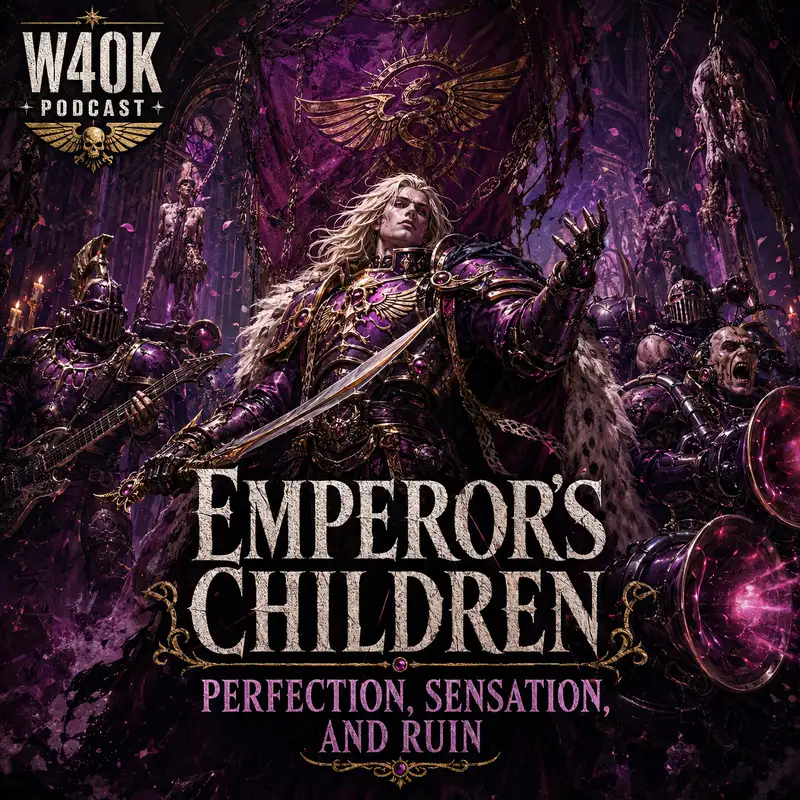
Emperor’s Children: Perfection, Sensation, and Ruin
Once, the Emperor’s Children were the only Space Marine Legion permitted to bear the Emperor’s own Palatine Aquila. Ten thousand years later, their descendants go to war amid narcotic incense, flayed banners, shrieking voices, and weapons that turn sound into physical ruin. Between those two images lies one of the most complete collapses in Imperial history. The Legion did not begin as a mob of pleasure-seekers. It began as a disciplined brotherhood convinced that service demanded perfection. The tragedy is that they never stopped pursuing it.
The central question is not simply why the Emperor’s Children fell to Slaanesh. Chaos can tempt the proud, the desperate, the angry, and the frightened in countless ways. The more revealing question is how a sincere desire for excellence became an appetite that could never be satisfied. Why did craftsmanship become vanity, discipline become obsession, and art become a weapon? The answer begins with a Legion that learned very early that being merely good might not be enough to survive.
Before Fulgrim was found, his warriors were known only as the Third Legion. During the early Great Crusade, they fought beside the Emperor during the Proximan Betrayal and suffered terribly while defending him. Their loyalty earned an honour granted to no other Legion. They were permitted to carry the Palatine Aquila, the Emperor’s own personal eagle, as a symbol of their service. It was not decoration. It was a public declaration that these warriors had been judged worthy by the master of mankind himself.
Then disaster nearly erased them. A series of calamities destroyed much of the Third Legion’s gene-seed reserve. Without a healthy supply of the organs required to create new Space Marines, the Legion began to wither. Other Legions expanded into armies of tens of thousands. The Third dwindled toward extinction. Every warrior lost was difficult to replace, and every survivor carried the burden of representing a force that might soon exist only in memorial records.
That crisis shaped their culture. If the Legion could not be numerous, then each warrior would have to be exceptional. Training became relentless. Equipment was maintained with exacting care. Officers were expected to master not only their own duties, but the methods of rival formations. A weakness was not merely inconvenient. It threatened the survival of the whole brotherhood. Perfection, at this stage, was not vanity. It was a practical answer to approaching extinction.
Fulgrim’s discovery appeared to solve both the biological crisis and the deeper crisis of identity. He had grown to maturity on Chemos, an exhausted industrial world where resources were failing and human life had narrowed into labour, rationing, and slow decline. Fulgrim did not save Chemos through brute strength alone. He repaired systems, reorganised production, improved what others had accepted as permanently broken, and taught a dying society to imagine more than survival. On Chemos, beauty was not a luxury. It was evidence that life could become something better.
When Fulgrim met the remnants of his Legion, he saw warriors who had refused to disappear. They saw in him everything they had been trying to become. He was graceful, brilliant, inventive, and almost impossibly capable. His arrival allowed the Legion’s gene-seed stocks to be rebuilt, and recruits from Chemos began to fill its ranks. The Emperor confirmed the name that would define them. They were the Emperor’s Children, not because they were his literal offspring, but because they were intended to serve as his chosen exemplars.
The name carried inspiration and danger in equal measure. To bear the Emperor’s eagle was to be honoured. To call oneself his child was to accept an impossible comparison. The Emperor’s Children did not merely want to win wars. They wanted every victory to demonstrate that they deserved the distinction placed upon them. Their armour became ornate, their ceremonies formal, and their standards severe. They cultivated music, sculpture, poetry, philosophy, and craftsmanship alongside the arts of war. They believed conquest should create civilisation, and that a warrior could be more than a weapon.
This was not empty posing. Before the Heresy, the Emperor’s Children were an outstanding military force. They studied the strengths of other Legions, absorbed useful methods, and refined them. They valued speed, precise manoeuvre, disciplined assault, and the careful matching of each warrior to a role. Their commanders planned operations in detail, and their formations could be both elegant and brutally effective. They were admired because they had earned admiration.
Yet their excellence contained a flaw. Achievement became meaningful only when measured against someone else. If another Legion performed better, the Emperor’s Children saw a challenge and an insult. If they surpassed a rival, pride quickly became contempt. A past victory offered little comfort because yesterday’s perfection was already obsolete. The standard always moved farther away.
That distinction matters. Excellence is a practice. Identity is something people defend. Once the Emperor’s Children made perfection the proof of their worth, every mistake became humiliation. Criticism became an attack. Restraint could look like cowardice. Refusing an enhancement could look like choosing mediocrity. The Legion’s culture began to reward not simply skill, but visible superiority.
Fulgrim carried the same contradiction. He was not born a monster, and his fall loses much of its meaning if it is treated as inevitable. He could be generous, loyal, and genuinely committed to the betterment of humanity. He formed a deep friendship with Ferrus Manus, Primarch of the Iron Hands. The two brothers were very different in manner, but both believed that weakness should be overcome through effort. Each forged a weapon for the other. Their friendship was built on admiration, competition, and the belief that one strong brother could sharpen another.
Fulgrim also grew close to Horus. The Emperor’s Children had spent years fighting beside the Luna Wolves while their own numbers recovered, and Horus became a mentor as well as a brother. That bond would later make Fulgrim vulnerable. When Horus turned against the Emperor, Fulgrim was not listening to a stranger. He was listening to someone whose approval had helped define his place in the Great Crusade.
The decisive acceleration came during the war against the Laer. The Laer were a formidable alien civilisation whose bodies had been deliberately altered for specialised roles. Their society presented a distorted reflection of everything the Emperor’s Children admired. The Laer pursued physical adaptation, aesthetic experience, and martial excellence without accepting any natural limit. Some Imperial planners considered them so difficult to conquer that accommodation or delay might be wiser. Fulgrim rejected that judgment. He would prove that his Legion could destroy them swiftly.
The campaign ended in victory, but the victory mattered less than what the victors carried away. Within a Laer temple, Fulgrim claimed a beautifully made sword. The weapon contained a daemonic presence connected to Slaanesh. It whispered to him, encouraged his resentments, and presented corruption in the voice most likely to be trusted. It did not tell Fulgrim that he was weak. It told him that he was exceptional, misunderstood, and entitled to become more.
The blade is important, but it should not be used as an excuse that removes Fulgrim’s responsibility. A weapon can open a door. It cannot explain why someone continues walking after the room beyond begins to smell of blood. The available accounts suggest that the sword amplified desires already present in Fulgrim and his Legion. Pride, rivalry, insecurity, and the fear of imperfection had prepared the ground. Chaos supplied permission.
Slaanesh is often described too narrowly as a god of pleasure. Pleasure is part of the domain, but the deeper principle is excess. Slaanesh offers the next sensation, the finer performance, the sharper pain, the purer note, the faster strike, and the flawless body. Satisfaction is always close enough to pursue and never close enough to reach. This made Slaanesh uniquely suited to the Emperor’s Children. They already believed that no achievement should be final.
Corruption spread through their existing institutions. The Legion possessed a large and influential Apothecarion, shaped in part by the old fear of genetic extinction. Under Chief Apothecary Fabius, improvement of the warrior’s body became increasingly radical. Experimental organs, altered nerves, enhanced senses, and invasive procedures promised better reflexes and new capabilities. The language remained clinical. The purpose was supposedly advancement. The fact that the patients increasingly enjoyed the process was treated as a secondary benefit.
The first alterations did produce results. That made refusal difficult. A warrior who declined an enhancement risked falling behind his brothers. A commander who questioned the experiments could be accused of fearing progress. The boundary between healing and redesign disappeared one incision at a time. The Emperor’s Children had always regarded the body as something to discipline. Now they began to regard it as unfinished material.
Their artists changed as well. Music grew louder and more complex because familiar harmonies no longer created a strong enough response. Painting turned toward violent colour and physical sensation. Performance became less concerned with communicating meaning and more concerned with forcing reaction. The audience was no longer invited to experience the work. The audience became part of the instrument.
This transformation reached a terrible expression in the performance known as the Maraviglia aboard Fulgrim’s flagship. What began as an ambitious work of music became a warp-charged eruption of sound, violence, and uncontrolled appetite. The performance overwhelmed both the human artists and the Space Marines present. Some Legionaries responded with altered voices and experimental sonic weapons, creating the beginnings of the warriors later known as Noise Marines. Music had ceased to represent beauty. It had become a method of invasion.
Noise Marines reveal what sensation means to the Emperor’s Children. They are not simply warriors who enjoy loud music. Their senses have been driven so far beyond ordinary experience that normal reality barely registers. Sonic weapons can rupture organs, shatter armour, and destroy the mind, but the users are also feeding themselves. Each blast is violence and stimulus at once. The enemy’s death becomes part of the performance, which is unfortunate for anyone who had hoped to leave before the encore.
By the time Horus openly rebelled, corruption had spread far through the Legion, but it had not claimed everyone. This is essential. Loyalist Emperor’s Children existed, and their choices prove that neither gene-seed nor culture made betrayal unavoidable. Captain Saul Tarvitz recognised the trap at Isstvan Three and helped warn the warriors marked for death. Those loyalists survived the initial virus bombardment and fought for weeks against their own brothers.
They were not rejecting perfection. They were defending an older definition of it. Duty, courage, restraint, and loyalty mattered more than applause. Tarvitz and the warriors beside him understood that excellence without purpose was merely vanity with good posture. Their resistance forced the traitors to spend time and blood destroying men who had been selected for death because they could not be trusted to abandon their oaths.
Lucius stood on both sides of that divide. A brilliant swordsman, he fought among the loyalists before resentment and ambition drew him back to the traitors. His later fate would turn his obsession into a curse. As Lucius the Eternal, he can return through those who kill him and take pride in the victory. The perfect duel therefore becomes impossible. Defeating him may simply provide the doorway through which he returns. Slaanesh has a sense of humour, although it is rarely appreciated by the surviving participants.
The Legion’s greatest personal tragedy came at Isstvan Five. Fulgrim had tried to bring Ferrus Manus into Horus’s rebellion and had failed. When they met again during the Drop Site Massacre, friendship had become hatred sharpened by betrayal. Ferrus represented a judgment Fulgrim could not charm, outshine, or dismiss. The two Primarchs fought, and Fulgrim killed the brother who had once forged a sword for him.
For a moment, the horror of the act broke through Fulgrim’s pride. He understood that he had destroyed something irreplaceable. The daemon within the Laer blade exploited that despair and took control. Later accounts make clear that possession did not remain a permanent excuse. Fulgrim eventually regained mastery of his own body and embraced the path he had begun. He did not merely suffer corruption. He chose to continue it.
Fulgrim’s eventual transformation into a Daemon Primarch made the Legion’s ideal visible in monstrous form. He became beautiful and grotesque, graceful and predatory, a serpentine creature whose appearance could shift with desire. Daemonhood offered power beyond mortal limitation, but it did not provide peace. Fulgrim became an immortal seeker of novelty, forever capable of experiencing more and forever unable to declare that anything was enough.
The Emperor’s Children remained lethal throughout the Horus Heresy, but they became less reliable as an army. Their warriors still possessed exceptional skill. Their commanders could still devise elegant attacks. The problem was that military purpose had to compete with personal appetite. An objective might be abandoned because a different target promised greater sensation. A formation might break apart as champions pursued private contests. Horus gained superb killers and gradually lost a Legion.
During the Siege of Terra, that failure became undeniable. The Emperor’s Children participated in major assaults, and Fulgrim himself entered the fighting, but their attention increasingly turned away from the strategic defeat of the Imperial Palace. They preyed upon Terra’s civilian population, taking captives for experimentation, narcotic distillation, ritual, and amusement. The Legion once trusted to carry the Emperor’s personal eagle had arrived at his throne world and decided that the war was less interesting than the victims.
After Horus fell, the Emperor’s Children retreated toward the Eye of Terror. Their unity deteriorated further during the wars among the defeated Traitor Legions. This fragmentation was not accidental. Brotherhood requires shared limits, obligations, and sacrifice. The worship of personal excess treats every limit as an insult. Warbands formed around individual obsessions, charismatic champions, sonic cults, duelling traditions, and competing visions of perfection. Every leader believed his own appetite was the purest expression of the Legion’s destiny.
Fabius Bile eventually separated himself from the Legion’s worship and insists that the Chaos Gods are not worthy of devotion. He continues to remake life in pursuit of a superior humanity, which is an impressive distinction to maintain while conducting experiments that would disturb most daemons. His story preserves the oldest Emperor’s Children temptation. He still believes ruin can be avoided if the work is precise enough and the next creation is better than the last.
Lucius preserves another part of their fall. He seeks the perfect opponent, yet his curse makes genuine risk increasingly difficult. Noise Marines seek the perfect sensation, yet every experience leaves them more numb. Fulgrim seeks challenges worthy of his attention, yet immortality makes novelty harder to find. Each receives exactly what was desired and discovers that possession has made desire worse.
One ancient loyalist understood this. Rylanor, a warrior entombed within a Dreadnought body, survived the betrayal at Isstvan Three and endured on the ruined world for thousands of years. He eventually drew Fulgrim back and confronted him with an unexploded virus bomb. Rylanor could not permanently destroy a Daemon Primarch, but he could refuse submission. The detonation wounded Fulgrim’s pride more deeply than it harmed his immortal flesh.
That encounter exposes the weakness beneath all the ornament. Fulgrim needed admiration. Rylanor offered contempt. The Daemon Primarch could regenerate his body, command corrupted sons, and drape himself in the rewards of a god, but he could not force one broken loyalist to call him perfect. Rylanor died. Fulgrim endured. The moral victory belonged to the man in the failing machine.
In the present age, Fulgrim has returned openly to realspace, and the Emperor’s Children again gather for war. They remain fast, skilled, imaginative, and terrifying. Their fall did not make them incompetent. It made their gifts serve appetites that cannot build anything lasting. They can execute a flawless attack and then squander the victory pursuing a more interesting victim. They can create beauty, but only by consuming the people meant to witness it.
Their story is not a warning against excellence, art, pleasure, or ambition. It is a warning about turning any of those things into the sole proof of personal worth. The Emperor’s Children ceased asking whether an act served a purpose beyond themselves. They asked whether it demonstrated superiority, produced sensation, or banished the fear that they might be ordinary.
Perfection became sensation because sensation could always be intensified. Sensation became ruin because no limit was allowed to remain. Service became self-display. Discipline became compulsion. Art became consumption. The body became raw material. Brotherhood became an audience, then a rivalry, then prey.
The Emperor’s Children once carried the Palatine Aquila because they had stood between the Emperor and death. Their descendants carry the memory as mockery, trophy, and accusation. They did not fall because they stopped reaching for perfection. They fell because Slaanesh ensured that they would reach forever, and arrive nowhere.