Eldrad Ulthran: The Farseer Who Moves Empires
There are rulers who move empires with decrees, generals who move them with armies, and priests who move them with belief. Eldrad Ulthran usually works with something smaller: a warning delivered to the right person, a fleet delayed by a few hours, an enemy encouraged to choose one road instead of another. The result may be a craftworld saved, a human world condemned, or a war redirected without those fighting it ever seeing the hand upon the map. This is why Eldrad is so difficult to judge. He does not merely predict the future. He edits the choices that make the future possible. The central question is not whether he can see what is coming. It is how far one ancient seer is willing to move other peoples, and sacrifice them, to prevent the extinction of his own.
That question begins with the catastrophe that defines the Aeldari. Their civilisation once dominated much of the galaxy, powerful beyond restraint. Its collapse tore open the Eye of Terror and gave birth to Slaanesh, the Chaos God that hungers for Aeldari souls. The survivors fled aboard vast craftworlds, each carrying a fragment of a civilisation that had discovered too late that pleasure without limit can become a weapon of mass extinction. Ulthwé, Eldrad’s home, travels close to the Eye of Terror. For its people, the ancient disaster is not merely history. It is geography. The wound in reality is always near, and the pressure of Chaos never truly fades.
Aeldari culture survives through discipline. Its people follow strict Paths that channel their intense minds into art, war, command, craftsmanship, or psychic study. Most who walk the Path of the Seer eventually leave it. Farseers are those who go so deep that they cannot return. They read the currents of the Warp, guide their craftworlds, and slowly approach the final stillness of the crystal seers who merge with the craftworld’s infinity circuit. Eldrad has remained active for an astonishing span of time. He was already shaping events during the Great Crusade and the Horus Heresy, and he still acts in the broken age beyond the Great Rift. His age measures how long he has carried futures that no one else could see.
Foresight in Warhammer forty thousand is not a clear window. Eldrad does not sit comfortably and watch tomorrow unfold from beginning to end. He sees branching possibilities, conflicting signs, symbolic visions, and paths that change when anyone acts upon them. A future can be likely without being certain. A warning can prevent the danger it describes, or create it by frightening the wrong person. Other psykers are looking as well. Daemons deceive. Chaos clouds the view. Powerful minds generate their own storms of possibility. The map changes while the farseer is reading it, and it changes again because he has read it. Eldrad’s genius lies less in seeing one perfect future than in recognising which tiny decisions can alter millions of lives.
He is often described as though he were the ruler of all Aeldari, but no such throne exists. The craftworlds are independent, their cultures distinct, their councils proud, and their rivalries ancient. Even on Ulthwé, Eldrad’s influence comes through the Seer Council, reputation, persuasion, and the uncomfortable fact that he is usually the person in the room who has already watched the argument end badly. He cannot command Biel-Tan, Saim-Hann, Iyanden, the Harlequins, or the Drukhari. He must bargain, warn, threaten, and sometimes act before permission can be refused. His authority is enormous, but it is rarely simple. That is the first secret of how he moves empires. He does not control them. He finds their points of leverage.
One of the clearest examples came before the Horus Heresy had fully begun. Eldrad foresaw that Horus, the Warmaster of the Imperium, would rebel against the Emperor. He attempted to carry the warning through Fulgrim, the primarch of the Emperor’s Children, arranging a meeting on an Aeldari maiden world. On paper, the choice made sense. Fulgrim was cultured, curious, and capable of conversation rather than immediate extermination. The problem was timing. Fulgrim had already fallen under the influence of the daemon-tainted blade he had taken from the Laer. Eldrad arrived with a true warning and delivered it to a man whose judgement was already being rewritten by Chaos. Suspicion became hostility, and the meeting ended in violence.
The failure is important because it strips away the comforting idea that prophecy equals control. Eldrad had identified the rebellion, understood the scale of the danger, and still could not make the Imperium listen. He knew something about Horus that Fulgrim did not, but he failed to understand how far Fulgrim himself had already fallen. The information was correct. The intervention was not. A prophecy that cannot be believed is scarcely better than silence, and a warning given too late can become proof of the listener’s worst suspicions. Eldrad would spend the next ten thousand years confronting variations of the same problem. He could often see the disaster. He could not always explain it without changing it, and he could not force proud rulers to trust an alien who admitted only part of what he knew.
During the Heresy, another group offered a cleaner answer. The Cabal, a secretive alliance of ancient alien powers, believed that a victory by Horus would lead to humanity’s rapid self-destruction. Humanity would burn, but Chaos would eventually be starved of its greatest source of fuel. The plan was monstrous, mathematical, and presented as necessary. Eldrad rejected it. The surviving accounts are complicated, but the central point is clear: he turned against the Cabal’s certainty and refused to accept the extinction of humanity as the proper price of defeating Chaos. That decision reveals a boundary in his thinking. Eldrad might sacrifice human armies, cities, or worlds. He would not casually accept the destruction of the human species, because he understood that a galaxy without humanity might not be a galaxy the Aeldari could survive either.
This did not make him a friend of the Imperium. From the Aeldari perspective, humanity was violent, expansionist, spiritually reckless, and inclined to answer unfamiliar shapes with heavy weapons. Yet the Imperium was also vast. Its armies contained Orks, Tyranids, daemons, and other threats simply by standing in their path. Its heroes could sometimes be pointed toward enemies that endangered everyone. Eldrad therefore treated humanity as both danger and shield. He could help Imperial commanders in one war and arrange the ruin of an Imperial world in another. The apparent contradiction was the policy. He was not building friendship. He was managing a force too large to ignore and too hostile to trust.
Ulthwé became well suited to that method. Its proximity to the Eye of Terror meant that it maintained a large corps of Black Guardians and relied heavily on its seers. Ulthwé often intervened while a future could still be changed. A cult might be destroyed before it opened a gate. A warlord might be eliminated before scattered raiders became a Waaagh. A convoy might be spared because one passenger mattered decades later. To those caught in the immediate battle, such actions could look random or treacherous. To Eldrad, they were cuts made in a tree of possibility, removing branches that ended in catastrophe. The difficulty was that people living on those branches rarely appreciated the gardening.
A classic and morally poisonous example is the long-standing account that Eldrad helped steer the rise of Ghazghkull Thraka and the Ork threat toward Armageddon rather than allowing it to fall upon Aeldari lives. The exact chain of manipulation is not described consistently, and some details belong as much to legend as confirmed history. The strategic idea, however, fits Eldrad’s established method. An Ork empire was going to grow somewhere. If its momentum could be directed into the Imperium, the Aeldari might gain time and survive. Armageddon then paid the price in invasion, destruction, and generations of war. From Ulthwé’s council chamber, the result could be recorded as a danger diverted. From the surface of Armageddon, it was a death sentence passed by an alien who never appeared in the sky.
Calling that act evil is understandable. Defending it is also possible, which is one reason Eldrad remains interesting. The Imperium routinely sacrifices worlds, regiments, and entire populations for strategic survival. It destroys alien civilisations as policy and sometimes kills its own citizens because an administrator fears what they might have seen. Eldrad’s calculations are not foreign to the setting. They are simply made for a different species. That does not absolve him. Those he manipulates have no voice in the decision, and he rarely explains the cost. His moral scale is measured in the survival of peoples, not the justice owed to individuals. A city can vanish inside that arithmetic with distressing ease.
The stakes are especially severe for the Aeldari because death does not promise release. Slaanesh waits for their souls. Spirit stones are carried so the dead can be preserved within a craftworld’s infinity circuit, protected from the god their ancestors created. Every lost stone is more than a casualty. It is the possibility of eternal consumption. A farseer can see futures where a failed campaign condemns thousands beyond death. Eldrad’s ruthlessness grows from that knowledge. He is rarely choosing between peace and war. He is choosing between wars, between different victims, and between disasters whose full costs are invisible to everyone without his sight. That makes his decisions comprehensible. It does not make them kind.
It also does not make them infallible. The Warp is not a neutral source of intelligence. It is a contested realm shaped by emotion, deception, and predatory powers. Other seers may reach different conclusions from the same signs. The future becomes harder to read around immense wills, Chaos, and events that create new possibilities. Orks are particularly inconsiderate in this regard, largely because their strategic planning often begins where sensible prediction ends. Eldrad’s greatest strength is that he can revise his plans when reality changes. His greatest danger is the temptation to believe that anyone who disagrees simply lacks his perspective. An ancient seer can still mistake experience for certainty.
For millennia, his attention remained fixed on the Eye of Terror and on Abaddon’s repeated Black Crusades. To Eldrad, Cadia was not merely an Imperial fortress world. It was a lock placed against the largest wound in reality. Ulthwé fought where its interests overlapped with humanity’s, because the collapse of the Cadian Gate would endanger every surviving civilisation. Such cooperation rarely produced affection. Imperial commanders saw Aeldari appear without warning, offer half an explanation, demand immediate action, and vanish before the paperwork could become vindictive. The Aeldari saw humans receive a life-saving warning, question every word, and then point weapons at the messenger. Both sides considered the other needlessly difficult.
Eldrad’s secrecy is partly practical. Explaining a prophecy can change the behaviour that makes it possible. Revealing every detail may expose agents or cause an ally to avoid one danger by walking into another. Yet secrecy is also one of his failures. He often asks others to risk everything while providing only fragments of the reason. He treats questions as obstacles because he has already seen where delay may lead. To those without his visions, that looks indistinguishable from arrogance. Many of his interventions become harder because he cannot, or will not, build trust before demanding obedience. He moves empires partly because he is brilliant at identifying pressure points, and partly because he has never learned how to make an empire feel that it chose the path itself.
His boldest plan concerned the doom at the centre of Aeldari existence. A prophecy held that Ynnead, the god of the dead, would eventually rise from the accumulated souls of the Aeldari and defeat Slaanesh. There was one obvious drawback. Ynnead was expected to awaken fully only when the Aeldari race had died. As rescue plans go, it was admirably thorough and slightly late. Eldrad refused to accept that extinction had to come first. He searched for a way to awaken Ynnead early, using the psychic power preserved within the Aeldari dead to create a weapon against the god that hunted them.
On the crystal moon of Coheria, Eldrad attempted the ritual. The act was dangerous enough that it shattered his standing with many of his own people and left him effectively exiled from Ulthwé. Imperial Deathwatch forces attacked, seeing an immense xenos psychic ceremony and concluding, not irrationally, that nothing good was likely to follow. Their intervention broke the ritual before Eldrad could complete it. The full awakening of Ynnead did not occur. The scene captures the tragedy of his entire career. Eldrad believed he was trying to save his species. The humans believed they were preventing an alien catastrophe. Each side acted from incomplete knowledge, and the future they produced was one neither had intended.
The attempt was not meaningless. Ynnead’s power began to move more openly through the galaxy. Yvraine emerged as the god’s emissary, the Yncarne appeared as its avatar, and the Ynnari gathered followers from groups that had spent millennia distrusting one another. Craftworld Aeldari, Drukhari, Harlequins, and other outcasts could now imagine a common cause based not on restoring the old empire, but on breaking Slaanesh’s claim upon their souls. Eldrad had not achieved the clean victory he sought. He had created a new political and spiritual force, one capable of crossing divisions that Aeldari civilisation had treated as permanent.
That new force soon helped move the Imperium itself. Yvraine and her allies played a decisive role in restoring Roboute Guilliman, primarch of the Ultramarines, to command. Eldrad did not personally perform the resurrection, and it would be wrong to give him credit for every act of the Ynnari. Yet the path he championed helped make the alliance possible. Guilliman’s return reorganised Imperial power, launched the Indomitus Crusade, and gave humanity a commander capable of responding to the Great Rift on a galactic scale. The farseer who once failed to warn one primarch before the Heresy had helped create the conditions for another primarch to stand at the head of humanity ten thousand years later.
The cooperation between Eldrad and Guilliman is not friendship, and neither man is sentimental enough to pretend otherwise. Guilliman knows the Aeldari manipulate their allies and conceal their purposes. Eldrad knows the Imperium can accept aid on one day and burn an Aeldari world on the next. Each nevertheless understands that Chaos, the Tyranids, and the collapse of reality itself are problems too large for species pride. Their exchanges carry a peculiar weight. Both are survivors burdened by civilisations that remember glory more easily than failure. They speak as statesmen while calculating how quickly cooperation might become war.
This is where the phrase “moves empires” becomes most accurate. Eldrad’s psychic power is immense, and he is dangerous in battle, but his true weapon is selection. He selects who receives a warning, which world is defended, which is abandoned, and which alliance must exist when a particular hour arrives. He rarely defeats an empire directly. He alters the conditions under which its rulers make decisions. A primarch turns. An Ork war changes direction. A fortress receives aid. A death cult becomes a new religion. The visible actors believe they are choosing freely, and in a limited sense they are. Eldrad has simply worked to make some choices more available than others.
The method carries a terrible moral debt. People become variables. Entire populations are reduced to weights on a scale they are not permitted to see. Even other Aeldari distrust him because his plans can endanger the traditions and souls he claims to protect. His exile is proof that foresight does not grant consensus. His interventions may save billions or merely produce different ruins. The record shows what followed his actions, not the disasters that never occurred. Eldrad therefore lives with a form of authority that can rarely be proven. Every success looks like coincidence to those who did not see the alternative. Every failure has bodies.
So how far will Eldrad Ulthran go to save his people? Far enough to sacrifice human worlds, defy his own craftworld, break with ancient allies, gamble with the souls of the dead, and place his hopes in partnerships that every culture involved has good reason to hate. Yet he is not simply an Aeldari supremacist moving lesser beings across a board. He rejected the Cabal’s plan to erase humanity. He repeatedly fought Chaos where human and Aeldari survival overlapped. He helped open the path that returned Guilliman to the Imperium. His choices reveal a harsh distinction. Eldrad will spend lives with frightening freedom, but he resists futures in which whole peoples are removed from the galaxy.
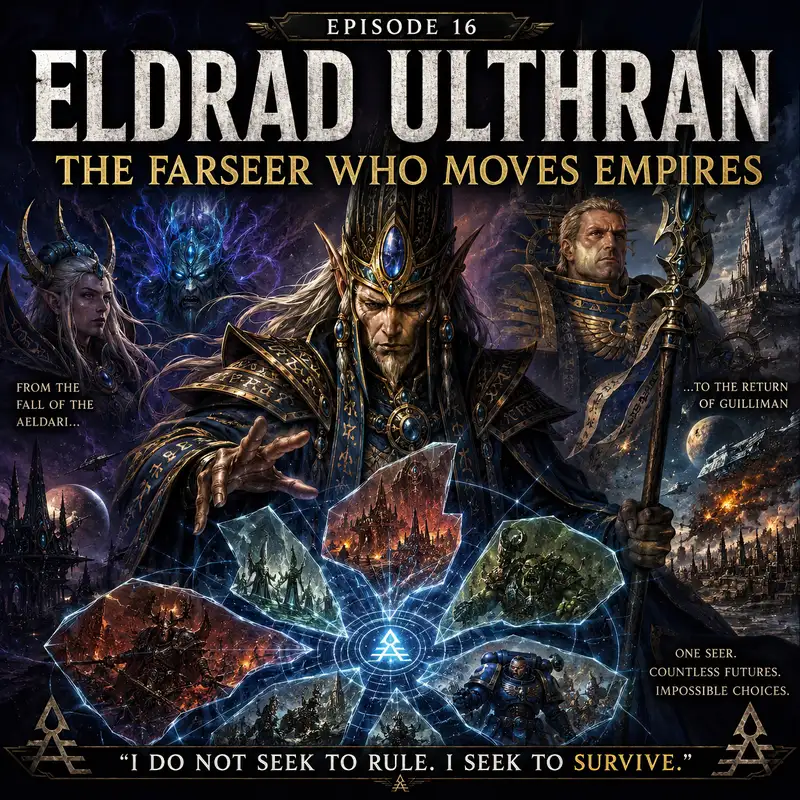
Picture him not upon a throne, but before a field of fractured light, each shard holding a different tomorrow. In one, Ulthwé burns. In another, Cadia falls sooner. In another, humanity destroys an enemy it never understood and celebrates for a century before the real disaster arrives. The roads where everyone lives are usually absent. Eldrad chooses the road where someone survives, then carries the knowledge of those he abandoned on the others. That is why he can move empires and still fail to master the future. His greatness and his danger are the same. He can see costs hidden from everyone else, and he is willing to impose them on people who never agreed to pay.
Eldrad Ulthran does not command the galaxy. He narrows it. He closes doors, opens others, and pushes civilisations toward the few paths that remain after prophecy, pride, and catastrophe have done their work. Sometimes he saves worlds. Sometimes he condemns them. Sometimes the difference cannot be known, because only the farseer remembers the future that did not happen. He moves empires because the future offers him no clean victories, only disasters he believes he can make survivable.