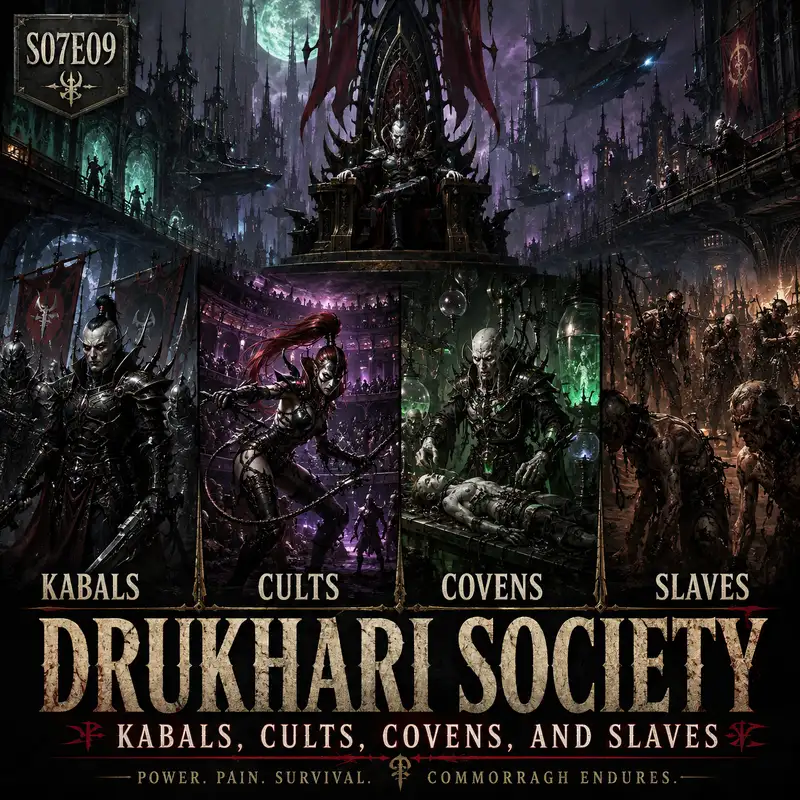
Drukhari Society: Kabals, Cults, Covens, and Slaves
A captive entering Commorragh does not first see a throne, a parliament, or even a city in any ordinary sense. The captive sees bridges hanging over bottomless darkness, towers joined by portals, skiffs passing beneath stolen suns, and crowds that watch new arrivals with the patient interest of buyers at a livestock market. Somewhere above, an Archon is deciding who will profit from the raid. Somewhere below, a Haemonculus is preparing an empty table. In the arenas, a Succubus is planning how the prisoners will die beautifully enough to satisfy an audience that has witnessed almost everything. This is Drukhari society in miniature. It is not chaos, despite the screaming. It is a system. Every blade has an owner, every victim has a price, and every alliance lasts exactly as long as the consequences of betrayal remain greater than the pleasure of attempting it.
The question is how such a civilisation continues to function at all. The Drukhari admire treachery, reward cruelty, and regard weakness as an invitation. They live for centuries, accumulate grudges with professional dedication, and possess weapons capable of turning a private disagreement into a district-wide emergency. Yet Commorragh has survived for more than ten thousand years. The answer lies in the wound left by the Fall of the Aeldari. Slaanesh did not consume the ancestors of the Drukhari outright, because they were sheltered within the Webway, but the protection was incomplete. Their souls are still slowly drained toward the Dark Prince. They stave off that loss by absorbing the extreme pain, fear, and despair of others. Cruelty therefore became more than appetite or tradition. It became medicine, wealth, political power, entertainment, and public infrastructure. This does not excuse what the Drukhari do. It explains why every major institution in their society is built to make suffering dependable.
Commorragh itself encourages this arrangement. The Dark City is not one continuous metropolis resting on a planet. It is a vast collection of territories, ports, satellite realms, fortresses, markets, laboratories, and arenas linked through the Webway. A doorway may cross a street or several thousand light years. A district can be sealed away, abandoned, or hurled into catastrophe without the rest of the city necessarily sharing its fate. Boundaries shift because power shifts. Kabals seize towers, trade routes, portals, and docks. Wych Cults hold coliseums whose audiences can determine fashion and reputation across whole regions. Haemonculus Covens occupy hidden laboratories where even an Archon may enter with careful manners. There is no meaningful citizenship binding all of this together. There is ownership, patronage, contract, fear, and the knowledge that Asdrubael Vect watches the contest from above and occasionally removes the board beneath players who have become inconvenient.
For an ordinary Drukhari, survival usually begins by belonging to something stronger. An unaffiliated killer may possess speed, intelligence, and centuries of experience, but those qualities do not stop a rival from taking their dwelling, their weapons, or their body. Membership in a Kabal, Cult, Coven, gang, shrine, or mercenary order provides a name that others must consider before striking. The protection is rarely affectionate. A Kabal defends its warriors because an attack on one member challenges the organisation. A Cult protects a promising gladiator because talent draws crowds. A Coven preserves an apprentice because useful hands are expensive to replace. In Commorragh, community exists, but it has been stripped of sentiment and rebuilt as mutual deterrence. Even companionship tends to arrive carrying an invoice.
The Kabals are the most visible political and military powers in this arrangement. A Kabal is part private army, part criminal syndicate, part commercial cartel, and part aristocratic court with the inheritance rules replaced by assassination. It controls territory, warehouses, weapons, spacecraft, informants, and access to realspace raids. At its head stands an Archon, whose authority rests on the belief that every subordinate plot has already been discovered. Beneath the Archon are layers of commanders, Trueborn elites, Sybarites, and Kabalite warriors. The exact titles matter because rank determines who may command, who receives the best equipment, who is worth recovering after death, and who may be killed without beginning a feud. A successful Kabal gives its members security, opportunities for plunder, and a share in collective prestige. It also places them inside a ladder where the traditional method of promotion is to ensure the person above can no longer object.
That sounds like an organisation designed to destroy itself, but the Kabal survives because betrayal has rules even when there is no law. An ambitious subordinate must judge not only whether an Archon can be killed, but whether the Kabal will remain strong afterward, whether allies will accept the new leadership, whether the victim arranged revenge in advance, and whether Vect might interpret the change as instability. A failed coup is fatal. A successful coup may also be fatal, only with a more impressive guest list. This produces a brutal kind of discipline. Kabalites scheme constantly, yet they also fight with remarkable coordination when the organisation’s wealth is threatened. They understand that a warrior without a Kabal is prey, while a warrior inside a powerful Kabal is part of a weapon aimed at everyone else.
The system owes much to Vect. Before his rise, Commorragh was dominated by ancient noble houses that treated power as hereditary property. Vect, remembered as having risen from slavery, broke their supremacy and elevated the Kabal as the central engine of rule. The resulting order is often described as a meritocracy, though that word should be handled with tongs. Talent can raise a Drukhari from the lower reaches of the city, but birth, patronage, wealth, beauty, and access to resurrection remain enormous advantages. What changed was not that Commorragh became fair. It became competitive in a way that served Vect. Every Archon could dream of rising, every rival could fear falling, and the Supreme Overlord could present himself as the final judge of a contest he had designed. He does not need to prevent every conflict. He needs to ensure that no conflict produces a stable power capable of replacing him.
The Kabals also connect Commorragh to the wider galaxy through realspace raids. These are not usually wars of conquest. The Drukhari do not want the burden of governing a human world when they can visit briefly, remove everything useful, and leave the survivors explaining the event to Imperial officials who will probably accuse them of poor morale. A Kabal identifies a vulnerable target, secures Webway access, assembles transports and gunships, and hires whatever specialists the operation requires. Speed is essential. The raiders strike before defenders understand the shape of the attack, paralyse rather than kill when possible, and withdraw with captives, beasts, relics, weapons, and trophies. The returning fleet brings more than material wealth. It brings proof that the Archon can deliver suffering, reward followers, feed allies, and keep Commorragh supplied with the one resource it can never produce in sufficient quantity by itself: fresh victims.
The Wych Cults turn those victims into spectacle. Their arenas are not merely places of recreation. They are theatres, feeding grounds, recruiting halls, marketplaces, and political stages. Wyches, also called Hekatarii, train to make killing difficult, graceful, and prolonged enough to hold the attention of an audience whose standards are ruinously high. Each Cult develops its own style and builds arenas with distinctive hazards. A battle may involve predatory beasts, shifting gravity, racing tracks, concealed blades, or environmental traps designed to punish any fighter who becomes predictable. The crowd does not attend only to see who wins. It attends to experience terror and agony at a scale capable of renewing the Drukhari watching from the tiers. A successful performance nourishes the audience, advertises the Cult’s skill, and can transform a fighter into a celebrity whose name carries political weight.
The rulers of the Cults are Succubi, gladiators who rose through performance, victory, and the disciplined murder of competitors. Their authority differs from that of an Archon. An Archon demonstrates mastery through plots, resources, and the ability to make enemies disappear. A Succubus must repeatedly prove supremacy where the entire city can watch. Failure cannot be hidden behind a press release, which may be one reason Commorragh considers the arenas refreshingly honest. Cults hire their fighters to Kabals for realspace raids, receiving slaves, combat drugs, protection, and patronage in return. The relationship is mutually useful and never comfortable. An Archon gains elite close-combat specialists and the prestige of association with famous killers. A Cult gains fresh opponents and opportunities to advertise itself beyond the arena. Both sides understand that cooperation is temporary. Both arrive prepared for the possibility that the entertainment may begin early.
The Haemonculus Covens hold a different kind of authority. Haemonculi are flesh-sculptors, surgeons, experimenters, and custodians of technologies so old and sophisticated that ordinary distinctions between medicine, art, and weaponry no longer apply. Their laboratories occupy the hidden depths of Commorragh, where Wracks serve as assistants and living demonstrations of their masters’ craft. Grotesques and pain engines emerge from these domains as altered bodies built for war, punishment, or both. A Coven may raid realspace to obtain rare organisms, unusual nervous systems, or subjects for a new theory. It may also sell its creations to an Archon who wants soldiers capable of surviving wounds that would kill a Kabalite. The Haemonculi claim the detachment of artists. Their customers tend to remember that artists in Commorragh can repossess the canvas.
Covens are indispensable because they control beginnings as well as endings. Most Drukhari are grown rapidly in artificial wombs maintained by Haemonculi. Those born naturally are known as Trueborn and often treat that rarity as evidence of superiority, because Commorragh can turn any accident of birth into a social weapon. The Covens also possess the means to restore dead Drukhari when enough of the body is recovered and delivered quickly. Through pain, biological reconstruction, and technologies poorly understood outside their orders, a wealthy client can return from injuries that should have been final. Resurrection is not universal. It is expensive, politically controlled, and vulnerable to sabotage. An Archon may return to discover that a subordinate delayed the recovery party. A Haemonculus may restore a client with an alteration that was not listed in the agreement. Immortality in Commorragh is therefore less a guarantee than a service contract with unusually severe cancellation terms.
This power gives the Covens independence from Kabalite politics. An Archon may command fleets and districts, but still require a Haemonculus to preserve valued officers, replace losses, or repair a body damaged by centuries of excess. A Succubus may be unmatched in the arena, yet a Coven supplies the drugs, alterations, and recoveries that keep performers at their peak. Haemonculi in turn need subjects, materials, territory, and access to raids. Their relationships are bargains between predators who each control something the others cannot easily replace. The Kabals control organised force and the flow of captives. The Cults control mass spectacle and a large share of the city’s emotional nourishment. The Covens control flesh, reproduction, transformation, and return from death. None trusts the others. All need the others. That is a stronger foundation than friendship has ever provided in Commorragh.
Beneath all three institutions stand the slaves. Captives power industries, maintain estates, carry burdens, fill arenas, serve as household property, and become material for experimentation. They are traded as currency because their value can be converted into labour, prestige, entertainment, biological resources, and suffering. A shipment of prisoners can pay a Cult for military support, a Coven for resurrection, a mercenary shrine for protection, or a subordinate for loyalty. The condition of the captives also matters. Exotic species, formidable warriors, rare psykers, or survivors taken during a difficult raid may be displayed as proof of skill. A live Space Marine is not merely a prisoner. It is a statement, though keeping the statement restrained long enough to show guests may require considerable effort.
Calling slaves the lowest class in Commorragh does not fully describe their position, because a class is still part of a society. Slaves are treated as the material on which Drukhari society operates. Their suffering keeps souls from withering. Their bodies support the city’s economy. Their deaths entertain crowds. Their existence permits the ruling institutions to exchange services without relying on a stable coinage or a common moral code. Drukhari can also be reduced to slavery through defeat, punishment, or debt, and the city never forgets that Vect himself rose from that condition. His ascent proves that movement is possible, but it does not make the system open. It makes every slave owner slightly more attentive. Commorragh’s favourite inspirational story is also a security warning.
The four elements named in this society are therefore not equal categories. Kabals, Cults, and Covens are power structures. Slaves are the foundation they stand upon and the resource they fight over. A successful realspace raid often brings representatives of all three structures together. The Archon commands the overall operation and provides ships. The Succubus contributes Wyches who can break resistance and turn battle into performance. The Haemonculus brings durable creations, specialist weapons, and an interest in prisoners who would otherwise be considered inconvenient. Mercenaries may be added from outside the three pillars. Incubi offer bodyguard service precisely because an Archon’s own followers are ambitious. Scourges carry messages and intelligence. Mandrakes, Hellions, Reavers, and alien killers accept contracts when the price is right. Drukhari cooperation is not rare. It is simply never mistaken for trust.
The existence of professional mercenaries reveals one of Commorragh’s most important adaptations. Trust has not disappeared. It has been outsourced. An Incubus is valuable because a contract, a shrine’s reputation, and a disciplined code can make the warrior more reliable than a Kabalite cousin. A Haemonculus keeps agreements because future clients must believe the service works, though the definition of success may contain surprises. A Cult fulfils a bargain because public reputation draws patrons and crowds. An Archon pays allies because failure to do so would make the next raid impossible. None of these arrangements depends on kindness. They depend on consequences that can be calculated. The city functions because even sadists prefer predictable profit to random loss.
Life for those without high rank remains precarious. A vat-grown Drukhari may begin as a gang member, arena aspirant, Coven subject, or Kabalite recruit, trying to become useful before becoming available. Advancement demands skill, nerve, patronage, and an ability to sense when a superior’s weakness is genuine rather than staged. Beauty can be armour. Reputation can be currency. A successful raid can purchase decades of status, while one public failure can erase centuries of careful ascent. The oldest Drukhari require ever greater suffering to renew themselves, which makes age both a sign of power and a growing expense. This is a society where longevity does not produce calm. It produces more elaborate appetites and longer memories.
Commorragh avoids collapse because its violence is channelled rather than uncontrolled. Vect permits rivalry, coup attempts, gang wars, arena feuds, and Kabalite conflict because they expose weakness and prevent unity among his enemies. When a struggle threatens the city’s survival or his own supremacy, the response becomes decisive. Districts can be isolated. Portals can be closed. Allies can be purchased. Entire populations can be sacrificed to contain a disaster. The system is monstrously wasteful, but it is not mindless. It directs aggression outward through raids, inward through controlled competition, and downward onto captives who possess no power to retaliate. The cost is paid by everyone beneath the winner, which means almost everyone.
Kabals, Cults, and Covens are sometimes presented as three flavours of Drukhari warfare, but inside Commorragh they are much more. They are the institutions that answer the Dark City’s essential needs. Kabals acquire territory, wealth, protection, and victims. Cults transform violence into nourishment, fame, and public legitimacy. Covens create bodies, alter them, weaponise them, and sometimes return them from death. Slaves make every exchange possible. Remove any one pillar and the others begin to fail. Remove the captives and the entire structure starves.
That is how Drukhari society survives when every inhabitant is a potential conspirator and every ruler is a potential corpse. It does not overcome treachery. It prices treachery, arms it, stages it before an audience, repairs the survivors, and sends the bill to the enslaved. Commorragh endures because cruelty has been organised into a complete political economy. Its greatest achievement is not that it has escaped Slaanesh, because it has not. Its achievement is that it has turned the slow loss of its own soul into a civilisation that consumes the lives of others in order to postpone the debt. Beneath the stolen suns, the Dark City remains alive, and somewhere in its depths another captive learns what that survival costs.