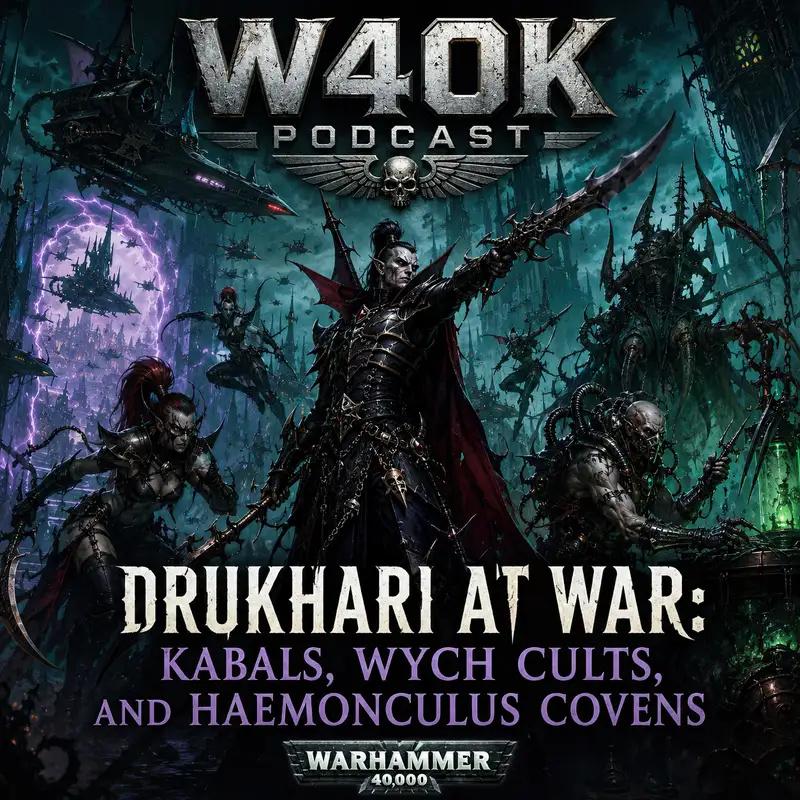
Drukhari at War: Kabals, Wych Cults, and Haemonculus Covens
The first sign of a Drukhari raid is often not gunfire. It is absence. A sentry fails to answer. A power conduit dies without warning. The sky remains empty, yet doors unlock, alarms contradict one another, and shadows begin moving where no passage should exist. Then the Webway tears open, and the attackers arrive at impossible speed.
They do not come to seize the governor’s palace and declare a new regime. They do not plant banners and wait for reinforcements. They strike communications, transport, and command posts, then pour into the confusion on skimmers that seem designed by someone who considered safety rails a personal insult. Some defenders are killed. Many more are wounded, isolated, or paralysed. The Drukhari have not come for territory. They have come for people.
That distinction explains nearly everything about the way they wage war.
The Drukhari are raiders, slavers, gladiators, flesh-sculptors, aristocrats, and predators. Their armies are not the military expression of a normal state. Commorragh, their impossible city within the Webway, is less a capital than a collection of realms held together by fear, commerce, rivalry, and the authority of whoever can survive long enough to claim authority. When the Drukhari go to war, three great institutions usually shape the attack. The Kabals provide political power, soldiers, ships, and ambition. The Wych Cults provide spectacle, speed, and close-combat mastery. The Haemonculus Covens provide monsters, resurrection, and a professional interest in suffering that even other Drukhari can find excessive.
Together, they form one of the most effective raiding forces in the galaxy. They also form a society that must continually prey on others in order to preserve itself.
The reason lies in the Fall of the Aeldari. Before humanity’s Imperium reached its present form, the ancient Aeldari civilisation dominated much of the galaxy. Its power, longevity, and mastery of technology allowed its people to pursue sensation and obsession without meaningful restraint. Over time, excess became culture, culture became compulsion, and the psychic weight of that civilisation gave birth to Slaanesh, the Chaos God of excess.
The birth of Slaanesh destroyed the old Aeldari empire and consumed countless souls. Some survivors escaped aboard the craftworlds. Others followed different paths. The ancestors of the Drukhari remained largely within the Webway, protected from the worst of the catastrophe but not freed from its consequences. Slaanesh still hungers for their souls. For a Drukhari, the drain is not merely a promise of damnation after death. It is a pressure felt across life, a slow spiritual withering that can be held back through the pain and anguish of others.
This is why cruelty within Drukhari culture is more than indulgence, though it is certainly also indulgence. The suffering of captives restores vitality. It sharpens dulled senses, renews vigour, and delays the claim of Slaanesh. A successful raid therefore brings wealth, status, entertainment, experimental material, labour, and something resembling spiritual sustenance. The Drukhari built an economy in which atrocity is profitable, politically useful, and personally necessary. They have had thousands of years to make it efficient.
The Kabals are the clearest expression of that efficiency. A Kabal is part military organisation, part criminal empire, part political faction, and part private army. Its leader, the Archon, rules through reputation and controlled terror. An Archon who appears weak invites assassination. An Archon who appears too powerful may inspire several rivals to cooperate, briefly and with deep reluctance. Survival depends on choosing enemies carefully, rewarding followers just enough, and ensuring that every subordinate fears the consequences of betrayal more than they desire the rewards.
This system is closely associated with Asdrubael Vect, the supreme overlord of Commorragh and master of the Kabal of the Black Heart. Vect rose from the lowest ranks of Drukhari society and broke the power of the older noble houses through manipulation, violence, and a talent for arranging disasters that somehow happened to benefit him. The Kabal system replaced inherited certainty with competitive predation. In theory, anyone ruthless and capable enough could rise. In practice, most attempts at advancement ended in a corridor, an ambush, and an immediate vacancy in the organisation.
A Kabal’s warriors are the backbone of most realspace raids. They carry splinter weapons that fire crystalline shards coated in potent toxins. These weapons are not designed merely to kill quickly. They can incapacitate, torment, or leave victims alive long enough to be taken. Dark lances and heavier weapons destroy armour and vehicles, while Raiders, Ravagers, and Venoms move troops at high speed across the battlefield. Drukhari vehicles are lightly protected by the standards of many armies, but that is a deliberate trade. Their commanders prefer not to be hit at all.
Kabalite warfare depends on initiative. A raid is planned around intelligence, hidden Webway routes, local weaknesses, and a precise window of opportunity. The target may be an isolated settlement, a void station, a military convoy, or a world already weakened by another war. The Drukhari are quite willing to let Orks, Tyranids, Chaos forces, or the Imperium exhaust one another before appearing to collect survivors. From their perspective, this is not cowardice. It is good logistics.
An Archon usually seeks more than captives. A raid can humiliate a rival, secure a rare relic, test a subordinate, settle a debt, or provide material for an alliance. Success is measured not only by the size of the harvest, but by who receives credit and who returns in disgrace. A commander who wins too brilliantly may become dangerous to the Archon. A commander who fails may become decorative. Drukhari military careers therefore require the ability to defeat the enemy while remaining only moderately threatening to one’s employer.
Kabals also hire specialists. Incubi are among the most feared. They are disciplined warriors trained in independent shrines, often employed as bodyguards or shock troops. Their heavy armour, great blades, and controlled violence stand apart from the theatrical cruelty of much Drukhari warfare. An Incubus does not need to shriek, boast, or explain. The blade is the argument. Archons value that discipline, though many also understand that a bodyguard who cannot be bribed is simply a different kind of danger.
Scourges, Mandrakes, mercenaries, and other independent killers may also appear in a raiding force. Commorragh produces no shortage of specialists willing to sell their skills. The difficulty is not finding someone capable of murder. It is arranging the contract so that the murder occurs in the preferred direction.
The Wych Cults bring a different form of power. Their home is the arena, where Drukhari crowds gather to watch combat staged with elaborate cruelty. Wyches fight captives, beasts, rivals, and one another in spectacles that feed the audience’s hunger for sensation and pain. The greatest performers become celebrities. Succubi, the leaders of the cults, combine political influence with lethal personal skill. In a civilisation where betrayal is common, the ability to defeat an assassin in front of thousands of delighted witnesses is a useful qualification for office.
Lelith Hesperax is the most famous example. Her reputation does not rest on heavy armour or elaborate weaponry, but on speed, precision, and an almost contemptuous mastery of close combat. She embodies the ideal that the Wych Cults sell to Commorragh: violence transformed into art, with the victim expected to participate whether or not they have rehearsed.
The arenas are not separate from war. They are training grounds, recruitment halls, political theatres, and marketplaces. Wyches learn to read movement, exploit hesitation, and control the pace of a fight. When deployed in realspace, they are particularly useful against enemies who must be taken alive. They can disable, surround, and break defenders without simply obliterating the prize. Their combat drugs heighten speed, strength, perception, or aggression, though the exact mixture is rarely designed with long-term health as its highest priority.
Reaver jetbike riders, Beastmasters, and other cult-associated fighters add speed and chaos to an attack. Reavers sweep through formations, severing lines and scattering defenders. Beastmasters unleash creatures bred or captured across the galaxy. The purpose is not only destruction. It is emotional control. Panic drives people into prepared routes. Rage draws warriors away from defensive positions. A terrified crowd becomes easier to divide, trap, and harvest.
Wych Cults also provide something the Kabals require but cannot produce alone: public legitimacy within Commorragh. A successful raid may supply the next great arena spectacle. Captured heroes can be displayed before cheering crowds. Exotic beasts become attractions. Rivals can be condemned to performances whose outcome has been carefully made uncertain enough to be entertaining and certain enough to be politically useful. The raid continues after the raiders return home. It becomes theatre, propaganda, and social discipline.
Then there are the Haemonculus Covens.
A Haemonculus is not merely a torturer or surgeon. Haemonculi are ancient masters of fleshcraft who treat the body as material rather than identity. Bone can be lengthened, muscle rearranged, organs replaced, limbs multiplied, and pain refined into both science and art. Many are so old that ordinary sensation has become difficult to achieve. Their experiments are efforts to recover novelty in a civilisation that exhausted most conventional forms of depravity long ago.
The Covens operate laboratories, workshops, and domains throughout the darker reaches of Commorragh. They create Wracks from altered servants and disciples. They shape Grotesques into massive engines of flesh and obedience. They build Talos and Cronos pain engines, devices that combine machinery, living tissue, and specialised methods of making the battlefield worse.
Their most valuable service, however, may be resurrection.
A wealthy Drukhari can arrange for a Haemonculus to restore them after death, provided enough remains can be recovered and the proper preparations were made. This makes some Archons extraordinarily difficult to remove. Assassination remains popular, but professionals understand that killing the target may be only the opening phase. The body must be destroyed, stolen, dispersed, or delivered to someone whose invoice exceeds the deceased’s available credit.
Resurrection changes Drukhari warfare. Leaders can take risks that would be final for others. Veterans may return with memories, grudges, and renewed appreciation for contractual detail. Yet resurrection is not guaranteed immortality. The Haemonculus may be bribed. The remains may be lost. The restored individual may owe a debt that makes death appear financially responsible. Every promise of survival creates another lever of control.
In battle, Coven forces serve as terror weapons, living shields, and instruments of capture. Wracks can endure injuries that would stop ordinary soldiers. Grotesques tear through defensive lines. Pain engines drift or stalk among the enemy, harvesting bodies and agony. These creations are slower than the sleek forces of Kabals and Wych Cults, but they give a raiding force weight. When speed and surprise are no longer enough, the Covens provide the part of the plan that walks directly through the barricade.
A Drukhari raid therefore resembles a temporary coalition of predators. The Archon may provide ships, intelligence, and overall command. A Succubus contributes fighters in exchange for captives, prestige, or future concessions. A Haemonculus supplies altered troops and expects rare specimens in return. Independent mercenaries fill specialised roles. Each participant enters the alliance with a private calculation. Every participant assumes the others are doing the same.
This should make coordinated action impossible. Often it nearly does. Yet the Drukhari are not mindless. They understand self-interest with exceptional clarity. Agreements are enforced by reputation, hostages, debt, mutual vulnerability, and the knowledge that a failed raid benefits no one. Betrayal usually waits until the objective has been secured. There are standards.
Once the force enters realspace, the operation unfolds quickly. Webway portals allow the raiders to bypass conventional front lines. Reconnaissance identifies command centres, shelters, transport routes, and areas where large numbers of people can be isolated. Kabalite elements strike communications and heavy weapons. Wych units move into the confusion, cutting off escape and drawing defenders into close combat. Coven creations break hardened resistance or turn secure positions into demonstrations.
The Drukhari use fear as a weapon because fear is tactically efficient. Broadcast screams, sudden darkness, mutilated remains, and attackers appearing from impossible directions can break cohesion faster than simple firepower. A defending force that remains disciplined is dangerous. A defending force that separates into angry individuals is inventory.
This does not mean Drukhari weapons are weak. Darklight technology can destroy heavily armoured vehicles. Their voidcraft are fast and lethal. Their warriors possess centuries of experience, and some have fought enemies from nearly every major species in the galaxy. Yet their preferred victory is asymmetric. They want the enemy confused, divided, and unable to bring superior numbers to bear. Prolonged attrition is wasteful. A dead raider is an inconvenience. A destroyed transport is expensive. A battlefield reduced to ash contains very few saleable captives.
When resistance becomes stronger than expected, Drukhari commanders often withdraw rather than fight for pride. This can look like cowardice to opponents raised on doctrines of heroic last stands. The Drukhari would regard that interpretation as charming. They can return through another portal, at another hour, against another district, or against the relatives of the officer who claimed victory. A raid is not judged by possession of the field after sunset. It is judged by what passes through the Webway before the gate closes.
Their greatest strength is control of tempo. They choose where to appear, how long to remain, and what kind of battle to create. Their speed punishes slow command systems. Their cruelty magnifies confusion. Their political flexibility allows an Archon to assemble a force tailored to a target. Kabals shoot and manoeuvre. Wych Cults close and capture. Covens absorb punishment and manufacture horror. None is complete alone, but together they cover one another’s weaknesses.
Their weaknesses grow from the same society. Drukhari forces are fragile when caught in sustained combat. Their alliances can collapse under pressure. Personal rivalries distort command decisions. A Succubus may pursue a spectacular duel instead of the safest objective. An Archon may withhold support from a subordinate who has become too popular. A Haemonculus may consider an unfolding disaster scientifically interesting. Even victory can trigger violence during the division of spoils.
They are also dependent on access. The Webway is vast but damaged, dangerous, and not perfectly understood. A blocked portal, corrupted route, or prepared ambush can trap a raiding force far from Commorragh. Enemies who survive repeated attacks may learn to defend likely entry points, maintain mobile reserves, and resist the urge to chase. The Drukhari remain terrifying, but they are not invincible. Their mythology benefits greatly from leaving before anyone has time to test that proposition.
The deeper horror of Drukhari warfare is not that it is chaotic. It is that it is organised.
The Kabals turn suffering into political capital. The Wych Cults turn it into entertainment and social prestige. The Haemonculus Covens turn it into technology, medicine, and raw material. Each institution performs a distinct function, and each reinforces the others. Captives feed the arenas. Arena fame produces influence. Influence funds raids. Raids supply laboratories. Laboratories return dead leaders to power. Those leaders order more raids.
Commorragh survives through this cycle. Its rulers may hate one another, but they share an interest in preserving the system that keeps Slaanesh at a distance and themselves above the victims. The Drukhari do not merely commit atrocities because they have abandoned morality. Their civilisation has made atrocity structurally necessary, then spent millennia ensuring that necessity is pleasurable.
That is why conquest usually matters less to them than access. They do not need to rule a human world. They need its population vulnerable. They do not need to hold a fortress. They need to know which tunnel leads beneath it. They do not need the enemy to surrender as a nation. They need individuals to panic, break formation, and disappear.
For those taken alive, the raid does not end when the portal closes. It has only moved beyond the reach of rescue. Some captives enter the arenas. Some become labourers or servants. Some are purchased by Covens. A few may survive long enough to understand the scale of Commorragh, which is not necessarily a kindness. The city consumes bodies, emotion, ambition, and pain with the appetite of an empire that insists it is merely conducting business.
The Drukhari at war are therefore not one army but an ecosystem of predation. The Kabals decide where the blade will fall. The Wych Cults teach the blade to dance. The Haemonculus Covens ensure that whatever remains can still be used.
Their speed, elegance, and precision can make them appear almost effortless in battle. That appearance is deceptive. Behind every raid stands a desperate civilisation fleeing a god it helped create. Every captive is wealth, spectacle, leverage, and another stolen moment of life. Every portal that opens onto a darkened street connects the victim not simply to an invading force, but to an entire society waiting on the other side.
When the last Raider vanishes and the Webway seals, the Drukhari leave no occupation force, no new laws, and often no clear explanation. They leave empty homes, broken commands, and survivors who understand that the attack was never meant to destroy their world. It was meant to prove that their world could be opened, harvested, and closed again before anyone powerful enough to stop it even knew where to look.