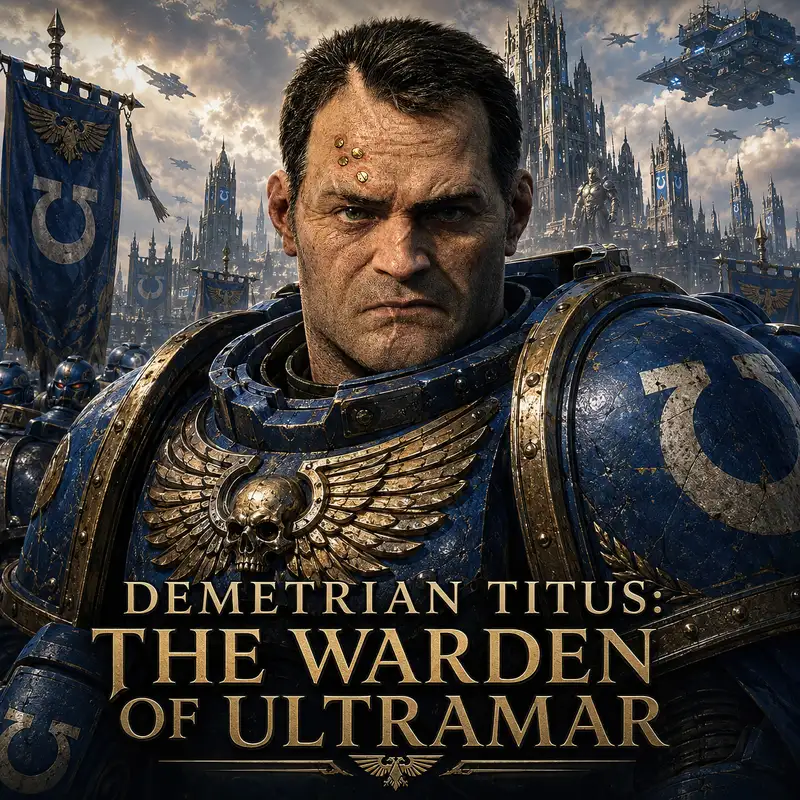
Demetrian Titus: The Warden of Ultramar
The man now entrusted with guarding the heart of Ultramar once vanished into an Inquisitorial prison so completely that even his own Chapter could not find him. His name was removed from command rolls. His company passed to other captains. More than a century of war moved on without him. Yet Demetrian Titus did not return as a ghost seeking revenge, or as a rival demanding restoration. He returned as a lieutenant, accepted orders from warriors who had been scouts when he disappeared, and went back to work. That quiet acceptance explains more about Titus than any chainsword duel. The question is not simply how he survived Orks, daemons, Tyranids, and the Inquisition. The question is why the Ultramarines eventually trusted this once-disgraced warrior with one of the hardest duties in their realm.
Titus is now Captain of the Ultramarines Second Company and holds the office of Master of the Watch. In practical terms, that makes him responsible for defending Macragge and the vulnerable interior of Ultramar while the realm expands toward its ancient borders. The title “Warden of Ultramar” captures the role, but not its difficulty. Ultramar is not one fortress or even one star system. It is a political, military, and cultural domain spread across worlds separated by the warp. Protecting it requires fleets, diplomats, astropaths, mortal armies, and Space Marines who can appear wherever the defence is failing. It is the sort of assignment the Imperium describes in a single line of orders, then supports with several thousand contradictory appendices and an inadequate supply schedule.
Demetrian Titus began far from that scale of responsibility. He was born on Tarentus, an agri world of Ultramar, around eighty years before Hive Fleet Behemoth descended upon Macragge. He was the only child of a family of modest means. Veteran Sergeant Metaurus was among those who recognised the potential in the young boy and helped guide him through the trials that transformed an ordinary human child into one of the Adeptus Astartes. Titus excelled, but his defining quality was not ambition. He did not seem driven by the desire to collect rank, honour, or ceremony. For an Ultramarine, whose Chapter can turn military administration into a sacred art, this restraint was unusual enough to be noticed.
By the time Hive Fleet Behemoth attacked Ultramar, Titus was already serving in the Second Company. He was not present for the great defence of Macragge. The company was campaigning far from home, and the shadow cast by the Tyranid hive mind strangled astropathic communication. When the distress calls finally reached them, the Second Company raced back but arrived too late for the decisive battle. They joined the purges that followed, hunting surviving broods across the worlds of Ultramar. That experience shaped Titus. He learned the Tyranids not from diagrams alone, but by meeting them at killing distance. He studied how alien creatures moved, adapted, and broke through Imperial positions. Titus has always respected doctrine, but he trusts knowledge tested under fire.
He served for nearly a century beneath Captain Lucian Trajan, first as a seasoned warrior and then as sergeant of Trajan’s command squad. Their company fought across the Imperium, and Titus developed a reputation for calm judgment in violent situations. He was aggressive without being reckless, methodical without becoming rigid. That distinction matters among the Ultramarines. Their primarch, Roboute Guilliman, wrote the Codex Astartes as a vast guide to warfare, organisation, and command. Later generations sometimes treated its guidance as fixed law. Titus understood it more as Guilliman intended it to be understood: a foundation for thought. A commander who consults doctrine but refuses to observe the battlefield has not mastered the Codex. He has merely found a very large book behind which to hide.
The event that made Titus a captain began on Beta Arcturus. A war host from Craftworld Biel-Tan demanded that the human population abandon the world, once part of the ancient Aeldari empire. The governor received roughly nine hours to comply. The Ultramarines arrived eight days later, which was not ideal for anyone still living in the burning cities. Trajan struck directly at the Aeldari command, slew their Autarch, and forced the invaders into withdrawal. During the retreat, the Aeldari captured a young Ultramarine named Leandros. Trajan led a rescue force after him and fell into an ambush. Titus counterattacked, recovered his captain’s body, and completed the campaign. Marneus Calgar made his battlefield command permanent. Titus became Captain of the Second Company.
The connection between Titus and Leandros would become one of the cruellest turns in his life. Titus had helped recover the young warrior from captivity, and Trajan had died in that effort. Years later, Leandros would help send Titus into captivity of another kind. There is no evidence that Leandros acted from malice. He believed he was protecting the Chapter from corruption. That is what makes the episode more disturbing. Warhammer forty thousand is filled with villains who know they are betraying someone. Leandros represents a colder danger: loyalty stripped of judgment. He could recite the rules, identify a deviation, and report it with a clean conscience. The machine of suspicion required no hatred. It only required someone willing to pull the lever.
Ten years after becoming captain, Titus led the response to the invasion of the forge world Graia. Orks under Warboss Grimskull had overrun much of the planet, seeking the weapons produced in its manufactorums. Titus fought beside Sergeant Sidonus and Leandros, using small-unit action to strike at targets an entire Imperial army had failed to secure. The campaign then revealed a second enemy. The supposed Inquisitor Drogon was a corpse inhabited by a daemonic presence, and the warp-powered device at the centre of his work became the prize of the Chaos lord Nemeroth. Titus survived exposure to energies that should have corrupted, broken, or killed him. He eventually destroyed Nemeroth. Graia was saved, at least by the generous standards applied to Imperial forge worlds.
Victory did not protect him. Leandros had watched Titus endure the touch of the warp without any visible taint. He concluded that such resistance was itself suspicious. Instead of taking the matter through the Ultramarines’ own Chaplains and command structure, he contacted Inquisitor Gerome Thrax. Titus could have resisted. He was a captain surrounded by his warriors, and the Inquisition’s authority over the Adeptus Astartes is often less straightforward in practice than it appears on parchment. Titus surrendered because open conflict would have confirmed every accusation. He chose obedience over self-preservation. It was an honourable decision, and it delivered him into the hands of a man who had already decided that innocence required proof no prisoner could ever provide.
Thrax held Titus for more than a century. The Inquisitor subjected him to psychic scourging, brutal examination, and repeated intrusion into his mind. No corruption was found. Thrax continued anyway. Marneus Calgar sent petitions demanding the return of his captain, but the requests disappeared into the secrecy and competing jurisdictions of the Inquisition. This is the Imperium at its most recognisable. A Chapter Master can command armies, destroy cities, and stand before the High Lords, yet still lose a warrior inside an office whose filing system has been classified above his authority. Titus endured without confession because there was nothing to confess. He also endured without rescue because the truth and the process had ceased to be related.
The irony was complete when Thrax himself fell to Chaos. During an investigation of a corrupted Space Marine Chapter, the daemon-hunting Inquisitor became possessed. The Grey Knights destroyed him and purged his holdings. Red Hunters searching one remote facility discovered almost twenty Space Marines preserved in stasis cells, prisoners gathered across years of private suspicion. Titus was among them. The Inquisition evaluated the survivors and sent Titus to the Deathwatch, where Space Marines from many Chapters serve together as specialist hunters of alien threats. He could have sought immediate return to the Ultramarines. Instead, believing his name had shamed the Chapter, he surrendered that name.
As a Black Shield, he called himself Nullus. The name meant that his past would not follow him and that no Chapter symbol would appear upon his shoulder. Titus devoted himself to the long vigil of the Deathwatch, fighting as though death might settle an account that no tribunal had managed to define. This was not cowardice. It was a form of wounded honour. Titus could survive torture, but he could not easily accept that his brothers might still want him. He had learned to distrust institutions, yet he continued to judge himself by their silence. His greatest weakness was not susceptibility to Chaos. It was his belief that endurance and secrecy were safer than allowing another person to share his burden.
The Fourth Tyrannic War finally broke that isolation. Nullus deployed with Kill Team Kasaeran into the Recidious System, where Hive Fleet Leviathan was tearing through Imperial defences. Their gunship was brought down, the kill team was overwhelmed, and Titus was gravely wounded by a Carnifex on Kadaku. He expected to die beneath a sky darkened by living weapons. Instead, Ultramarines arrived. Chief Librarian Varro Tigurius had recognised Titus’s psychic presence through the turmoil of the warp, and the strike cruiser Righteous Fury carried the dying Black Shield away from the battlefield. It was the same vessel on which Titus had once served beside Captain Trajan. In the Imperium, even redemption occasionally arrives with a sense of theatre.
His wounds were so severe that survival required the Calgarian Rites, the dangerous transformation often called crossing the Rubicon Primaris. Titus emerged physically remade as a Primaris Space Marine. More important was what came after. Tigurius examined him and found no taint. Calgar authorised his reinstatement. Titus did not return to the Second Company as captain. He accepted the rank of lieutenant beneath Captain Sevastus Acheran, a warrior whose rise had occurred during Titus’s lost century. There was no public demand for compensation and no attempt to reclaim old privileges. Titus had once obeyed an Inquisitor because duty required it. Now he obeyed a younger captain for the same reason. Rank mattered. Service mattered more.
His return did not erase suspicion. In the Recidious System, Titus was assigned to fight beside Sergeant Gadriel and Brother Chairon. Gadriel knew that this newly arrived lieutenant had once been a Black Shield, bore unexplained chains of service, and seemed strangely resistant to warp phenomena. Titus answered reasonable questions with silence. He believed he was protecting his squad from his past, but secrecy produced the very distrust he feared. Gadriel began to see the same pattern Leandros had seen on Graia. The difference was that Titus had changed enough to recognise the danger. Trust could not be ordered into existence. It had to be risked.
The campaign drove them from the Tyranid swarms of Kadaku into the industrial ruins of Avarax and the ancient tomb structures of Demerium. The Adeptus Mechanicus had attempted to weaponise Necron technology through a project called Aurora, hoping to manipulate the forces of the warp. The result attracted the Thousand Sons and their sorcerer Imurah. Once again Titus stood near an artefact that reacted to him in ways no one fully understood. Once again Chaos tried to turn uncertainty into division. Yet this time Titus did not face the crisis alone. Gadriel and Chairon learned enough of his past to judge the man before them rather than the rumours surrounding him. Their loyalty became a choice informed by experience, not a reflex imposed by rank.
Titus, Gadriel, and Chairon fought through the Thousand Sons while Calgar and the Ultramarines brought the wider battle under control. Imurah was defeated, and the immediate catastrophe was contained. The victory did not explain Titus’s unusual relationship with warp energy. It did something more important. It proved that uncertainty need not end in accusation. Gadriel had doubted Titus, challenged him, and nearly repeated the old disaster. He then revised his judgment when the evidence changed. That ability to correct oneself is rarer in the Imperium than courage under fire. At the campaign’s end, Titus also discovered that Leandros had become an Ultramarines Chaplain. The man who once reported him now watched over the Chapter’s spiritual purity. The past had not vanished. It had acquired black armour and an official office.
Soon afterward, Titus joined a small force on the world of Zsah’uj. The mission was expected to be suicidal. A Tzeentchian cult occupied a stronghold that could not be reached by conventional assault, so Titus, his old mentor Metaurus, and two veteran brothers fought their way in on foot. Within the temple, a powerful sorceress attacked through fear, turning the warriors’ minds against them. Titus endured what she showed him and killed her with the same knife found beside him when Metaurus first discovered him as a boy. Two Ultramarines died. Metaurus was terribly wounded. Titus refused to abandon him and dragged his mentor clear before orbital fire erased the site. The scene revealed that Titus’s courage is not the absence of memory. It is the refusal to let memory choose his duty.
Further victories against the Tyranids followed, but the Second Company paid for the wider war. Captain Acheran led a force to the hive world of Trygg after signs of a Genestealer Cult uprising. Chairon accompanied him. The cult had infiltrated the hive from its undercity to its ruling spires and was preparing the world for Tyranid consumption. Acheran sealed the city, trapping his own force inside with the uprising so the infection could not spread. The Ultramarines were worn down and killed, but their sacrifice contained the threat. Acheran and Chairon died doing exactly what the Imperium asks of its finest commanders: exchange a small number of irreplaceable lives for a much larger number of lives that the official record will probably describe as replaceable.
Titus was the clear successor. His victories in the Recidious System, his survival on Zsah’uj, and his later actions in the Bastior region had silenced most of the doubts surrounding him. He once again took command of the Second Company. With that captaincy came the office of Master of the Watch and responsibility for defending the interior of Ultramar. This was not simply the restoration of a rank stolen from him. The Titus who returned to command was not the same officer taken from Graia. He had served beneath strangers, fought without a name, accepted suspicion, and learned that keeping every wound private could become its own kind of failure.
His command staff shows how far he has developed. Metaurus serves as an experienced counsellor rather than a relic to be admired from a distance. Gadriel, now honoured as the Ancient who carries the Second Company’s standard, is valued partly because he speaks plainly to his captain. Titus also relies on mortals whose skills no Space Marine can replace. Astropath Dainal Kornelius carries messages through the warp. Lucia Vestha negotiates with worlds that might otherwise require conquest. Gaius Silva commands the defence fleets and understands the limits of their human crews. Legatus Aemelia Minervas connects Titus to the disciplined armies of the Ultramar Defence Auxilia. Together they are the Wardens of Ultramar. Their existence is an admission that even an exceptional Space Marine cannot guard a civilisation by himself.
That lesson matters because Guilliman’s renewed vision of Ultramar reaches toward the old Five Hundred Worlds. The name is partly historical, partly political, and entirely ambitious. Worlds lost to invasion, rebellion, distance, and neglect must be defended or brought back into the realm. Every recovered system stretches fleets, garrisons, communication, and trust. Titus must secure the heart while other forces push toward the borders, and the Necrons now threaten the Vespator Front under the murderous influence of Nekrosor Ammentar. This is no longer the work of a lone warrior charging toward the largest enemy in sight, although Titus remains distressingly willing to do that when circumstances permit. It is the work of choosing where limited strength can prevent the next collapse.
Demetrian Titus is not a hero because he stands outside the Imperium. He is a Space Marine, created to preserve a brutal regime through controlled violence. He has destroyed enemies without hesitation and defended institutions that treated him unjustly. His importance comes from the tension inside that loyalty. Titus believes in duty, but experience has taught him that authority can be corrupted, doctrine can be misunderstood, and suspicion can disguise itself as virtue. He follows the Codex without worshipping the page. He accepts command without needing command to prove his worth. Most of all, he has learned that trust is not weakness, and that a commander who refuses every human connection eventually leaves Chaos and bureaucracy to explain him in his absence.
The warrior taken from Graia was feared because no one could explain why the warp did not break him. The captain who now watches over Ultramar is trusted for a harder reason. His brothers have seen what he does when power, shame, and uncertainty all press upon him at once. He remains at his post. He listens more than he once did. He judges by evidence rather than fear. Around him stand the mentor who found him, the sergeant who once doubted him, and the mortal officers whose voices carry across the Five Hundred Worlds. Ultramar did not return Titus to the life that was stolen from him. It gave him something heavier: the duty to stand watch over what remains.